

Selective Breeding of Chickens: A Practical Backyard Guide
You're standing beside the coop with a simple question in front of you: which rooster should stay, which hens deserve another season, and which chicks are worth growing out? The answer shouldn't depend only on the prettiest plumage or the largest body. Every breeding choice shapes the next generation, including traits you may not notice until heat, illness, stress, or winter exposes them.
Selective breeding of chickens works best when you start with your own flock's purpose. You might want dependable eggs, calm family-friendly birds, resilient meat chickens, or a balanced group that can forage and reproduce without constant intervention. The strongest backyard programs select for several useful traits at once, protect welfare, and keep enough genetic variety to prevent a slow decline in flock health.
What Selective Breeding of Chickens Really Means for a Small Flock
Selective breeding means choosing which birds produce the next generation because they show traits you want to preserve or improve. A casual flock may contain one rooster with every hen, and every fertile egg may be hatched without records. That still produces a genetic direction, but chance, not the keeper, controls it.
Suppose you have five hens and one rooster. One hen lays consistently, stays calm, hatches strong chicks, and remains active during hot weather. Another lays attractive eggs but becomes aggressive and loses condition quickly. If both contribute equally to the next generation, you're preserving both sets of traits. If you choose the first hen's family more often and exclude the second from breeding, you've made a selection decision.
Selection and culling are different decisions
Selection identifies birds that should reproduce. Culling means deciding which birds shouldn't reproduce, and it doesn't always mean removing them from the flock immediately. A hen may remain a valued layer or companion while being excluded from the hatching group.
Use clear reasons rather than vague impressions:
- Keep for breeding: sound legs, normal activity, good fertility, calm behavior, useful production, and no recurring health problem.
- Keep for the flock but don't breed: a pleasant bird with poor records, uncertain parentage, or a trait that doesn't match your goal.
- Remove from the flock: a bird with severe aggression, chronic illness, deformity, or suffering that good care can't resolve.
Practical rule: Don't breed a problem you already recognize just because the bird has attractive color or an impressive body.
The history of domestication shows why your small flock contains more possibility than it may appear to. Chickens descend primarily from the red junglefowl, Gallus gallus, and human selection in Southeast Asia extends roughly 8,000 years into the past, favoring traits such as reduced aggression, adaptability, egg laying, and meat production (Food and Agriculture Organization). The FAO reports more than 1,600 recognized chicken breeds worldwide, each reflecting different combinations of body size, plumage, growth, behavior, egg traits, and environmental tolerance.
A small flock won't transform overnight, and you shouldn't expect every chick to match its parents. But consistent decisions, simple records, and careful family management can shift a flock in a useful direction over several generations. You don't need industrial incubators, genomic testing, or a large farm to begin. You need a defined goal and the discipline to let only suitable birds shape the next hatch.
The Basic Genetics Every Backyard Breeder Should Know
A hen lays well in your coop, and her pullets look healthy. Should you breed all of them? Not automatically. A bird's appearance is useful evidence, but it is only part of the inheritance story.
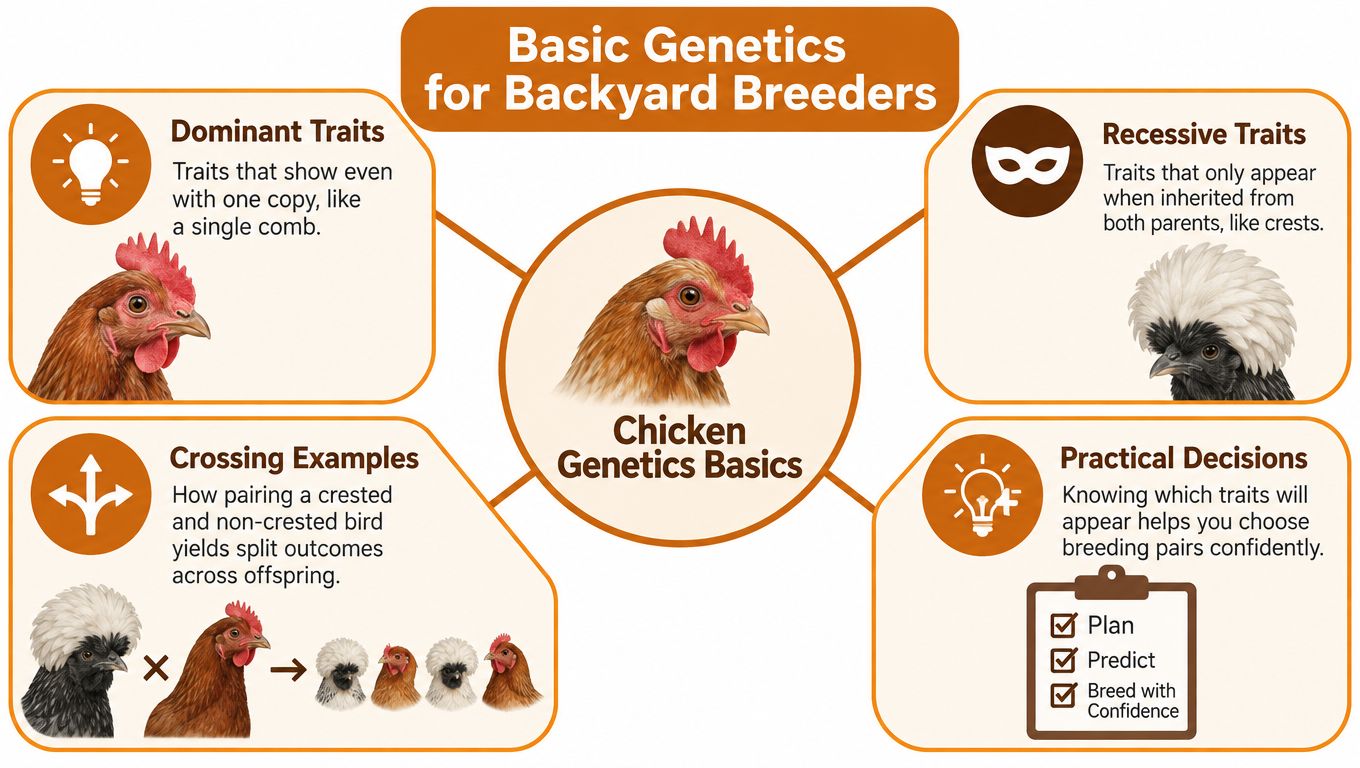
A dominant trait can appear when a chick receives one copy of the relevant form from either parent. A recessive trait usually appears only when the chick receives that form from both parents. Two ordinary-looking birds can therefore produce a chick showing a feature neither parent displays.
Hidden inheritance behind visible traits
Each parent carries two forms for many traits. One may be visible, while another remains hidden and can pass to offspring. If both parents pass the same hidden form to a chick, that chick may show the trait. The pattern differs among traits, so treat dominant and recessive inheritance as a useful starting point rather than a complete explanation.
Egg color shows why simple labels can mislead. A cross involving brown-egg birds may produce unexpected shell colors because several inherited factors interact, including contributions carried through both sides of the pedigree. Appearance tells you what a bird shows, not everything it can pass on.
Heritability describes how much of the observed variation in a trait is associated with inherited differences within a particular population and environment. It does not promise that a selected parent will produce an identical chick. A trait with higher heritability often responds more predictably to selection. Traits strongly affected by feed, disease, housing, season, or stress require better records because management can hide or imitate genetic differences.
Research on Horro chickens illustrates why breeders should measure rather than guess. Reported heritability for monthly egg number ranged from 0.20 to 0.32, reached 0.56 in the third month of lay, and cumulative egg-number traits ranged from 0.24 to 0.35 (research on egg-number genetics). Those findings describe that study population. They do not predict the result from your flock.
Family resemblance is not genetic sameness
Full siblings inherit different combinations of genes, so they are not clones. One pullet may be calmer, healthier, or more productive than her sister even when both have the same parents. Parent and offspring pairings, and especially sibling pairings, can also bring hidden weaknesses together. That risk matters before a keeper becomes attached to a particular color or body type.
Daily care still shapes what a bird can express. A pullet with useful genetic potential may perform poorly with inadequate feed, chronic stress, or disease. Genetics sets possibilities, while nutrition, housing, and health determine how much of that potential becomes visible.
Feed supports evaluation, but it cannot replace selection. For keepers raising young birds or supporting layers during demanding periods, USA GROWN BLACK SOLDIER FLY LARVAE FOR CHICKENS is one supplemental option. Its listed product information includes 36–42% crude protein and 75 times more calcium than mealworms. Keep such treats within a balanced feeding program, so extra nutrition does not disguise weak condition or distort your judgment of genetic merit.
Choosing Traits Worth Selecting For in a Backyard Program
A keeper with six hens may want dependable household eggs, while another may value table birds, a heritage line, or birds suited to a difficult climate. Those goals require different priorities. Begin by writing down what your flock must do, then select birds against that purpose rather than choosing the most striking individual.
A useful selection index combines several traits in one decision. Rank each trait by practical importance, observe birds under ordinary feed and housing, and remove any candidate with a health or welfare problem. This prevents one attractive feature from outweighing poor movement, recurring illness, or weak condition.
Match traits to the flock's purpose
| Goal | Top Traits to Emphasize | Traits to Monitor Closely |
|---|---|---|
| Household eggs | Sustained laying, shell quality, calm behavior, survival | Body condition, broodiness, heat performance |
| Meat for home use | Sound legs, steady growth, carcass utility, activity | Mobility, breathing, excess body size |
| Breeding stock | Fertility, hatchability, family health, temperament | Relatedness, defects, uneven offspring |
| Dual-purpose flock | Moderate body size, useful laying, foraging, hardiness | Feed needs, late maturity, production trade-offs |
| Climate-resilient flock | Feed intake, fertility, survival, normal behavior during local extremes | Heat stress, cold tolerance, feather condition |
For an egg-focused flock, identify eggs by hen instead of judging production from a shared nest. Record age at first egg, egg weight, shell quality, laying persistence, and survival. Research in Horro chickens found a positive genetic correlation between egg number through 44 weeks and body weight at 16 weeks, estimated at approximately 0.73. Treat that result as a warning about linked traits, not as a promise for your birds. Selecting for more eggs may also affect size, feed needs, or carcass value.
Your index should reflect the trade-offs you are willing to accept. A small flock cannot optimize every trait at once, so decide whether a modest reduction in laying is acceptable for better shell strength, calmer behavior, or stronger survival.
Look beyond the obvious winner
The largest rooster may be a poor sire if he moves badly, shows aggression, has low fertility, or produces daughters that struggle in your conditions. A hen with the highest short-term egg count may also be a weak breeder if she loses condition, lays fragile-shelled eggs, or repeatedly becomes ill. Family performance matters, not only one impressive bird.
Egg color, crest shape, feather pattern, and comb type can be valid aims in a preservation project. Keep them beside functional traits, not in place of them. Inherited characteristics may involve several sections of DNA that code for traits, and housing, nutrition, and weather can change how those characteristics appear.
Climate belongs in the index too. A bird that maintains feed intake, fertility, normal activity, and steady production during local heat may serve your flock better than one that excels only in mild weather. Local adaptation can matter more than a breed label.
For starting material, the guide to the best chicken breed for eggs offers practical comparisons. Breed descriptions remain a starting point. Your records should determine which families return to the breeding pen.
Record-Keeping and Family Tracking That Actually Works
A breeding record doesn't need to be elaborate. It needs to survive the entire season and answer one question later: why did I choose this bird?
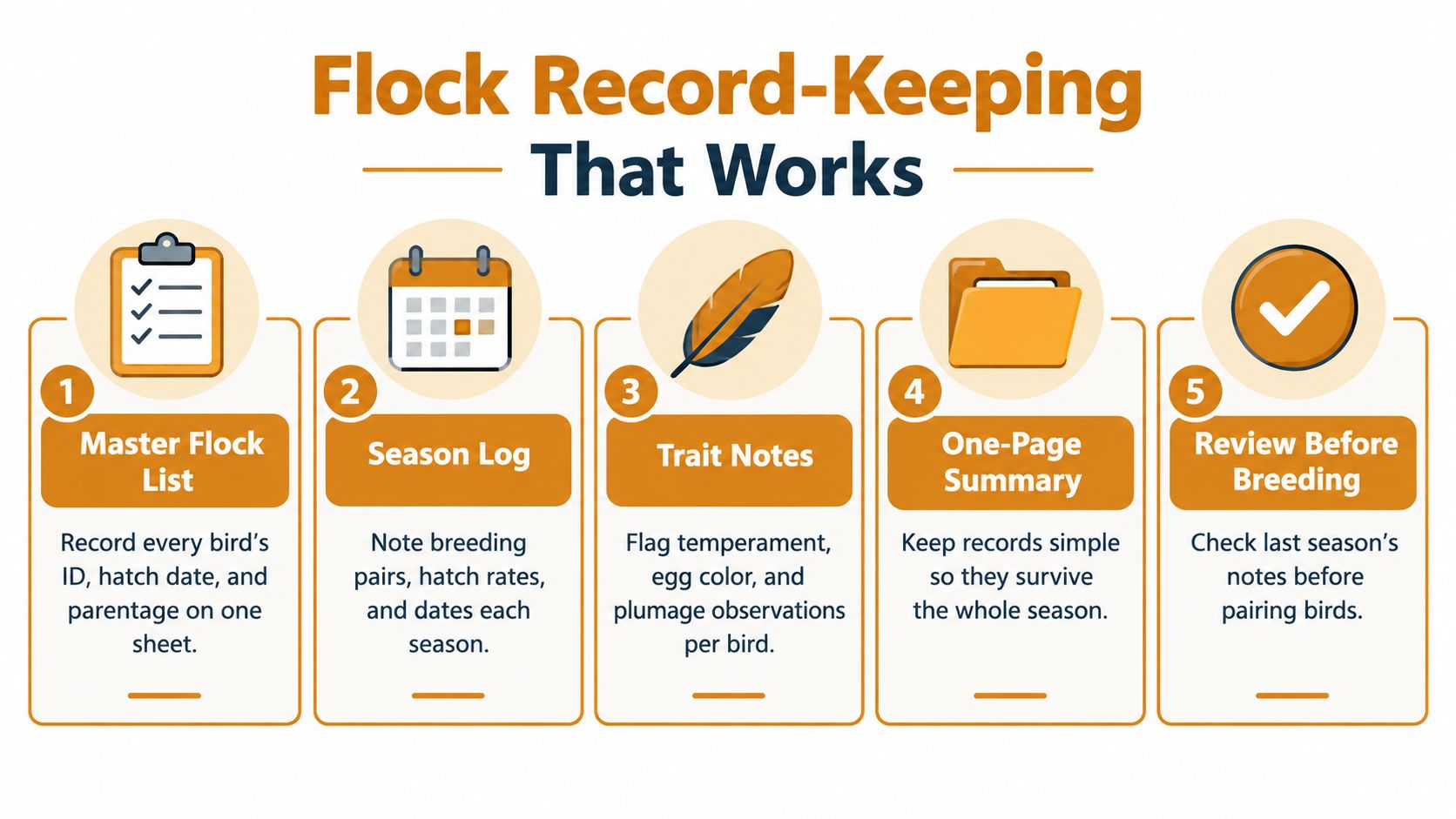
Begin with a master flock list. Give every bird a unique ID that remains readable and doesn't depend on memory. Record hatch date, source, sex, breed or cross, parents when known, and current pen.
Keep five records that earn their space
- Master list: One row per bird, with identity and parentage.
- Season log: Breeding pen, rooster, hens, dates, and hatch results.
- Trait notes: Temperament, leg soundness, plumage, egg color, shell quality, and unusual behavior.
- Health notes: Illness, treatment, injury, recurring weakness, and recovery.
- Production notes: Lay start, egg counts, interruptions, and body condition.
Use the same observation language each time. “Calm” should mean the bird can be handled without panic or persistent attack. “Good shell” should mean the shells remain intact and normal during the period you're evaluating, not just that one attractive egg survived collection.
Track families, not only individual stars
A pullet's performance tells you something, but her family tells you more. If several sisters from one hen consistently show good temperaments and strong survival, that family deserves attention even if no single bird dominates every category.
Keep mating groups separate when possible. If you can't house every family independently, mark hatching eggs by pen and date, then brood chicks in clearly labeled groups. A basic family code such as “Blue rooster with North hen line” is more useful than relying on a photograph months later.
At selection time, compare families using the same questions:
- Which family produced the healthiest chicks?
- Which pullets began laying normally and maintained condition?
- Which birds stayed calm and mobile?
- Which weaknesses appeared repeatedly?
- Which family can be paired with another without closing the pedigree too tightly?
An imperfect notebook beats a complex spreadsheet you abandon after hatch day. Review last season's notes before choosing pairs, and write down the reason for every breeding decision. That habit turns a flock history into a tool rather than a collection of memories.
Pairing Strategies and How to Avoid Inbreeding in a Closed Flock
A closed flock gradually reuses the same genetic material. If the same rooster fathers daughters, granddaughters, and later generations, related birds eventually meet unless you actively prevent it. That process can increase homozygosity, which means offspring receive more matching copies of inherited variants.
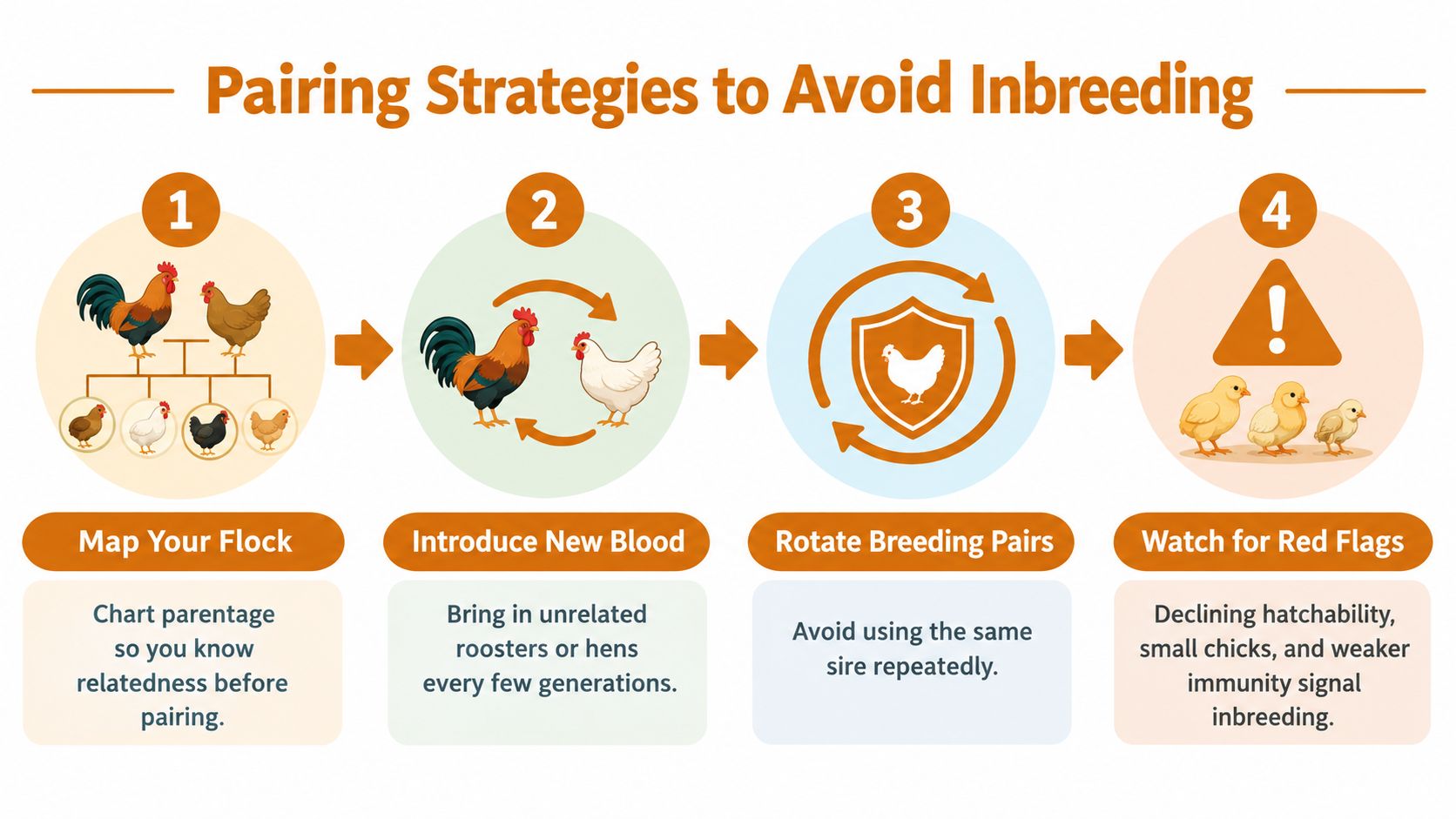
The concern isn't relatedness by itself. Linebreeding can help stabilize desired traits, but close relationships also make hidden harmful variants more likely to pair. Watch for a pattern of declining hatchability, smaller or weaker chicks, poor fertility, reduced survival, or recurring immune problems rather than blaming one disappointing hatch.
Draw the pedigree before you choose the pen
Create a simple family tree and look back several generations. A cautious rule is to avoid pairing birds when the same ancestor appears on both sides of the pedigree within roughly three to four generations, especially in a small flock with limited replacement options. This isn't a substitute for a formal calculation, but it catches many preventable pairings.
Breeding safeguard: If you can't explain how two birds are related, treat their relationship as uncertain and don't pair them until you've checked the records.
Small keepers can use several workable strategies:
- Rotate roosters: Move breeding males between family groups so one sire doesn't dominate every generation.
- Maintain two lines: Keep Line A and Line B separate, selecting for similar core standards, then cross them when you need vigor without abandoning your goals.
- Exchange males: Obtain an unrelated rooster from a trusted breeder whose health, temperament, and production records fit your program.
- Refresh carefully: When outside genetics are unavailable, introduce one sound unrelated rooster, record the cross clearly, and avoid immediately breeding him back to close daughters.
Don't bring in a bird solely because it's unrelated. New genetics can also introduce aggression, poor fertility, defects, disease exposure, or traits that conflict with your environment. Quarantine and health assessment belong before breeding plans.
Fertile eggs provide useful information, but fertility alone doesn't prove that a pair is genetically suitable. For the practical handling side, use this guide on how to check if chicken eggs are fertilized while continuing to evaluate hatchability, chick vigor, and later performance.
Ethics, Welfare, and the Case for Selecting for Resilience
The highest-producing bird isn't automatically the best breeding bird. A chicken that lays heavily for a short period but becomes fragile, immobile, or chronically unwell can pass a costly package of traits to the next generation.
Modern poultry breeding shows why narrow selection requires caution. Twentieth-century programs shifted from general-purpose chickens toward specialized lines for meat or eggs. Broiler selection emphasized rapid growth, carcass yield, feed efficiency, disease resistance, and livability, while laying lines focused primarily on sustained egg production (history of modern poultry breeding). Those gains also highlighted trade-offs among body size, reproduction, behavior, and longevity.
Put welfare standards ahead of a single record
For backyard breeding, a resilient candidate should show:
- Sound movement: The bird walks, stands, perches, and forages normally.
- Stable behavior: It remains socially manageable and doesn't show persistent aggression or panic.
- Useful body condition: It can maintain condition without extreme management.
- Reliable reproduction: Fertility, hatchability, and chick vigor matter alongside adult appearance.
- Environmental tolerance: The bird continues normal activity and feed intake during local heat or cold.
- Freedom from recurring problems: A repeated health issue is a breeding warning, even if production looks attractive.
Rapid growth can contribute to metabolic, skeletal, and locomotor problems in broilers, and welfare guidance warns that selecting for a narrow production or health metric doesn't guarantee good welfare (research on thermotolerance and welfare). Your small flock gives you room to choose differently. You can reject a bird that reaches a target quickly if it struggles to move or breathe comfortably.
Disease resilience also deserves measured attention. FAO material describes associations between Marek's disease resistance and major-histocompatibility-complex haplotypes, and between avian leukosis resistance and receptor-gene differences. It also describes combining molecular information with traditional family-based selection to improve durability in meat and egg strains (FAO poultry genetics resource).
You won't need genotyping to act on that principle. Record family-level survival, vaccination response where relevant, treatment history, and performance under ordinary farm conditions. Select birds that stay useful without demanding extreme housing, constant intervention, or tolerance of suffering.
A Practical Breeding Calendar and Next Steps for Your Flock
A seasonal plan keeps selection from becoming an improvised spring decision. Adjust the timing to your climate, but keep the order of decisions consistent.
Late winter planning
Review the previous season's records. Mark birds that meet your minimum welfare standard, identify family relationships, decide which traits receive priority, and assign breeding pens. Remove candidates with recurring illness, poor movement, severe aggression, or uncertain suitability.
Early spring mating and egg collection
Set up pens before you need hatching eggs. Confirm that each breeding group has a known rooster and documented hens, label collected eggs by group and date, and avoid saving eggs from birds you haven't evaluated carefully. If you use an incubator, follow a consistent process and record the settings and outcome. This incubation guide can support the practical preparation.
Late spring hatching and brooding
Mark chicks by family as soon as it's safe and practical. Record hatch quality, chick vigor, early defects, and losses without excusing a weak family because its parents look impressive. Give every group comparable feed, space, warmth, and observation so management differences don't distort your comparisons.
Summer and fall evaluation
Watch pullets and cockerels during ordinary flock life. Note legs, activity, temperament, growth pattern, feed use, environmental response, and the first signs of reproductive performance. Select a small group that meets the full index, then keep the records that explain why each bird stayed.
If you're a beginner with a mixed flock, choose one goal and start with IDs plus weekly observations. If you're ready to focus on a breed or cross, separate families and track individual egg data. If you're considering a small line, build the pedigree first, plan a rooster rotation, and define welfare standards that no production result can override.
Start this season with one notebook page, one clear breeding goal, and one honest rule about which birds shouldn't reproduce. Feed and manage the flock well, evaluate families rather than appearances alone, and let resilience become part of what you mean by a successful chicken.
Pure Grubs offers USA-grown dried Black Soldier Fly Larvae as a supplemental feed option for chickens, with product information listing calcium, protein, and fat content for uses such as laying, growth, and molting. Visit Pure Grubs to review the product details and decide whether it fits your flock's nutrition plan.