

No Additives or Preservatives: A Bird Feed Guide
You're standing in the feed aisle with two bags in your hands. Both promise “no additives or preservatives,” yet one looks like a familiar yellow commodity mix while the other contains dried black soldier fly larvae. Turn the bags around and the ingredient panels tell very different stories. One claim suddenly feels like a broad marketing message, while the other appears to describe a single, recognizable feed ingredient.
That confusion is reasonable. A clean front label doesn't tell you whether the product is a complete ration, a supplement, or a treat. It also doesn't explain what the manufacturer has added, how the product was dried, or whether you need to handle it differently once it reaches the coop.
A useful way to judge the claim is to answer four practical questions: What do the words mean? Why do they matter for laying hens and eggs? How does a specific product meet the claim in production? And what can you verify yourself on the bag? Those are the questions I use before putting any new feed in a storage bin.
Standing in the Feed Aisle Trying to Make Sense of the Bag
The first thing I do isn't admire the picture of a glossy hen or read the promise printed in large type. I turn the bag around. The ingredient list, guaranteed analysis, origin statement, and storage instructions usually tell me more than the front panel.
Suppose the yellow mix lists grains, vitamins, minerals, colorants, and a shelf-life ingredient. The dried-grub pouch may list only black soldier fly larvae. Both products could still use the phrase “no additives or preservatives” on the front, but the phrase may be describing different things. One might mean no chemical preservatives while still containing functional additives. The other might be a single-ingredient product with no extra coating, dust, or flavoring.
That difference matters because “additive” is a wider word than “preservative.” A preservative is used to slow spoilage. An additive can serve many other purposes, including stabilizing fats, changing color, improving texture, or making feed more appealing. If you read only the front label, you won't know which interpretation applies.
My first aisle rule: treat the front claim as an invitation to inspect the back panel, not as proof that the bag contains what you want.
For laying hens, the decision also involves more than personal preference. A hen may eat the same base ration day after day, while a dried insect product may be offered only as a supplement. Feed storage, moisture control, egg production, and the difference between a complete diet and a treat all affect what the claim means in practice.
By the time you finish this guide, you should be able to look past the slogan and ask sharper questions. What was intentionally added? What is the product made of? How was it processed? And can the manufacturer show enough detail for you to check the answer yourself?
What Additives and Preservatives Actually Mean on a Feed Label
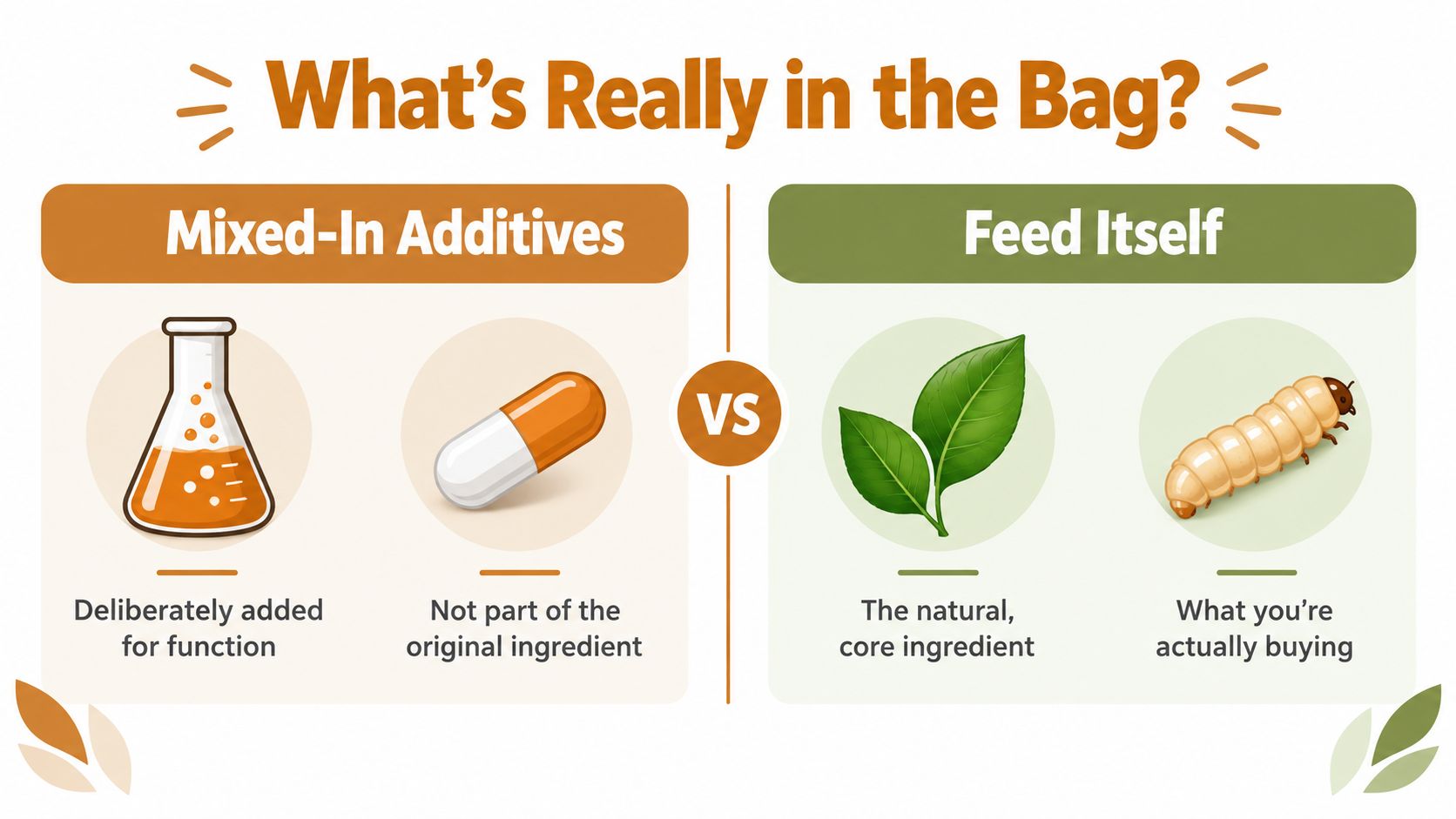
An additive is a substance deliberately mixed into feed to perform a job. The feed itself might be grain, seed, dried larvae, or another core ingredient. An additive is something introduced to change how that feed stores, looks, smells, tastes, or behaves.
A preservative is one type of additive. Its job is to slow deterioration caused by organisms or environmental exposure. The World Health Organization's explanation of food preservatives describes their role in slowing spoilage from mold, air, bacteria, or yeast and helping control contamination that can cause foodborne illness. In feed, the practical question is similar: was a substance added to protect the product from spoilage or improve its stability?
Think of the bag as either a pantry or a chemistry shelf. A pantry contains recognizable ingredients that make up the food itself. A chemistry shelf contains isolated compounds added in small amounts for a specific function. The distinction isn't that one word automatically means safe and the other means harmful. The point is to know which role each ingredient plays.
The categories that cause confusion
A poultry label may use the word additive for several different kinds of ingredients:
- Antioxidants, such as ethoxyquin or BHA, help slow oxidation in fats.
- Mold inhibitors, including substances such as propionic acid, help control mold growth.
- Synthetic vitamins and minerals provide nutrients in a formulated ration, though their presence doesn't necessarily mean the product contains preservatives.
- Artificial colors may be used to change the appearance of feed or influence the appearance of yolks.
- Palatants and flavoring ingredients can make a ration more attractive to an animal.
A whole dried black soldier fly larva is different. It is the feed ingredient itself, not a chemical added to another ingredient. That distinction is useful when you compare a single-ingredient pouch with a mixed ration. For a deeper look at why consistency and ingredient identity matter in insect feed, see Pure Grubs' guide to product standardization.
The key reading habit is simple: “no preservatives” doesn't automatically mean “no additives.” Look for every deliberately added functional ingredient, not only those whose main purpose is preventing spoilage.
U.S. food-label oversight has a long regulatory history. Federal control over preservatives and other food-safety rules dates to 1906, when the Pure Food and Drugs Act created the starting point for modern federal oversight, while the 1938 Food, Drug, and Cosmetic Act expanded the structure that followed. The history of food safety regulation in the United States helps explain why label language matters. Terms such as preservative aren't merely casual descriptions. They sit inside a system concerned with intentional addition, technological function, and proper declaration.
Why the Clean-Label Claim Matters for Chickens and Eggs
A laying hen turns a label decision into a repeated exposure decision. She doesn't sample a ration once and move on. She may receive the same feed across ordinary days, weather changes, molt, and long stretches of egg production. That makes the ingredient list more relevant than it is for an occasional snack.
The claim also deserves a poultry-specific reading because feed inputs connect to the egg basket. Some compounds that dissolve readily in fat can move through an animal's metabolism differently from water-soluble substances, and the yolk contains fat. That doesn't mean every additive in feed will appear in an egg or create a predictable problem. It does mean a keeper should ask what a product contains, why it was included, and whether the manufacturer explains its use.
Four practical reasons to look closely
Daily intake changes the context. A minor ingredient in a once-in-a-while treat isn't the same choice as a functional ingredient present in a daily ration. The amount, duration, and purpose all matter.
The ceca need a functioning microbial environment. Chickens rely on microbial communities in their digestive tract, particularly in the ceca, to help process feed components. Mold inhibitors and synthetic antioxidants are designed for feed stability, not to support that microbial ecosystem. A clean-label choice can therefore be a way to reduce unnecessary inputs, though it isn't a guarantee of a particular gut outcome.
The egg is part of the conversation. A hen's feed supports the bird first, but it also contributes to the nutrients and characteristics of the egg. Feed changes can coincide with changes in yolk color, shell quality, appetite, manure, or egg flavor. Those observations don't prove that one ingredient caused a change, but they give you useful reasons to review the ration.
A treat isn't a complete layer feed. Dried larvae can provide protein, fat, and minerals, but a supplemental product shouldn't replace a balanced layer ration unless the label specifically says it's formulated as complete feed. Treating a supplement as the entire diet can create nutritional gaps even when the ingredient list is beautifully short.
Public concern about additives is broader than preservatives alone. The Global Food Research Program's summary of U.S. purchasing data reports that about 60% of foods and beverages purchased by Americans contain technical additives such as preservatives, colorings, flavorings, or sweeteners. That context helps explain why a no-additive treat can feel meaningful, but the sensible goal is not to treat every additive as identical. It is to understand the specific ingredient and the job it performs.
How Pure Grubs Meets the No-Additive Standard
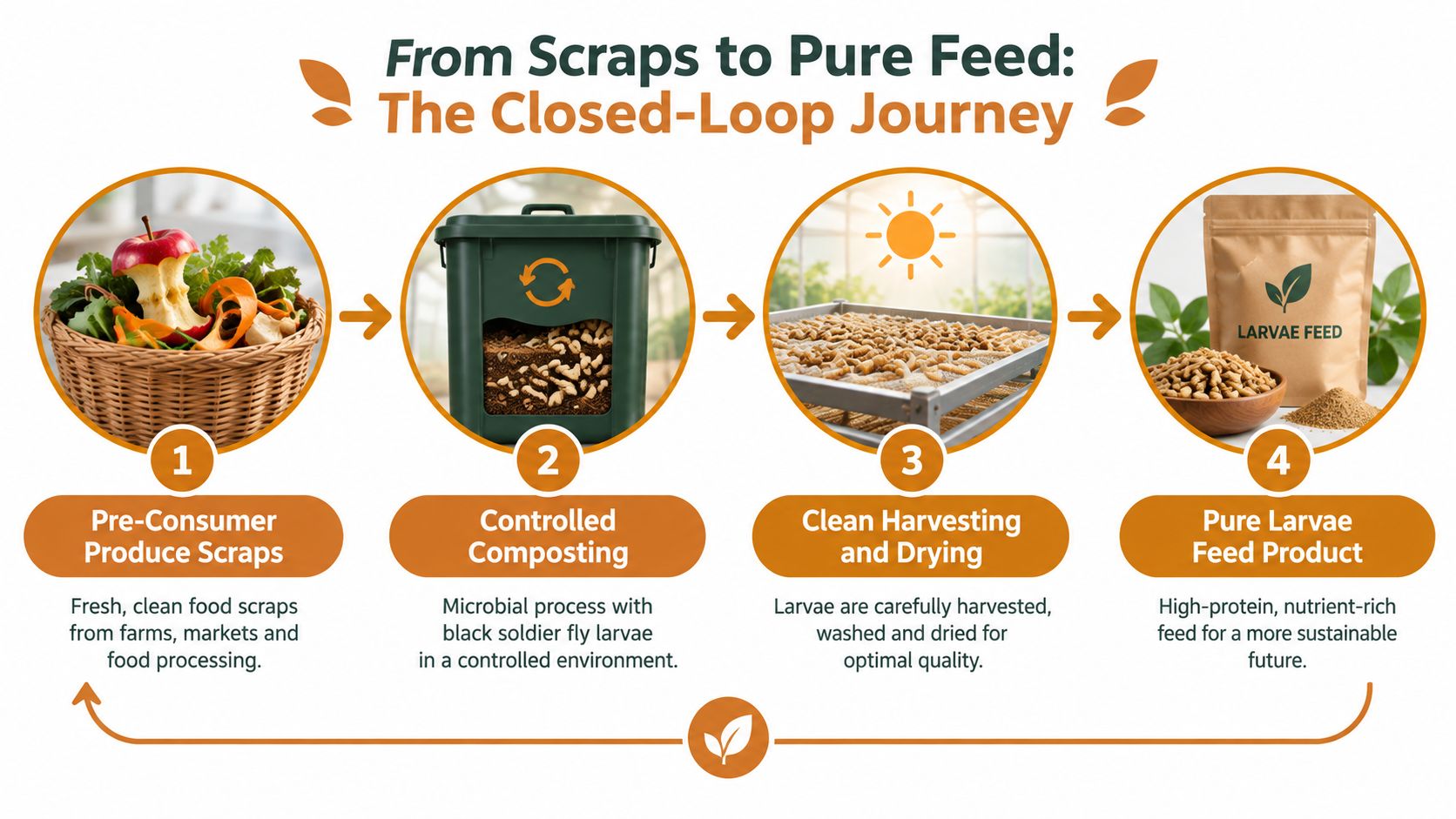
A laying hen cannot read the front of a bag, so the useful question is what the product contains and how it was made. Pure Grubs describes its black soldier fly larvae as single-ingredient BSFL, grown and dried in the United States on a plant-based diet. The stated process begins with pre-consumer produce and grain byproducts from human food streams, without adding antibiotics, hormones, or growth promoters during insect rearing.
That detail separates the larvae from a blended treat. If the dried larvae are the product, there is less need for a post-harvest spray, coating, filler, or flavoring. The label claim then has a clear meaning: the bag is intended to contain the dried insect itself, rather than an insect product dressed with functional ingredients.
Drying replaces the need for a chemical preservative
Pure Grubs describes low-temperature drying. Removing moisture limits the conditions mold and bacteria need to multiply, allowing moisture control and packaging to support stability instead of a chemical preservative. Drying does not make feed immune to humid air, so the bag still needs sensible storage.
The product snapshot describes the larvae as naturally dried and rich in healthy fats. It lists 36–42% crude protein and says they provide up to 85% more calcium than mealworms in the linked USA Grown Black Soldier Fly Larvae for Chickens catalog description. These are product-specific claims. Check the current bag and product information before treating them as a description of every insect feed.
Testing gives the clean-label claim another point of verification. Pure Grubs states that each batch receives third-party heavy-metal and microbiological testing, including checks for pathogens such as Salmonella. Ask how the test connects to a specific batch, what the reports cover, and whether the company can explain the testing scope.
Here's a closer look at the drying and production story:
The practical standard is simple. The bag should contain what the label says it contains, and the production method should explain how the product stays stable without preservatives.
Reading a Bird Feed Label Like an Inspector
Start with the ingredient list, not the product name. Ingredients generally appear in descending order by weight, so the first items tell you what makes up most of the product. A short list isn't automatic proof of quality, but a list made entirely of recognizable feed ingredients is easier to audit than one filled with broad categories and unexplained functional terms.
Then compare the front and back panels. If the front says “no additives or preservatives,” search the back for antioxidants, mold inhibitors, colors, stabilizers, palatants, and flavoring terms. “Natural flavors” can still describe a mixture rather than one simple kitchen ingredient, so ask the manufacturer what that term means in this particular feed.
A quick label comparison
| Claim on Front | What to Check on Back | Red Flag |
|---|---|---|
| No additives or preservatives | Full ingredient list and any processing aids | The claim appears, but the back lists functional additives |
| Single ingredient | Whether the ingredient list contains only the named feed | Vague carriers, coatings, fillers, or flavor systems |
| Natural feed | Country of origin, processing description, and species directions | “Natural” appears without a clear definition |
| Supports laying hens | Guaranteed analysis and feeding instructions | The product is a treat but is presented like complete feed |
| Tested for safety | Batch identification and the type of testing performed | A general safety statement with no testing detail |
A guaranteed analysis panel helps you understand the nutritional profile, but it doesn't replace the ingredient list. Protein and fat values tell you what the product provides. They don't tell you whether a preservative, colorant, or palatant was added.
Country-of-origin statements and processing details can also reveal whether the company is willing to make the supply chain visible. Look for wording about where the insects were raised, what they were fed, how they were dried, and how the finished product was packed.
The same skepticism helps with products for other animals. If you're unsure how to evaluate a label, Pure Paw Labs offers a practical guide on how to audit your dog's supplement tub. The species changes, but the habit stays useful: check the complete panel, identify vague terms, and separate a marketing promise from a verifiable ingredient statement.
Storing Additive-Free Feed Without Losing the Benefit
A preservative-free product puts more responsibility on the keeper. Moisture, heat, oxygen, sunlight, and pests can damage feed even when the original bag was carefully made. The absence of chemical preservatives doesn't make a product fragile by definition, but it does mean storage conditions become part of the quality plan.
For dried larvae, moisture is the first thing I check. A crispy product should not develop damp clumps, a stale or sour odor, visible mold, or unusual discoloration. Any of those signs is a reason to stop feeding it and contact the supplier rather than trying to rescue the bag.
Four storage enemies
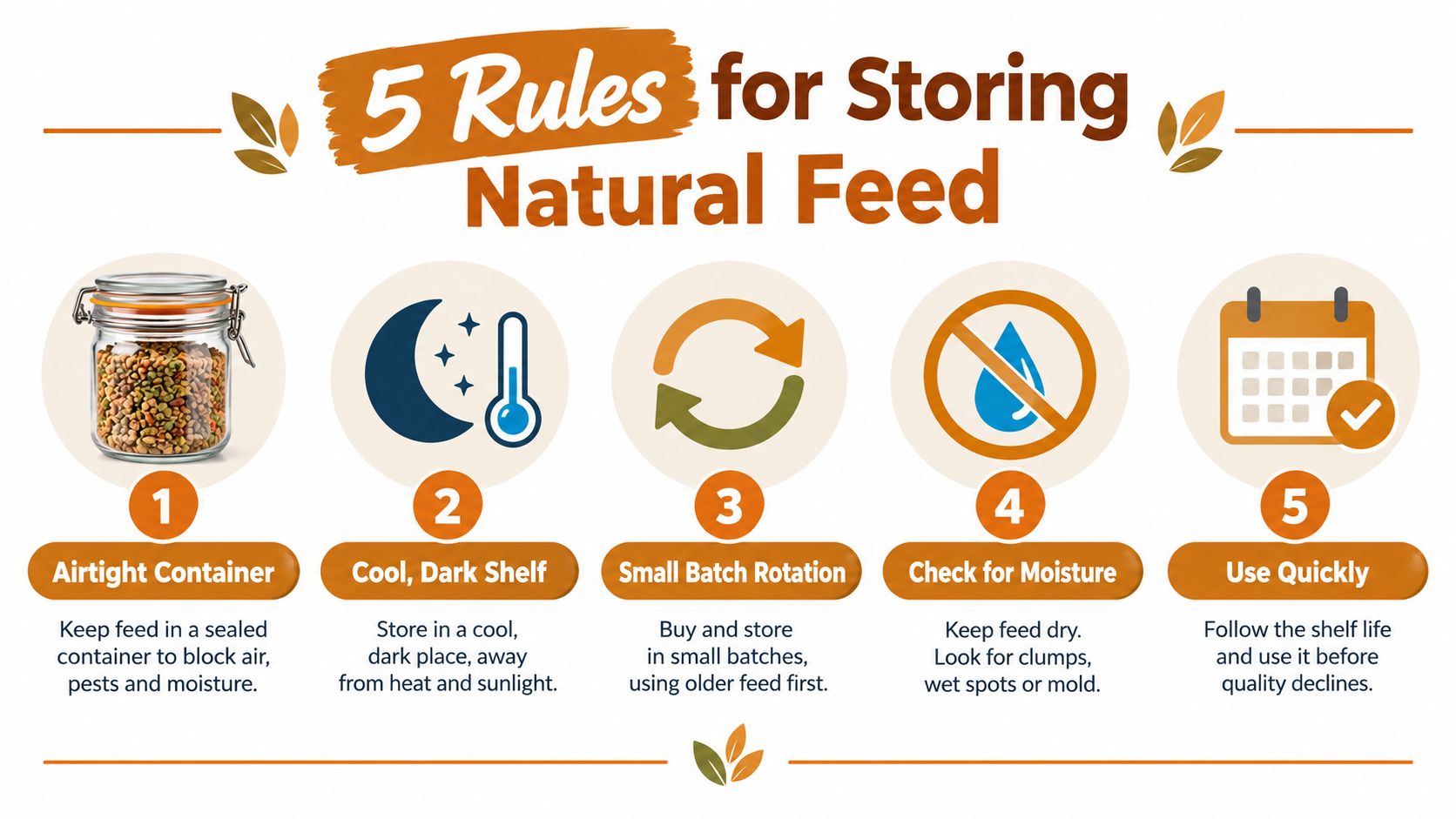
- Moisture encourages clumping, mold, and microbial growth. Keep the package sealed and use a clean, dry scoop.
- Heat speeds oxidation, especially in feeds containing natural fats. Choose a cool location away from heaters and hot sheds.
- Oxygen and sunlight gradually reduce freshness. A gasketed food-grade bin with an opaque exterior gives the bag extra protection.
- Pests can contaminate open feed. Keep the container raised, closed, and away from rodents, insects, and damp concrete.
Use first-in, first-out rotation. Don't pour a new bag on top of an old one without cleaning the container, and don't store feed directly on a concrete floor where temperature shifts and condensation can introduce moisture.
Product-specific guidance matters more than a generic shelf-life guess. Follow the date and storage directions printed by the manufacturer, and keep opened bags moving through the flock rather than buying more than you can protect. Pure Grubs also provides practical chicken feed storage guidance for keepers who want a dedicated storage routine.
Storage rule: clean, dry, sealed, cool, and rotated. A clean label can't compensate for a wet bin.
Common Concerns About Additive-Free Bird Feed Answered
Is the claim only packaging?
It can be if the back panel doesn't support it. The way to test the claim is to compare the complete ingredient list with the front statement, then ask for production and testing details. A single-ingredient product gives you a simpler starting point than a blend containing broad flavoring, color, or stabilizing categories.
Third-party testing adds a separate layer of accountability when the producer identifies what it tests and connects results to a batch. Pure Grubs describes heavy-metal and microbiological testing, including Salmonella testing, for its batches. That doesn't mean you should skip label reading. It means the claim can be evaluated through both the formulation and the production controls.
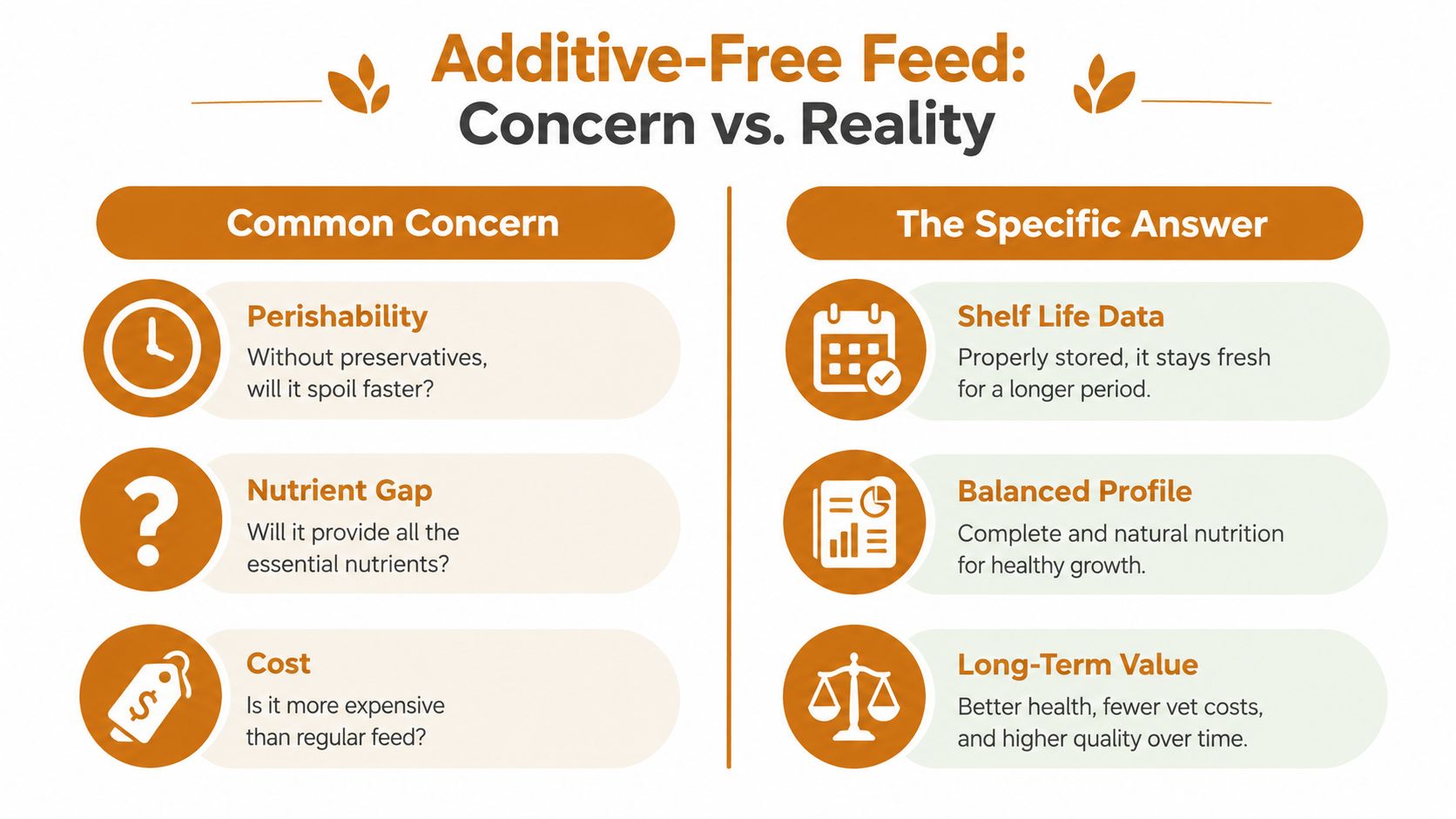
Won't feed spoil without preservatives?
Dried feed can remain stable without chemical preservatives when the producer reduces moisture effectively and the keeper protects the finished product. Low-temperature drying, intact packaging, and a dry storage environment work together. Once the bag is opened, humidity and handling become your responsibility.
Don't rely on a calendar alone. Use the printed date, inspect the product, and discard anything with moisture clumps, mold, pest contamination, or an off smell. A product's actual storage life depends on its formulation, packaging, drying process, and environment.
Is BSFL real nutrition or just a treat?
Both descriptions can be true. Dried black soldier fly larvae can provide meaningful protein, fat, and calcium, but a treat remains a supplement unless it has been formulated and labeled as a complete ration. Offer it alongside a balanced layer feed, fresh water, and appropriate grit practices rather than replacing the base diet.
The product's role also changes by flock. A keeper may use dried larvae as a training reward, a supplemental protein source during molt, or an occasional enrichment food. The right amount depends on the complete ration and the manufacturer's feeding directions.
Does the cleaner label justify the cost?
That is a personal value judgment, not a guaranteed health outcome. Some keepers prioritize traceable origin, a short ingredient list, and the ability to identify every component. Others may prioritize convenience, price, or a long storage period.
A sensible comparison includes more than the purchase price. Consider what you're buying, how much waste you create through poor storage, whether the product is a treat or complete feed, and whether the supplier provides enough information for you to make a confident choice. The Pure Grubs safety guide for dried grubs offers another product-focused reference for that evaluation.
Consumer concern also deserves nuance. A 2026 cohort analysis reported associations between high intake of certain preservatives and higher risks of hypertension and cardiovascular disease, including a 29% greater risk of hypertension for the highest intake of non-antioxidant preservatives and a 16% higher risk of cardiovascular disease, as reported by ScienceDaily's coverage of the analysis. Those findings concern human dietary exposure, not a direct prediction about a hen or an egg. They support a more careful question, which compounds, at what exposure, and for whom, rather than a blanket claim that every preservative behaves the same way.
A Short Checklist Before the Next Bag Hits the Coop
At the feed store, turn the bag around before putting it in your cart. A clean front label is a useful starting point, but the ingredient panel, feeding directions, and package condition show whether the claim holds up.
- Read every ingredient. Look for recognizable feed ingredients. If the product says it contains one ingredient, the list should contain one ingredient too. Pause at terms such as natural flavors, carriers, coatings, or unspecified functional blends, because they do not tell you exactly what was added.
- Separate a supplement from complete feed. Dried insects can provide useful nutrients without meeting every requirement of a laying hen's diet. Keep a complete layer ration as the foundation unless the bag clearly identifies the product as complete feed.
- Check origin and processing. Review the stated country of origin, the insect diet, and the drying method. If USA-grown or low-temperature-dried describes the product, those details should be stated clearly rather than implied by the front label.
- Ask about testing. Batch testing for heavy metals and microbiological hazards gives you specific information to assess. Ask which hazards were tested and how the report connects to the product in your hands.
- Inspect the package. Check that the seal is intact, review the packaging or best-by information, and move the feed into a cool, dry, pest-resistant container after opening. Additive-free feed still needs protection from humidity, insects, and contamination in the coop.
- Watch the flock after introducing it. Start with a small amount and observe appetite, droppings, shell quality, and general behavior during the first week. If digestion or egg production changes, review the whole ration and feeding routine before blaming one ingredient.
Use the checklist together. Verify the ingredients, confirm the product's nutritional role, store it properly, and watch how the hens and eggs respond.
Pure Grubs offers USA-grown, dried black soldier fly larvae with a single-ingredient, no-additives-or-preservatives approach for chickens and other birds. Visit Pure Grubs to review the product details and decide whether a traceable insect supplement fits your flock's feeding routine.