

Natural Chicken Treats: What to Feed and What to Avoid
You're standing in the feed aisle with a bag in each hand. One says natural, one says high protein, and both show happy hens on the front. Your own birds are back home waiting by the gate because they know your footsteps, and you want to bring them something they'll love that won't undo their layer feed. That small choice is where good treat habits start.
Why Natural Treats Matter for Your Flock
Last spring, a new keeper I know bought the biggest bargain bag she could find. Her hens mobbed her for it every morning, which felt like success, until they started leaving much of their layer feed untouched. Egg numbers slipped, shells got thinner, and she couldn't figure out why because the treat bag looked wholesome.
Her mistake wasn't caring too much. It was assuming a treat is just a treat. For chickens, natural chicken treats do two jobs at once. They give birds something to chase, scratch for, and get excited about, and they add real nutrients, or real empty fill, to the day's total intake.
Just as snacks serve kids, an apple after school and a bag of candy after school both count as a snack, yet they don't do the same work in a body. Hens are no different, except their bodies are also building an egg almost every day, so the margin for nutritionally empty extras is smaller.
The bonding side is real too
Treats aren't frivolous. A small handful scattered in the run gets shy birds moving, helps you train the flock to come when called, and makes health checks easier because birds gather close instead of scattering. That daily moment also lets you spot a limping hen, a pale comb, or a bird hanging back from the group.
Happy, active birds are easier to observe, and observation catches problems early.
Why the label alone can't settle it
The word natural tells you something about origin, but it tells you almost nothing about protein, calcium, safety testing, or how the ingredient was raised. Two bags can both be insect based and still differ a lot in what's inside. Learning what chickens naturally eat when they're foraging helps you judge a product against a bird's real instincts, not just its packaging.
By the time you finish reading, you'll have a simple way to judge any treat, portion it without diluting the main feed, and check where it came from. You don't need to stop spoiling your flock. You just need to spoil them on purpose.
What Makes a Treat Natural and Nutritious
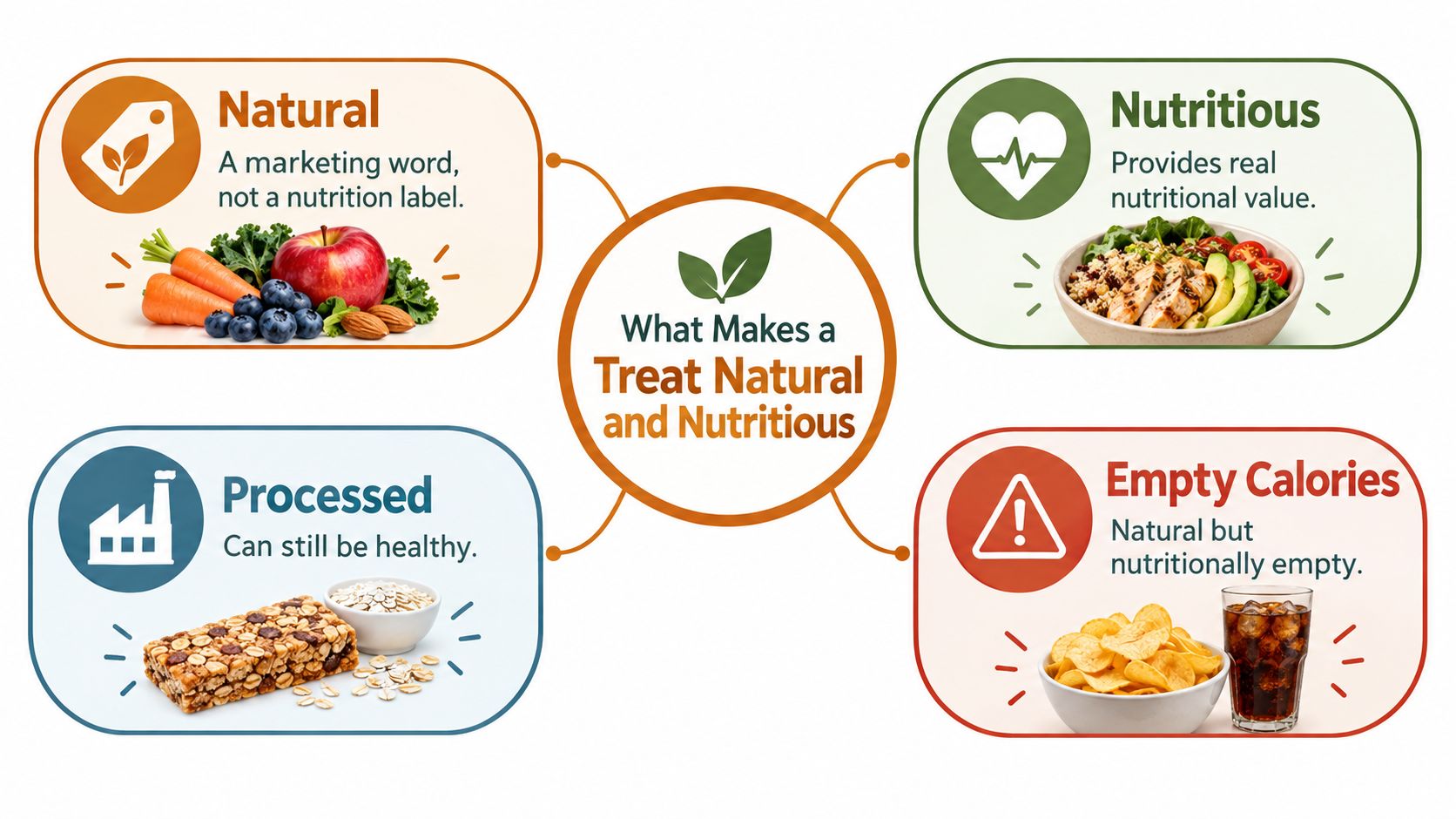
Natural and nutritious sound like the same promise, but they're answering different questions. Natural mostly describes where an ingredient comes from and how little it's been altered. Nutritious describes what that ingredient delivers once your hen eats it.
A handful of cracked corn is natural. So is a handful of dried insect larvae. Yet one is mostly energy with little protein or calcium, while the other is concentrated protein and minerals in a small serving. If you only shop by the word natural, you'll treat those two as equals when your hens' bodies won't.
The visual below maps how these ideas overlap and where they pull apart.
Use the almonds versus chips test
Picture your own snack drawer. Almonds and potato chips both come from plants, both are sold as simple foods, and both are easy to overeat. Almonds bring protein, healthy fats, and minerals. Chips bring mostly starch, oil, and salt.
Chicken treats sort the same way. Ask what a treat contributes before you ask whether it sounds wholesome. A treat that adds useful protein during a molt is doing a job. A treat that only fills the crop with starch is taking up room that complete feed needed.
A three question check for any treat
You don't need a nutrition degree to evaluate a bag or a kitchen scrap. Run it through three plain questions and you'll sort most options correctly.
- What nutrients does it deliver: Look for protein, calcium, or useful fats, not just calories your hens will burn through quickly.
- Can hens use it: Whole, digestible ingredients in bite sized pieces work better than hard, oversized, or heavily seasoned foods birds struggle to break down.
- What role does it play today: Decide whether you're offering enrichment, a protein boost during feather regrowth, or just variety, then portion it for that job.
Processed isn't automatically bad
Drying is a form of processing, and it's what makes insect larvae shelf stable and easy to scatter. That doesn't strip away their value. On the flip side, a raw, unprocessed food can still be a poor choice if it's spoiled, moldy, salty, or nutritionally thin.
Practical rule: Judge a treat by nutrient density and safety first, and by how rustic it sounds second.
Once you separate those two ideas, shopping gets calmer. You're no longer hunting for the most natural sounding bag. You're looking for a treat that earns its place in the bucket because it gives your hens something their main feed routine can use.
Nutrition Benefits of Natural Treats
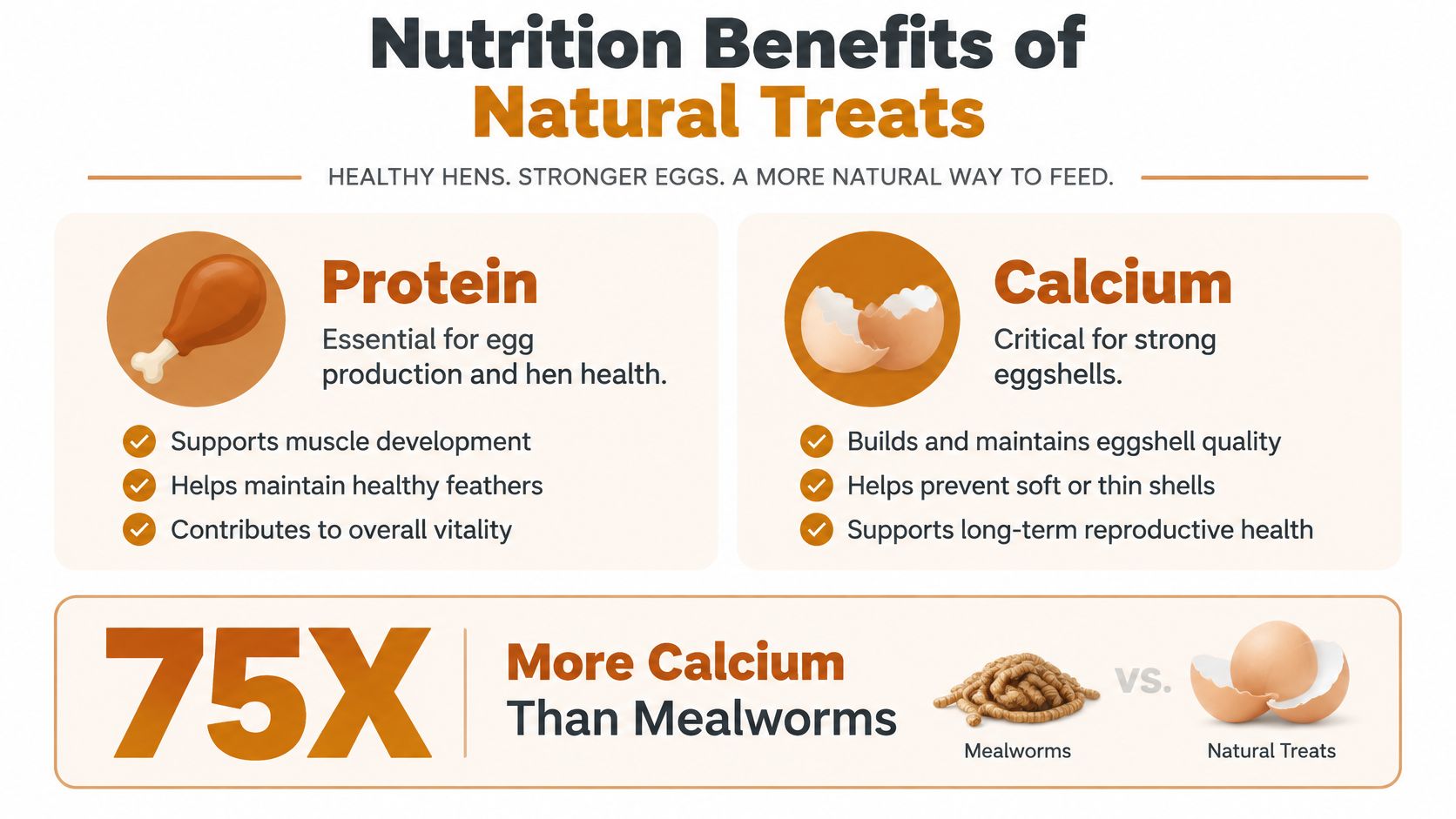
Two nutrients do most of the heavy lifting for laying hens, and they're the two worth understanding before you buy anything. Protein builds and repairs the body, and calcium builds the shell. A treat that supplies one or both in a concentrated form can support a flock in ways a starchy snack won't.
The infographic below sums up why those two nutrients sit at the center of treat choices for layers.
Protein and the work you can see
Feathers are mostly protein, so a molting hen is rebuilding her coat out of the same nutrient she needs for body maintenance. That's why birds can look rough and lay less during a molt. Their protein budget is stretched thin.
A concentrated insect treat makes sense in that moment because a small serving carries a lot of protein without requiring the hen to eat a large volume. Think of it as handing a construction crew extra bricks during a renovation, rather than extra coffee. Energy helps, but building material is what's short.
protein also supports ordinary body condition outside molt season. Hens that are recovering condition, growing, or very active foragers use amino acids constantly. The point isn't to flood the diet, it's to add a dense supplement at the times demand rises.
Calcium, shells, and what research actually shows
Calcium is less visible until it goes wrong, usually as a thin shell that cracks in the nest box. In a 2018 study in Poultry Science on hens fed 7.5% black soldier fly larvae meal, birds produced similar egg production and total egg mass to hens on a conventional corn and soybean diet, with improved eggshell characteristics suggesting larvae may support calcium absorption or metabolism.
That finding needs its honest limits. Feed conversion was poorer at that inclusion level in the same work, which means more larvae isn't automatically better. The evidence supports larvae as a supplement to a complete layer ration, not a replacement for it, and not a guarantee for every flock.
This short video shows what a feeding moment with larvae looks like in a real run, which helps newer keepers picture portion and bird response.
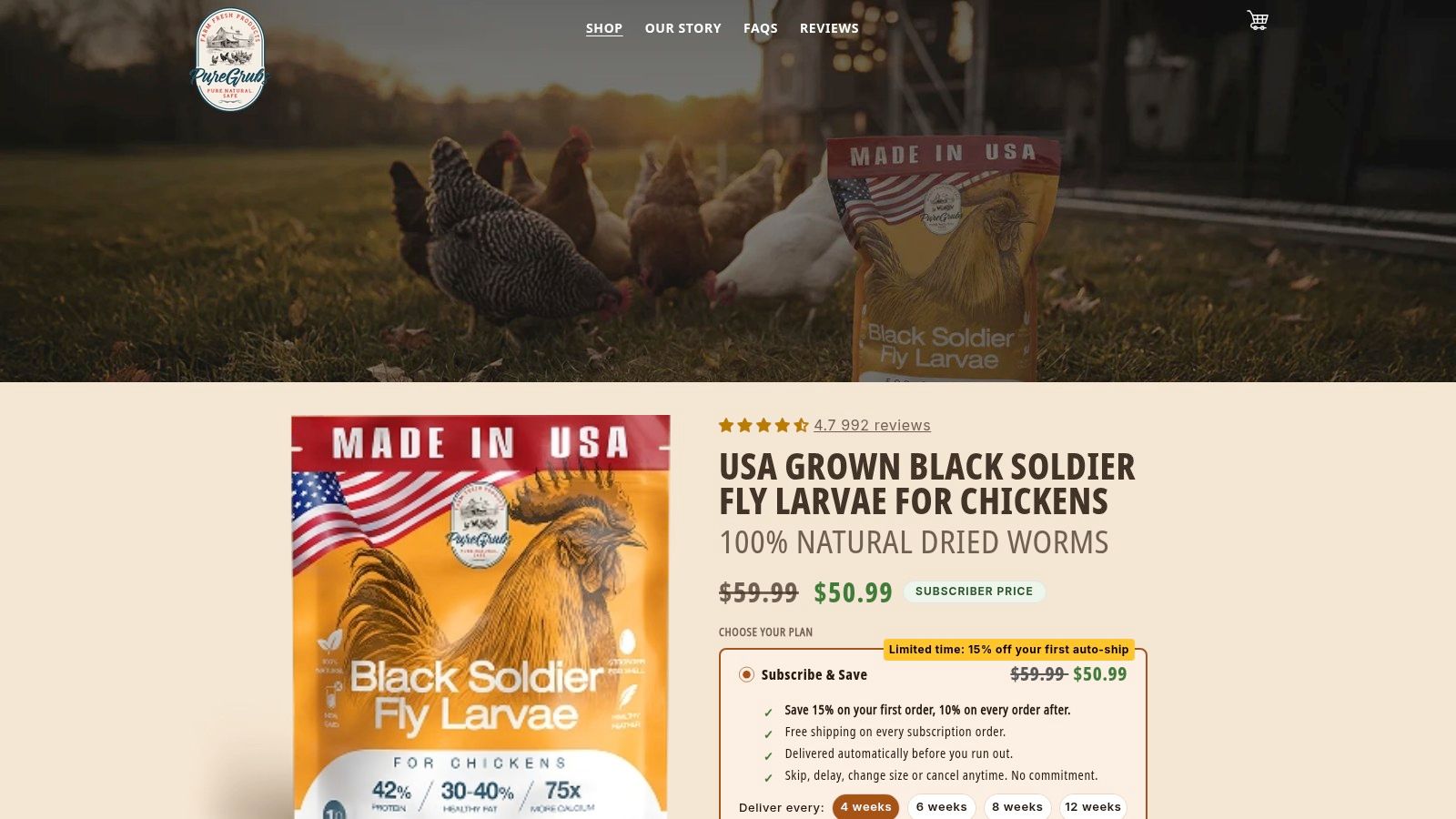
For a concrete product example, USA GROWN BLACK SOLDIER FLY LARVAE FOR CHICKENS are listed as USA grown and dried, raised on a plant based diet, with 36 to 42% crude protein and substantially more calcium than mealworms, and no additives, preservatives, or fillers. Treat those label details as the kind of specifics to look for on any brand, not just one.
The takeaway for your bucket is simple. Choose treats that bring concentrated protein, calcium, or both, use them in modest amounts, and keep the complete feed as the foundation your hens rely on every day.
Feeding Rates and Safety Guidelines
Most keepers assume that if a treat is natural, it must be safe in any amount from any source. That assumption is where trouble starts. An insect is shaped by what it ate while growing, so the rearing conditions behind the bag matter as much as the species name on the front.
In a 2025 analysis of 21 retail and online dried black soldier fly larvae samples, products sourced from China averaged 25 times more lead and arsenic than North American products, and many imported products lacked or failed to meet U.S. labeling requirements. That's not a reason to fear insect treats. It's a reason to verify them.
Why substrate and origin matter
Larvae raised on controlled, permitted feed inputs are a different product from larvae raised on unknown waste streams, even if they look identical in a scoop. What goes into the larvae during growth can affect microbial safety and heavy metal content in the finished treat. You can't see that difference, which is exactly why documentation matters.
Buying honey from a labeled local apiary versus an unlabeled jar at a swap meet makes for a useful comparison. Both are honey, both are natural, but only one lets you trace where it came from and ask questions about how it was produced.
A purchasing checklist you can use in store
Before a bag goes in your cart, run through these checks. A trustworthy maker should answer most of them on the label or on request.
- Transparent origin: The label states where larvae were grown and dried, not just where the bag was packed.
- Permitted substrate: The maker can say what larvae were fed, ideally a clean, controlled diet rather than unspecified waste.
- Lot level testing: Ask whether batches are tested for contaminants such as lead and other heavy metals, and whether a certificate of analysis is available.
- Clear species identification: The ingredient is named as black soldier fly larvae, not vague terms like dried insects or grubs.
- A way to contact the maker: A real address or contact route means you can ask for testing documents before you buy again.
If a seller can't tell you where larvae were raised or what they ate, that's your answer.
How much to offer
Portioning protects the base diet. Offer treats after birds have had access to complete feed, scatter a modest amount, and watch how quickly it disappears. If treats linger on the ground, you offered too much, and leftover food invites pests and mold.
Also keep a mental list of foods that don't belong in the run at all, including moldy items, heavily salted scraps, and anything you're unsure about. Reviewing common foods that are harmful to chickens before you clean out the fridge for the flock prevents well meant mistakes. When in doubt, leave it out and reach for a treat you've already verified.
Best Natural Treat Options for Chickens
You have four broad categories to rotate, and each one earns its place for a different reason. Comparing them side by side keeps you from relying on whichever scrap happens to be on the counter. Variety also keeps birds interested, because chickens get bored with a single repeated snack faster than most keepers expect.
Natural Treat Categories Compared
| Treat Type | Protein | Calcium | Safety Notes |
|---|---|---|---|
| Insects such as BSFL and mealworms | High and concentrated | BSFL notably higher than mealworms | Verify origin, substrate, and batch testing |
| Fruits and vegetables | Low | Low | Chop small, remove questionable seeds or spoiled parts |
| Kitchen scraps and cooked grains | Low to moderate, varies widely | Usually low | Plain only, no salt, seasoning, grease, or mold |
| Fresh greens and plants | Low | Low to moderate, varies by plant | Confirm the plant is safe before offering, avoid treated lawns |
Insects as the concentrated option
Insects match what chickens hunt on their own, which is why flocks react so strongly to them. Black soldier fly larvae stand out in this group for calcium, while mealworms are better known as a protein and fat treat. Either way, insects deliver the most nutrition per small handful of any category here.
Because they're concentrated, insects are also the easiest category to overdo. A modest scatter goes further than keepers think, especially when every hen is competing. Use them when you want a deliberate protein or calcium supplement, such as during molt or for calling birds in at night.
Fruits, vegetables, and the water content trap
Produce adds color, hydration, and foraging interest. Chopped apples without seeds, berries, pumpkin, cooked sweet potato, and chopped carrots are the kinds of options keepers commonly rotate. Birds enjoy pecking them apart, which stretches a small amount into real enrichment.
The trap is volume. Watery produce fills the crop while contributing little protein or calcium, so a big pile can displace complete feed without looking like much. Treat produce as a garnish on the day, not a second meal, and remove uneaten pieces before they spoil in bedding.
Kitchen scraps and greens need the most judgment
Plain cooked grains and plain vegetables from your own cooking can work in small, unseasoned portions. The moment salt, butter, sauces, or heavy seasoning enter the picture, that scrap stops being suitable. If you wouldn't call it plain, don't feed it.
- Greens for pecking interest: Leafy greens and safe garden plants give birds something to tear at and explore.
- Scraps for occasional variety: Keep portions small enough that they vanish quickly and never become a daily habit.
- Anything doubtful stays out: Moldy, spoiled, or unidentified plants aren't worth the risk for a few minutes of excitement.
Rotating across these categories through the week keeps nutrition and interest balanced. Insects do the concentrated work, produce and greens provide activity and variety, and scraps stay occasional and plain.
How Treats Fit Into a Balanced Layer Diet
A complete layer feed is formulated to cover energy, protein, calcium, vitamins, and minerals in the right proportions. No combination of treats you assemble in a bucket reliably does that. Treats fit best when they sit on top of that foundation as enrichment and small supplements, not underneath it as a substitute.
A helpful analogy is your own plate. A balanced dinner works because the main foods cover your needs, and dessert is enjoyable precisely because it's a small addition. If dessert came first and filled you up, the meal underneath would suffer, even if dessert was homemade.
The timing and quantity method
Poultry Extension guidance on feeding chickens for egg production says scratch grains and table scraps should be offered only after birds eat complete feed, in quantities they finish within roughly 15 to 20 minutes, and it identifies regular supplementation with low nutrient ingredients as a common small flock feeding mistake. That time window gives you a practical measuring tool that doesn't require a scale.
Try this sequence on treat days. Fill feeders with complete feed in the morning and let birds eat normally first. Later, scatter the treat widely so subordinate hens get access, then watch the clock and the ground. If food remains after that window, cut the next portion down.
Adjust for the flock in front of you
A fixed handful doesn't fit every situation. Use these adjustments to keep portions sensible across the year.
- Flock size and competition: More birds need wider scattering, not just a bigger pile in one spot.
- Age and laying status: Actively laying hens need their calcium and protein intake protected, so keep low nutrient treats especially small for them.
- Season and condition: Birds in molt can use protein dense treats more purposefully, while overweight hens need fewer energy dense extras.
- Other extras that day: If birds already received scraps, skip the second treat instead of stacking them.
Portion check: If hens are leaving layer feed in the feeder but mobbing you for treats, the ratio is upside down.
For the base ration itself, reviewing how to feed laying hens for steady production helps you confirm the foundation is right before you fine tune treats. Once the main feed is solid, treats become what they should be. They're a small, deliberate bonus that supports the diet instead of undermining it.
Why USA-Grown BSFL Is a Safe High-Calcium Option
Black soldier fly larvae keep coming up in treat conversations for a specific reason. Their calcium content is unusually high for an insect, and that matters for birds building shells daily. The stronger claim, though, is about verification, and that's where USA grown sourcing becomes relevant.
In a 2025 peer-reviewed study of 288 Hy-Line Brown laying hens over 210 days, hens fed 6% BSFL meal produced significantly stronger eggshells than the control group, while the 3% group produced thicker eggshells than all other treatment groups. Egg production and egg weight didn't differ significantly, and higher inclusion groups had poorer feed to egg ratios later on.
The screenshot below shows the kind of product page detail to look for, including origin and composition information in one place.
Calcium content isn't the whole story
How much calcium a hen absorbs matters alongside how much she eats. In a laying hen trial replacing soybean meal with BSF meal at levels up to 10%, the 10% group consumed about 3.8 g of calcium per hen per day compared with 4.9 g per day in controls, yet eggshell quality didn't significantly deteriorate. That supports a careful claim only. BSFL can support a balanced diet, but it shouldn't replace a formulated calcium source.
Questions to ask any maker
USA grown on a label is a starting point, not the finish line. Ask where larvae were raised and dried, what they were fed, whether facilities meet FDA and AAFCO standards, and whether each batch is tested for heavy metals including lead, arsenic, mercury, and cadmium. A maker doing that work will usually say so plainly.
That combination is the argument. Documented shell benefits at moderate inclusion, plus traceable origin and batch testing, makes USA grown BSFL a reasonable high calcium supplement for keepers who want proof behind the bag.
Building a Smart Treat Routine
Keep the routine boring in structure and interesting in content. Feed the complete layer ration first, offer a modest treat birds finish quickly, and rotate between concentrated insects and lighter produce or greens across the week. Check origin and testing before you buy, not after a problem appears.
If shells, feathers, and body condition look steady, your ratio is working. If feed sits untouched while hens wait for snacks, pull treats back. Small, verified, nutrient dense treats given on purpose will keep both the flock and the egg basket in good shape.
If you want a verified, USA grown larvae option to anchor that routine, Pure Grubs offers dried black soldier fly larvae grown and dried in the USA on a plant based diet, with batch testing and transparent origin labeling. Visit the store to compare sizes, read the product details for yourself, and choose a quantity that fits your flock's treat routine.