

How to Add Protein to Chicken Feed the Smart Way
You're standing at the feed bin, wondering why the hens are pecking at scratch grain while the layer pellets sit untouched. The eggs have become less frequent, feathers are appearing in the run, and nothing about the flock looks dramatically wrong. Before you dump another scoop of mealworms into the feeder, check the bigger issue: protein must match the birds' life stage, production demand, and amino-acid needs.
Learning how to add protein to chicken feed isn't about finding one magic ingredient. It's about protecting the complete ration while making a controlled adjustment. The most reliable approach is to choose the right base feed first, then add a measured protein source only when the flock's condition and production justify it.
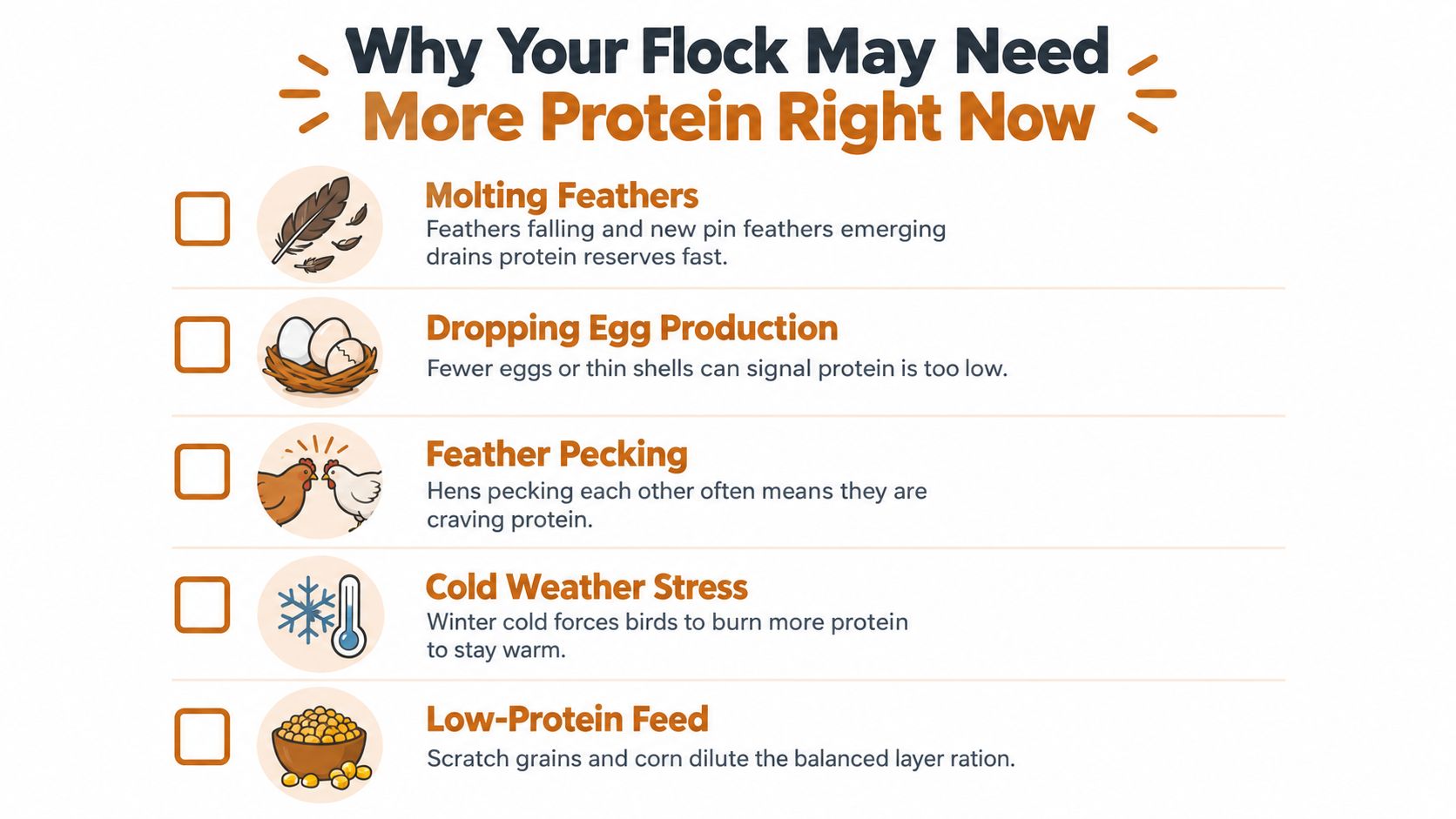
Why Your Flock May Need More Protein Right Now
A flock's protein demand can rise for several ordinary reasons. Young birds need protein for growth, laying hens use amino acids to produce eggs, and molting birds need building material for new feathers. A hen recovering from illness, broodiness, or a stressful event may also need stronger nutritional support while she rebuilds body condition.
Cold weather complicates the picture. Birds use more energy to maintain body heat, and a poor-quality feather coat makes that job harder. That doesn't mean every winter flock needs a dramatic protein increase, but it does mean you should watch weight, feather condition, appetite, droppings, and laying pattern instead of feeding by the calendar alone.
Start with the base ration
Protein isn't a single knob you turn upward. A ration suitable for a six-week-old pullet may be inappropriate for a mature laying hen, while a layer ration can undersupply a rapidly growing bird. Modern poultry guidance places starter, grower, and layer diets at different crude-protein targets because physiological demand changes with age and purpose. The Merck Veterinary Manual's poultry nutrition guidance also emphasizes that breed and production system affect the appropriate target.
You control four practical levers:
- Shift the complete feed: Move chicks, growers, layers, or molting birds onto a ration formulated for their current stage.
- Add a whole ingredient: Use a measured source such as insect meal, soybean meal, or fish meal.
- Layer in treats carefully: Treats can support a short-term boost, but they can also dilute the balanced ration.
- Adjust feeding access: Make sure dominant hens aren't consuming the high-value feed while timid birds get leftovers.
Practical rule: If the flock is eating mostly scratch, corn, or scraps, fix access to complete feed before adding another supplement.
The common signs are useful clues, not a diagnosis. Molting, reduced egg production, feather pecking, thin shells, slow growth, and poor body condition can also reflect disease, parasites, mineral problems, stress, or inadequate calories. If a bird is losing weight or acting ill, correct the feed program and investigate the health problem rather than trying to cover it with extra protein.
Protein Targets by Life Stage
The feed bag should answer the first question: what percentage of crude protein is already in the ration? Reference standards show that starter diets are commonly formulated around 18.8% to 23% crude protein, growing-bird diets around 16.7% to 20%, and layer diets around 13.6% to 18%, with variation by breed and production system. These ranges are summarized in poultry nutrient guidance from Merck Veterinary Manual.
| Life Stage | Crude Protein % | Feeding Window | Main Driver |
|---|---|---|---|
| Starter | 18.8% to 23% | Early chick growth | Muscle, organ, and skeletal development |
| Grower | 16.7% to 20% | Juvenile growth | Frame development and steady body gain |
| Layer | 13.6% to 18% | Active egg production | Egg formation and body maintenance |
| Molt support | Use a higher-protein formulated ration within the applicable range | Feather regrowth | Keratin production and tissue repair |
| Winter maintenance | Select a complete ration suited to body condition and production | Cold-weather maintenance | Feather condition, energy use, and continued production |
A chick needs a concentrated, digestible diet because growth is rapid. A pullet needs enough amino acids to fill out her frame without being pushed into excessive weight gain. A laying hen must divide nutrients between body maintenance, feathers, and eggs, while a molting hen redirects much of her nutritional investment toward plumage.
Don't feed a mixed-age flock by convenience
Straight layer feed is a poor solution for a mixed-age flock. Calcium levels intended for laying hens aren't the same nutritional package that growing birds need, and a ration that suits mature layers may leave juveniles short of the nutrients required for development. Separate feeding areas or a flock-raiser approach are safer than allowing young birds to compete with adult hens around one feeder.
The modern industry moved away from treating crude protein as the whole answer. The Auburn poultry feeding reference explains the shift toward amino-acid nutrition, where soybean meal, fish meal, and other ingredients are balanced as building blocks rather than tossed into feed without calculation.
For a practical insect option, USA GROWN BLACK SOLDIER FLY LARVAE FOR CHICKENS is listed with 36% to 42% crude protein and 30% to 40% fat. Treat that product as an ingredient with a nutrient profile, not as a free-choice replacement for complete feed.
Best Protein Sources to Add to Chicken Feed
Four sources make the most sense for backyard keepers, but they don't serve the same purpose. Black soldier fly larvae are useful when you want protein alongside calcium and fat. Mealworms work better as a high-value training treat. Soybean meal is a dense plant protein for actual ration formulation, while fish meal is powerful in small quantities and easy to overuse.
| Protein Source | Crude Protein % | Key Strength | Safe Inclusion | Main Drawback |
|---|---|---|---|---|
| Black soldier fly larvae | 32% to 53% | Protein, fat, and calcium | Start around 5% to 10% of the ration | Nutrient profile varies by product and production conditions |
| Dried mealworms | Varies by product | Palatability and easy portioning | Keep treat portions controlled | Cost and fat can make them a poor bulk protein |
| Soybean meal or properly roasted soybeans | High plant-protein ingredient | Dense protein and lysine contribution | Up to 15% when properly formulated | Raw soy contains antinutritional factors and needs appropriate heat treatment |
| Fish meal | High-protein animal ingredient | Methionine and useful marine fatty acids | Cap at 5% to limit egg taint risk | Excess can affect egg flavor and feed odor |
The evidence for black soldier fly larvae supports a measured start. A review of black soldier fly larvae in poultry nutrition reports that protein commonly ranges from 32% to 53% and fat from 18% to 33%, depending on larval age and substrate. That variation is why you should check the label and rebalance the ration rather than assuming every dried larvae product is nutritionally identical.
A meta-analysis summarized in the REDVET poultry study found no adverse performance effect up to 15% inclusion, while a controlled laying-hen study maintained production efficiency, body weight, and egg quality with 10% dried BSFL but saw reduced performance at 18%. For a backyard flock, the practical lesson is simple: start low, measure the amount, and don't chase the upper limit.
Soy is the better choice when you're building a ration rather than handing out a treat. It contributes valuable lysine, but methionine still needs attention. Fish meal can help close that methionine gap, yet excessive use can taint eggs. Peas and alfalfa can contribute protein and fiber, while dairy may be useful in small amounts, but these options rarely replace a carefully balanced feed on their own. More detail on practical protein foods appears in this guide to high-protein foods for chickens.
How Much to Add and How to Mix It In
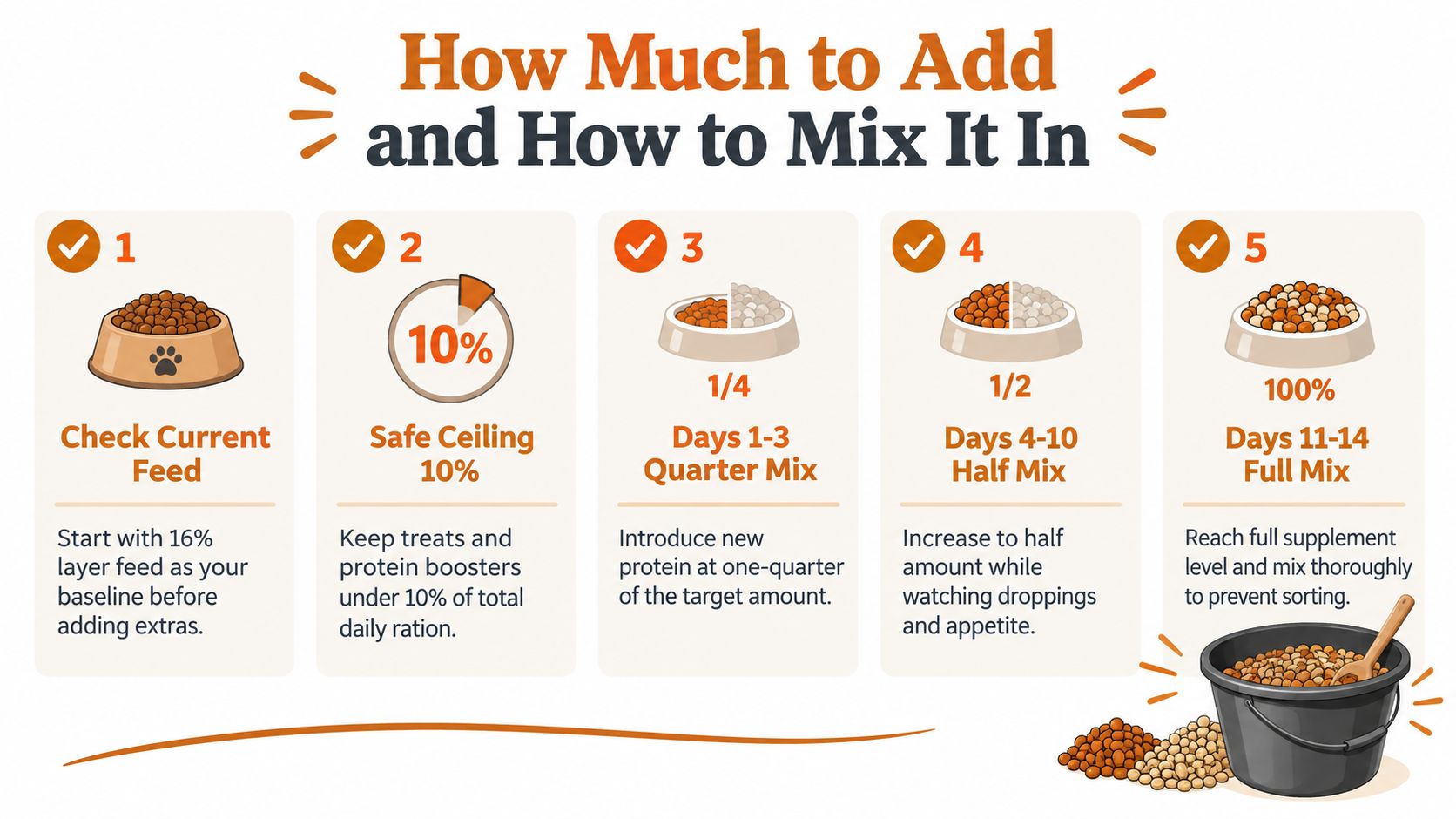
The safest method is to decide the target inclusion first, then introduce the ingredient gradually. Don't scatter a large handful over the top of the feeder and assume every hen receives the same dose. Dominant birds will pick out the most attractive pieces, and the flock may leave the balanced ration behind.
Use a two-week ramp:
- Days 1 to 3: Add one-quarter of the intended amount.
- Days 4 to 7: Increase to half the intended amount.
- Days 8 to 14: Move to the full amount only if appetite and droppings remain normal.
- After day 14: Review body condition, feather quality, egg output, and feed consumption before deciding whether to continue.
For a practical ceiling, keep BSFL and mealworms up to 10% of daily intake, roasted soy up to 15%, and fish meal capped at 5% because of egg-flavor risk. These are inclusion limits, not goals. Most backyard flocks don't need the maximum.
Mix for uniform intake
Dry larvae, meal, and powdered ingredients should be mixed directly into the base ration in a clean trough or bucket. Lightly moistened mash can help powders cling to the feed, but remove leftovers promptly so the mixture doesn't spoil. Whole treats can be offered separately in a controlled portion, but don't let them become the flock's main meal.
Keep a simple first-month record:
- Feather quality: Look for new growth, reduced breakage, and less picking.
- Droppings: Watch for persistent wetness, unusual odor, or a sudden change after each increase.
- Water intake: Any marked change deserves attention, especially alongside loose droppings.
- Laying pattern: Track production qualitatively and note thin shells, misshapen eggs, or an abrupt decline.
- Feed behavior: Make sure birds still consume the complete ration instead of sorting for supplements.
Mix the ration, not just the treat. Uniform distribution matters more than an impressive ingredient list.
If performance worsens after an increase, step back to the last tolerated level. A drop in appetite or egg production is a reason to reassess the whole formulation, including energy, calcium, phosphorus, and amino acids.
Amino Acids and Digestibility Matter More Than You Think
A bag showing a higher crude-protein number can still produce disappointing results if the amino acids are poorly balanced. Chickens need usable amino acids, especially lysine, methionine, and threonine, to build feathers, muscle, and eggs. Crude protein tells you how much nitrogen-containing material is present. It doesn't tell you whether the bird can use that protein efficiently.
A ration made largely from grain may display a respectable protein number while remaining short of a limiting amino acid. A lower-protein ration with properly balanced soybean meal, fish meal, or supplemental methionine can outperform a higher-protein ration that lacks the right amino-acid pattern. That's why adding ingredient after ingredient often fails. You may be increasing crude protein while leaving the actual bottleneck untouched.
The Cambridge analysis of whey protein in broiler diets illustrates the point: the modeled optimal whey inclusion changed sharply by growth phase, reaching about 11.1% in starter diets, 10.8% in grower diets, and 0.15% in finisher diets. Protein additions are therefore phase-specific, not automatically beneficial at every age.
| Source | Crude Protein % | Methionine | Lysine | Threonine |
|---|---|---|---|---|
| Black soldier fly larvae | 32% to 53% | Useful but variable | Useful but variable | Useful but variable |
| Soybean meal | High | Often limiting relative to lysine | Strong contribution | Contributes |
| Fish meal | High | Strong contribution | Strong contribution | Contributes |
| Whole grains | Lower than concentrated protein ingredients | Often limited | Often limited | Often limited |
These source descriptions should be treated as formulation guidance, not laboratory guarantees. The research comparing insect meal with soybean meal shows that insect meal can replace soybean meal only when the diet is carefully fortified. Without that correction, protein quality can fall even when the crude-protein label looks attractive.
The mistakes that waste good feed
Don't stack fish meal, soy, larvae, mealworms, and scraps without recalculating the ration. Don't assume a complete layer feed needs extra protein because egg production has slowed. First check whether the problem is daylight, illness, parasites, water access, heat or cold stress, or feed refusal.
Soy also requires care. Properly heat-treated soybean products are appropriate feed ingredients, while raw soy contains compounds that interfere with digestion. If you're not formulating with a verified product, use a complete commercial ration as the foundation instead of improvising with raw beans.
Timing Protein Boosts Around Molt, Winter, and Stress
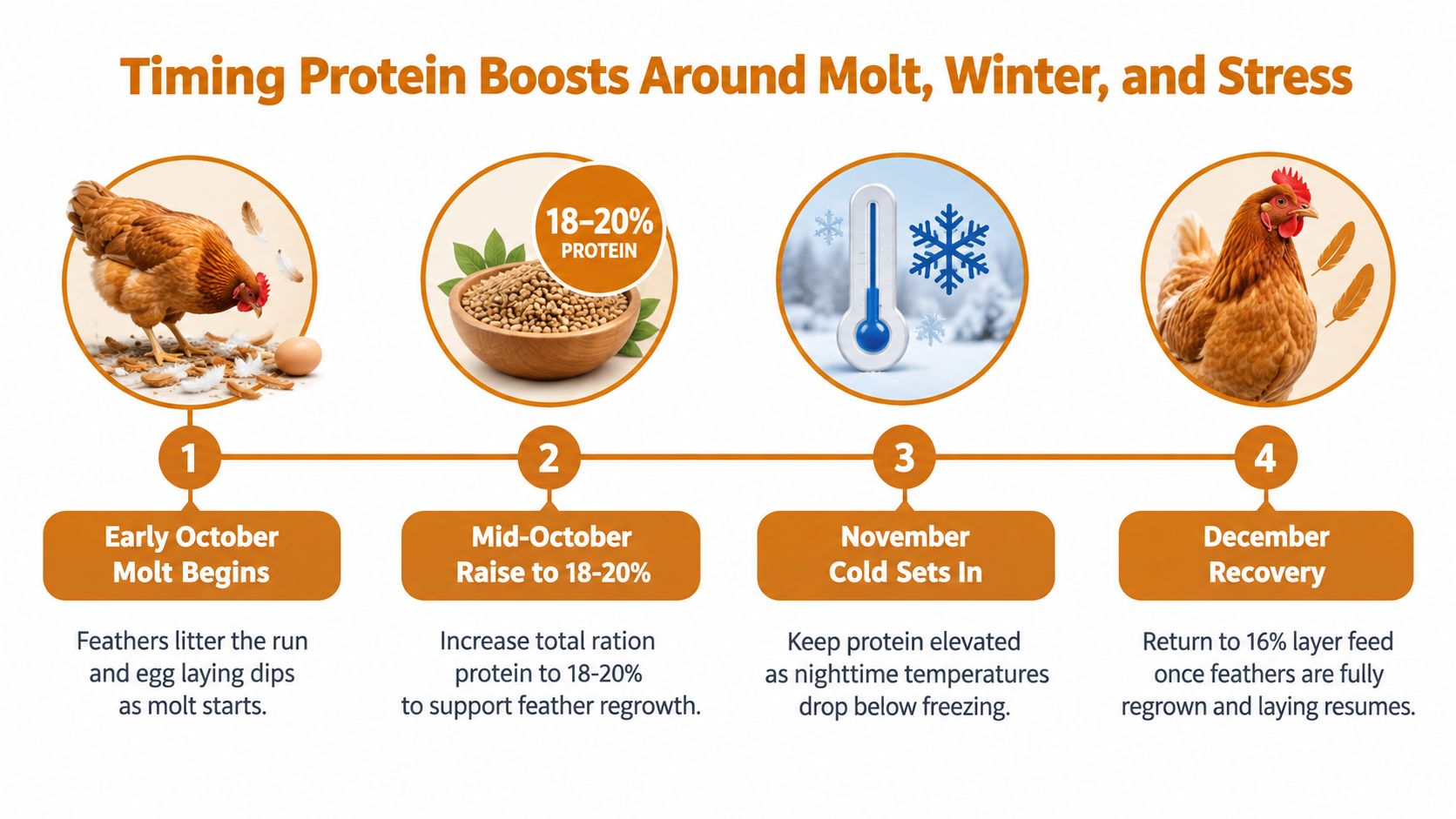
In early autumn, a flock may enter molt just as nights turn cold. Feathers collect in the run, egg production dips, and the hens look untidy. That is the moment to inspect the base ration, not throw treats into the bedding.
For a hard molt, temporarily moving from a layer ration toward a 20% to 22% protein feed can make sense when the product is formulated for the birds' needs. The Auburn poultry feeding reference describes starter diets that may reach 20% to 23% and broiler programs that decline as birds mature, reinforcing the principle that feed targets change with physiological demand.
Use the boost for a defined window
During peak feather regrowth, add a controlled portion of BSFL or mealworms rather than leaving them available all day. A 5% to 8% supplement portion can fit within a temporary program when the complete ration remains the main food, but monitor intake and droppings closely. The goal is to support feather production without encouraging selective feeding or displacing essential minerals.
Feather replacement is a protein-intensive job, but winter adds a second demand: maintaining body heat. In cold weather, keep the base feed available and make sure water stays clean and accessible. Extra protein won't compensate for inadequate calories, dehydration, poor shelter, or a feeder that empties before timid birds can eat.
Reasonable triggers for a temporary adjustment include:
- A hard molt: Pin feathers are emerging and the flock's body condition remains sound.
- Predator or handling stress: Birds need recovery after a disruptive event.
- Flock expansion: Growing birds require a ration matched to growth rather than adult layer feed.
- Broody recovery: A hen returning to normal feeding may need close observation and easy access to complete feed.
- Post-illness rebound: Restore intake gradually and address the underlying condition.
The off-ramp matters. Once feathers are fully regrown and the flock resumes its normal production pattern, taper the supplement and return to the appropriate complete ration rather than stopping every change abruptly. If the birds worsen during the transition, reassess the feed, body condition, and health rather than automatically increasing protein again.
For seasonal feeding ideas that keep the base ration in view, see what to feed molting hens.
Pure Grubs offers USA-grown, dried black soldier fly larvae listed at 36% to 42% crude protein, with 30% to 40% fat, and the catalog describes them as containing more calcium than mealworms. If you want a measured insect supplement for molt recovery or a controlled protein addition, visit Pure Grubs and choose a portion size that fits your flock's existing ration.