

How Many in a Flock: Ideal Size for Backyard Keepers
There's no single universal number, but a small backyard flock of 4–10 laying hens is common among hobby keepers, and the practical ceiling starts with usable floor space, about 3 square feet per hen indoors, rather than a fixed headcount.
If a coop has room for more hens, does that mean you should bring them home? Not necessarily. You also need to consider how the birds get along and where newcomers will stay before joining the resident flock.
Why There Is No Single Number for Flock Size
The idea that every backyard should have the same number of chickens sounds convenient. It leaves out nearly everything that makes your yard different from your neighbor's: housing, available time, existing birds, and room to handle trouble.
Small flocks are certainly familiar. A Texas A&M summary included in Purdue Extension's poultry learning material reports that 71% of keepers own fewer than 10 birds. That describes what people keep, not what every household should aim for.
A headcount isn't a management plan
A keeper with spare housing and a well-arranged enclosure may be better prepared for expansion than someone with fewer birds but nowhere to separate a newcomer. That's why I'd start with capacity rather than a shopping list.
Think of your flock size as a decision that must pass several checks:
The practical test: Your birds need a workable social group, enough usable living space, and a keeper who can isolate newcomers and monitor the flock.
These checks answer different questions. Social behavior concerns how birds interact. Floor space concerns whether they can move and reach resources. Biosecurity concerns whether you can manage arrivals and illness without putting every bird together.
- Start with your purpose. Decide whether you want household eggs, breeding birds, or a broader poultry project.
- Identify your tightest limit. A roomy run doesn't solve a cramped overnight shelter or a missing quarantine area.
- Leave yourself options. Don't fill every available corner before you know how you'll manage an injured or excluded bird.
My practical recommendation is to treat a capacity estimate as a ceiling, not a target. You don't need to occupy every possible place for your flock to be worthwhile.
What Counts as a Flock Across Species and Scale
If you keep several kinds of birds, count each species separately for planning, even if you call them one flock. That makes it easier to track who shares housing, equipment, and daily care. The USDA's backyard poultry biosecurity information includes chickens, turkeys, ducks, geese, and gamebirds such as pheasants, quail, and partridges as poultry. Its study also included birds kept at home, elsewhere on a property, or in a community coop.
In management terms, a flock is the group you feed, house, and check together. Birds that gather or roost near each other are not necessarily one flock for care and planning.
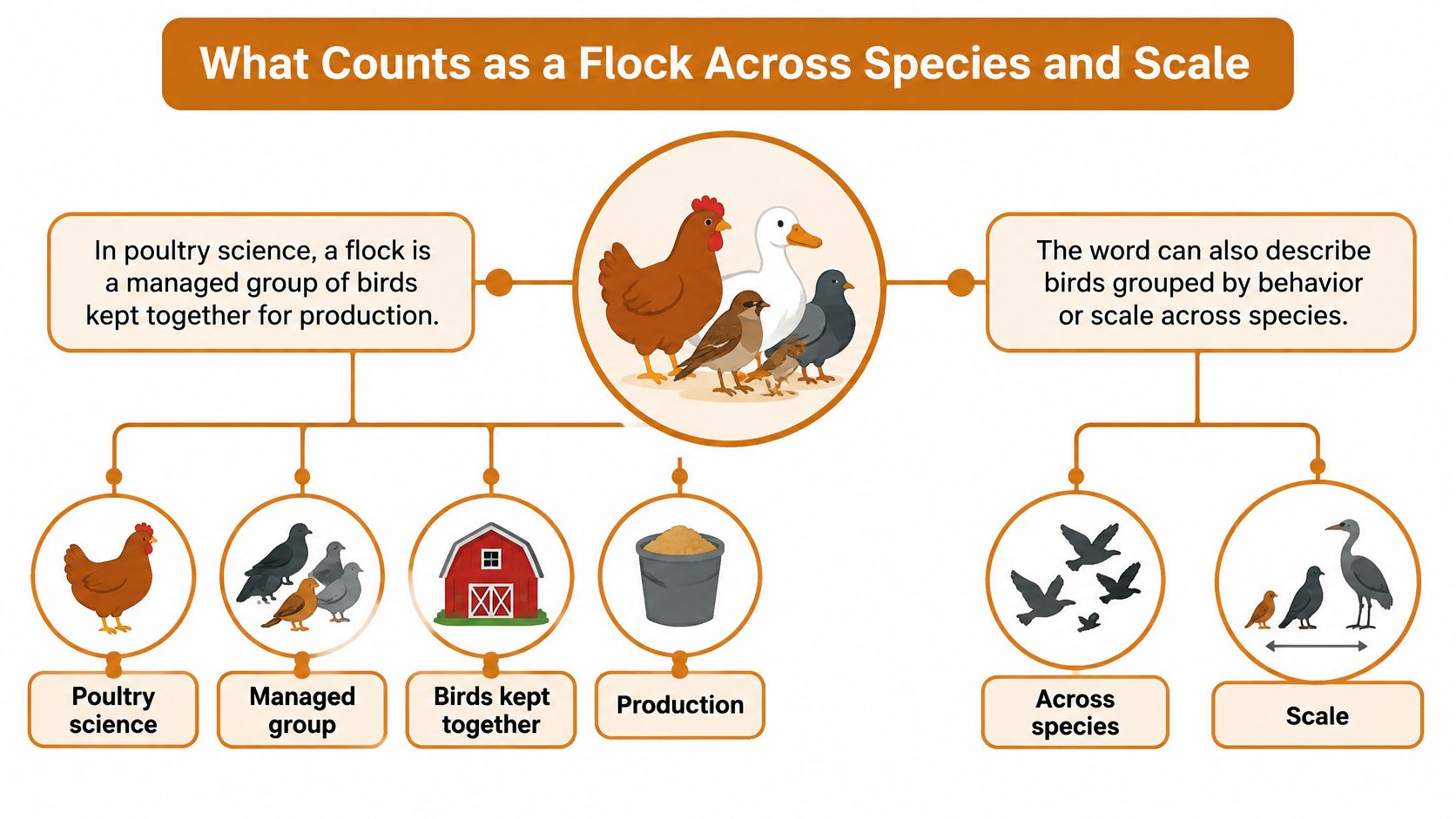
Your purpose decides which birds belong in your count. For household egg production, you may be planning around laying hens; a guide to poultry for eggs can help you consider that goal before settling on a number. For a breeding project, track breeding birds and their offspring separately so you can plan their care clearly.
A household coop and a commercial poultry house can both hold a flock, but they involve different workloads. For your own count, include the birds whose housing, feeding, and health you manage. Keep visiting wild birds out of your domestic flock total. They do not add usable capacity, and they may raise separate concerns if they enter the poultry area. If that happens, you can explore residential wildlife control options while assessing your enclosure.
The embedded video is available as another visual resource.
The Social Limit Around Thirty Birds
What changes when a flock grows beyond the size where hens can readily recognize one another? Social relationships can become less stable, so headcount is one of the thresholds to watch alongside usable floor space and your ability to separate birds when needed.
Extension guidance on feather pecking and cannibalism describes individual recognition beginning to break down around 30 birds, with a potentially unstable 30–60-bird intermediate range. It also reports a controlled study comparing groups of 15, 30, 60, and 120 birds at 5 birds/m². In that study, 30-bird groups had smaller eggs, and birds in the 30- and 120-bird groups were lighter than birds in the other groups. The study used defined groups under set conditions, so use these thresholds to decide what to watch, not as a prediction for your flock.
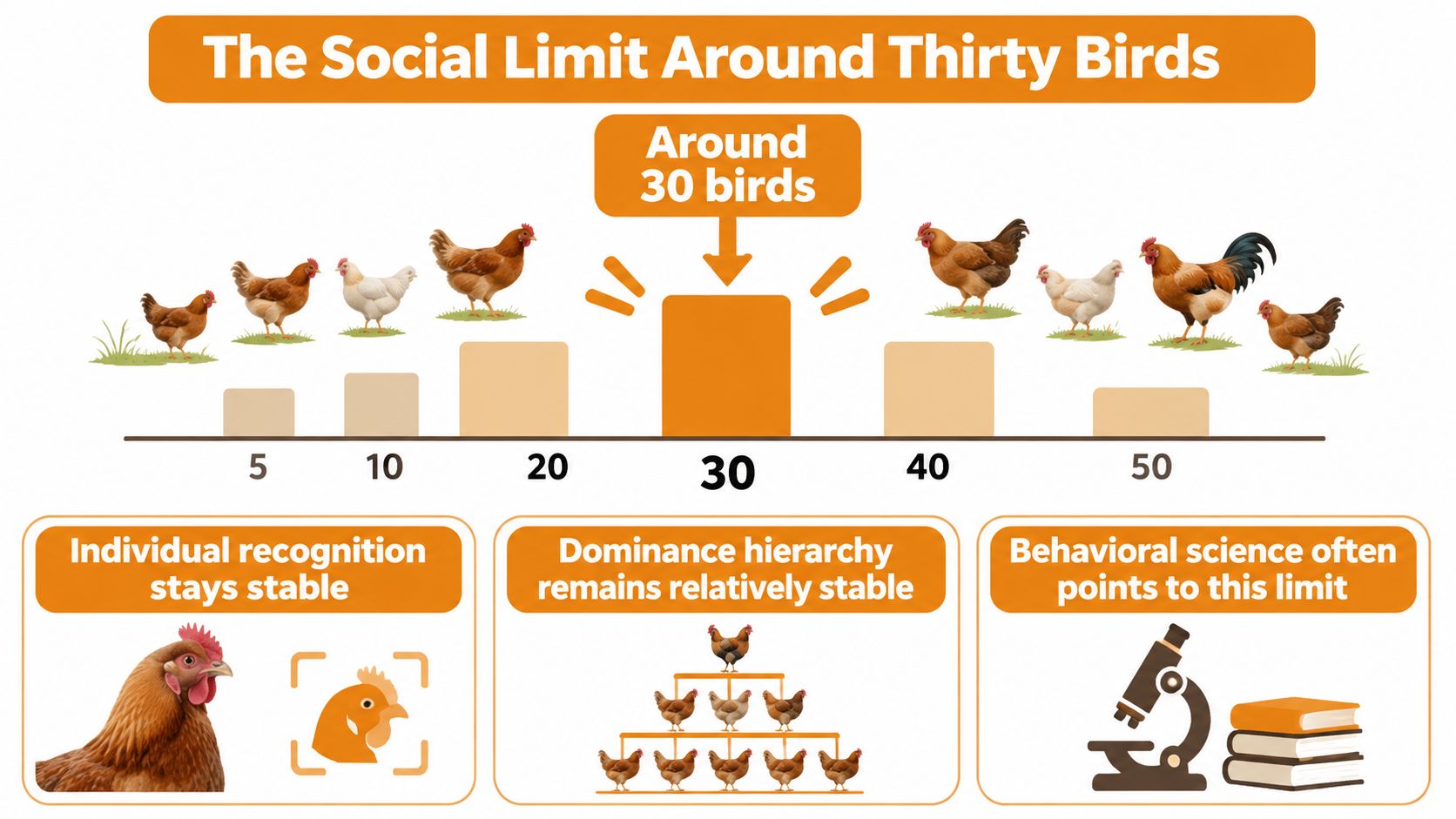
Social stress does not rise in a straight line with flock size. A group can run smoothly at 25 birds and become tense at 32 if the feeding layout stays the same.
More birds aren't a reliable treatment for an unsettled flock.
Before adding birds near this transition, give hens more than one way to reach food, water, and shelter. Separate feeding points so one dominant bird cannot guard every approach. Add alternative drinking locations, then watch whether quieter hens can drink without being displaced.
For visual breaks, place a solid barrier or a row of perches at least 3 feet from the feeder. That gives a subordinate hen room to leave another bird's line of sight. Walk the run and check that each corner has two exits, rather than a narrow pocket where a hen can be trapped.
Watch the quieter birds, too. A lack of fighting does not prove the setup works. If the same hens repeatedly wait at the edges while others eat, change the layout and observe again.
Calculating Capacity from Usable Floor Space
How much space can your birds use? A coop listing gives you a building size, not a stocking number. Measure accessible floor area, then divide it by an allowance suited to your birds and how they will be kept.
A review of poultry space and behavior reports a University of Maryland guideline of approximately 5 adult birds per square meter, equivalent to 0.20 m² or 2.15 ft² per bird. It also reports a proposed minimum of 600 cm² per bird for flocks of 100 or more. These are context-dependent minimum benchmarks, not interchangeable backyard targets. This article uses 2.15 square feet per bird as the indoor planning figure because it is the most specific guideline cited here. Larger birds or long periods indoors call for more room.
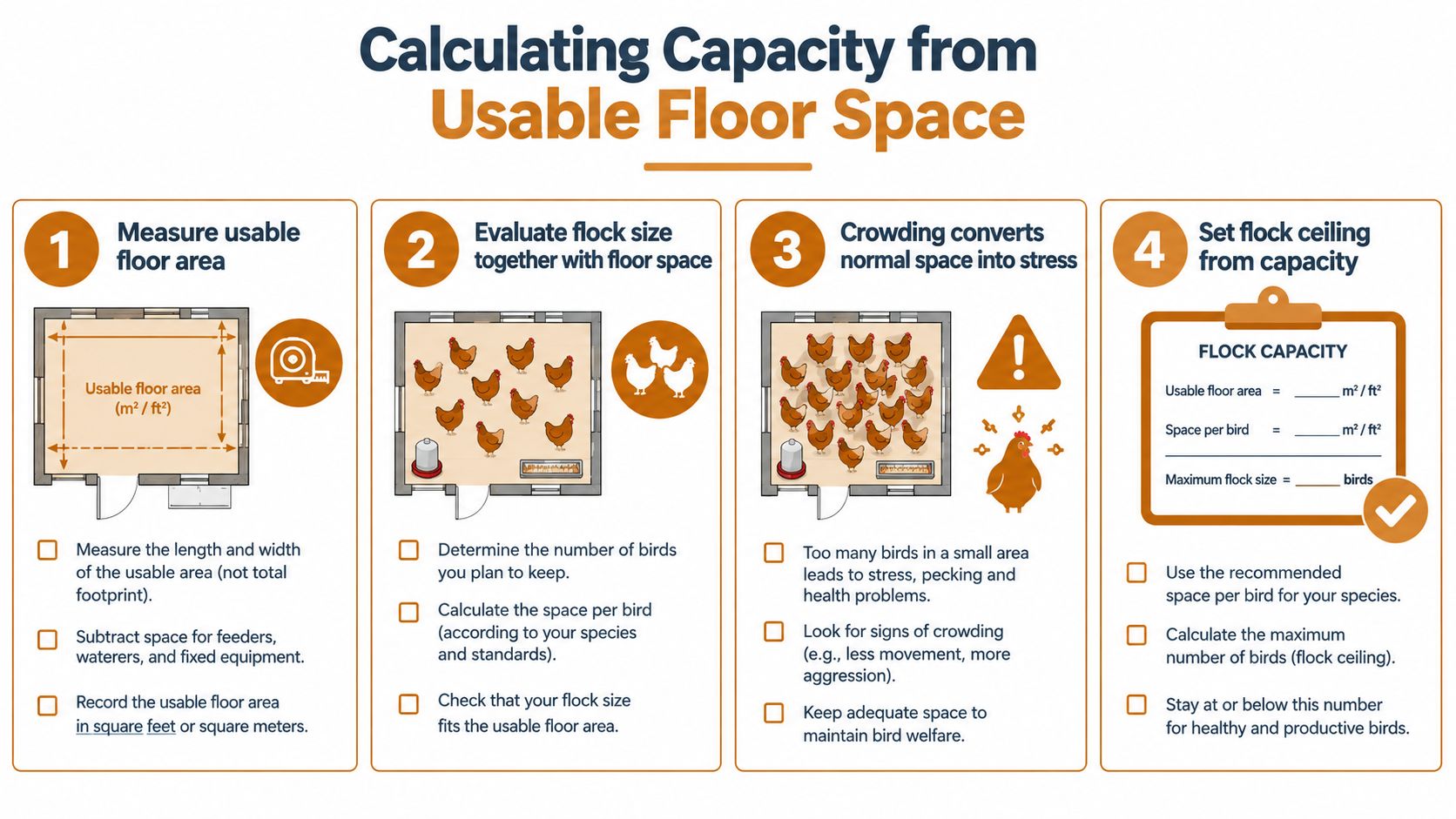
Planning capacity = usable indoor floor area ÷ appropriate indoor allowance per bird.
Round down. If your birds will be kept indoors for more than a day at a time, plan from a more generous allowance, even if that reduces your total count by a third. Larger-bodied birds, heat, limited enrichment, and awkward feeder placement are further reasons to allow extra space.
To run the calculation for your own coop, sketch the shelter on graph paper and shade every area birds cannot reach. Multiply the remaining square footage by the allowance you chose. Exclude storage and blocked-off areas, and check whether feeders or other equipment narrow the routes birds use to move around.
Before adding birds, work out where they will stay if they cannot use their usual outdoor area. A chicken coop and run planning guide can help you review the layout. Outdoor room and indoor room both belong in the plan, but one cannot replace the other.
Recommended Flock Sizes by Bird Type and Purpose
How many birds fit depends on more than the species. Social recognition, usable indoor space, and the room to keep newcomers separate all set limits. A group that suits a laying-hen setup may not suit meat birds, ducks, or turkeys.
The ranges available here apply to laying hens. For other birds, use a species-specific housing plan rather than borrowing the hen benchmark. Where no published backyard range is available, the table gives a practical starting rule.
Typical Flock Sizes and Space Needs by Bird Type
| Bird Type | Typical Backyard Flock Range | Indoor Space Benchmark | Notes |
|---|---|---|---|
| Laying hens | Start with 4 to 10 hens, then adjust for housing | Apply the laying-hen allowance already discussed | Match the group to household goals and housing |
| Meat chickens | No published range; start with your housing plan | Ask your state extension office for guidance for the birds and production system | Plan for the full growing period |
| Ducks | No published range; start with a duck-specific housing plan | Ask your state extension office for a duck housing guideline; allow room to stand, turn, and reach water | Assess their housing separately from hens |
| Turkeys | No published range; start with a turkey-specific housing plan | Use an allowance suited to the birds' size and housing | Don't treat turkeys as hen equivalents |
| Mixed poultry | Set numbers for each species and keep separate pens where needed | Evaluate each species' space needs separately | Plan separate housing and resources before combining groups |
The available sources cover laying hens, not backyard ranges for ducks, turkeys, or meat birds. For those species, a local poultry extension contact can help you adapt housing to the birds and your setup. A shared headcount can hide different space needs.
Keep nutrition separate from stocking capacity
Feed belongs in the feeding plan, not the space calculation. Treats won't solve overcrowding.
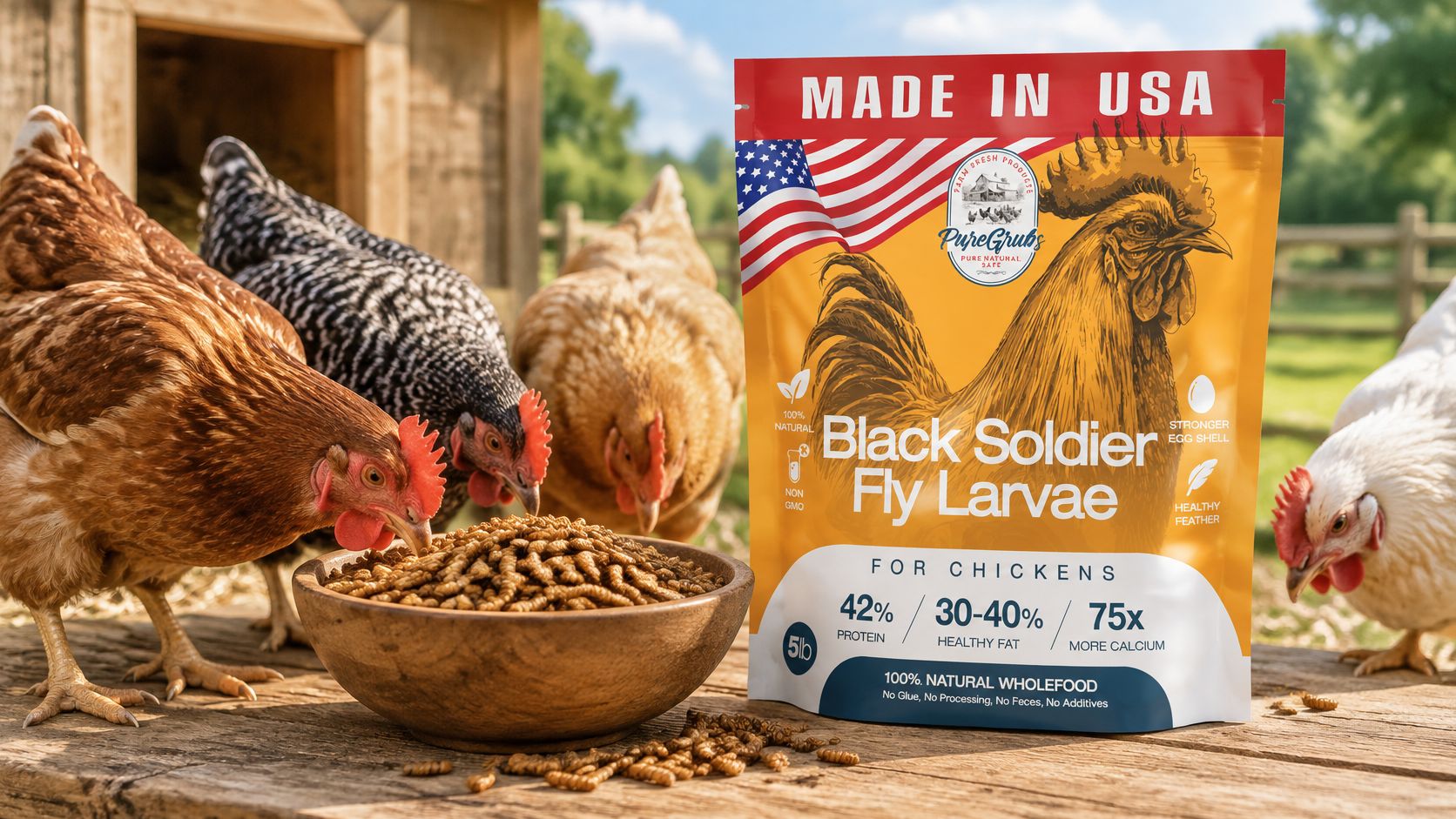
One option is USA GROWN BLACK SOLDIER FLY LARVAE FOR CHICKENS, a dried insect treat described in the catalog as grown and dried in the USA without additives or preservatives. Consider it alongside other supplemental feeding options, not as a reason to increase your flock.
The product image below identifies that option.
For laying, breeding, or growing birds, settle the main feeding program first. Then decide whether extras fit the routine you can maintain.
Scaling Up Without Breaking Biosecurity
The useful expansion question is how many can I safely add? An empty corner in the resident coop doesn't answer it.
Small-flock biosecurity guidance warns that newcomers can carry disease without visible signs and recommends quarantine for at least two weeks before introduction. That makes separate holding capacity part of your flock limit, not an optional accessory.
Make arrivals a separate project
Prepare before you collect birds. Don't bring them home and then improvise a pen beside the existing flock.
- Have spare housing ready. Decide where arrivals will stay and whether that arrangement allows separation.
- Plan equipment control. Work out how you'll manage feeders, drinkers, tools, and footwear between groups.
- Keep species separation available. Don't make successful cohabitation your only workable outcome.
- Control visits and borrowing. Decide how visitors and shared equipment will fit into your poultry-care routine.
- Allow time for observation. Add only as many birds as you can watch closely without neglecting the residents.
Ask a poultry veterinarian or local extension advisor whether your circumstances require a longer or more restrictive quarantine plan. A published minimum shouldn't replace advice about a known disease concern.
Before ordering: Name the place where newcomers will live. If you can't, postpone the purchase.
Set a stopping point
Expansion also needs a pause button. If you're dealing with unexplained illness, unresolved injuries, or persistent access problems, I'd address those before bringing in another group.
Use a chicken health maintenance guide to organize your routine, and keep notes on arrivals, observations, and any professional advice. Records give you something more dependable than memory when several things change at once.
The goal isn't merely to get newcomers through the gate. It's to retain enough capacity to manage the flock afterward, including the days when care takes longer than expected.
Putting the Thresholds Together
Answer the question by naming the limiting constraint first, then choosing the flock size that constraint allows. That gives you a practical ceiling, not a target you have to fill. A coop with room to spare can still be too large for the keeper's time or available separation space.
Let the tightest constraint decide
A simple comparison helps identify what is holding your plan back:
| If this is your limiting factor | Make this decision first |
|---|---|
| Birds can't reliably reach resources | Improve the arrangement before adding |
| Usable housing is already committed | Expand suitable housing or keep the current group |
| No workable arrival pen exists | Delay purchases until separation is possible |
| Daily observation is rushed | Choose a flock you can monitor consistently |
| Local rules restrict your plan | Resolve the legal limit before ordering |
This also separates physical capacity from operating capacity. Physical capacity is what your facilities can house. Operating capacity includes the time, backup care, equipment, and attention you can provide when something goes wrong. Like a bucket with several holes, the smallest capacity sets the amount you can safely hold.
Start with the tightest limit, then check local ordinances and confirm that your daily routine covers the number you chose. A flock is right-sized when you can care for its regular needs and respond when an unexpected problem comes up.
For example, a keeper hoping for more household eggs may be able to expand after improving the setup. Another may keep the current group because adding birds would use the only spare pen. A keeper who stays at 6 hens and one who grows to 12 can both make sound choices if each has checked the limits that apply to their yard and routine.
Use the result as a working ceiling, and revisit it if the flock changes, housing changes, or your capacity to provide care shifts.
Your Next Step for a Right-Sized Flock
What would need to change before your next chick order? Start with the birds you intend to keep and use the usable-area method from Section 4. Then check whether your plan fits the social limits, available floor space, and quarantine capacity discussed above. A flock can fit one threshold and still exceed another.
Make a short flock plan
- Write down the target group. Include each species and purpose, not just the total. A mixed flock may need different arrangements from a group of one kind of bird.
- Check the local rules. Confirm that your proposed flock and housing are permitted.
- Review feeding access. Mark where birds can eat and drink without relying on a single approach.
Use the calculation and arrival-space checks from the sections above. Then walk through an ordinary day as if the new birds were already there. Where will you carry water? Which pen will you check first? Who can care for the flock if you're away? These questions test whether the plan works in practice, not only on paper.
Choose what to improve before buying
Use your audit to choose the next step. If there is no suitable space for arriving birds, choose the smaller order until separation is possible. If the feeder is the bottleneck, improve access before adding birds. If usable housing is the limit, expand it only when you can still manage the larger flock day to day.
Pure Grubs offers USA-grown dried black soldier fly larvae as a supplemental treat for chickens and other birds. Once your housing and flock plan are settled, visit Pure Grubs to explore an option for your feeding routine.
Write your final target where you keep your poultry records.