

Feeding Laying Chickens for Peak Egg Production
You lift the nesting-box lid expecting the usual warm brown eggs, then spot a soft shell collapsed into the straw. Sometimes the yolk has leaked through a paper-thin membrane. Sometimes there's only a damp smear where an egg should be. It's frustrating, but it's also useful information: your hens are telling you that the feeding program needs attention.
Feeding laying chickens isn't just a matter of keeping the feeder full. Egg production draws heavily on calcium, protein, energy, vitamins, minerals, and water, and the balance changes as hens move from first lay through peak production and into late lay. A complete layer ration is the foundation, but the right mineral form, feeding routine, and carefully chosen supplements can determine whether older hens continue producing usable eggs or leave you cleaning broken shells from the coop.
The Morning Egg Check and Why Nutrition Matters
A soft shell in the morning nesting box is easy to dismiss as a one-off. If thin shells, cracks, or misshapen eggs keep appearing, inspect the flock before changing feed blindly. Look at the bedding, the hens' posture, the feeder, and whether quieter birds can reach it.
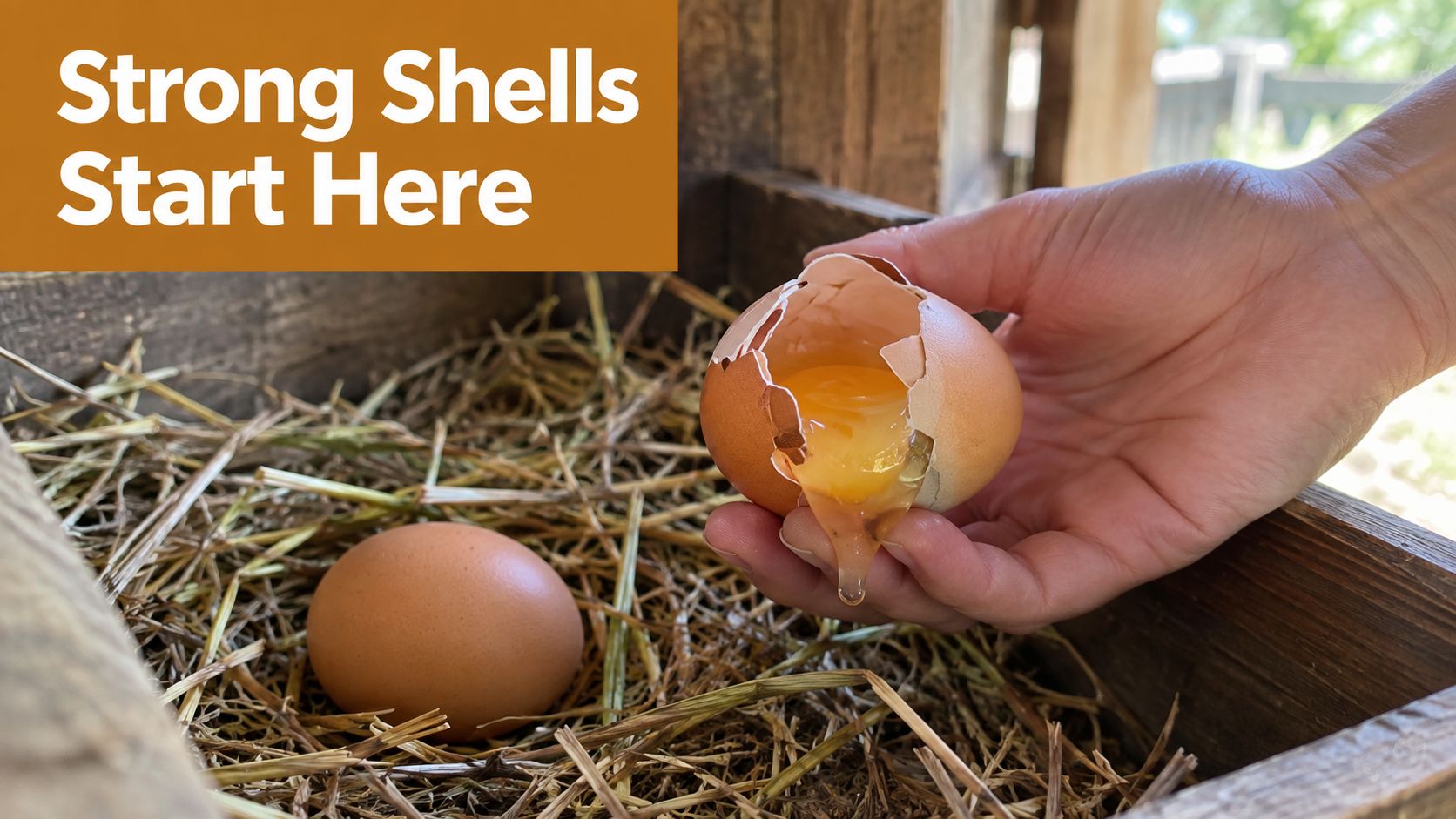
A laying hen is supporting her own body while producing an egg. That demand includes protein, energy, minerals, feathers, muscles, immunity, and daily activity. Shell formation draws on calcium carbonate, and an inadequate or poorly timed supply can make her draw calcium from medullary bone, the reserve held in specialized bone tissue. That may cover a shortfall, but repeated withdrawal can weaken her structural support.
Practical rule: Recurring shell defects are a ration or flock-management signal, not a cosmetic nuisance.
The same feed does not suit every bird. Chicks, growing pullets, active layers, molting hens, and older birds have different demands. A grower ration can support muscle and feather development without providing the calcium density needed for shell production. A high-calcium layer ration given to birds that are not laying can also create health concerns.
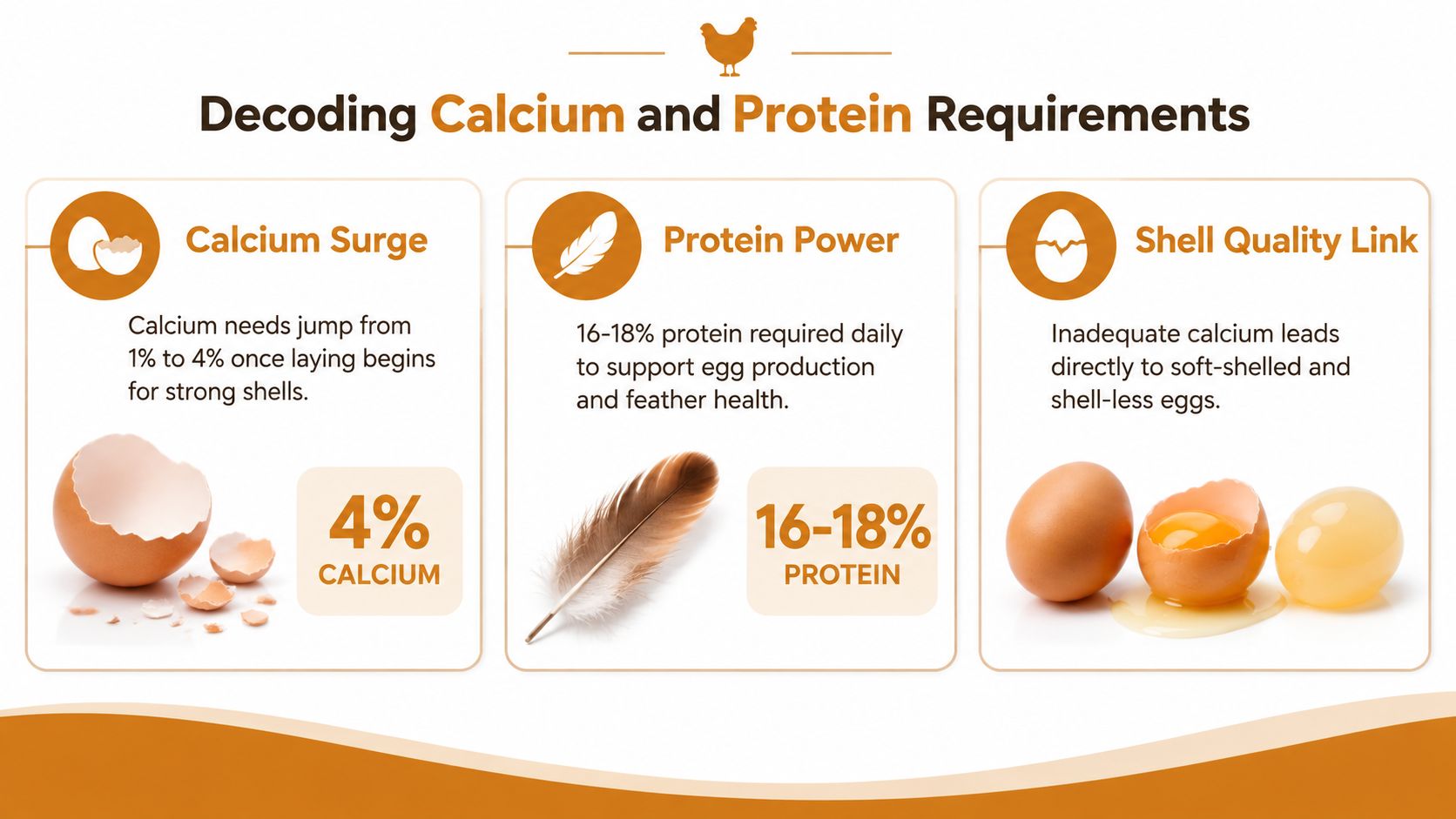
The first egg marks a major feeding change. NRC-based guidance in the review of calcium nutrition in laying hens describes about 2% dietary calcium from 18 weeks until laying begins, then about 3.5% once production exceeds 5%, assuming daily feed intake of 100 to 120 g per hen. The review also notes that non-laying hens eat far less feed, so a layer ration must be much more calcium-dense than a grower ration.
Keep the morning check tied to the feed label and the flock's production stage. Peak lay can hide a marginal mineral program because hens are still producing heavily. As they move into late lay, eggshell quality often exposes that weakness first. Check the calcium source, particle size, water access, and actual feed intake before adding random supplements. Targeted insect-protein treats can support condition when used sparingly, but they do not replace a complete layer ration. Dominant hens may also eat more than timid birds, leaving the quieter birds short despite a full feeder.
Decoding Calcium and Protein Requirements
A pullet's ration should change as soon as she becomes an active layer. Before laying, she is building bone, muscle, and body reserves. Afterward, she must supply protein for the egg and send calcium toward a new shell repeatedly. The shift from peak lay to late lay deserves particular attention, because hens can keep producing while their mineral reserves and shell quality gradually weaken.
The calcium increase is substantial. NRC-based guidance places dietary calcium at about 2% before laying begins and about 3.5% after egg production exceeds 5%, assuming feed intake of 100 to 120 g per hen daily. Other guidance gives approximately 3.25% calcium for Single-Comb White Leghorns and roughly 3.4% to 3.6% for brown-egg layers, or about 3.25 g per day for white layers and 3.6 g per day for brown layers under those intake assumptions. These figures are summarized in the peer-reviewed calcium nutrition review.
Calcium has to arrive in a usable form
A shell places a steady demand on the hen. Layer-feeding guidance reports a typical need for about 4 to 4.5 g of calcium supplementation per day. Eggshell calcium contains about 385 to 401 mg per gram, and the shell is roughly 40% elemental calcium. The exact requirement changes with the hen, egg size, diet, and production conditions, but calcium cannot be treated as a minor ingredient. The production and shell benchmarks appear in the commercial layer feeding guidance.
Particle size also affects availability. Hens need about 2 to 2.5 g of calcium for each eggshell, with roughly 60% to 75% of shell calcium coming directly from the diet and the remainder mobilized from medullary bone. Research supports offering a coarse calcium source, such as large-particle limestone or oyster shell, with about two-thirds of the calcium in coarse form during late lay. The University of Alberta thesis on calcium management explains these mineral-management findings.
Fine particles move through the digestive tract faster. Coarse particles remain available longer, including overnight while shell calcification continues and the hen is not eating continuously. A separate dish of oyster shell therefore has a practical role, even when the complete layer ration already contains calcium. It lets individual hens take extra calcium when needed instead of making every bird consume the same amount.
For a practical comparison of calcium options, see this guide to calcium sources for chickens.
Protein supports the whole laying system
Shell defects attract attention, but protein supports albumen, yolk-related tissues, muscle maintenance, and feather growth. A ration can contain sufficient calcium and still produce disappointing egg mass, worn feathers, or declining body condition if its protein balance is poor.
Start with a complete layer feed formulated for laying birds. Random high-protein scraps cannot correct a weak base ration, and too many treats dilute the nutrients hens need every day. Insect ingredients can provide protein and minerals, but they remain supplements. The catalog for USA GROWN BLACK SOLDIER FLY LARVAE FOR CHICKENS lists 36% to 42% crude protein and describes dried, USA-grown larvae with no additives or preservatives. That makes them a concentrated treat option, not a replacement for complete layer feed.
Read the label for calcium, protein, and the intended life stage. If shells become thin or rough, check water access, illness, heat, feed freshness, and flock competition alongside the ration. During late lay, stage-specific calcium management and restrained insect-protein treats can help preserve condition, but neither can repair a broader management problem alone.
Structuring a Daily Feeding Schedule
A good feeding schedule should be boring. Hens do best when the same dependable food and water are available through changing weather, free-ranging habits, flock politics, and seasonal production shifts.
Morning starts with the complete ration
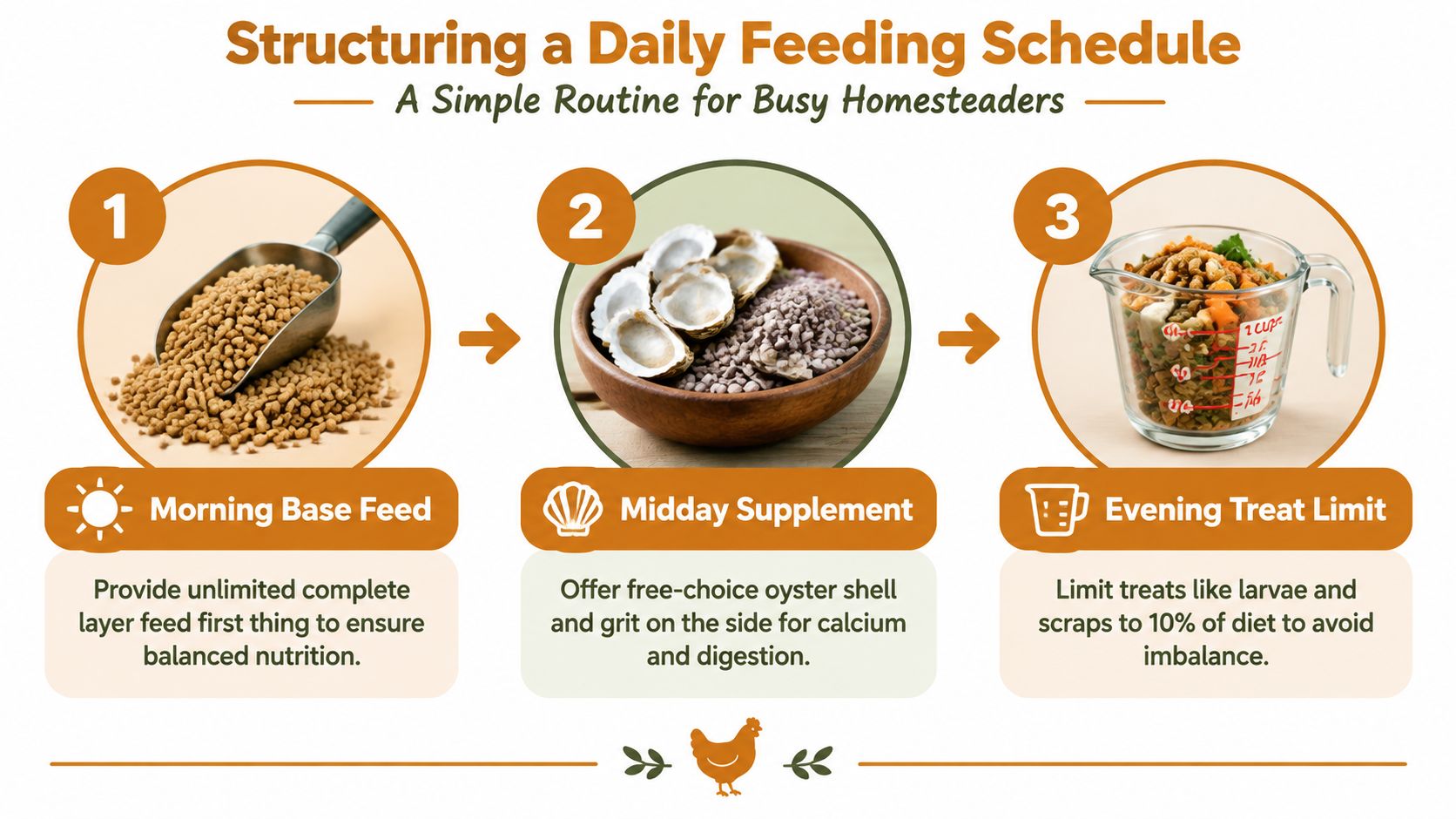
Fill or check the layer feeder early, before scattering treats or opening the run. The complete layer feed should be the first substantial food available, because it provides the planned combination of energy, amino acids, minerals, and vitamins. Pellets usually reduce sorting, while crumbles can work well for smaller birds or flocks that reject large pieces. Whichever form you use, keep it fresh and dry.
Check that timid hens can reach the feeder. A dominant bird guarding one access point can create uneven intake even when the flock appears to have plenty of food. Multiple feeding locations may help in a crowded or hierarchical flock, but don't use extra feeders to justify excessive total feed or let damp feed sit long enough to spoil.
Fresh water belongs beside the morning check. A hen can't maintain steady production if water is dirty, frozen, or unavailable, and water problems often look like feed problems from a distance. Clean the drinker routinely and inspect it whenever egg numbers or shell quality change.
Midday supplements stay separate
Offer oyster shell in its own container rather than mixing it through the complete feed. This gives each hen an opportunity to regulate supplemental calcium intake. Keep poultry grit available when hens eat scratch, forage, or other food that needs mechanical grinding. Oyster shell supplies calcium, while grit supports gizzard function. They aren't interchangeable.
Free-ranging adds useful behavior and variety, but it doesn't guarantee a consistent nutrient profile. Pasture, insects, and vegetation change with weather and location, so ranging should complement the complete ration rather than replace it. The practical principles are also laid out in these chicken feeding guidelines.
Evening treats should be measured
Treats are easiest to control after hens have had access to their balanced feed. Scatter a small amount so birds forage naturally, but avoid filling crops with scratch grain, bread, or kitchen leftovers before they've eaten the ration.
The infographic's routine uses a 10% treat limit, which is a practical ceiling for keeping extras from displacing the complete diet. That figure comes from the supplied visualization brief, not from a new calculation here. Treats should remain a minor part of feeding laying chickens, especially when shell quality or body condition is already slipping.
A workable routine looks like this:
- Morning: Check water, offer complete layer feed, and inspect access for every hen.
- Midday: Refresh oyster shell and grit, then allow normal forage or run time.
- Evening: Offer a modest measured treat only after the base ration has been available.
- Weekly: Examine feed storage, remove stale or damp material, and compare shell quality with the flock's recent pattern.
If hens are eating large amounts of scratch and ignoring pellets, the program is out of balance. Cut back the extras first rather than immediately adding more supplements.
Strategic Treats and the Power of Black Soldier Fly Larvae
Most backyard feeding mistakes happen in the treat bucket. Kitchen scraps are convenient, but they're inconsistent. Lettuce, garden trimmings, and small amounts of suitable produce can provide enrichment, yet they don't reliably deliver the calcium and amino-acid balance required for sustained laying. Scratch grain is enjoyable and useful for scattering, but too much of it dilutes the nutrient density of the complete ration.
Mealworms are a familiar protein treat, but they aren't the only insect option. Product information for Pure Grubs describes its dried black soldier fly larvae as providing 75 times more calcium than mealworms and 36% to 42% crude protein. Those are catalog claims, so I'd treat them as product-specific figures rather than general properties of every black soldier fly product. The useful comparison is that an insect treat can be selected for a particular purpose, rather than chosen only because chickens enjoy it.

Match the supplement to the problem
Use treats to support behavior and targeted nutrition, not to repair a poor base ration. A flock in good body condition can receive a small insect treat during training, flock relocation, or a routine health check. Molting hens may also benefit from a carefully controlled protein supplement, but the complete feed remains the nutritional anchor.
The product snapshot identifies the larvae as 100% USA-grown and dried, raised on a plant-based diet, with no additives, preservatives, or fillers. It also lists 30% to 40% healthy fats. Those details may matter to keepers who want traceable sourcing and a concentrated treat, but they don't remove the need to control portions.
Scatter larvae after the hens have eaten their regular feed. This encourages pecking and searching without teaching the flock to wait for treats instead of using the feeder. If you use treats for training, call the birds with the same sound or container, scatter the larvae in a clean area, and stop once the exercise is complete.
The research direction is broader than one product. A 2025 study reported that low inclusions of black soldier fly larvae or prepupae in aged hens didn't harm productivity and could improve feed conversion and economic efficiency, while another 2025 paper reported that flax seed increased egg production and egg mass and that combinations involving hemp, black pepper, and turmeric altered yolk fatty acids and cholesterol. Those findings appear in this 2025 research on alternative proteins and functional feed ingredients. They support a cautious approach: alternative ingredients may have a role, but their use should be purposeful and measured.
A good treat makes the flock easier to manage without making the main ration harder to balance.
For practical handling ideas, see this guide to dried black soldier fly larvae.
Watch how the flock responds before changing the feeding plan. Eager birds, clean feeding behavior, and stable body condition are more useful observations than excitement alone. Chickens will rush toward almost any novel food, including foods that shouldn't become a daily staple.
Adjusting Rations for Older Hens and Molting Flocks
A hen can look healthy while her shells gradually become thinner, rougher, or easier to crack. The ration that supported her through peak lay may no longer cover the demands of late lay. Egg numbers often fall with age, yet every remaining egg still requires calcium, phosphorus, vitamin D3, and adequate feed intake.
For older hens, increase attention to mineral delivery rather than just adding more calcium. Coarse oyster shell or limestone gives calcium time to remain available while a hen forms the shell, and a separate dish lets birds adjust intake. Keep the complete layer ration as the foundation. Overfeeding fine calcium cannot correct poor particle size, inadequate vitamin D3, dirty water, or a hen that is eating too little.
Late lay needs a different mineral strategy
Once a flock moves beyond peak production, inspect eggs during collection. Track thin shells, cracks, rough patches, and shell-less eggs. A single abnormal egg may mean little, but a repeated pattern calls for a closer look at feed freshness, water access, calcium particle size, and flock health.
Reviews of nutrition for persistent laying describe the period beyond about 60 to 70 weeks as a stage requiring more precise management. They report that calcium should rise and phosphorus should decline as hens age, while higher vitamin D3 or 25-OH-D3 can support shell strength, thickness, and performance. The discussion appears in this research on nutrition for persistent laying.
Late-lay management is a balancing exercise. Offer coarse calcium separately, confirm that hens use it, and choose feed suited to their production stage. If shell quality keeps worsening, investigate vitamin D3, phosphorus balance, feed intake, parasites, and reproductive health before raising calcium again.
Molting changes the priority
During molt, feather regrowth draws on nutrients that might otherwise support egg production. Some hens stop laying, while others produce occasional eggs. Keep complete feed and clean water available, remove low-value scraps from the routine, and use protein-rich treats only in controlled portions when body condition or feather recovery needs support.
Targeted insect protein can help without displacing the ration. A small serving of larvae may suit a bird that needs extra interest in feed, but large handfuls in the run can leave hens full before they consume the balanced feed. Watch body condition, feather growth, and appetite rather than treating every molt the same way.
Older hens also need practical access to the feeder. Arthritis, poor eyesight, bullying, and cold weather can stop a bird from eating even when feed remains in the hopper. Add another feeding point if dominant hens guard one location, and observe quieter birds separately from the flock average. Weight loss, isolation, or repeated abnormal eggs warrants investigation of health and reproductive causes, not an automatic increase in calcium.
Your Flock Feeding Checklist and Final Takeaways
A reliable feeding plan gives you something concrete to inspect every day. Pin this checklist near the feed storage area and use it during the morning egg collection.
Daily checks
- Complete layer feed: Make the balanced layer ration the flock's main food, and keep it clean, dry, and accessible.
- Fresh water: Check the drinker for cleanliness, flow, freezing, and contamination.
- Shell quality: Look for thin, cracked, rough, or shell-less eggs, then note whether the problem is isolated or recurring.
- Separate oyster shell: Offer a coarse calcium source where hens can choose it without forcing it into every bird's ration.
- Grit access: Provide grit when hens eat forage, scratch, or other foods that require gizzard grinding.
- Treat control: Keep larvae, scraps, grain, and produce subordinate to the complete feed. The supplied feeding guide uses a 10% treat limit, so treat portions should stay modest.
- Flock access: Watch timid birds at the feeder and check that dominant hens aren't controlling the only feeding point.
Stage checks
A pullet approaching lay needs a careful transition away from grower nutrition. An actively laying hen needs dependable calcium delivery. A late-lay hen deserves closer attention to coarse calcium, phosphorus balance, and vitamin D3 support, while a molting bird needs protection from nutritional dilution as feathers regrow.
Morning warning signs: Repeated shell defects, poor feather condition, weight loss, reduced activity, feed sorting, or a noticeable change in water use all justify a closer review of the ration and the flock's health.
Seasonal management matters too. Heat can reduce feed interest while increasing water needs, and cold weather can reduce forage opportunities. Keep the base ration consistent, make water your first weather-related check, and adjust supplements only after observing body condition, shell quality, and actual eating behavior.
The most useful habit in feeding laying chickens is not chasing a perfect recipe. It's building a stable system, then responding to what the birds and eggs show you. A complete layer feed, separate calcium, controlled treats, and stage-specific attention can keep a flock productive without asking older hens to perform on a ration designed for a different season of life.
Pure Grubs offers USA-grown dried black soldier fly larvae with 36% to 42% crude protein, product-listed calcium advantages over mealworms, and no additives or preservatives. Use them as a measured supplemental treat for foraging, training, or carefully supporting protein intake during molt, then visit Pure Grubs to review the available option for your flock.