

Behaviour of Chickens Explained Simply
You're probably seeing it right now. One hen steps out of the coop first, pauses, and scans. Another makes a straight line for the feeder. Two start scratching in the same patch of dirt as if they've got an appointment there. One lowers herself into dry soil and tosses dust through her feathers like she's taking a spa bath in the garden.
None of that is random.
The behaviour of chickens follows patterns. Once you learn to read those patterns, your flock starts making a lot more sense. The hen that keeps hanging back at feed time may not be “shy.” She may be getting pushed off resources. The bird that suddenly stops dust-bathing may not be “moody.” She may be uncomfortable, stressed, or unwell. The rooster calling sharply from one side of the yard may be telling everybody there's something worth noticing.
Backyard keepers often get told simple things like “chickens have a pecking order” or “they just do chicken stuff.” That's true, but it doesn't help much when you're trying to work out why feathers are looking rough, why squabbles are increasing, or why the whole flock seems restless by mid-morning.
Good chicken-keeping isn't guesswork. It's observation plus small, practical changes.
Why Understanding Chicken Behaviour Matters
You open the coop at first light and the flock gives you a quick status report, whether you mean to read it or not. A comfortable group spreads out, gets busy, and settles into familiar jobs. One bird heads for the scratch area, another checks the feeder, another preens in a sunny patch, and a lower-ranking hen chooses a route that avoids trouble without much fuss.
That ordinary morning is useful information.
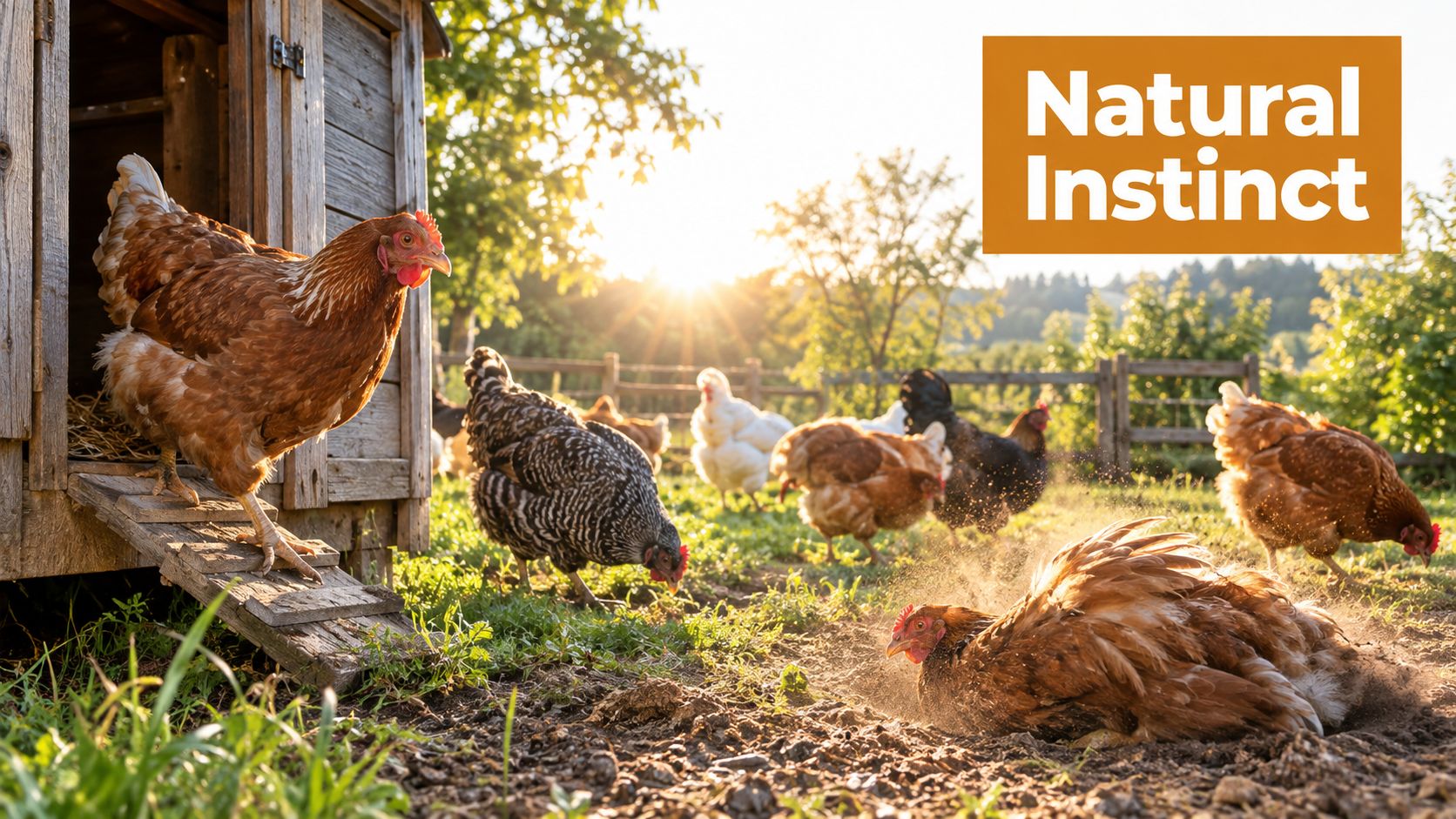
Behaviour is the flock's early warning system
Chickens often change their behaviour before they show clear signs of illness or stress in their body condition. A hen may hang back from the group, skip a perch she usually likes, stop joining a shared dust bath, or go quiet at times when she is usually active. If you only look for limping, weight loss, or obvious feather damage, you miss the earlier clues.
Welfare research and day-to-day keeping point in the same direction. Careful observation of laying hens has linked standing time, social displacement, and nest-related movements with normal biological events and social pressure, which helps explain why small shifts in routine can mean something real, not just a bird having an off day. For a backyard keeper, that turns behaviour from background noise into a practical health check.
Small observations can prevent bigger problems
A flock works a bit like a shared kitchen. If one doorway is crowded, one bowl is hard to reach, or one corner feels unsafe, tension shows up in movement first. You see waiting, circling, sidestepping, and short little confrontations before you see injuries.
That matters because many behaviour problems respond well to simple changes in setup or feed routine.
- At the feeder: If one hen keeps getting edged out, add space or a second feeding spot so lower-ranking birds can eat without a contest.
- In the run: If birds drift around but do not settle to scratch, check the ground. Dry litter, loose soil, leaves, or a foraging patch often gives them something useful to do.
- At roost time: If a few hens hesitate, bunch up, or sleep in odd places, look at perch height, grip, and crowding.
- Around nest boxes: If traffic builds and birds seem tense, you may need more privacy, better placement, or less competition.
Food choices fit into this picture too. Chickens are built to investigate, peck, and work for part of what interests them. Offering part of the diet or treats in ways that support foraging, such as scattering them through litter or using nutrient-dense options like BSFL, can make feeding time more natural and reduce boredom-driven squabbling. The point is not to keep birds busy for the sake of it. It is to match the setup to the behaviour their bodies and brains are already asking for.
A good rule is simple. Do not ask whether a chicken is acting weird. Ask what changed from her usual pattern, who else is affected, and what in the environment might be pushing that change.
When you understand the behaviour of chickens, you catch stress sooner, make better welfare decisions, and solve more problems while they are still small. That saves pecked feathers, missed meals, and a lot of avoidable flock drama.
How Chicken Behaviour Actually Works
You open the coop at first light and one hen heads straight for the litter, another pauses tall and alert, and a third hangs back near the pop door. None of that is random. Chickens behave the way they do because three forces are working at the same time: built-in drives, social pressure, and physical state.
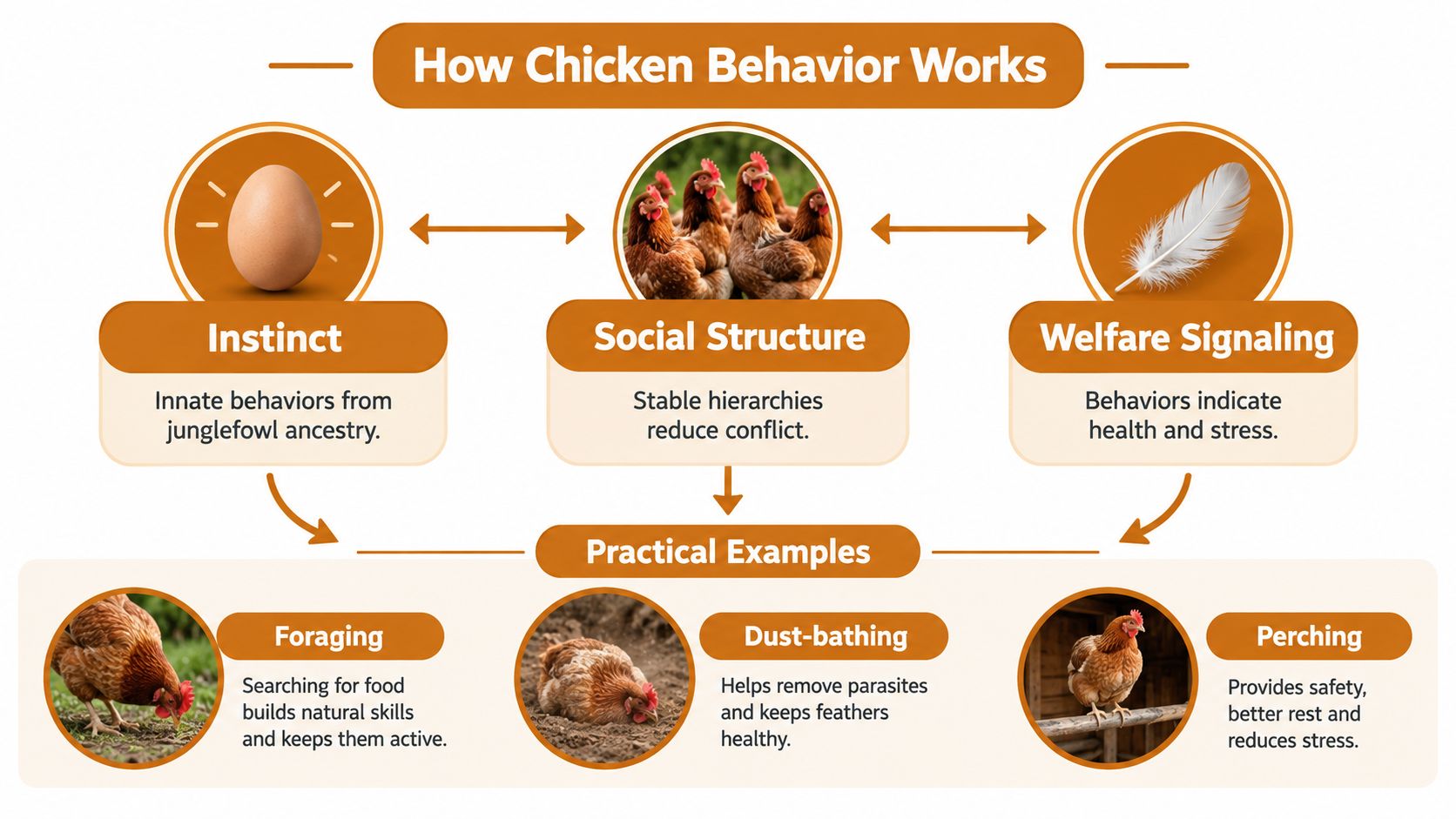
Built-in drives come first
A chicken's brain is set up to notice food, company, height, shelter, and sudden change fast. That wiring is old. Domestic hens still carry many of the same behavioural priorities as their wild ancestors, so they do not experience the coop as a keeper does. You see a feeder full of pellets. The hen also sees litter to scratch, a patch to inspect, shadows to check, and flockmates to follow.
That helps explain a common backyard puzzle. A hen may show more interest in feed scattered through leaves than the same feed served neatly in a dish. She is not being fussy. She is carrying out a search pattern her body expects to perform.
This matters for welfare. Birds usually cope better when the setup lets them express those normal actions instead of blocking them.
Social pressure shapes the moment-to-moment choices
Even calm hens are reading each other all day. Who steps aside. Who keeps the sunny patch. Who approaches the feeder with confidence. Who waits until the crowd thins out.
A flock works a bit like a shared kitchen at a busy family gathering. The food may be enough for everyone, but timing, space, and confidence still decide who gets in easily and who hesitates. In practical terms, behaviour changes with the conditions around the bird. Tight spacing, awkward layouts, poorly placed feeders, or repeated interruption can make normal social friction feel much sharper.
That is why two coops with the same birds and the same feed can produce different behaviour. The environment changes the pressure level.
The body tells you how the bird is coping
This is the part a keeper can read without any special equipment. Behaviour is not just personality. It is feedback.
Watch for patterns like these:
- Feathers: Sleek and settled, ragged from wear, or damaged in one target area
- Posture: Relaxed, balanced, and busy, or hunched, stiff, and guarded
- Movement: Steady exploring, repeated pacing, reluctance to join the group, or sudden darting
- Use of space: Comfortable spreading out, repeated crowding in one spot, or avoiding a certain area
- Vocalising: Soft clucks and routine chatter, or frequent alarm, protest, or distress calls
A single moment can mislead you. A pattern is more useful. If the same hen withdraws every afternoon, or several birds grow restless at the feeder, the behaviour is pointing to a cause you can investigate.
Food choices can play a role here too. Some keepers use USA GROWN BLACK SOLDIER FLY LARVAE FOR CHICKENS as part of a balanced ration, especially when they want to encourage active foraging by scattering a small amount through litter. The value is not only what the birds eat. It is also how the feeding method gives them a natural job to do.
A useful rule is simple. When a hen acts differently, ask three questions. Does she feel safe, where does she fit in the group, and is the setup allowing normal chicken behaviour or getting in its way?
The Pecking Order and Flock Hierarchy
You open the coop in the morning and two hens head for the same feeder. One steps in first. The other pauses, sidesteps, and tries again a moment later at a different angle. That tiny exchange is the pecking order in real life. It is less like constant fighting and more like traffic rules the flock has learned over time.
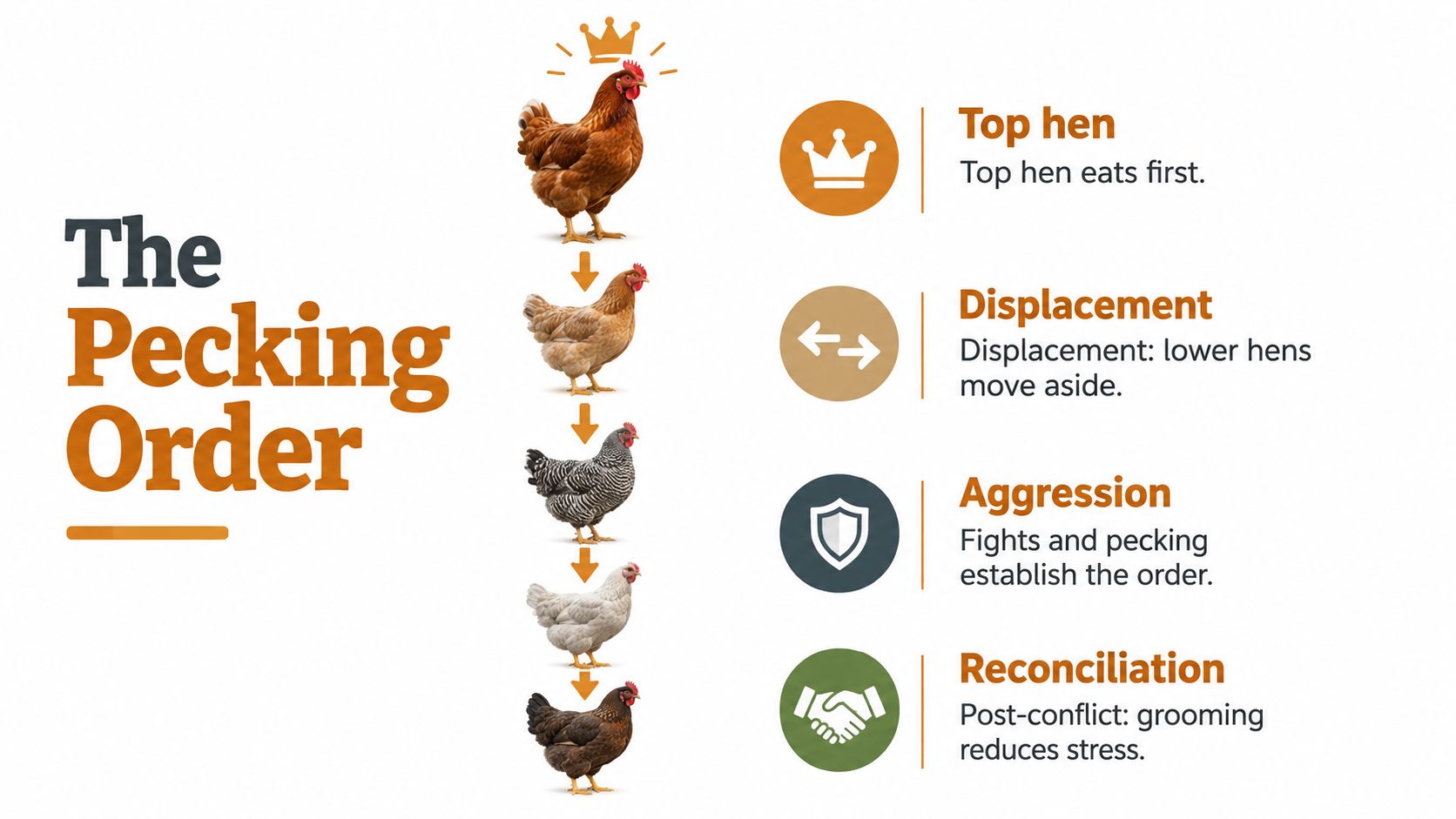
A flock hierarchy helps chickens settle who gets first access to valued spots and who usually gives way. From a welfare point of view, that matters because stable social rules can reduce repeated conflict. From a keeper point of view, it explains why one hen always seems to claim the favorite perch, why another waits for the dust bath to clear, or why tension spikes when one drinker freezes over and everyone is forced into one queue.
Dominance is often quiet.
The highest ranking bird does not need to chase everyone all day. More often, she controls space with body language. She stands tall, walks straight at another bird, or claims a spot early and holds it. Lower ranking hens often read those signals and adjust before contact happens. That is why a hierarchy can look calm right up until a resource gets scarce.
You will notice the pattern most clearly at pinch points:
- Feeders and waterers: Subordinate birds may hang back, dart in quickly, or choose a less preferred station.
- Perches: Higher ranking birds often secure the safer or more comfortable sleeping spots first.
- Nest boxes: Competition can flare when several hens want the same box at the same time.
- Pop holes, ramps, and narrow run access points: One confident bird can slow several others by standing in the way.
Housing and setup shape how often these clashes spill over into trouble. Researchers comparing laying-hen systems found more problem behaviours in aviary conditions, especially when climate control was poor (housing system and behaviour study). Backyard flocks are smaller, but the lesson carries over. A good setup gives birds room to avoid each other, approach resources from more than one direction, and stay occupied.
Here's a useful visual example before we go further.
How to keep hierarchy from turning nasty
Trouble starts when normal rank behaviour gets trapped in a bad setup. Picture a run with one feeder, one waterer, and nowhere to duck out of sight. Social pressure builds because every need has to be negotiated in the same small space.
Start with the environment:
- Spread out resources: Two feeding stations usually create less friction than one crowded one.
- Add visual breaks: Crates, branches, panels, or shrubs help a lower ranking hen disappear for a minute and reset the interaction.
- Open up routes: Avoid dead ends where one bird can corner another.
- Introduce changes carefully: Adding or removing birds reshuffles the whole social map.
- Watch bodies, not just pecks: Feather wear on the back, base of the tail, or around the vent can show repeated targeting before you catch the act.
Nutrition and enrichment also influence how this social energy gets expressed. Chickens are built to spend a large part of the day searching, scratching, and pecking at appropriate things. If that drive has nowhere useful to go, flockmates can become the target. Scattering a small amount of treats such as BSFL through litter can turn pecking into foraging work instead of social pressure, as long as the main diet stays balanced and every bird still has fair access.
If feather pecking has already started, this guide on how to stop feather pecking in chickens is a practical next read.
Foraging, Dust-Bathing, and Daily Routines
A healthy flock doesn't spend the day doing one thing. Chickens rotate through a set of maintenance behaviours that keep feathers, skin, feet, and nerves in working order.
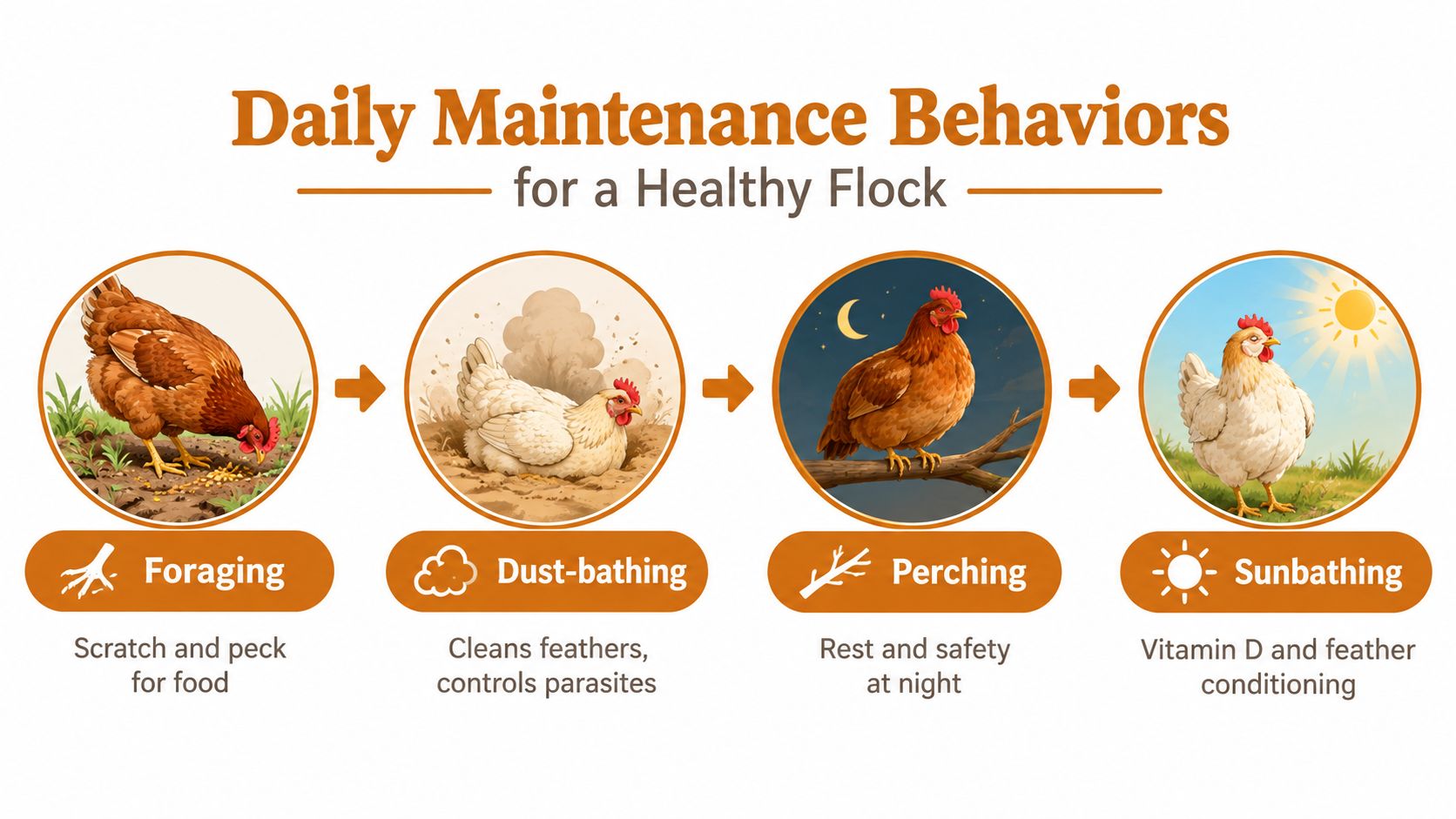
The four behaviours worth watching most
Foraging is the engine of the day. Chickens scratch backward, peck forward, inspect, reject, and inspect again. If you've ever watched a hen flip the same leaf three times, you've seen how much of their brain likes searching.
Dust-bathing is not silliness. It's body care. Review evidence shows hens use dust bathing to disperse lipids, improve feather structure, and help dislodge skin parasites. One study reported average dust-bathing bouts of about 22.63 ± 2.13 minutes in floor systems, and later work found hens performed better dust-bathing in circular baths and with 5 cm of material depth (dust-bathing review and design findings).
Perching gives birds a place to rest and settle, especially at night. A good perch supports balance and spacing. A poor one causes jostling and sleep disruption.
Preening is feather maintenance. Chickens draw their beaks along feathers to straighten and condition them. When preening drops off, something is often off elsewhere.
What blocked behaviour looks like
When the environment frustrates normal behaviour, the signs are usually visible.
- No loose substrate: Birds may peck aimlessly, pace, or make poor use of the run.
- Crowded resting areas: Roost-time bunching and shoving become more common.
- Hard or wet ground: Birds avoid settling into full-body maintenance behaviours.
- Barren spaces: Activity becomes repetitive instead of purposeful.
A lot of backyard owners notice this most clearly in semi-constrained setups. A reported 2026 CDC backyard flock survey found 47% spent most of the day in a covered run and 54% of owners said wild birds could access food or water, highlighting how behaviour, stress, and biosecurity often overlap in real home flocks (backyard flock management report).
A simple daily rhythm to look for
Morning usually brings active foraging. Midday often includes dust-bathing, preening, and periods of rest. Evening brings more feeding, social reshuffling, and then a move to roost.
If you enjoy seeing how people have long relied on animal behaviour in practical working roles, this short piece on the roles of working animals in Magnolia offers an interesting wider lens on how humans read animal habits.
For a chicken-specific version of that weekend observation habit, it helps to know what chickens eat naturally, because food-search behaviour makes more sense when you know what birds are wired to seek.
Birds that can carry out normal maintenance behaviours usually look calmer, use space better, and spend less time in pointless conflict.
Broodiness, Communication, and Flock Dynamics
Broodiness is one of the clearest examples of how biology changes behaviour. A broody hen doesn't just “feel like sitting.” Her priorities shift. She becomes nest-focused, more defensive, less interested in roaming, and often less interested in eating than usual.
To a new keeper, that can look like laziness or illness. It often isn't either.
What broodiness looks like in the coop
A broody hen tends to stay planted, puff herself up, and object strongly if you try to move her. She may cluck in a low, repetitive way that sounds different from her ordinary chatter. Some hens become dramatic little dragons. Others go quiet and stubborn.
Broodiness also affects the flock around her. Nest boxes get congested. Other hens may complain if their usual laying spot is occupied. A broody hen's stillness changes the flow of traffic in a surprisingly small coop.
Chickens talk more than people expect
Flock dynamics run on communication. Keepers usually notice the loud signals first, but chickens also rely on posture, spacing, and attention.
Common examples include:
- Food calls: One bird finds something interesting and others converge.
- Alarm calls: Heads lift. Bodies pause. The whole yard changes tone.
- Submissive crouching: A bird lowers herself and avoids escalation.
- Recruitment and reassurance sounds: Soft contact noises help maintain group cohesion.
A confident flock often looks less chaotic because birds can predict one another. That predictability is valuable. It reduces pointless chasing and helps birds return to routine after small disputes.
When to let broodiness continue
That depends on your setup and goals.
If you want chicks and can give a broody hen a safe, quiet arrangement, she may be useful. If you don't want chicks, prolonged broodiness can become physically draining and can interfere with the flock's daily flow. In that case, many keepers choose to interrupt the nesting setup rather than let the cycle continue.
The key is not to treat broodiness as bad behaviour. It's better understood as a normal biological state with management consequences.
How Diet and Enrichment Shape Chicken Behaviour
If you want to change what your chickens do, don't just watch the birds. Look hard at the setup around them. Behaviour follows opportunity.
A low-stimulus flock often has feed available, but not much to do. Birds walk to a feeder, eat quickly, stand around, and start noticing each other's feathers. An enriched flock has more outlets. Birds search, scratch, investigate, pull, toss, and redirect pecking into useful activities.
Why nutrition shows up in behaviour
Aggression isn't only a personality issue. Research indicates genetics and feeding regime both matter. Meat-type birds showed significantly more non-reciprocal aggression than egg-type birds, and feed restriction can increase aggression, especially around predictable hunger peaks. Reintroducing full feed can reduce aggression within days (aggression, genetics, and feed regime).
For backyard keepers, the practical lesson is straightforward. Hungry, frustrated, under-stimulated birds are harder to live with.
Some nutrient gaps also show up through feather condition, pecking interest, and general restlessness. That doesn't mean every pecking issue is a diet issue, but diet is part of the picture, especially during moult or other demanding periods.
Compare the setups side by side
| Factor | Low-Stimulus Setup | Enriched, Protein-Rich Setup |
|---|---|---|
| Feeding style | Feed disappears quickly from one main spot | Feed or treats can be scattered, hidden, or used in foraging games |
| Bird activity | More standing around, waiting, and watching each other | More scratching, searching, and ground-focused pecking |
| Feather attention | Pecking may drift toward flockmates | Pecking is more often redirected into substrate and objects |
| Run use | Birds cluster in familiar zones | Birds spread out to investigate multiple interest points |
| Stress response | Small social friction can build faster | Birds have more ways to avoid, occupy, and regulate themselves |
Useful enrichment that changes behaviour you can see
Try practical items, not complicated ones.
- Deep litter or loose substrate: Gives birds somewhere to scratch properly.
- Hanging greens or treat puzzles: Slows intake and adds purposeful pecking.
- Visual barriers: Helps lower-ranked birds step away from pressure.
- Perches and platforms: Expand usable space and create options.
- Protein-rich treats used thoughtfully: Can support moulting birds and make scatter-feeding more engaging.
For keepers thinking about the food side in more detail, this guide to a healthy diet for chickens is a useful companion to behaviour watching.
One more welfare lens matters here. A 2025 review noted that the field still leans heavily on negative stress signals, while positive behaviours such as play, comfort, and exploratory behaviour are among the most common indicators of better welfare (review of positive and negative welfare indicators). That's a helpful reminder. Don't only watch for problems. Watch for signs that birds are thriving.
Common Misconceptions About Chicken Behaviour
Chicken folklore travels fast, and a lot of it isn't very useful.
Myth that causes the most confusion
The big one is that the pecking order is a rigid ladder with one permanent boss at the top. In real flocks, status shifts with age, health, space, and context. A hen may dominate at the feeder and still avoid another bird at roost time.
That matters because keepers sometimes shrug off repeated bullying as “just the pecking order,” when what they're really seeing is poor setup, crowding, or a bird that has become an easy target.
Other myths worth dropping
- Aggression means a chicken is mean: Sometimes it does reflect a bold bird, but management often drives it.
- Broody hens are sick or lazy: Broodiness is a normal state, even if it's inconvenient.
- Free-range solves everything: It can improve options, but it doesn't erase parasites, fear, social tension, or nutritional imbalance.
- Chickens are dumb: Anyone who's watched a flock solve feeding routines, remember pathways, or read one another's intent knows better.
A better way to think
Treat behaviour as information, not attitude.
When a hen chases another bird, ask what resource is involved. When several birds seem loud and restless, ask whether weather, layout, or feeding rhythm changed. When a usually active bird withdraws, ask what normal behaviour she has stopped doing.
That shift in mindset is one of the biggest upgrades a keeper can make.
Reading Your Flock and Frequently Asked Questions
A good flock check doesn't take long. What matters is doing it often enough to spot patterns.
A simple weekly observation checklist
Pick one short window in the morning and one near roost time. Keep notes in a phone or notebook.
- Morning spread-out: Are birds moving out confidently, or hesitating and clustering?
- Feeding access: Does every bird get a fair chance without repeated displacement?
- Dust-bath use: Are birds using the substrate fully, or ignoring it?
- Perch choices: Who roosts well, who gets squeezed out, and who sleeps elsewhere?
- Feather condition: Look for wear around the back, vent, tail, and neck.
- Vocal tone: Normal flock chatter sounds different from repeated distress or alarm.
- Droppings and energy: Behaviour and physical output often change together.
Weekend habit: Watch for what has stopped, not only for what has started. Loss of a normal behaviour is often the clearest clue.
Frequently asked questions
How do I stop feather pecking?
Start with the setup. Increase resource access, improve enrichment, check flock density, and review the diet.
What does broody behaviour look like?
Nest staying, puffed feathers, protest clucking, and strong reluctance to leave the box are common signs.
Why do chickens chase each other?
Usually because of hierarchy, feed access, nest-box competition, or general social pressure.
Do I need a rooster for a pecking order?
No. Hens form social hierarchies on their own.
Do chickens remember things well?
Yes, in practical flock life they clearly remember places, routines, and familiar flockmates.
Can treats help reduce aggression?
Treats alone won't solve a management problem, but when used as part of scatter-feeding or enrichment, they can redirect pecking and increase foraging time.
The behaviour of chickens makes the most sense when you stop looking for single dramatic moments and start looking for repeated patterns. A weekly behaviour log will teach you more about your flock than almost any gadget.
Pure Grubs offers USA-grown dried Black Soldier Fly Larvae that fit naturally into the behaviour side of chicken keeping because they can be used as a calcium-rich, protein-rich treat in scatter-feeding, moulting support, and enrichment routines. If you want to pair better flock observation with practical nutrition choices, visit Pure Grubs.