

Backyard Chicken Treats: A Practical Feeding Guide
At dawn, the coop is barely open before the treat tin starts rattling. The hens rush over, necks stretched and feet scrambling, ready for scratch, mealworms, or whatever scraps were saved from breakfast. Their excitement is real, but it can hide the more important question: what is each treat replacing in the feeder?
Backyard chicken treats work best when you treat them as targeted supplements rather than rewards. A nutrient-dense insect can add protein and minerals in a small serving, while a handful of bread or grain may mostly add energy and fiber. The choice affects the flock's overall ration, especially for laying hens that depend on steady calcium intake for eggshell formation. The practical rule is simple: every treat must earn its place.
Treats Are a Nutrition Decision, Not a Reward
A hen can eat the same volume of two treats and receive very different nutrition. Oats, scratch grains, and bread add variety, calories, and bulk. Dried black soldier fly larvae provide more concentrated protein and fat, plus calcium that can vary with the larvae's rearing conditions. Reported dried BSFL composition ranges from 37% to 63% protein and 7% to 28% fat. (Wageningen University research)
That nutrient density changes how I portion treats. A crop has limited capacity, so a hen that fills it with low-density food may eat less complete layer ration afterward. A spoonful of scratch is not automatically harmful. Repeatedly replacing balanced feed with bread, grain, or other filler foods can reduce intake of the calcium, phosphorus, amino acids, and vitamins needed for reliable production.
Practical rule: Give each treat a purpose. Use protein-rich insects during molt, calcium-supportive choices when shell quality declines, and small servings of produce for variety.
Kitchen scraps need the same scrutiny. Leafy greens supply some vitamins and moisture, but watery produce cannot replace a balanced ration. Bread may attract the flock while contributing little calcium compared with layer feed. Scratch supports foraging and enrichment, yet it should remain a supplement rather than the foundation of the diet.
The useful treat is the one that adds a needed nutrient without displacing complete feed. Measure portions instead of scattering unlimited handfuls, monitor eggshell quality, and check insect packaging for a clear origin and nutrition analysis. Those details matter as much as the flock's enthusiasm. A cheap or convenient treat can become a poor trade if it lowers layer-feed intake or comes from a source with unclear handling.
The 90/10 Rule and Why Calcium Drives It
A flock can finish a bucket of scratch and still come up short on the nutrients that support eggs. Extension guidance for backyard flocks recommends keeping treats to no more than about 10% of the daily diet by weight, with approximately 90% supplied by a balanced layer ration. Layer feed is formulated to provide the regular calcium, protein, vitamins, and minerals a laying hen needs.
Calcium in layer feed is commonly set around 2.5% to 3.5%. If bread, scratch grains, or low-calcium scraps replace part of that ration, total calcium intake can fall even when the hen appears well fed. Thin shells and soft-shelled eggs may signal that the complete diet is not meeting demand.
What the treat replaces matters
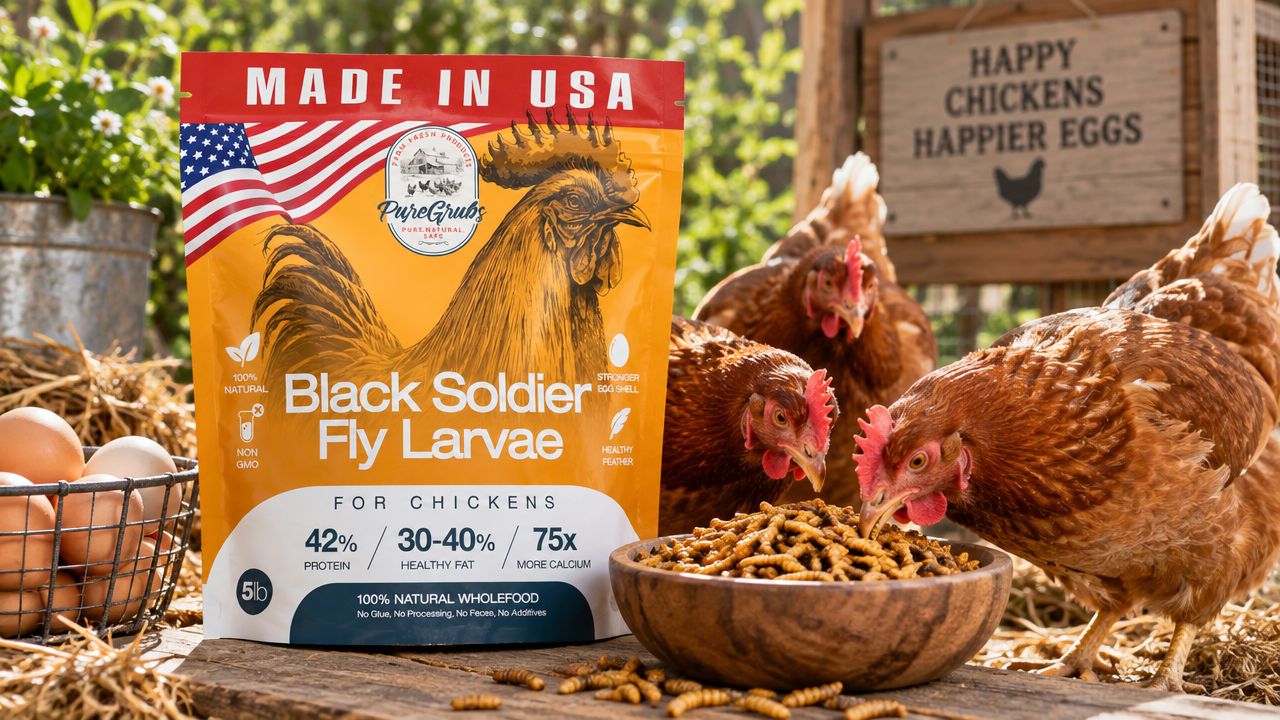
Judge a treat by two things: its nutrient density and the feed it displaces. A small portion of BSFL can add concentrated protein and meaningful calcium, while a similar portion of bread or grain mainly adds energy. That difference matters most in laying hens, where eggshell production creates a continuing calcium demand.
Published BSFL composition reviews report products ranging from up to 9% calcium on a dry-matter basis to around 2.4%, depending on the product and production conditions. The species name alone therefore cannot establish a larva's mineral value. Read the package analysis before using it as a calcium-focused supplement.
If you're considering USA GROWN BLACK SOLDIER FLY LARVAE FOR CHICKENS, use the stated product information rather than assuming every BSFL product has the same composition.
| Treat Category | Crude Protein | Calcium | Calories per 10g | Effect on Ration Balance |
|---|---|---|---|---|
| Balanced layer ration | Formulated complete feed | About 2.5% to 3.5% | Not specified in verified data | Supplies the nutritional base |
| Dried BSFL | About 37% to 63% | Product-dependent, up to 9% in reviewed meal | Not specified in verified data | Concentrated supplement when portioned |
| Scratch grains | Not specified in verified data | Generally lower than layer feed | Not specified in verified data | Adds energy and fiber, may dilute minerals |
| Bread and most scraps | Not specified in verified data | Usually low relative to layer feed | Not specified in verified data | Can displace complete feed without replacing calcium |
Protecting the calcium budget
Provide oyster shell, calcite, or limestone free-choice when the main ration does not supply enough calcium. Hens can select extra shell material according to their needs, but that option does not make unlimited low-calcium treats appropriate. It also cannot correct a poor-quality layer feed.
For a closer comparison of supplemental options, see this guide to calcium sources for chickens. Keep the 10% ceiling in view, then assess what each treat contributes to the whole ration. For a flock made up mainly of laying hens, calcium comes before calories.
BSFL vs Mealworms vs Crickets vs Silkworms
A mealworm, black soldier fly larva, cricket, and silkworm can all attract chickens, but they do not fill the same nutritional role. Protein, fat, calcium, phosphorus, and amino-acid profiles vary by insect, life stage, processing method, and feed source. Treat the label and sourcing details as part of the nutrition decision.
BSFL offer the clearest case for a calcium-focused insect supplement. Poultry nutrition literature reports BSFL meal at roughly 49.8% crude protein, 22.1% ether extract, 9.60% ash, 2.61% calcium, and 0.98% phosphorus on a dry-matter basis. (Poultry nutrition review) Other reviewed products show different calcium levels, so those figures describe one reported meal, not every bag of dried larvae.
Mealworms are familiar, easy to portion, and highly motivating during training. Their calcium contribution is commonly lower than that of BSFL products, so use them as small rewards or occasional variety unless the rest of the ration already covers a laying hen's calcium needs. Their higher appeal can also encourage overfeeding if birds fill up on them before eating complete feed.
| Insect | Crude Protein (dry) | Calcium (dry) | Ca:P Ratio | Best Use |
|---|---|---|---|---|
| BSFL | About 37% to 63% in reviewed dried larvae | Product-dependent, up to 9% in reviewed meal | Product-dependent | Calcium-conscious supplementation and molting support |
| Mealworms | Not specified in verified data | Lower than the cited BSFL comparison | Not specified in verified data | Training rewards and occasional variety |
| Crickets | Not specified in verified data | Not specified in verified data | Not specified in verified data | Occasional variety when the product is clearly labeled |
| Silkworms | Not specified in verified data | Not specified in verified data | Not specified in verified data | Targeted variety when a traceable product is available |
The research base is stronger for BSFL than for broad claims about crickets, mealworms, or silkworms. Published research documents BSFL use as a poultry feed additive as early as 1973, while European regulation expanded approved insect use to poultry and pig feed on August 17, 2021. That history supports closer scrutiny of BSFL, but it does not make every insect product suitable. Check whether insects were raised on a known substrate, processed for feed, and sold with a clear composition.
For practical portioning and presentation ideas, see this guide to feeding mealworms to birds. The practical fit is clear: choose BSFL when calcium and protein both matter, mealworms for high-value, low-volume rewards, crickets for rotation, and silkworms only when their composition and source can be verified.
Safe Kitchen Scraps and Garden Foods
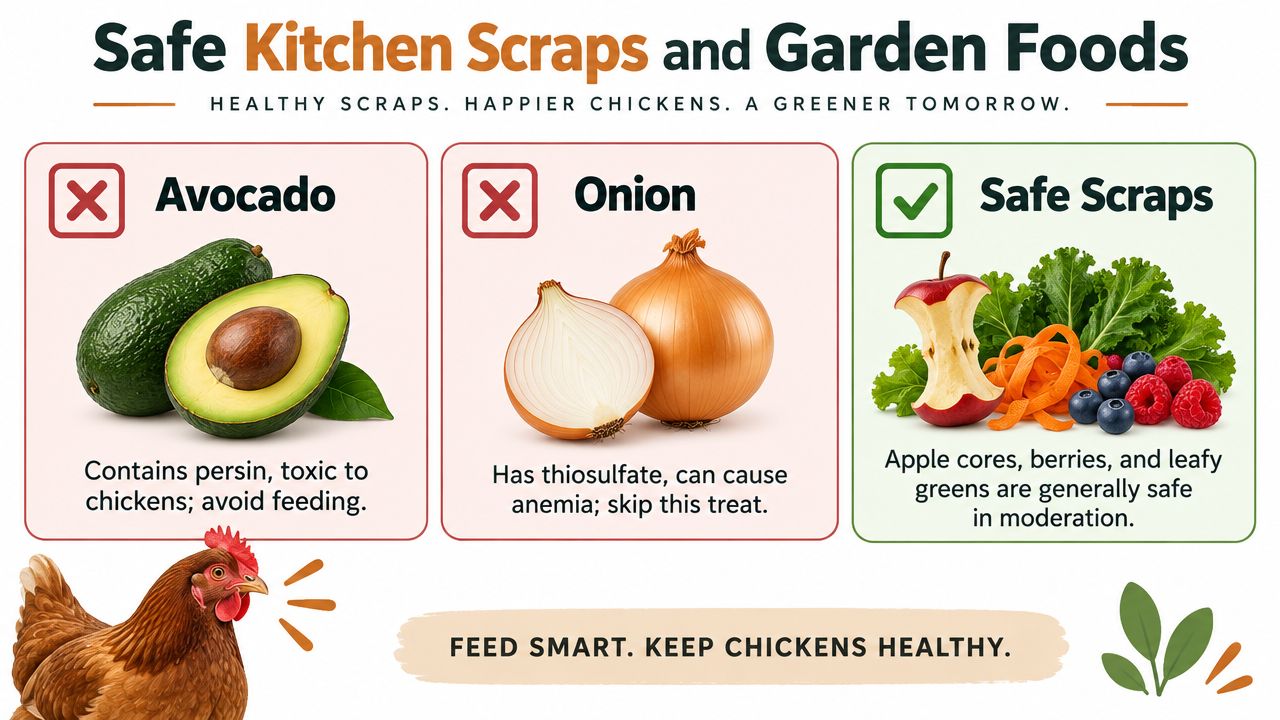
A flock can empty a bowl of leftovers and still miss the nutrients that support steady laying. Use kitchen scraps and garden produce as targeted supplements, not as a second ration. Leafy greens such as lettuce, kale, and Swiss chard add variety. Berries, melon, and apple pieces work in moderation, with apple seeds removed. Zucchini, cucumber, and fresh herbs are practical garden offerings.
Plain cooked rice, pasta, and oats are suitable additions. Reject anything moldy, heavily salted, greasy, or seasoned. Raw beans also stay out of the feed bucket because their lectins require cooking before feeding.
Three foods to leave out
Keep these warnings visible near the coop:
- Avocado: Leave out the fruit, skin, and pit. Avocado contains persin, which can be toxic to chickens.
- Onion: Skip onions because thiosulfate can damage red blood cells.
- Chocolate: Do not feed chocolate because it contains theobromine and caffeine.
Safe food can still dilute the ration if birds fill up on it. Offer a small serving occasionally, then remove leftovers before they spoil. If garden access needs restricting, these Little Green Leaf fence ideas can help separate useful grazing from destructive access.
Keep the ration in charge
Extension guidance recommends keeping treats at roughly 10% or less of daily intake by weight. A scale is unnecessary for every scrap, but a repeatable routine matters. Offer modest portions, keep clean water available, clear away food that becomes dirty or soft, and ensure complete layer feed remains the flock's main source of protein, minerals, and calcium.
For more examples, use this guide to chicken food scraps. The useful scrap is the one that adds a nutrient or variety without crowding calcium-rich layer feed out of the feeder. For laying hens, that calcium trade-off matters more than whether a leftover feels like a treat.
DIY Treat Recipes and Store-Bought Shortcuts
Homemade treats give you control. You know whether the yogurt is plain, the fruit is fresh, and the greens are free from seasoning. The trade-off is consistency. A homemade mixture can vary from batch to batch, and it's difficult to know exactly how much calcium or protein each bird receives.
A frozen herb-and-berry block is an easy warm-weather option. Mix parsley, blueberries, and plain yogurt, spoon the mixture into ice cube trays, and freeze it. Offer the cubes outdoors and remove any uneaten portions once they become dirty or soft.
For colder weather, combine oats, wheat berries, dried mealworms, and chopped kale. If you use a calcium carbonate top-dress, measure it carefully and treat the mixture as a supplement rather than a replacement for layer feed. Don't add salt, sugary sauces, oily leftovers, or moldy grains.
| Factor | Homemade | Commercial |
|---|---|---|
| Ingredient control | High, if every ingredient is known | Depends on the label and manufacturer |
| Nutrient consistency | Can vary by batch | More consistent when guaranteed analysis is provided |
| Calcium dosing | Difficult to standardize | Easier to compare when mineral data is listed |
| Freshness | Usually high when prepared immediately | Depends on drying, packaging, and storage |
| Shelf life | Often short | Usually longer, but check dates and packaging |
| Sourcing transparency | Visible in your own kitchen | Must be verified from the supplier |
Commercial treats save preparation time, but the label deserves scrutiny. Look for the insect species, crude protein, calcium information, country of origin, additives, and storage instructions. A bargain product with vague “insect meal,” salty filler, or inconsistent grinding may offer less practical value than its package weight suggests.
Price per pound can mislead. Compare cost per gram of useful protein, then consider calcium and traceability. A treat that costs less but contributes little beyond calories isn't automatically economical.
Matching Treats to Your Flock Type
A laying hen, a broiler, a duck, and a young chick don't have the same nutritional job. Treats should reflect that job rather than follow one universal list.
Laying hens benefit most from calcium-conscious choices. BSFL can add protein and calcium, while oyster shell or another appropriate calcium source remains available separately when needed. Dark leafy greens contribute variety and micronutrients, but they don't replace complete layer ration.
Broilers need restraint. Their main feed already supports rapid growth, so energy-dense treats can interfere with the balance you're trying to maintain. Small servings of scratch or mealworms may provide enrichment, but treats shouldn't become a major part of the feeding program.
Ducks handle wet foods well and often enjoy chopped greens, peas, and suitable foraged items floated in water. Keep clean water available while feeding wet treats, and provide access to appropriate grit when the diet includes foods that require grinding.
Chicks should rely almost entirely on starter feed while that feed is being established. If treats are introduced, use very small portions of finely chopped, easy-to-eat foods rather than large pieces or rich mixtures. Young birds can fill up quickly, so a treat that seems tiny to an adult hen may still displace an important amount of starter ration.
Pullets approaching lay need a deliberate transition to layer nutrition. Don't try to solve the change with treats alone. The complete feed should carry the nutritional load, while supplements remain controlled and purposeful.
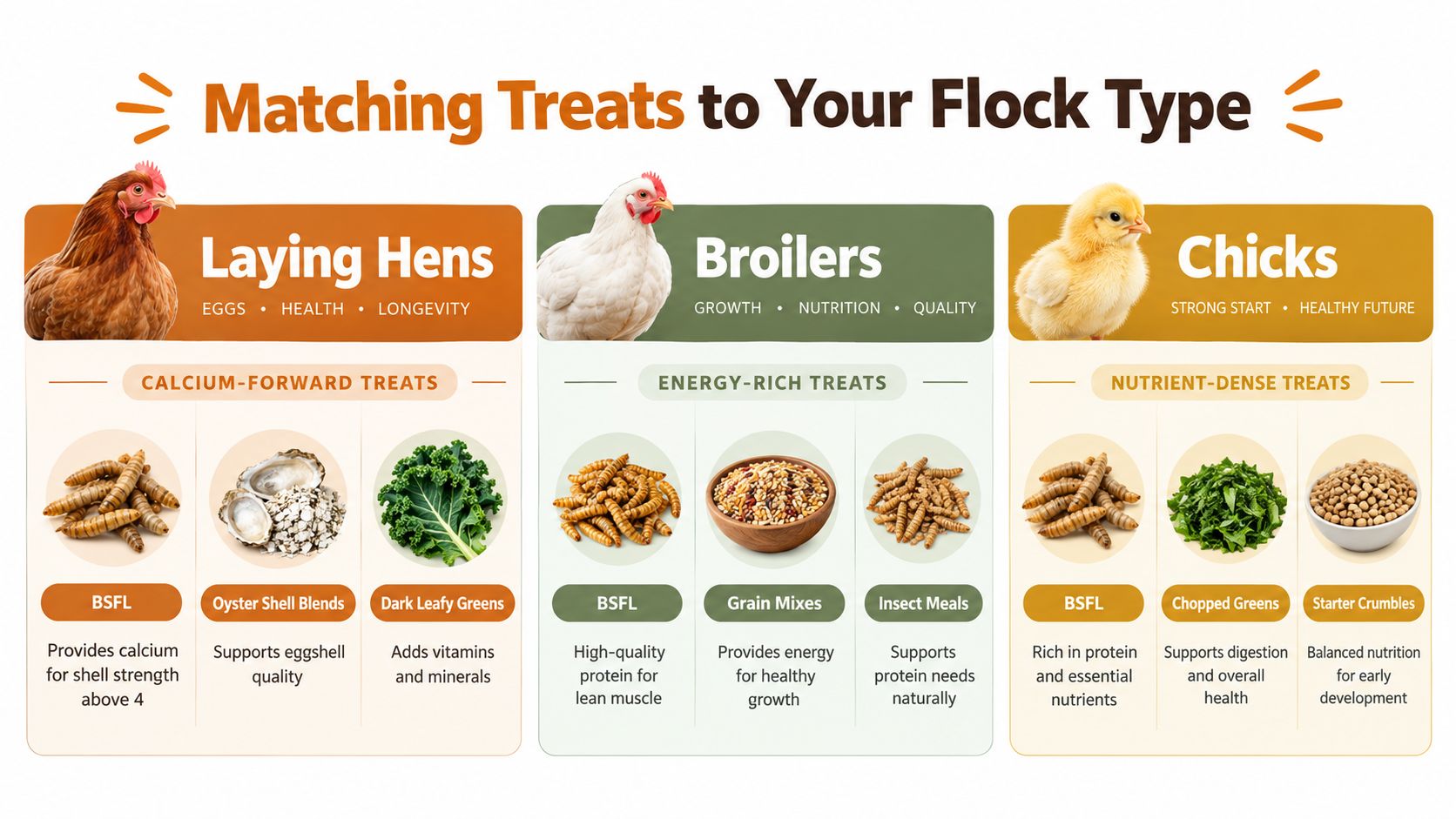
The flock's age and purpose should determine the treat. Protein and calcium are more relevant to layers and molting birds, while broilers and chicks need tighter control because their complete feeds are doing most of the work.
Why Sourcing and Safety Testing Matter
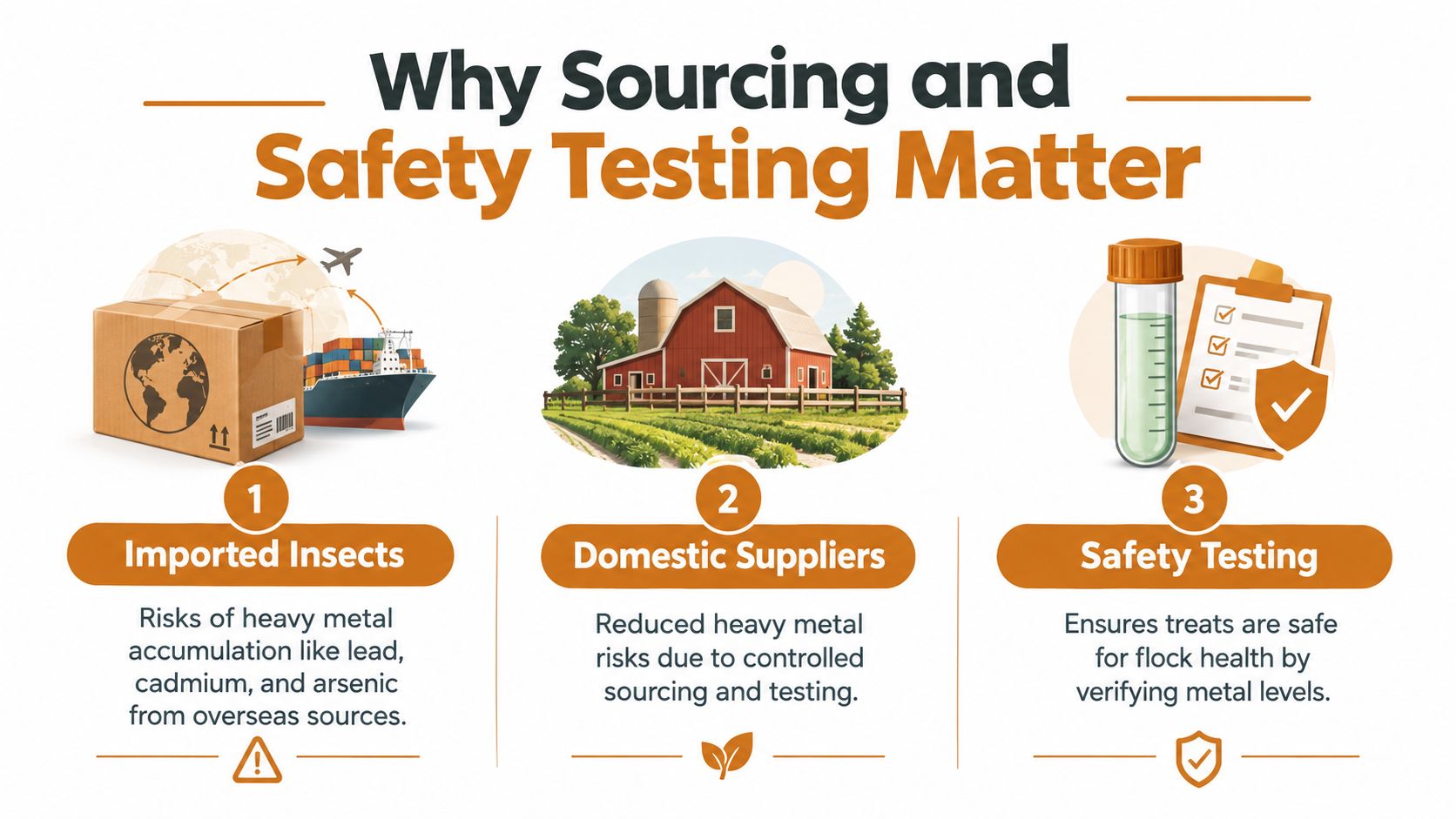
A treat can look clean and still carry avoidable risk. Insects reflect the material on which they were raised, so the substrate, origin, processing, and testing deserve attention. A species name alone does not tell you enough about quality or safety.
Ask suppliers for batch-level records whenever they can provide them. Look for certificates of analysis covering heavy metals, pesticide residues, and microbial testing, including Salmonella and E. coli. The package should identify the insect species, country of origin, guaranteed analysis, lot number, and storage instructions.
Don't treat origin as a cosmetic detail
Imported insects are not automatically unsafe, and domestic insects are not automatically superior. Ask whether the supplier can describe how the insects were raised and whether the finished batch was tested. Published BSFL composition reviews note that mineral content varies with the rearing substrate, so calcium values can differ between batches or products. (BSFL mineral review)
The same care applies to grain treats. Damp or poorly stored corn and scratch may develop mold or mycotoxin problems. Keep grains and dried larvae sealed in airtight containers in a cool, dry place. Discard any product with a stale, rancid, damp, or visibly moldy smell.
A practical label check
Before buying, check for:
- Named species: “Black soldier fly larvae” gives more information than a vague insect-meal description.
- Origin information: The label should state where the insects were raised and processed.
- Guaranteed analysis: Protein and fat help with portion decisions, while calcium matters particularly for layers.
- Traceability: A lot number identifies the specific batch if a concern arises.
- Storage guidance: Heat, air, and moisture can reduce the quality of fat-rich dried larvae.
Testing does not turn a treat into complete feed. It reduces the chance that a targeted supplement introduces a preventable hazard. That matters when comparing the calcium payoff and nutrient density of insects with grains or kitchen scraps.
Choosing the Right Treat for Your Flock Goals
Start with the flock goal, not the treat aisle. If shells are the concern, choose calcium-forward options and protect the layer ration from dilution. If molting is underway, protein density and amino-acid supply matter more than another scoop of scratch.
| Flock Goal | Recommended Treat | Nutritional Lever |
|---|---|---|
| Shell support | BSFL alongside appropriate free-choice calcium | Protein and calcium contribution |
| Molting | BSFL, silkworms, or plain cooked egg in controlled portions | Concentrated protein |
| Training and recall | A small amount of high-value insect treat | Strong motivation with low volume |
| Chick development | Starter feed first, then only carefully limited small treats | Protects balanced early nutrition |
| Garden enrichment | Leafy greens, berries, cucumber, or zucchini | Variety and foraging |
| Broiler management | Minimal treats, if any | Prevents unnecessary ration disruption |
A good treat decision follows three steps. Identify the problem, choose the nutrient that addresses it, and select the smallest serving that delivers that benefit. For example, a hen with poor shell quality needs a review of her complete feed and calcium access before she needs more snacks. A molting flock may benefit from a protein-rich insect supplement, but scratch grains won't solve an amino-acid shortage.
Training is where small servings shine. A few larvae used to call birds into the coop can create a reliable routine without filling their crops with low-density grain. The treat earns its place because it changes behavior while using very little food.
Pure Grubs offers USA-grown dried black soldier fly larvae with product information describing 36% to 42% crude protein, plant-based feeding, and no additives or preservatives. Review the label and feeding role carefully, then use Pure Grubs as one traceable insect option within a complete flock ration.