

7 Animals That Lay Large Eggs: Size Comparisons
The ostrich lays the largest eggs among living birds, with an average egg weighing about 1.4 kilograms, or 3.1 pounds. Among practical backyard choices, geese, turkeys, ducks, and chickens offer large eggs without the specialized demands of ratite keeping.
A chicken egg feels familiar because it's easy to collect, store, cook, and sell. Move up to ducks and turkeys, however, and the shell becomes heavier and the contents more substantial. Goose eggs create an even bigger jump, while emu and ostrich eggs turn egg production into a specialty operation.
This ranking focuses on typical egg weight, not just the largest recorded specimen. That distinction matters. The biggest egg isn't always the best choice for a homestead. A keeper also needs to consider laying frequency, calcium requirements, housing, seasonal production, handling, and whether local buyers want the product.
The list moves from the lightest supplied species to the heaviest. Nutrition guidance is supplemental, not a replacement for a complete, species-appropriate diet.
1. Guinea Fowl
Guinea fowl sit at the small end of this list, with eggs that are typically lighter than chicken eggs. Their value comes from a different combination of traits: hard shells, distinctive speckling, natural foraging, and usefulness around a homestead.
A guinea fowl egg can suit a keeper who wants specialty eggs rather than maximum size. The smaller format may appeal to customers looking for something unusual, while the firm shell can help the eggs tolerate ordinary handling. Guinea fowl also spend much of their time searching for insects and other forage, so supplemental feed should support that behavior rather than replace it.
A small egg with practical value
For backyard and homestead keepers, guinea fowl can serve more than one purpose. They provide eggs, forage actively, and can fit into a mixed-bird setup when the keeper is prepared for their distinct behavior and housing needs.
Shell quality offers a useful management signal. If shells become noticeably thin, rough, or inconsistent, review the bird's complete diet, access to calcium, water, stress, and laying conditions before assuming that a single treat will solve the problem.
A simple routine can include:
- Use supplemental protein carefully: Offer black soldier fly larvae as a treat alongside a complete feed and natural forage.
- Support shell mineralization: Provide an appropriate calcium source, such as oyster shell, according to the needs of laying birds.
- Watch the shell: Consistent, firm shells are more useful indicators than color alone.
- Time changes sensibly: Introduce any new supplement gradually, especially when birds are young or already under stress.
Practical rule: A smaller egg can still be a premium product when its appearance, flavor, and local availability matter more than its weight.
Guinea fowl suit keepers who value foraging and specialty appeal. They aren't the answer for someone seeking the largest possible breakfast egg, but they can be a sensible choice for a diverse homestead flock.
2. Chickens
Chicken eggs usually rank below duck, turkey, and goose eggs by weight, yet chickens remain one of the most useful large-egg birds for keepers. They combine manageable size, regular household use, accessible housing, and established feed routines. A large heritage hen can still produce an egg that feels substantial at the kitchen table.
Breed selection affects the result. Brahmas, Orpingtons, and Wyandottes are familiar choices for keepers seeking larger heritage-type eggs, although individual hens differ. Select healthy birds from a line known for the egg traits you want, then keep feeding, water, and daily care consistent.
Build shell quality before chasing size
Shell production places a steady demand on calcium. A laying hen needs about 2 to 2.5 grams of calcium per day, as discussed in the research on calcium and eggshell quality. Forming one shell requires roughly 2 to 2.5 grams of calcium per egg, and about 95% of a dry eggshell is calcium carbonate, according to the same poultry nutrition review.
These figures describe the bird's demand, not a reason to supply unlimited calcium. A complete layer ration should form the foundation. Free-choice calcium and occasional treats provide support, while reliable water helps maintain general health and laying performance.
For insect treats, how to improve egg quality provides practical feeding guidance. Dried black soldier fly larvae are a calcium-rich treat option, and the USA GROWN BLACK SOLDIER FLY LARVAE FOR CHICKENS product page lists current formulation and purchasing details. Use treats as a small part of the routine, not as a replacement for balanced feed.
Chickens suit backyard flocks, small homesteads, and heritage-breed projects. They do not lead the seven-bird ranking by egg weight, but their moderate size makes them easier to house, feed, collect, and use every day.
3. Ducks
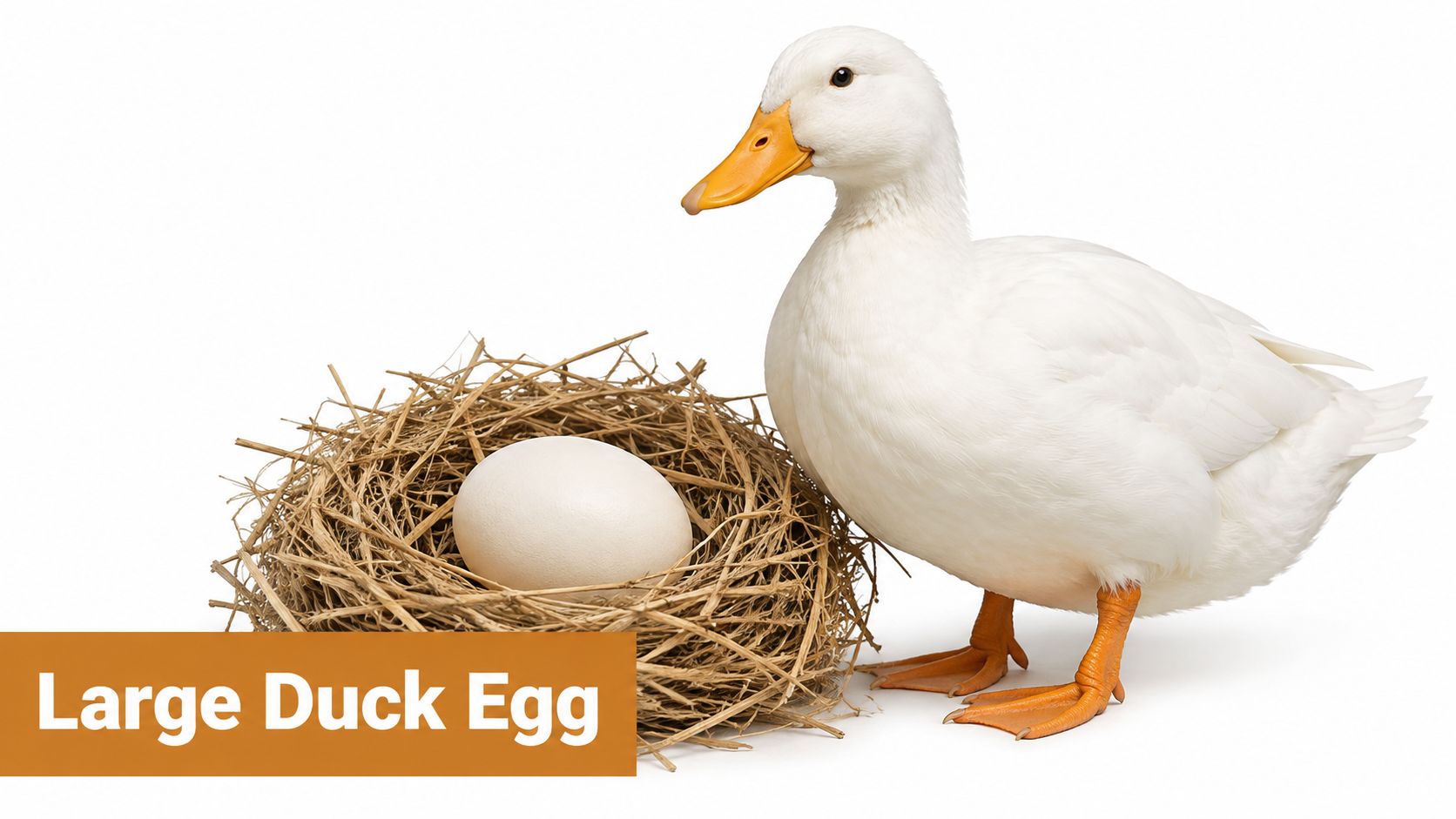
Duck eggs move the ranking into a clearly larger format. Domestic ducks produce eggs that are generally heavier than chicken eggs, with thicker shells and rich contents that attract home cooks, specialty bakers, and customers who want an alternative to standard poultry eggs.
Pekin ducks are a familiar choice for keepers focused on large eggs, while Khaki Campbells are valued for production and Muscovies bring different body and management traits. Breed choice should follow the actual goal. A homesteader supplying a household has different priorities from a small farm selling eggs to a bakery.
Water, feed, and shell support
Ducks create a practical trade-off. Their eggs are large and attractive, but ducks are messier around water and need management that accommodates wet bedding, muddy ground, and active foraging. A clean drinking supply is essential, and swimming water can improve quality of life without being the only source of hydration.
Calcium still belongs in the whole-diet discussion. Provide a complete duck-appropriate ration, then use suitable supplemental calcium according to the flock's needs. Black soldier fly larvae can add protein and minerals as a treat, but they shouldn't displace the feed that supplies the bird's daily nutritional balance.
The guide to duck egg production can help keepers think through laying management. In practice, monitor shell texture, egg appearance, body condition, water cleanliness, and changes in laying behavior. A duck that lays a large egg but struggles with poor shell quality needs a management review, not more treats.
Ducks work well for homesteaders, waterfowl enthusiasts, and specialty-food producers. They offer a larger egg than chickens while remaining much more accessible than emus or ostriches.
4. Turkeys
Turkey eggs sit above duck eggs in typical weight, giving them a clear specialty position in this ranking. Their thick shells and rich contents suit cooks who want an uncommon ingredient, yet their seasonal laying pattern makes them very different from chickens, which can supply eggs more routinely.
That difference changes the keeper's calculation. A heritage flock may support conservation, breeding, or household self-sufficiency, while a specialty farm could sell limited quantities to interested cooks. For a backyard owner, however, the egg is only one part of the decision. Turkeys need more space, sturdier housing, and management suited to their temperament.
A turkey egg is like a larger project rather than a larger everyday breakfast. More shell material and reproductive effort require attention to the hen's condition, especially before laying begins.
Feed first, then adjust support
Start with a complete turkey ration. Calcium and protein support can then be adjusted for age, body condition, reproductive stage, and veterinary or nutrition guidance. Watch shell strength, laying activity, appetite, and body condition together. A change in one sign may be temporary, but several changes suggest that the feeding or housing plan needs review.
A large egg is useful only when the hen can produce it without losing condition.
Treats, including insects, should remain a small part of that plan. The available information on what to feed turkeys does not establish one feeding amount for every turkey flock. Chicken or duck routines should not be copied automatically, because species, age, reproductive status, and the rest of the diet all affect the right approach.
For practical planning, reserve turkeys for keepers who value uncommon eggs, heritage breeding, or specialty sales. Provide suitable nesting areas during the laying season, prepare for periods with few or no eggs, and protect calcium balance through the complete ration before considering supplements. Their larger body and stronger infrastructure needs also make them a more demanding choice than ducks.
The payoff is distinction rather than volume. Turkeys can produce an egg that attracts attention, but the trade-off is seasonal availability and more deliberate care.
5. Geese
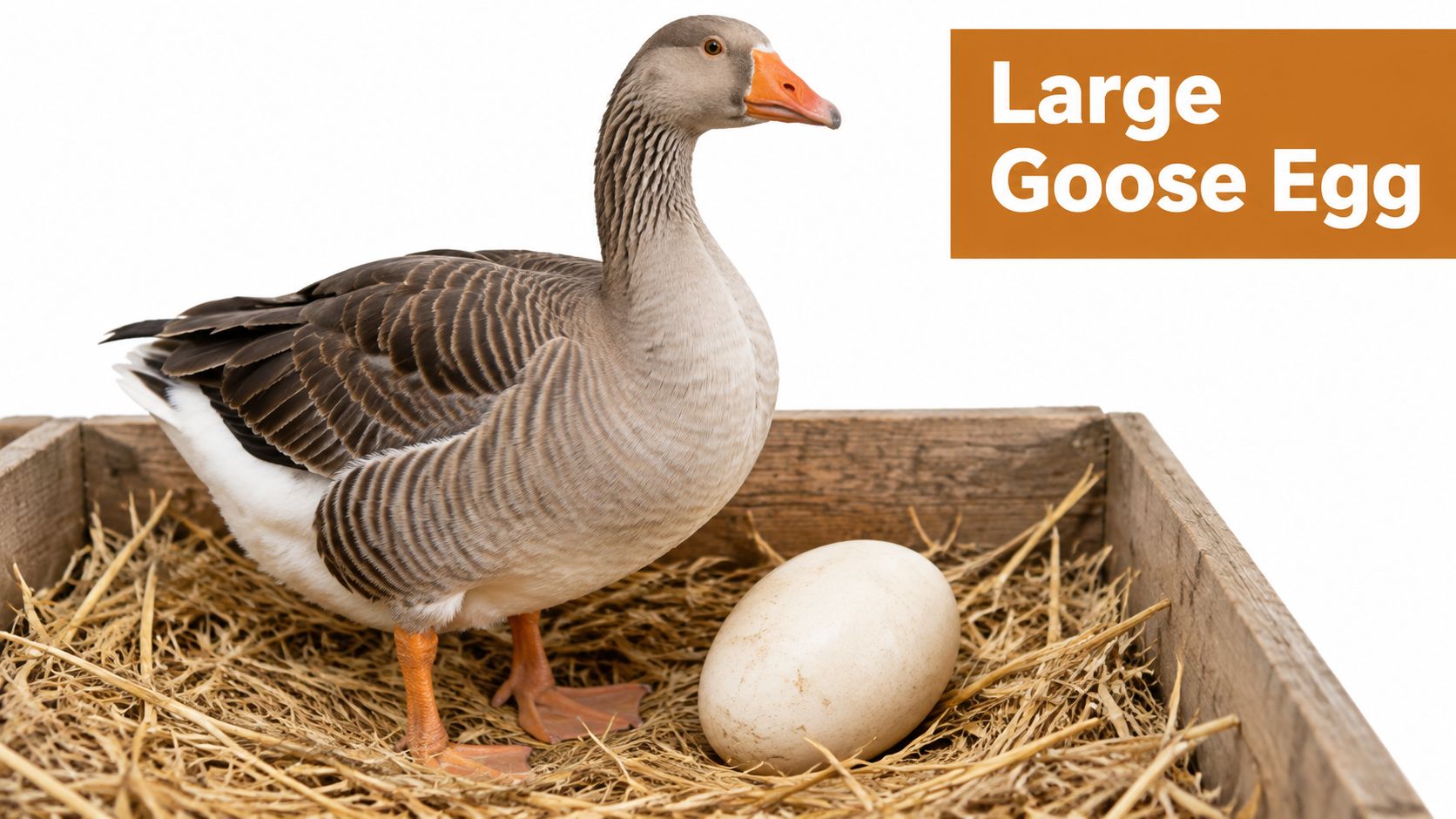
A domestic goose egg belongs near the larger end of the poultry range, usually above duck and turkey eggs but far below emu and ostrich eggs. Its very large size, substantial shell, and rich contents suit specialty cooking, baking, pasta, and other small-batch uses. For a backyard keeper, one egg can contribute more to a recipe than an ordinary chicken egg, but the flock will not replace a high-output layer.
Production frequency sets the main trade-off. Geese lay seasonally and far less often than familiar laying breeds, so their value comes from size, distinctiveness, and timing rather than steady volume. A household may welcome occasional eggs, while a homestead or specialty farm can plan around a limited seasonal supply.
A larger shell changes the keeping plan
A goose egg requires considerably more shell material than a chicken egg. Cross-species research connects egg size with adult body mass, clutch size, lifespan, and eggshell chemistry. The analysis in comparative research on egg size and shell chemistry also found higher eggshell calcium carbonate content in species whose eggs were larger than expected for their body mass.
The practical lesson is simple: a large egg is not merely a scaled-up chicken egg. The goose must direct minerals and energy toward reproduction while maintaining body condition, often within a seasonal laying cycle. A complete diet, suitable forage, clean water, secure nesting, and room to move all matter. Calcium support may have a place, but it should be considered alongside the base ration and the bird's condition rather than used as a substitute for balanced feeding.
Geese fit several keeper goals:
- Homestead cooking: occasional eggs add variety without commercial-scale production.
- Specialty baking: rich contents and large size suit small batches.
- Breeding projects: healthy adults and hatchability may matter more than egg count.
- Local niche sales: limited supply can work when buyers understand seasonality, as the Carlton farm on Shopifarm demonstrates with its goose-focused operation.
Geese occupy the specialty middle of this ranking. They offer more egg per laying event than ducks or turkeys, while demanding more space and accepting a lower-frequency production model.
6. Emus
Emu eggs are enormous compared with ordinary poultry eggs, placing these ratites firmly in the specialty category. An emu egg typically weighs about 500 to 600 grams, so one egg represents a substantial reproductive investment for the hen. Emus produce relatively few eggs, which makes each one more important to the operation.
The appeal extends beyond food. Specialty keepers may work with emu eggs for culinary presentation, decorative products, or other niche applications. Those uses don't make emu keeping simple, though. The birds require secure infrastructure, appropriate handling, and experienced care.
Large eggs require specialized oversight
Emu nutrition should begin with the bird, not the product. A complete ratite-appropriate diet needs to provide appropriate energy, protein, calcium, and other minerals. Because egg production is so demanding, a keeper should work with an avian veterinarian or qualified nutrition professional before making major dietary changes.
Shell quality, laying behavior, body condition, and breeding performance provide more useful information than egg size alone. Individual birds can differ, so a feeding routine that works for one hen may not suit another. Keepers should also consider whether their local market can support a specialty egg operation before acquiring birds.
The larger the egg, the less room there is for casual nutrition decisions.
Emus fit experienced specialty operators better than ordinary backyard flocks. Their eggs can create a distinctive product, but housing, safety, veterinary support, and market access become central parts of the project.
This is also where calcium advice needs the strongest caveat. Black soldier fly larvae may be a protein-rich treat, but no supplied evidence establishes a universal emu feeding quantity or proves that a particular supplement will improve emu egg output. Use treats as part of a professionally reviewed diet, never as the sole mineral strategy.
7. Ostriches
At about 1.4 kilograms, or 3.1 pounds, an ostrich egg ranks first among living birds by typical egg weight. One egg has roughly the mass of 20 to 25 chicken eggs, while recorded specimens have exceeded 2.5 kilograms. Its shell is also substantial, with a typical length of about 15 centimeters and width of 13 centimeters, according to data on the world's largest egg.
That scale makes the ostrich a clear winner for maximum individual egg size. It also creates a very different keeping project. Specialized land, strong fencing, experienced handling, breeding knowledge, and veterinary support all matter before an egg reaches the market.
An ostrich egg suits a demonstration, specialty farm, educational setting, or decorative craft more readily than an ordinary household breakfast. The durable shell offers a large surface for artisans, while culinary buyers may value the novelty. Each use depends on careful handling, local compliance checks, and a dependable buyer or audience.
The calcium question follows the same pattern. A shell this large represents a major mineral investment, so the feeding program must be formulated for ostriches. Calcium should be planned with professionals familiar with ratites, since adding more of one mineral does not automatically improve shell quality or bird health.
For a prospective keeper, the practical test is broader than egg weight:
- Space: A typical small poultry enclosure will not suit ostriches.
- Handling: Their size and strength call for experienced management.
- Production: The business plan must account for limited, specialty output.
- Market: Likely customers include chefs, artisans, educators, and specialty farms.
- Animal welfare: Breeding birds need suitable social conditions, surroundings, and veterinary care.
History shows an even larger scale. The extinct elephant bird of Madagascar laid eggs far bigger than ostrich eggs. Reconstructed specimens reached about 33 centimeters in length, around 8.5 liters in volume, and as much as 10 kilograms. The species disappeared roughly 1,000 years ago, placing it beyond modern keeping and near the historical upper limit for known bird eggs, as described by the history of the largest bird egg.
Top 7 Large-Egg Birds Comparison
| Species (avg egg wt) | Implementation Complexity 🔄 | Resource Requirements ⚡ | Expected Outcomes 📊⭐ | Ideal Use Cases 💡 | Key Advantages ⭐ |
|---|---|---|---|---|---|
| Chickens (50–70 g) | 🔄 Low, simple housing and routine supplementation | ⚡ Moderate, standard layer feed + regular Ca/protein supplements | 📊 Rapid improvement in shell thickness (2–3 weeks); high egg volume; ⭐⭐⭐⭐ | Backyard flocks, small homesteads, premium layer feed trials | Quick nutritional response; high market demand; breed diversity |
| Ducks (60–90 g) | 🔄 Moderate, water access and wet-environment management | ⚡ Higher, extra water, space, higher Ca needs | 📊 Larger, nutrient-dense eggs; thicker shells; ⭐⭐⭐⭐ | Specialty markets, homesteads selling premium eggs, aquatic setups | Larger eggs, longer lifespan, efficient feed conversion |
| Geese (140–200 g) | 🔄 Moderate–High, larger space, seasonal aggression management | ⚡ High, substantial space, water, and Ca per egg | 📊 Very large, high-value eggs but low annual output; ⭐⭐⭐ | Specialty bakeries, artisanal producers, premium homesteads | Largest domestic eggs, longevity, niche premium positioning |
| Turkeys (75–90 g) | 🔄 Moderate, seasonal breeding cycles and brooding needs | ⚡ Moderate–High, space, pre-breeding supplementation | 📊 Large seasonal eggs with high nutrient density; ⭐⭐⭐ | Heritage breed programs, specialty culinary producers | Premium egg quality, natural brooding, conservation value |
| Emus (500–600 g) | 🔄 High, specialized facilities, veterinary expertise | ⚡ Very High, intensive nutrition and management; low annual yield | 📊 Extremely high per-egg value; very low volume; ⭐⭐⭐⭐ (value) | Niche emu farms, cosmetic/culinary product suppliers | Highest per-egg market value, unique product applications |
| Ostriches (1.3–1.6 kg) | 🔄 Very High, specialized infrastructure and legal/regulatory needs | ⚡ Extremely High, large land, capital, continuous premium nutrition | 📊 World's largest eggs; exceptional per-egg value; very low annual count; ⭐⭐⭐⭐ | Ultra-premium culinary/decorative markets, specialized B2B partners | Unmatched egg size, long productive lifespan, premium branding |
| Guinea Fowl (35–45 g) | 🔄 Low, hardy, forage-oriented management | ⚡ Low, minimal supplementation; efficient forage conversion | 📊 Consistent hard-shelled speckled eggs, moderate-high annual output; ⭐⭐⭐ | Backyard pest control, specialty egg producers, sustainable farms | Disease resistance, consistent production, natural pest control |
Choose Egg Size by Your Real Goal
The ostrich wins the ranking for living birds, but record size isn't the same as practical flock value. Emus and geese occupy the specialty middle, where large eggs can support niche culinary or decorative uses. Turkeys and ducks offer substantial eggs for keepers who can manage seasonal production, water, or larger birds. Chickens remain the most accessible choice for many backyards because they combine useful egg size with familiar housing and feed systems. Guinea fowl bring a different advantage, with smaller specialty eggs and strong foraging value.
Egg weight should be only the first filter. Ask how often the species lays, how much space it needs, whether production is seasonal, how much shell mineralization the diet must support, and who will buy or use the eggs. A large egg from a bird that doesn't fit your property, skills, or market isn't a practical success.
Research also shows why size deserves a biological explanation. A meta-analysis covering 283 studies and 1,805 correlations found that larger bird eggs were positively associated with nearly all measured offspring traits across the life cycle, as reported in the review of egg size and offspring quality. In imperial cormorants, egg mass ranged from 39.1 grams to 81.1 grams, and the largest egg was 107% heavier than the smallest within that field case study. Egg size can therefore affect the starting reserves available to a hatchling, but producing that egg also carries costs for the parent.
Use this decision process:
- Select the species first: Match body size, temperament, housing, water, and seasonal behavior to your property.
- Choose a complete feed: Start with a ration formulated for the species and life stage.
- Monitor shell quality: Track thin, cracked, rough, or misshapen shells alongside body condition and laying changes.
- Treat supplements as additions: Black soldier fly larvae can provide protein and calcium, but they aren't a complete diet.
- Plan the outlet: Decide whether eggs are for household cooking, hatching, specialty sales, education, or crafts.
- Get professional help for unusual birds: Ratites and other specialty species deserve guidance from an avian veterinarian or nutrition professional.
If you're choosing for an ordinary backyard, start with chickens or ducks. If you're building a specialty enterprise, assess geese, emus, or ostriches only after confirming the space, care, legal, veterinary, and market requirements.
Pure Grubs offers USA-grown dried Black Soldier Fly Larvae as a calcium- and protein-rich supplemental treat for chickens and other birds, including ducks. Visit Pure Grubs to review the available larvae options and choose a supplement that fits your flock's complete feeding program.