

Why Won't My Chickens Lay Eggs? A Practical Troubleshooting Guide
When you head out to the coop and find the nesting boxes empty day after day, it's easy to worry. But a sudden stop in egg laying isn't usually a mystery—it's your hens' way of telling you something in their world has changed. The most common reasons are almost always tied to daylight hours, diet, stress, or natural cycles like molting.
Getting to the bottom of it just takes a little detective work and careful observation of your flock.
Your Quick Egg Production Troubleshooting Guide
Think of your daily egg count as a direct report on your flock's well-being. When the "egg factory" unexpectedly shuts down, it’s time to figure out what's causing the slowdown.
The reasons can be as simple as the changing seasons or as complex as a hidden health issue. More often than not, it's a combination of factors. For example, shorter winter days are a natural signal for a hen’s body to conserve energy, which means putting a pause on egg production. Likewise, if her diet is missing key nutrients like protein or calcium, she'll prioritize her own health over laying an egg—and her body always wins that debate.
This decision tree gives you a great starting point, walking you through the three most critical areas to check first: age, food, and health.
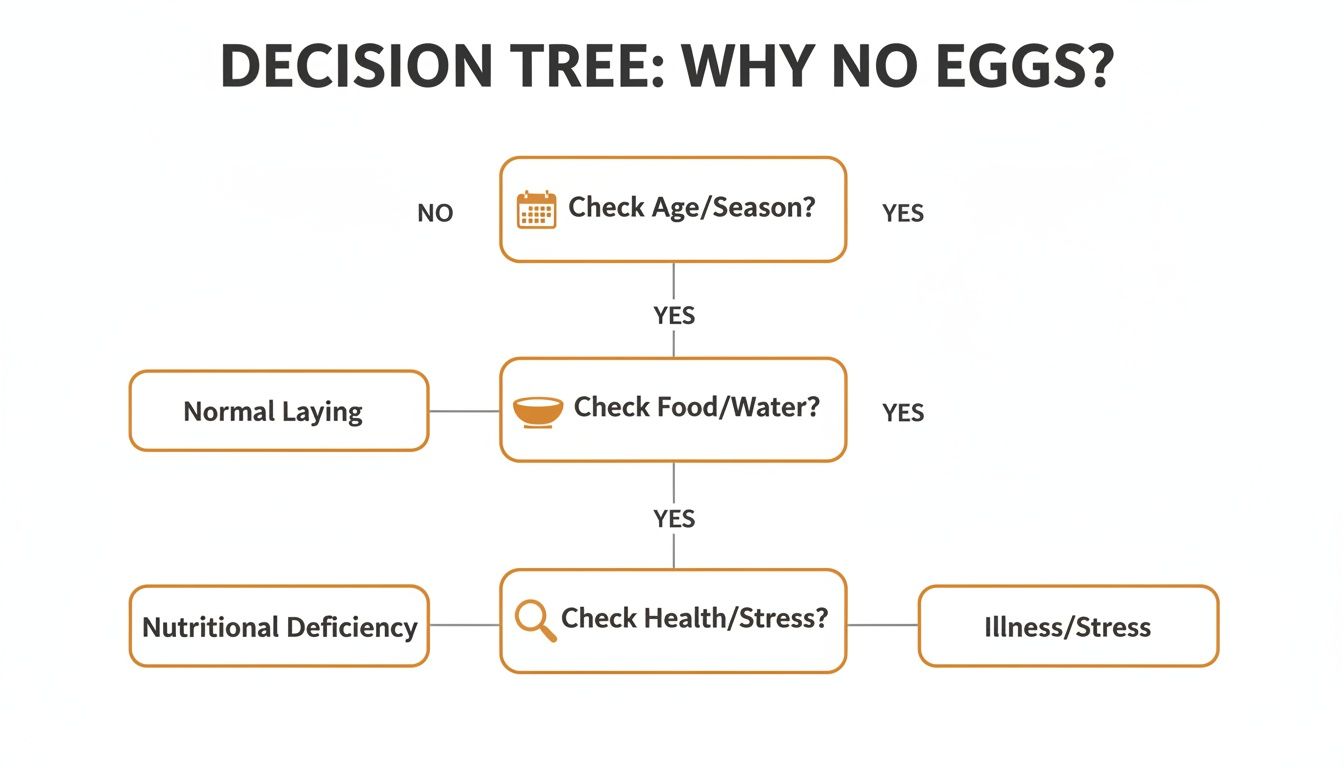
By starting with the most common causes, you can quickly narrow down the possibilities. For a more detailed breakdown, the table below is your go-to reference.
Common Reasons for Paused Egg Production
Use this quick-reference table to diagnose why your hens may have stopped laying and find the most effective initial solutions.
| Potential Cause | Key Symptoms | First Steps to Take |
|---|---|---|
| Seasonal Light Changes | A gradual or sudden stop in egg laying as fall and winter arrive. | Add supplemental light on a timer to provide a consistent 14-16 hours of light daily. |
| Nutritional Deficiencies | Soft shells, egg-eating, lethargy, or noticeable weight loss. | Confirm you're using a quality layer feed with 16-18% protein; offer free-choice supplemental calcium. |
| Stress | Hiding, feather loss from pecking, or a very abrupt stop in production. | Look for signs of predators, overcrowding, or bullying. Ensure every hen has enough space and resources. |
| Molting | Obvious feather loss, bald patches, and the appearance of new pin feathers. | Boost their protein intake with high-protein treats to help them regrow feathers faster. |
| Broodiness | A hen who refuses to leave the nest box, puffs up, and gets aggressive when you approach. | Gently and consistently remove her from the nest multiple times a day to break the hormonal cycle. |
| Age | A hen is over two years old and is laying much less frequently than before. | This is a natural decline. Continue to support her health with a quality diet and appreciate the eggs she gives. |
| Hidden Illness | A pale comb, lethargy, changes in droppings, sneezing, or respiratory sounds. | Perform a thorough health check and isolate any bird showing signs of sickness immediately to prevent spread. |
This table covers the biggest offenders, helping you troubleshoot with confidence and get your flock back on track.
Fueling Your Flock for Consistent Egg Laying
Think of your laying hen as a tiny, high-performance factory. Every single day, she needs the right raw materials to keep the production line humming. If even one key component runs short—especially calcium—the whole operation can grind to a halt. This is why nutrition isn't just important; it's the absolute bedrock of reliable egg production.
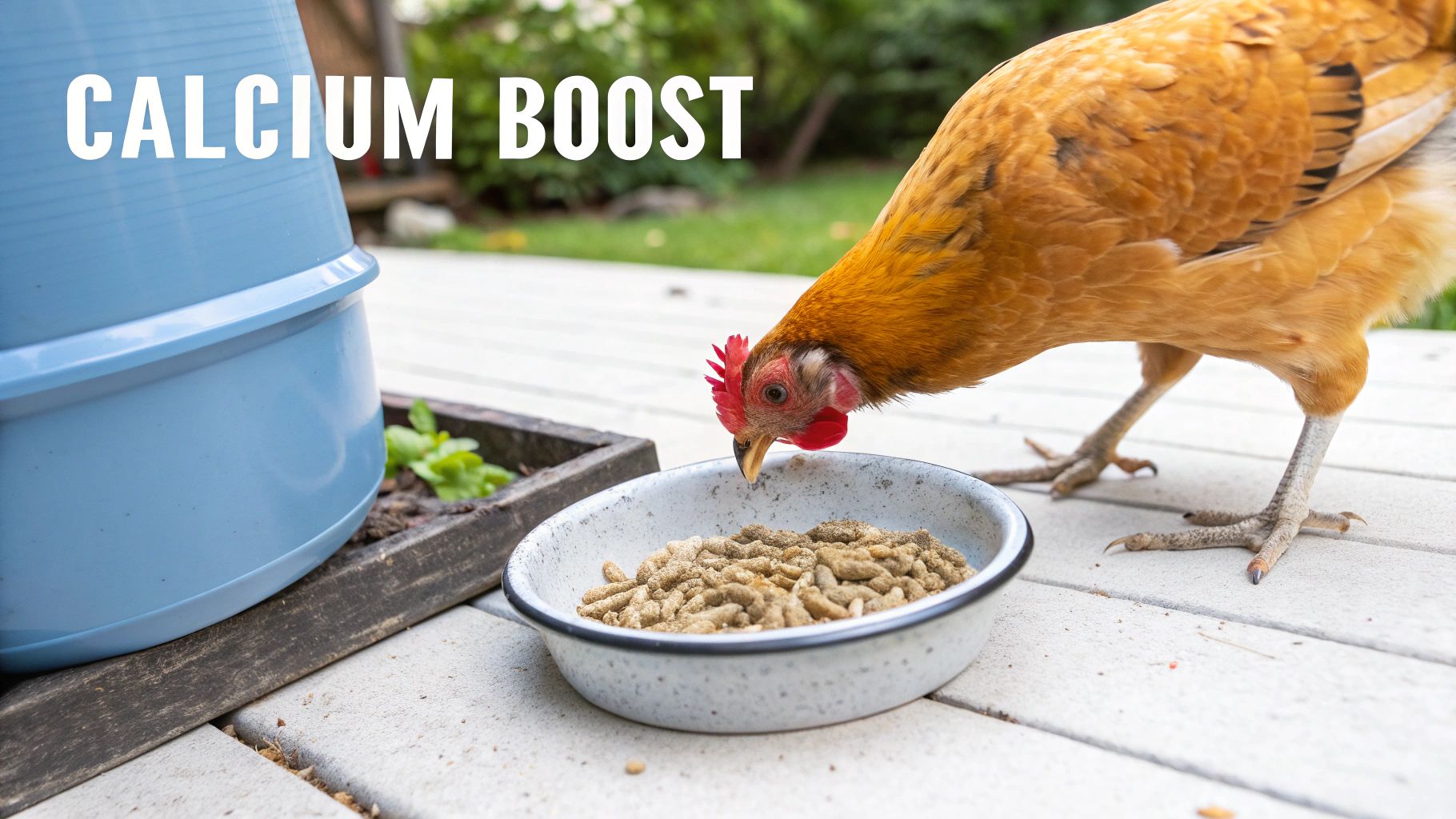
A quality layer feed is a great start, but it’s only the baseline. Chickens are notorious for picking through their food to find their favorite bits, like corn and tasty grains, often leaving the most nutrient-packed pellets behind. This kind of selective eating can quickly create nutritional gaps and is often the simplest answer to the frustrating question, "Why won't my chickens lay eggs?"
The Critical Role of Calcium
To create just one strong eggshell, a hen's body needs a surprising amount of calcium—between 4-5 grams of it. This isn't just a helpful nutrient; it's an absolute, non-negotiable requirement for egg production. If her diet doesn't provide enough, her body has a backup plan: it will start pulling calcium directly from her own bones.
But that’s a short-term fix. If the calcium deficiency continues, her system makes a smart survival decision. It shuts down egg production entirely to preserve her own health. You’ll often see the warning signs before the shutdown happens:
- Thin or soft shells: This is the first red flag that her calcium reserves are running dangerously low.
- "Rubber eggs": Sometimes, she'll lay an egg with only the membrane, a clear sign of a severe calcium shortage.
- A complete stop: Eventually, her body simply turns off the "egg factory" to conserve its own vital resources.
This is exactly where a high-calcium supplement becomes crucial, not just for improving eggshell quality, but for convincing her body it’s safe to start laying again.
Supercharging Her Diet for Egg Production
Getting a hen back into the rhythm of laying is a bit like coaching an athlete. Her standard feed is her daily meal plan, but a high-impact supplement is the specialized fuel that drives peak performance.
This is where Black Soldier Fly Larvae (BSFL) really shine. They are a nutritional powerhouse, and they are especially well-suited for this job. Unlike mealworms, which are comparatively low in calcium, Pure Grubs BSFL can contain up to 85% more of this essential mineral.
Adding a scoop of Pure Grubs to their feed accomplishes two things at once. First, it’s an exciting treat they'll gobble up, ensuring they actually consume the nutrients. Second, it delivers a concentrated dose of the exact "raw material" their bodies need to build strong eggshells and confidently restart the production line.
For a more detailed look at building the perfect diet, take a look at our complete guide on what to feed laying hens. By directly targeting and filling that calcium gap, you give your hens’ bodies everything they need to get back to work.
How Light and Seasons Influence Egg Production
Ever wonder why your egg basket starts to feel a little lighter as the days get shorter? It's not just your imagination. A hen’s entire world revolves around the sun, and her internal clock is hardwired to tell her when it’s the best time to raise healthy chicks. For her, long, sunny days are nature's green light for laying eggs.
This ancient biological trigger is hands-down one of the most common reasons your flock's egg production takes a nosedive in the fall and winter. To keep laying at full steam, a hen’s body needs to think it's spring. Without that critical signal from the sun, her reproductive system naturally powers down to save energy for the colder, leaner months ahead.
A hen's laying cycle is directly controlled by photoperiodism—her body's reaction to the length of daylight. Her pituitary gland needs a certain amount of light to kickstart the hormones responsible for ovulation.
Think of daylight as the "on" switch for your hen's personal egg factory. When that switch isn't flipped on for long enough each day, the whole production line grinds to a halt. This is why a sudden drop in egg numbers so often lines up perfectly with the changing of the seasons.
The Magic Number for Daylight
So, how much light is "enough"? For most breeds, the magic number is between 14 and 16 hours of light per day. Once the daylight hours dip below that, her body gets the memo to either slow down or stop laying altogether.
This is a powerful survival instinct passed down through generations. In the wild, shorter days mean winter is coming—a tough time to find enough food and successfully raise a brood. By putting egg-laying on pause, she saves precious calories and nutrients for herself. In fact, studies have shown that chickens stop laying when daylight drops below the 14-hour mark, but adding supplemental light can mimic springtime and significantly boost laying rates. You can dig into the data yourself by checking out the findings from this agricultural report.
Safely Using Supplemental Lighting
The good news? You can easily and safely trick your hens into thinking the days are longer, which helps ensure a steady supply of fresh eggs all year long. You don't need any fancy or expensive equipment—just a simple light bulb and a timer will do the trick.
Here’s how to set it up for success:
-
Choose the Right Bulb: A simple low-wattage LED or incandescent bulb is all you need. The goal is to provide gentle light, not to heat the coop. A 25 to 40-watt bulb is typically more than enough for a standard backyard coop.
-
Use a Timer for Consistency: Chickens are creatures of habit and thrive on a predictable routine. A plug-in timer is your best friend here, as it guarantees the light switches on and off at the same time every single day. An inconsistent schedule can actually stress them out and defeat the purpose.
-
Add Light in the Morning: The best way to do this is to set your timer to add those extra hours of light before sunrise. This allows the hens to wake up gradually with the artificial light and then go to roost naturally as the sun sets. Abruptly plunging them into darkness at night can cause panic and lead to injuries as they scramble for a perch.
By providing this little bit of consistent, gentle light, you can effectively manage one of the biggest reasons for a winter laying slump. For more tips on this, check out our guide on how to increase chicken egg production.
Understanding a Hen's Natural Breaks: Molting, Age, and Broodiness
Sometimes, an empty nesting box isn't a red flag. It’s just your hen listening to her body's natural rhythms. Before you start tweaking her feed or rearranging the coop, it's worth understanding the three most common—and completely normal—reasons a healthy hen takes a well-deserved break: molting, age, and broodiness.
Think of it less like a problem and more like scheduled downtime. A hen’s body works incredibly hard, and these cycles are built-in recovery periods that let her rest up for the next laying season. Knowing how to spot the signs can save you a lot of worry.
The Annual Molt: A Full-Body Feather Makeover
At least once a year, usually when the days start getting shorter in the fall, your flock will start to look a little… rough. This is molting, and it’s their version of a total wardrobe replacement. They shed their old, battered feathers and grow a fresh, fluffy set to get them through the cold winter. It's an exhausting, energy-intensive process.
Growing thousands of new feathers takes a ton of protein and nutrients. In fact, a single feather is over 85% protein. Faced with this massive biological task, a hen's body makes a very sensible choice: it shuts down the egg factory and redirects all that energy into making new feathers. During this time, which can last anywhere from 8 to 16 weeks, expect egg production to stop completely.
Your job is to support her through it with plenty of high-protein feed. You can learn more about how to do that in our guide on what to feed molting hens.
How a Hen's Age Affects Her Laying
Just like an athlete, a hen has her peak performance years. A young pullet usually lays her first egg around 18 to 22 weeks old. For the first year or two after that, she's an absolute egg-laying machine, often giving you an egg almost every single day.
But after about two years, you'll notice her production naturally starts to slow down. An older hen might lay every few days, take longer breaks, or eventually stop laying for good. This isn't a sign that she's sick—it's just a normal part of getting older. She’s earned her retirement and can still be a wonderful, bug-eating member of the flock for years to come.
When Your Hen Decides She's a Mom
Every now and then, a hen's powerful maternal instincts will kick in, and she'll go broody. This is a hormonal state where she becomes absolutely determined to sit on a clutch of eggs and hatch them. You'll know it when you see it: she'll be flattened in the nesting box like a pancake, puffing up her feathers and making a low, protective growl if you get too close.
When a hen is broody, her body completely halts egg production. Her one and only mission is to incubate her clutch—whether the eggs are real or imaginary. If you aren't planning on raising chicks, the best thing to do is to gently "break" her broodiness by regularly moving her out of the nest and away from the temptation.
These natural cycles explain a lot of empty nesting boxes. Hens over two years old naturally slow down, while molting birds will pause laying for 8-16 weeks to regrow feathers. For those of us raising flocks, high-calcium BSFL from Pure Grubs can help speed up post-molt recovery. With 85% more calcium than other treats and no preservatives, they support strong shell development and a quicker return to laying. You can dig into more poultry facts and figures over at UnitedEgg.com.
How to Identify and Reduce Flock Stress
Chickens are creatures of habit, plain and simple. Their ability to lay those beautiful eggs is directly linked to how safe and secure they feel. When something spooks a hen or throws her routine out of whack, her body flips into a "fight or flight" mode. It's a survival instinct that instantly redirects all her precious energy away from non-essential tasks—like making eggs—and pours it into staying alive.
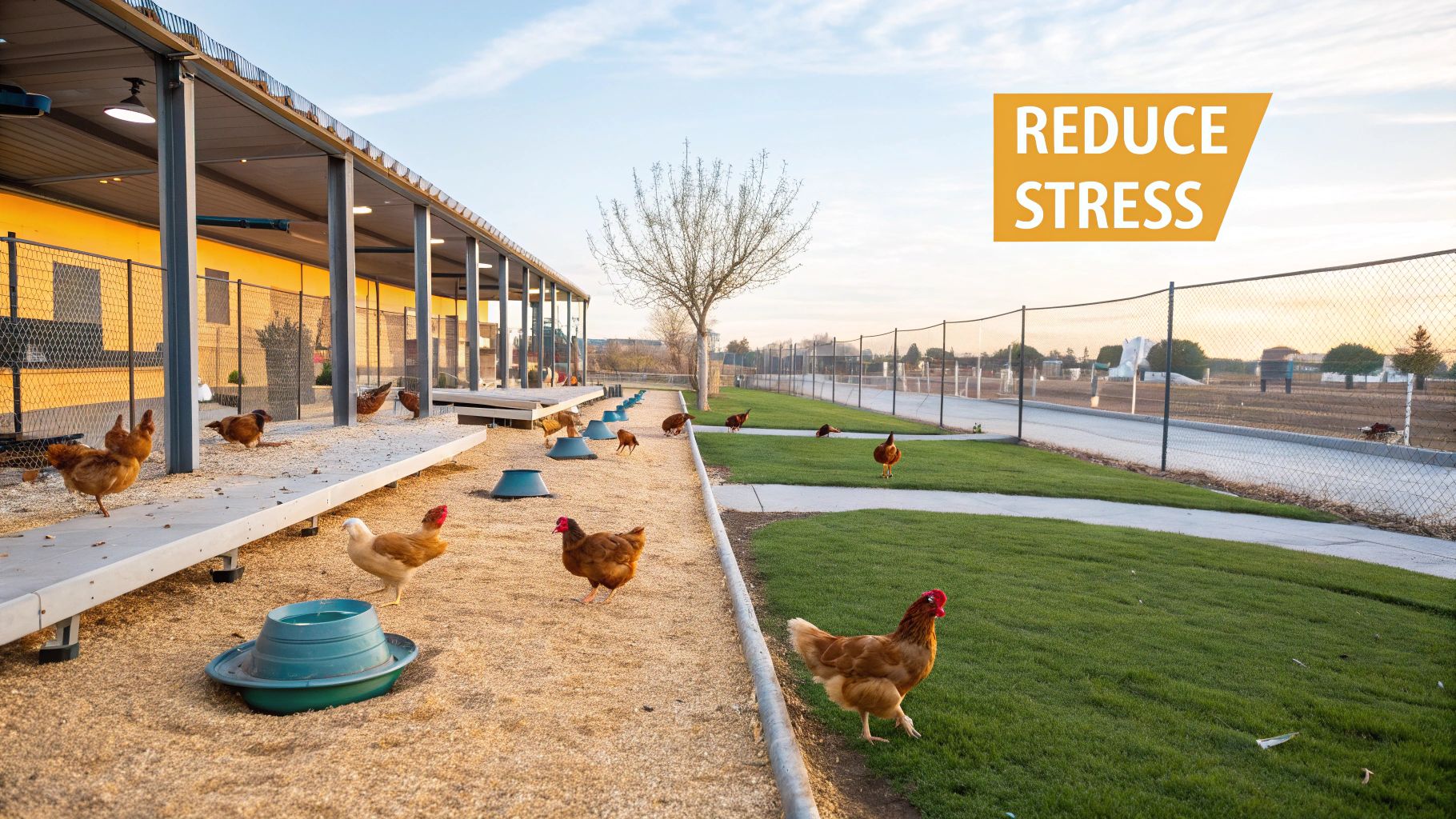
Think of it like a personal energy budget. On a good day, a hen has plenty of resources to cover all her bodily functions, with a surplus set aside for egg production. But when stress hits, it’s like a sudden, massive emergency bill that drains the account, leaving nothing left for the "luxury" of laying an egg.
Common Coop Stressors and Their Solutions
Even small changes that you might not notice can put your entire flock on edge. A calm, predictable environment is one of the best things you can provide for consistent egg-laying. The good news is that many of these stressors are surprisingly easy to fix once you know what to look for.
A few of the biggest culprits in the coop are:
- Overcrowding: This is a recipe for conflict, bullying, and disease. As a rule of thumb, make sure each standard-sized bird has at least 4 square feet of coop space and 10 square feet in their outdoor run.
- Resource Competition: If your hens have to fight over food and water, the ones at the bottom of the pecking order will be constantly stressed and underfed. Often, just adding an extra feeder and waterer on the opposite side of the coop can solve this overnight.
- Predator Threats: A hawk circling overhead, a raccoon rattling the coop at night, or even the neighbor's dog barking at the run can put egg production on hold for days. The fix is to secure the coop and run with sturdy hardware cloth (not chicken wire!) and provide cover spots like shrubs or small A-frames where they can hide.
A hen’s perception of safety is everything. The mere presence of a predator, even without an attack, can trigger a hormonal cascade that shuts down her reproductive system as a self-preservation measure.
Changes in the Flock and Environment
Chickens live by a very strict social ladder, what we call the pecking order. Any disruption to this hierarchy is a major stress event for every single bird in the flock.
Introducing new chickens, for example, forces everyone to re-establish their place in the order, which often involves some squabbling and a temporary halt in laying. Likewise, sudden loud noises from construction next door, a constantly barking dog, or even something as simple as moving the coop to a new spot can be enough to throw them off their game.
Keeping their world as consistent and peaceful as possible is one of the most effective ways to keep your hens feeling safe, happy, and productive.
Checking Your Hens for Hidden Health Issues
When a hen suddenly stops laying, it’s often her body’s way of sending up a flare signal. Think about it: a healthy, happy hen is a laying hen. But when she feels unwell, her system wisely redirects all its energy toward healing and survival, not egg production. Becoming a good flock keeper means learning to spot these subtle signs before they escalate into bigger problems.
A quick wellness check is one of the best habits you can develop. Consider yourself a bit of a flock detective, looking for clues that tell the real story of your hen’s health. A simple head-to-toe inspection can reveal exactly why those nesting boxes are suddenly empty.
Performing a Simple Wellness Check
You definitely don't need to be a vet to give your chickens a basic health assessment. Just gently pick up a hen and hold her securely, speaking to her in a calm, reassuring voice. A healthy bird should feel solid and well-muscled, not frail or bony to the touch.
Start by examining her head. Her eyes should be bright, clear, and wide open, with no sign of discharge or swelling. Her comb and wattles are fantastic barometers of her overall condition—they should be a vibrant, rich red. A pale, droopy, or purplish comb is almost always one of the very first signs that something is off.
Next, take a look at her vent, which is the all-in-one opening where she lays eggs and passes waste. A healthy vent should be clean, moist, and a healthy pinkish color. If you see a dirty, messy vent, it can point to digestive trouble or internal parasites, both of which are common reasons why chickens won't lay eggs.
Spotting Common Parasites and Pests
External parasites like mites and lice are tiny energy vampires. They can quite literally drain a hen’s resources, leading to anemia and a complete shutdown of egg production. This is a very frequent—but often overlooked—cause of laying slumps.
Here’s what to look for when you're checking her over:
- Mites: Keep an eye out for tiny red or black specks, especially around the vent and under the wings. You might also spot irritated skin. Another common issue is scaly leg mites, which cause the scales on her legs to become raised and crusty.
- Lice: Look for clusters of small, white eggs glued to the base of the feathers. The vent area is a hotspot for these.
- Behavioral Clues: A hen struggling with parasites often seems agitated. She might preen constantly or have bald patches from picking at her own irritated skin.
When it comes to pests, prevention is always the best medicine. Giving your flock a dedicated dust bath filled with sand, soil, and a sprinkle of diatomaceous earth provides a natural way for them to keep parasites at bay.
Ultimately, a clean and dry coop is your number one defense against most health issues. By checking in on your flock regularly and getting a feel for what "normal" looks and feels like, you'll be able to catch problems early and help your hens get back to their happy, healthy, egg-laying selves.
Common Questions About Chicken Egg Laying
Even when you've done everything right, you'll still have questions when the egg basket starts coming up empty. Let's tackle some of the most common head-scratchers I hear from fellow chicken keepers.
How Long Does It Take for a Hen to Lay Again After Fixing a Problem?
This really depends on what caused the "egg-it" in the first place. Every situation is a little different.
If you've just corrected a simple issue, like adding more light during the winter or beefing up their feed, you could see eggs again in just a couple of weeks. Sometimes, if it was a minor scare like a dog barking all night, they might only take a day or two off.
But if your hen is in the middle of a heavy molt, you have to play the waiting game. That's a huge, natural-but-draining process for her. It can easily take 8 to 16 weeks before she's fully re-feathered and has the energy to start laying again.
Why Is My Hen Eating Her Own Eggs?
This is one of the most maddening habits a chicken can pick up. Almost every time, it signals that she's missing something important in her diet—usually calcium or protein. Her body is practically screaming for those nutrients, and she's found a source right there in the nesting box.
It can also start by accident if an egg breaks and she gets a taste. To break the cycle, make sure she's on a high-quality layer feed, provide extra calcium (like crushed oyster shells), and collect eggs as soon as you can. A clean, well-padded nesting box helps prevent accidental breaks, too.
Can Adding New Chickens Stop My Flock from Laying Eggs?
Oh, absolutely. Bringing new birds into the fold is a huge deal for a flock. It completely throws their established "pecking order" into chaos, and that social stress is a classic reason for egg production to screech to a halt.
You might see a laying strike that lasts for several weeks while everyone figures out their new place in the hierarchy. The best way to soften the blow is to introduce new members gradually, and ensure you have more than enough space, feeders, and waterers to keep squabbles to a minimum.
A consistent, high-calcium diet is your best defense for helping hens bounce back from stress, molting, and other laying pauses. Pure Grubs are USA-grown Black Soldier Fly Larvae that pack up to 85% more calcium than mealworms. This boost helps build stronger shells and gets your flock back on track faster. Give your hens the nutritional boost they need today.