


Why Are Chickens Not Laying Eggs A Backyard Keeper's Guide
If you've noticed your nesting boxes are suddenly empty, you're not alone. Chickens can stop laying eggs for a whole host of reasons, and it’s rarely just one thing. Often, it’s a mix of factors, from simple seasonal light changes and diet deficiencies to normal life stages like molting or broodiness.
The good news is that you can usually figure it out by playing detective and paying close attention to your flock and their environment.
The Mystery of the Empty Nesting Box
It’s a feeling every chicken keeper knows well: you head out to the coop, basket in hand, expecting a haul of fresh eggs, only to find nothing. Your first thought might be that something is seriously wrong, but a drop-off in egg production is often a perfectly natural part of a hen's life.
It helps to think of a hen’s ability to lay as a highly sensitive system that’s directly wired to her well-being and surroundings. She isn't an egg-making machine; she’s a living creature with deep-seated biological rhythms.
Her body is constantly picking up cues from the world around her. When conditions aren't right for raising healthy chicks—like during the dark, cold days of winter or when she's under physical stress—her system wisely shuts down the "egg factory" to conserve her own precious energy.
Key Factors Influencing Egg Laying
Getting to the bottom of why your chickens are not laying eggs starts with looking at the bigger picture. Several core factors can bring production to a grinding halt, and they often overlap.
- Daylight Hours: A hen's entire reproductive cycle is triggered by light. To lay consistently, she needs at least 14 hours of daylight a day.
- Nutrition and Diet: Creating a perfect egg is a huge nutritional drain. If she’s not getting enough protein, calcium, or even clean water, her body will stop production almost immediately.
- Age and Breed: A hen’s prime laying years are her first two. After that, you’ll see her production naturally and gradually slow down.
- Stress and Environment: Things like overcrowding, predator threats, loud noises, or a messy coop can cause a spike in stress that directly impacts laying. If you're wondering about your setup, you can learn how to perfect your chicken coop egg collection in our detailed guide.
- Natural Cycles: Molting (the yearly process of regrowing feathers) and broodiness (the powerful instinct to sit on and hatch eggs) are normal, healthy breaks that every hen takes.
To help you get a head start on your investigation, the table below quickly summarizes the most common culprits behind an empty nesting box.
Quick Guide to Common Egg Laying Issues
This table breaks down the most frequent reasons your hens might have stopped laying and offers an initial solution to investigate.
| Common Cause | Key Symptoms | Quick Solution |
|---|---|---|
| Less Daylight | Egg production stops in fall/winter. | Allow a natural rest period or add supplemental coop lighting. |
| Molting | Feather loss, patchy appearance, usually in autumn. | Increase protein intake with a high-quality feed to support feather growth. |
| Poor Nutrition | Thin or soft shells, lethargy, reduced laying. | Ensure constant access to layer feed and a calcium source like oyster shell. |
| Stress | Hiding, reduced activity, sudden stop in laying. | Identify and remove stressors like predators, bullying, or overcrowding. |
| Broodiness | Hen stays in the nest box, acts aggressively, fluffs up. | Gently and consistently remove her from the nest box to break the cycle. |
| Age | Hen is over 3 years old and lays infrequently. | This is a natural decline; enjoy her as a flock member. |
Think of this as your starting checklist. By working through these common issues, you can usually pinpoint the problem and get your girls back on track.
A Hen's Natural Egg Laying Journey
To figure out why your egg basket is suddenly empty, we first need to get inside the mind—and body—of a hen. A chicken isn't an egg-making machine that you can just switch on and off. She’s a living creature with a built-in biological clock that dictates when she lays, why she lays, and when she takes a well-deserved break.
Understanding this natural rhythm is the key. It helps you spot the difference between a real problem and a hen just doing what nature intended.
Think of it like this: a hen is born with a finite "basket" of potential eggs. She’s not going to lay forever, and her output will absolutely change over time. Once you get a feel for her journey from a gangly young pullet to a seasoned flock matriarch, you can set realistic expectations and give her the right support at every stage.
The Lifetime Egg Supply
Here's a fascinating fact: a female chick hatches with every single yolk (or ova) she will ever produce already inside her. Her body's job isn't to create new eggs from scratch, but to mature and release the ones she was born with. This is precisely why a hen’s first year of laying is always her most impressive.
After that initial burst of productivity, you can expect her output to drop by about 15-20% each year. So, a hen that gave you 250 beautiful eggs in her first year might give you around 200 in her second, and so on. This isn't a sign that something's wrong; it's just the simple, predictable reality of her biology.
From Pullet Eggs to Peak Production
A young hen, called a pullet, usually starts laying her first eggs somewhere between 18 and 24 weeks of age. Don't be surprised if her first few attempts are... well, a bit weird. These "pullet eggs" are often tiny, misshapen, or even shell-less. It’s all perfectly normal—her internal egg factory is just warming up.
Within a few months, she’ll hit her stride and enter her peak production phase, which typically lasts for her first two years. During this time, the incredibly complex process of forming a single egg takes about 26 hours.
- First, her ovary releases a yolk (ova).
- Next, the yolk travels down the oviduct, where it gets wrapped in layers of egg white (albumen), a process that takes several hours.
- Finally, it enters the shell gland, where it spends a whopping 20 hours being encased in its protective calcium shell.
This demanding schedule is why even the most champion layers rarely manage more than one egg per day. It’s an energy-intensive marathon, not a sprint.
A hen's body pours a tremendous amount of resources—especially calcium and protein—into every single egg. If anything disrupts her health, diet, or sense of security, her body will wisely hit pause on that 26-hour assembly line to conserve energy.
Breed and Annual Output
Of course, genetics plays a huge role. Some breeds were developed specifically for high-volume egg production, while others lay more modestly but for more years.
| Breed Type | Average Annual Eggs | Laying Characteristics |
|---|---|---|
| Production Reds | 250 - 300+ | Bred for high volume; tend to slow down significantly after 2 years. |
| Leghorns | 280 - 320 | Prolific white-egg layers; known for their efficiency. |
| Plymouth Rocks | 200 - 280 | Dual-purpose birds; steady layers of brown eggs. |
| Orpingtons | 150 - 200 | Heritage breed; known for consistent laying and going broody. |
Knowing your breed's potential gives you a realistic baseline for what to expect from your flock.
The Annual Cycle of Light and Rest
If there's one factor that overrides all others, it's daylight. A hen’s reproductive cycle is wired to the sun. She needs at least 14 hours of light each day to trigger the hormones responsible for egg production.
When the days get shorter in the fall, her body gets a clear signal: winter is coming. In the wild, this means food will be scarce and it's a terrible time to try and raise chicks. So, her system naturally begins to shut down production.
This annual winter break is one of the most common reasons why chickens are not laying eggs. It’s not a problem—it’s a vital rest period that lets her body recover and recharge for the spring laying season.
How a Hen’s Environment Affects Her Laying
Think of a hen's body as a finely tuned egg-making machine. Her environment is the world that machine operates in. If that world is stable, safe, and predictable, she’ll be a consistent producer. But when things get chaotic or stressful, her system shuts down production to focus on one thing: survival.
A hen is incredibly sensitive to her surroundings. She's constantly reading signals to determine if it’s a good time to bring new life into the world. If the answer is "no," the egg assembly line grinds to a halt. Luckily, by taking a good look at your coop and run, you can often spot exactly what’s causing the egg shortage and fix it.
The Power of Light
Daylight is the single most important switch for a hen's reproductive cycle. It all comes down to her pituitary gland, a tiny but powerful organ in her brain that reacts directly to how long and bright the days are. To keep laying steadily, she needs a solid 14 to 16 hours of daylight every day.
As the days get shorter in the fall and dip below 12 hours, that gland sends a clear signal throughout her body: "Winter is coming. Time to rest." This is a natural, healthy shutdown that helps her conserve energy for the cold months. While many chicken keepers let their flocks take this winter break, you can also add a low-wattage bulb on a timer to give them a few extra hours of "daylight" in the morning and keep the eggs coming.
The Impact of Stress
Chickens are creatures of habit. They thrive on routine and a calm, predictable life. Anything that shatters that peace can trigger a stress response, flooding their system with hormones like cortisol that put a direct stop to egg laying. A stressed-out hen simply won't lay.
So, what stresses a chicken out? More things than you might think.
- Predator Threats: Even seeing a hawk circling high above or hearing a neighborhood dog barking near the fence can be enough to stop egg production for days. Make sure their run is secure and has places for them to hide and feel safe.
- Flock Drama: Bullying, squabbles over the feeder, or introducing new birds can create massive social stress. A hen at the bottom of the pecking order is often too stressed to lay.
- Loud Noises: Nearby construction, a loud party next door, or any constant, unfamiliar racket can put the whole flock on edge and cause a collective drop in egg numbers.
- Extreme Weather: A blistering heatwave or a bitter cold snap forces a hen to put all her energy into just staying cool or warm. There’s simply nothing left over for making eggs. This is why shade in the summer and a draft-free coop in winter are non-negotiable.
A hen’s sense of security is directly tied to her ability to lay. She needs to feel that her environment is a safe place to bring the next generation into the world. If it’s not, her body will simply refuse to try.
Your Coop and Nesting Box Conditions
Finally, the state of their home base plays a huge role. No hen wants to lay an egg in a place that’s dirty, crowded, or feels unsafe. The coop should be their sanctuary, not another source of stress.
When you look over your setup, check for these common problems:
- Overcrowding: Every chicken needs at least 4 square feet of space inside the coop and 10 square feet out in the run. Cramming them in leads to bullying, stress, and a much dirtier environment.
- Poor Ventilation: Ammonia from droppings can build up fast, causing respiratory problems and making the coop an awful place to be. You need good airflow to get the stale air out, but without creating a cold draft.
- Dirty Nesting Boxes: Hens are surprisingly picky. If the nesting boxes are full of poop or don’t have enough clean, soft bedding, they’ll either find somewhere else to lay (like under a bush) or just stop laying entirely. Keep those boxes fresh and inviting.
Big environmental shocks can have a huge impact, and this is true for backyard flocks just as it is for commercial farms. We see this on a massive scale when events like avian flu outbreaks lead to a projected 4.4% cut in U.S. egg production for 2025. Those industry-wide dips, as detailed in reports on egg production statistics, are caused by the same biological principles that make your stressed hen stop laying—it’s just a matter of scale.
The Fuel Your Egg Factory Needs
Picture your laying hen as a tiny, highly efficient biological factory. Every single egg that appears in her nesting box is the end product of a complex, energy-draining process, and that process requires specific, high-quality fuel. If the right ingredients aren't on the menu every day, the entire assembly line slows to a crawl or shuts down completely.
A hen's body is incredibly smart. It knows instinctively when it lacks the nutritional resources to build a healthy egg. Instead of producing a weak or deficient egg that couldn't support a viable chick, her system will conserve energy by pausing production altogether. It's a built-in survival mechanism, and it all starts with what you put in her feeder.

The Unmistakable Importance of Protein
Protein is the absolute cornerstone of a hen's diet—it’s the primary building block for her body and her eggs. A high-quality layer feed isn't just a good idea; it's the non-negotiable foundation for any laying flock. You need to be feeding a formula that contains 16-18% protein to support both her daily bodily functions and the demanding job of egg creation.
If her diet dips below that, often from too many low-protein treats like scratch grains or kitchen scraps, her body is forced to make a choice. It will divert the limited protein to essential life-sustaining functions—like tissue repair and immune response—leaving nothing left over for the "luxury" of making an egg.
The Calcium Conundrum
An eggshell is almost 95% calcium carbonate. That means a laying hen has to find and process a huge amount of calcium every single day just to keep up with production. It takes about 2 grams of calcium to form one strong eggshell, but a hen’s body can only store around 1 gram at a time. The rest has to come directly from her daily meals.
When calcium runs short, you’ll see the signs almost immediately.
- Thin, weak, or rubbery eggshells are the first major red flag.
- A complete stop in laying follows when her body can't even scrape together enough calcium for a single shell.
This is precisely why you must offer a separate, free-choice source of calcium, like crushed oyster shells. It allows each hen to take exactly what her body needs, right when she needs it. To dive deeper into crafting the perfect diet, check out our guide on what to feed laying hens for optimal health.
This direct link between nutrition and egg output is a well-documented phenomenon. Even on a national scale, by January 2025, U.S. egg output had dropped by 4% year-over-year, a decline tied directly to nutritional shortfalls and high feed costs. When hens don't get the right fuel, they simply stop producing.
A fantastic solution for backyard keepers is to supplement with high-calcium treats. Pure Grubs Black Soldier Fly Larvae (BSFL), for example, pack up to 85% more calcium than mealworms. This directly tackles the deficiencies that cause laying to stop and helps your hens build strong, healthy eggshells.
Hidden Health Issues That Stop Laying
Sometimes, the problem isn’t the fuel you’re providing, but tiny thieves stealing a hen's energy from the inside out. Parasites can quickly drain a hen's resources, leaving her too weak and run-down to even think about laying an egg.
A quick health check can help you spot these hidden culprits.
- Mites and Lice: These nasty external parasites live on a hen's skin and feathers, usually congregating around the vent. They feed on her blood, causing anemia, constant irritation, and a ton of stress. Look for tiny moving specks, clumps of eggs at the base of feathers, and raw, red skin.
- Internal Parasites (Worms): Roundworms and other internal parasites set up shop in the hen's digestive system and steal nutrients before she can absorb them. The symptoms can be subtle, but often include lethargy, pale combs and wattles, and strange-looking droppings.
A healthy hen is a productive hen. By ensuring her diet is perfectly balanced and she is free from energy-sapping parasites, you give her internal egg factory everything it needs to run smoothly and keep those nesting boxes full.
Molting and Broodiness: Nature's Scheduled Breaks
Sometimes, an empty nest box isn't a sign of trouble at all. It's just a hen doing what hens do. Before you jump to conclusions about illness or diet, it's worth understanding the two most common—and perfectly normal—reasons a healthy hen stops laying.
Think of these pauses as part of a chicken's natural rhythm. One is like a scheduled wardrobe change, and the other is a powerful maternal instinct taking over. Knowing the difference can save you a lot of worry.
The Annual "Spa Day": Molting
Every year, usually as the autumn days grow shorter, your flock will start its annual molt. This is their natural process of shedding old, battered feathers to grow a fresh, thick coat for the winter ahead. The first sign? Feathers everywhere. Your birds might look a little scruffy and bare for a bit.
Growing a whole new set of feathers is a massive energy drain. Feathers are made of about 85% protein, and producing thousands of them requires a hen to divert all her bodily resources to the task.
It’s a simple trade-off: a hen's body can either make feathers or make eggs, but it can’t do both at once. Feather production takes priority every time, so egg laying grinds to a halt. This natural break can last anywhere from 8 to 16 weeks.
The best way to support your flock during this time is to up their protein. Giving them a feed with a higher protein content—around 20%—can help them regrow their feathers more quickly and get back to laying sooner.
The Broody Hen Mindset
The second normal break from laying is broodiness. This is when a hen's powerful maternal hormones kick in, telling her it's time to sit on and hatch a clutch of eggs. Some breeds, like Silkies and Orpingtons, are famous for their tendency to go broody.
A broody hen is completely focused on one thing: hatching chicks. She'll stop laying new eggs and will plant herself in a nesting box, determined to sit on her clutch—even if the eggs aren't fertile.
You'll know you have a broody hen if you see these classic signs:
- She refuses to leave the nest box, only getting up for a quick bite and a drink.
- She’ll fluff up, puff out her chest, and let out a deep, dinosaur-like growl if you get too close.
- She might even peck at you to defend her nest.
This motherly trance typically lasts for 21 days, which is the incubation period for chicks. While it’s completely natural, you don't want her to stay broody for too long if you aren't hatching eggs, as she can lose a lot of weight and condition.
There are gentle ways to snap her out of it and get her back into the flock's routine. For a complete walkthrough, check out our guide covering the symptoms of broody chickens and how to manage them. Understanding these natural cycles helps you see an empty nest not as a problem, but as a sign that your hen is just following her instincts.
Your Step-By-Step Diagnostic Checklist
When the nesting boxes suddenly go empty, it's time to play detective. Instead of just guessing what's wrong, a systematic approach is your best bet. This checklist will help you work through the most common reasons hens stop laying, starting with the simplest and most natural causes.
This way, you can methodically rule things out and zero in on the real issue.
Let's begin with the most obvious and entirely normal reasons for a laying break. This simple flowchart is a great visual guide for quickly figuring out if your hen is just on a natural, healthy pause from her duties.
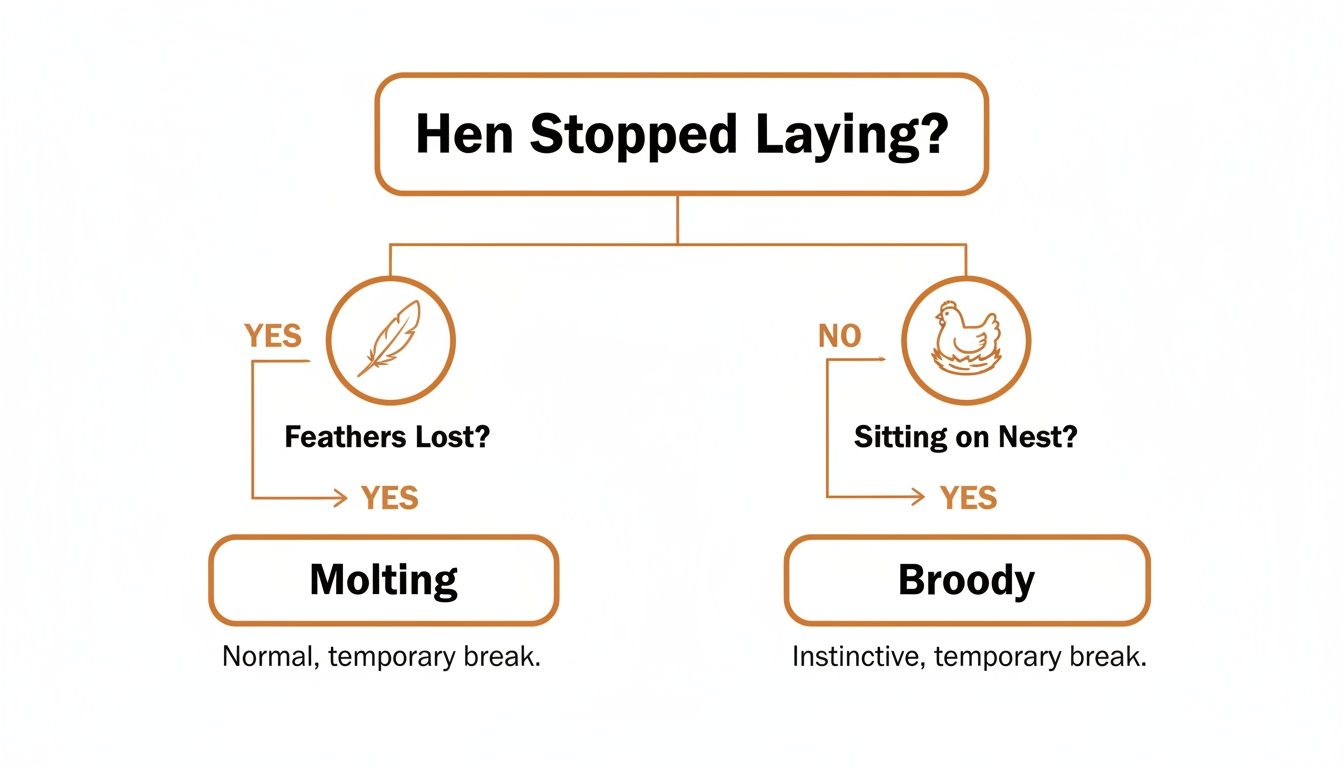
As you can see, the two most common natural breaks are easy to spot: if she’s losing feathers, she's molting. If she’s glued to the nest, she's gone broody.
Step 1: Look for Natural Cycles
Before you start worrying about bigger problems, always check for these two perfectly normal phases in a hen's life. They are nothing to be alarmed about.
-
Is she molting? Take a look around the coop. See a bunch of feathers everywhere? Is your hen looking a bit scruffy and patchy? She's molting. This process of shedding old feathers for a new winter coat demands a huge amount of protein, so her body puts egg production on hold.
-
Is she broody? A broody hen is unmistakable. She’ll sit stubbornly in the nesting box, puff out her feathers like a feathered balloon, and might even let out a low growl when you get close. Her powerful mothering instincts have kicked in, and her sole focus is hatching eggs—even if there aren't any.
If you answered yes to either, you've probably found your culprit. Just support her with plenty of good food and water, and she'll get back to laying when she's ready. If not, let's move on.
Step 2: Assess Her Environment
A hen’s environment directly affects her ability to lay eggs. If she's stressed or uncomfortable, egg production is often the first thing to shut down. Take a walk through your coop and run, and see it from her perspective.
-
Is there enough light? Hens need at least 14 hours of daylight to keep their egg-laying hormones firing. As the days get shorter in the fall and winter, a lack of light is a primary suspect.
-
Is the coop clean and safe? Look for damp, dirty bedding or a sharp ammonia smell that stings your nose. Are the nesting boxes clean, dry, and inviting, or are they a mess? Check for any signs of predators that might be spooking the flock at night.
-
Is there peace in the flock? Spend some time just watching your chickens interact. Do you see any bullying? Is the coop overcrowded? A stressed-out hen, especially one at the bottom of the pecking order, will often stop laying.
Step 3: Evaluate Her Diet and Health
If her environment checks out, it’s time to look at her fuel tank and overall condition. A quick, hands-on health check can tell you everything you need to know.
Gently pick her up and feel her body. Does she feel lighter than normal? Is her comb pale and shrunken instead of bright red and full? Carefully check the feathers around her vent for mites or lice—they look like tiny, fast-moving specks.
Widespread health issues can have a massive impact, a fact we see even at the national level. For instance, in June 2025, U.S. egg production dropped by 5% compared to the previous year, a decline largely attributed to avian flu outbreaks. For backyard keepers, this is a stark reminder of how quickly health problems can stop production. It also underscores why building flock resilience with great nutrition—including high-calcium treats like USA-grown Black Soldier Fly Larvae (BSFL)—is so important. You can read more about the trends in U.S. egg production.
When to Call a Vet
Most laying pauses can be fixed at home, but some signs are red flags that need a professional. If a hen is lethargic, has a swollen, hard abdomen, is walking like a penguin, or seems to be straining without passing an egg, she could be egg-bound. This is a life-threatening emergency that requires immediate veterinary care.
Your Top Egg-Laying Questions, Answered
Even after keeping chickens for years, you'll run into situations that leave you scratching your head. When the nesting boxes are suddenly empty, specific questions tend to pop up. Let's get right to them.
How Long Can a Chicken Go Without Laying an Egg?
This is a classic "it depends" situation, but we can definitely narrow it down. A healthy hen's break from laying really hinges on the reason behind it.
Here’s a rough timeline you can expect:
- During a heavy molt: Don't expect any eggs for a while. A hen will typically take an 8 to 12-week break as her body pours all its resources into growing a new set of feathers.
- If she's gone broody: She'll stop laying for about 3 to 4 weeks. This lines up perfectly with the time it would take to hatch a clutch of eggs.
- For the winter slowdown: The short days trigger a natural pause that can last 2 to 3 months. It's her body's way of conserving energy.
If a hen in her prime stops laying for more than a week and you can't pinpoint a reason like molting or broodiness, it’s time to play detective. A good health check and a thorough look around the coop are your next steps.
Is My Hen Too Old to Lay Eggs?
Age is absolutely a factor, and it's one of the most common reasons for a drop-off. A hen's first two years are her egg-laying prime. After that, you'll see a natural and gradual decline in production each year.
Once she hits age five or six, it's completely normal for her to lay only sporadically or stop laying altogether. This isn't a sign that something's wrong; think of it as her well-earned retirement from the demanding work of egg production.
What does it mean if my hen laid a soft-shelled egg?
A soft, rubbery egg is a big red flag for a calcium deficiency or a sudden jolt of stress. It means her system just couldn't pull together the resources to finish the shell. Make sure she has free-choice calcium, like crushed oyster shells, available at all times. If she seems sick or is straining, she could be egg-bound—a serious condition that needs immediate attention.
To give your girls a reliable, high-calcium treat that helps build strong eggshells and supports their overall health, we trust Pure Grubs. Our USA-grown Black Soldier Fly Larvae are a safe and natural way to make sure your flock has the nutritional building blocks they need.