

What Does FDA Compliant Mean for Poultry Feed
Most flock owners assume that “FDA compliant” means a product has been tested, approved, and proven safer than competing feed. That assumption is understandable, but it can lead you to overlook the evidence that matters most for chickens, ducks, and the eggs they produce.
The phrase usually describes a facility's legal alignment with FDA requirements. It doesn't automatically mean the finished feed earned an FDA approval stamp, passed independent heavy metal screening, or offers superior nutrition. To understand what does FDA compliant mean for poultry feed, separate the regulatory baseline from the voluntary testing, sourcing records, and manufacturing controls that give you a clearer view of real-world safety.
The Truth Behind the FDA Compliant Label
A bag of chicken treats marked FDA compliant can sound like it carries an official government seal. It doesn't. In food and animal-feed contexts, the phrase generally communicates that the business believes it follows the rules that apply to its facility, product category, labeling, and production practices. That's important, but it's narrower than approval or certification.
The FDA's food business guidance explains the registration and food-safety obligations that apply to covered food facilities. Those obligations create a legal foundation. They don't turn the words “FDA compliant” into a guarantee that every ingredient was independently tested or that one product is nutritionally better than another.
Compliance is a floor, not a trophy
Think of compliance as the floor of a coop, not the quality of every feeder placed inside it. A clean floor is necessary, but it doesn't tell you whether the feed is fresh, traceable, properly formulated, or screened for contaminants.
For a backyard flock owner, the practical distinction looks like this:
- Facility compliance concerns whether a covered operation meets applicable registration, manufacturing, sanitation, hazard-control, and recordkeeping requirements.
- Product testing concerns what a particular batch contains and whether the manufacturer checked for hazards such as heavy metals.
- Nutritional quality concerns the feed's ingredients, intended use, nutrient profile, and suitability for the species receiving it.
- Transparency concerns whether the seller can explain where ingredients came from, how they were processed, and what records support its claims.
Those categories overlap, but none automatically proves the others. A registered facility may still leave shoppers with unanswered questions about batch testing. A transparent label may still need verification. A product can follow applicable rules without being the most nutritious option available.
Practical rule: Treat “FDA compliant” as a starting point for questions, not as the final answer.
The same principle applies to packaging used around regulated food production. A company evaluating custom films for food safety is addressing a packaging and handling consideration, but suitable packaging alone doesn't prove that the feed inside was tested for every contaminant. Look for the complete safety picture, including facility practices, source records, and test documentation.
Facility Registration and Legal Requirements
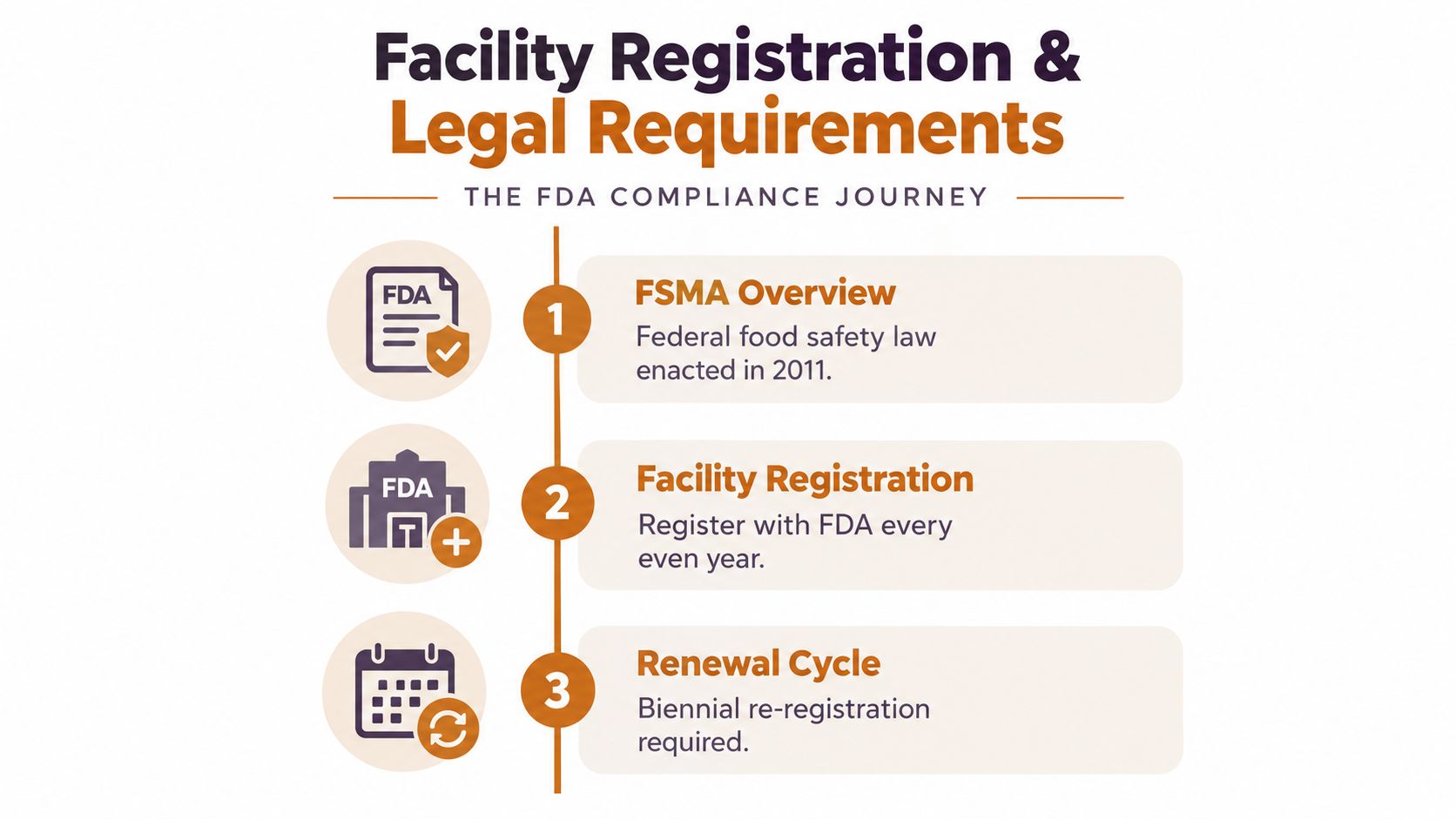
The legal meaning becomes clearer when you follow the path a covered facility must take before it can operate. Under the Food Safety Modernization Act, or FSMA, enacted on January 4, 2011, FDA expanded its oversight of facilities that manufacture, process, pack, or hold food for people or animals.
Registration isn't a decorative line on a website. For covered facilities, it connects the business to FDA's food-safety system and allows the agency to identify the operation responsible for handling regulated food or feed.
What registration requires
The process has several practical parts:
- Determine whether the facility is covered. Domestic and foreign facilities that manufacture, process, pack, or hold food for human or animal consumption generally must register unless an exemption applies. A domestic facility may still fall under the requirement even when it doesn't ship products across state lines.
- Register before operations begin. A covered operation must have its registration in place before it starts the relevant activity.
- Provide a unique facility identifier. FDA requires covered registration information to include a unique facility identifier. This helps connect the facility to its regulatory record.
- Renew on the required schedule. Registration isn't a one-time filing. Renewal occurs during October 1 through December 31 of each even-numbered year, as described in FDA's food business guidance.
- Maintain records and inspection readiness. Registration brings continuing responsibilities. The facility needs records that support its food-safety controls and must allow FDA inspection as permitted by law.
FDA also states that there's no fee to register a food facility, and facilities can register electronically through FDA systems. The absence of a registration fee doesn't make the process informal. The business still has to provide accurate information, keep it current, and meet the operational rules connected to the category of food or feed it handles.
Why flock owners should care
Suppose you're comparing a bag of dried insect treats with a similar product from an unknown source. Registration doesn't tell you which bag has the best calcium profile or which producer performs more frequent laboratory testing. It does give you a basic question to ask: Can the seller identify the facility responsible for production and explain how it maintains its regulatory status?
For example, a product listing for USA GROWN BLACK SOLDIER FLY LARVAE FOR CHICKENS describes USA-grown dried larvae, a plant-based diet, no additives or preservatives, and stated nutritional claims including 75 times more calcium than mealworms and 36–42% crude protein. Those are product and sourcing statements, not a substitute for understanding FDA registration, but they give a buyer specific details to investigate rather than relying on a vague compliance badge.
A reputable seller should be able to explain how its facility, records, and product information fit together. That connection is what turns a marketing phrase into something you can evaluate.
Preventive Controls and Manufacturing Standards
Registration is the doorway, not the whole building. The production floor is where a feed manufacturer turns legal requirements into daily controls over ingredients, equipment, workers, sanitation, and records.
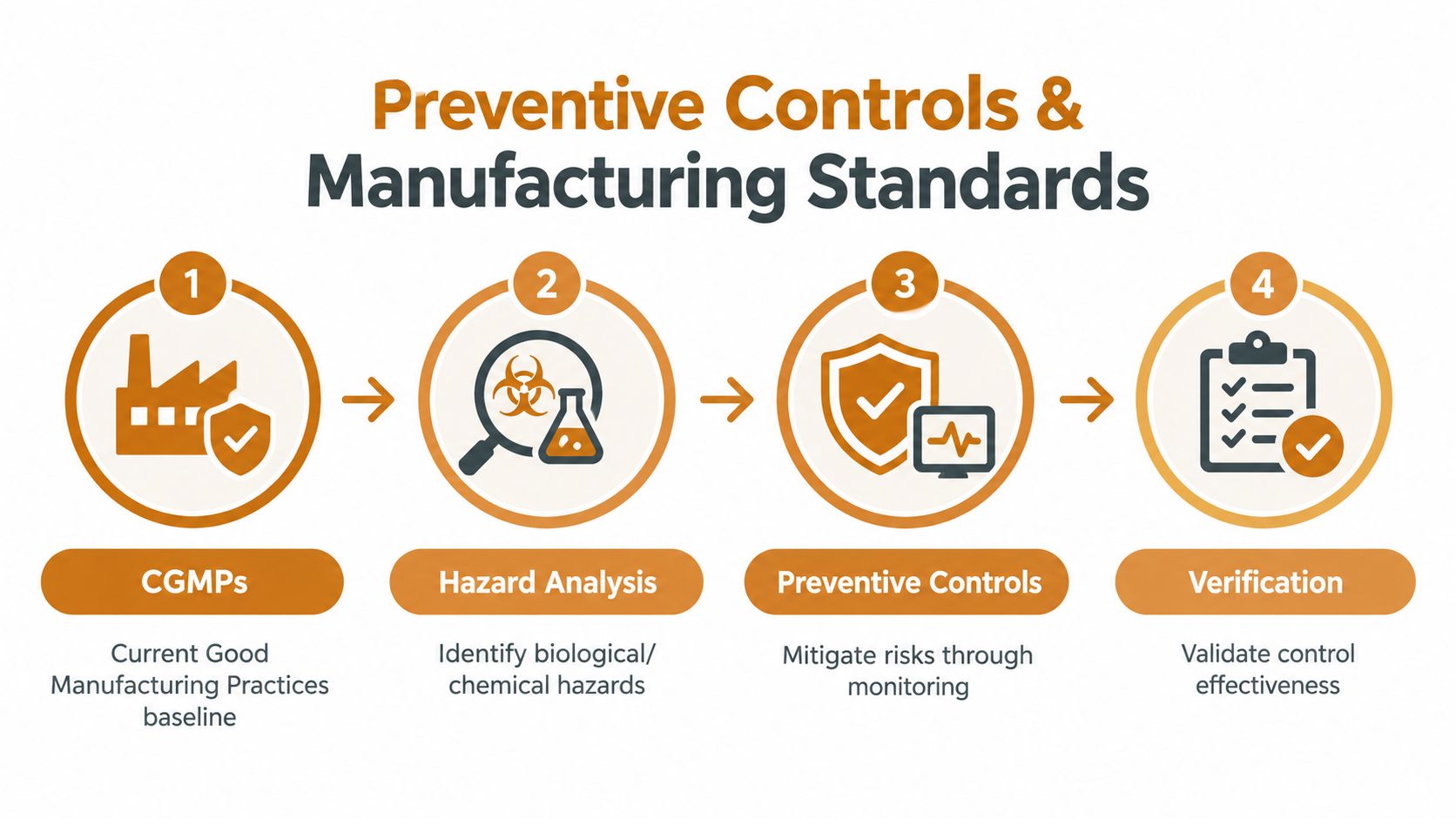
FDA's preventive controls rule for human food describes the importance of current good manufacturing practices, commonly called CGMPs, along with a written food-safety plan for covered operations. For animal food, CGMPs establish baseline safety and sanitation expectations. Preventive controls add a structured process for identifying hazards and documenting how the facility manages them.
The control system behind the label
A useful way to understand the process is to follow one ingredient through production. Consider dried insect feed:
- CGMPs establish the conditions. The facility controls sanitation, employee practices, equipment condition, storage, and handling so the product isn't exposed to avoidable contamination.
- Hazard analysis identifies what could go wrong. The team considers biological, chemical, and physical hazards. For insect-based feed, that may lead to questions about the rearing substrate, water, environmental conditions, drying, foreign material, and storage.
- Preventive controls address significant risks. The facility applies controls where they matter, monitors them, and records what happened. A written plan makes those actions specific rather than dependent on memory.
- Verification checks whether the controls work. The manufacturer reviews records, confirms procedures were followed, and uses appropriate checks to detect failures or trends.
The details vary by operation and product. A responsible producer should still be able to describe its sanitation practices, ingredient controls, traceability system, and response when a record shows a problem.
Why records matter in a small flock
You may never visit the processing facility, but records affect the answers you receive. If a supplier can trace a finished lot back through production, it can investigate a complaint more effectively than a seller who only knows what a distributor told them.
Water handling, breeding conditions, drying, packaging, and storage all deserve attention for insect-based feed. “Naturally sourced” doesn't remove the need for sanitary production. Nor does “made in the USA” by itself prove that every step was controlled.
A detailed explanation of the manufacturer's approach can be more informative than a broad claim. The quality assurance testing information gives flock owners an example of the kind of production and testing details they can seek when comparing suppliers.
The important shift is from asking, “Does this bag say compliant?” to asking, “What hazards did the producer identify, what controls were applied, and what records verify those controls?”
Minimum Compliance Versus Rigorous Batch Testing
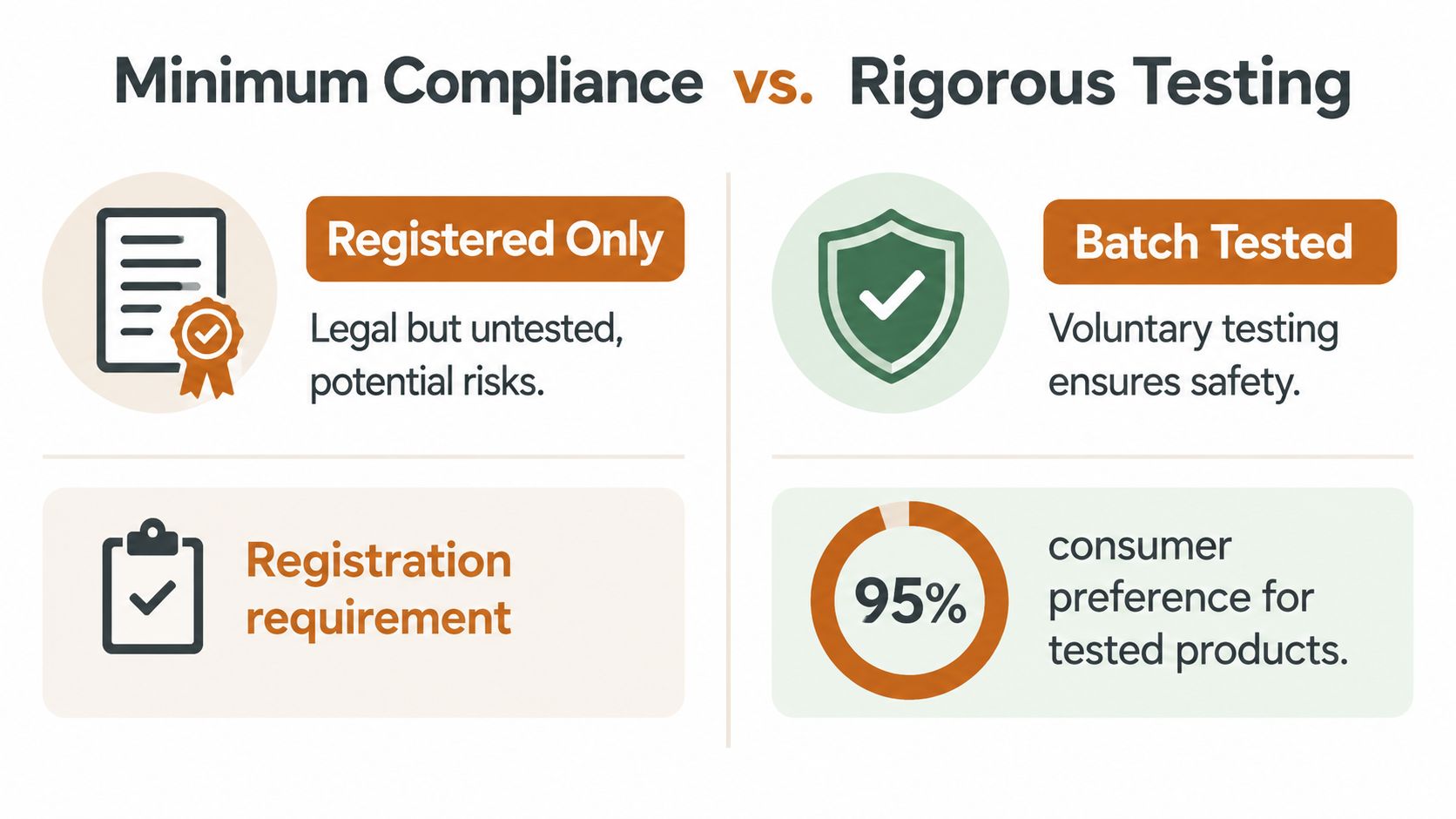
A registered facility and a tested batch answer different questions. Registration asks whether a covered facility has met its regulatory obligation to identify itself and operate within the applicable framework. Batch testing asks whether a sample from a particular production run was examined for a specific hazard.
That distinction matters for insect-based feed because the source and handling of the insects can influence what deserves attention. Heavy metals, including lead, arsenic, mercury, and cadmium, are among the contaminants a careful producer may screen for when evaluating the safety of feed ingredients.
Two different kinds of evidence
| Question | Registration evidence | Batch-testing evidence |
|---|---|---|
| What does it address? | The facility's legal status and regulatory obligations | The condition of a tested product sample |
| What can it show? | That a covered operation has registered and maintains required information | That a laboratory examined the sample for named contaminants |
| What should you ask for? | Facility identity, applicable practices, and current records | Test scope, laboratory documentation, sample or lot identification, and results |
| What does it not prove by itself? | Superior nutrition or contaminant-free feed | Complete facility compliance or overall product quality |
A manufacturer might follow its food-safety plan and still choose additional testing to increase confidence in a particular ingredient or batch. That extra work can be especially useful when the buyer wants evidence about heavy metals rather than a general statement about regulatory alignment.
Why heavy metals deserve a direct question
Lead, arsenic, mercury, and cadmium are not concerns that a flock owner can reliably identify by smell, color, or texture. If contaminated feed enters the diet, the concern extends beyond the bird eating it. Laying hens and their eggs make the source and handling of feed especially important to a homesteader who wants control over the food chain.
A claim such as “tested for heavy metals” still needs clarification. Ask which metals were included, whether the testing applied to the batch you're buying, who performed the analysis, and whether the documentation identifies the sample or lot. A vague “lab tested” statement doesn't tell you what the laboratory measured.
The heavy metal testing resource illustrates the kind of specific information buyers can look for when they compare a legal baseline with voluntary verification. Testing doesn't replace sanitary manufacturing or registration. It adds another layer of evidence.
Ask for the test, not just the promise. A transparent supplier should explain what was tested and connect the result to the product being sold.
Why Sourcing and Transparency Matter for Flocks
A compliant facility can still leave a flock owner wondering where the ingredients originated. That's why sourcing deserves its own place in your buying decision. The location of production, the diet used to raise insects, the handling method, and the ability to trace ingredients all influence how much confidence you can place in a feed claim.
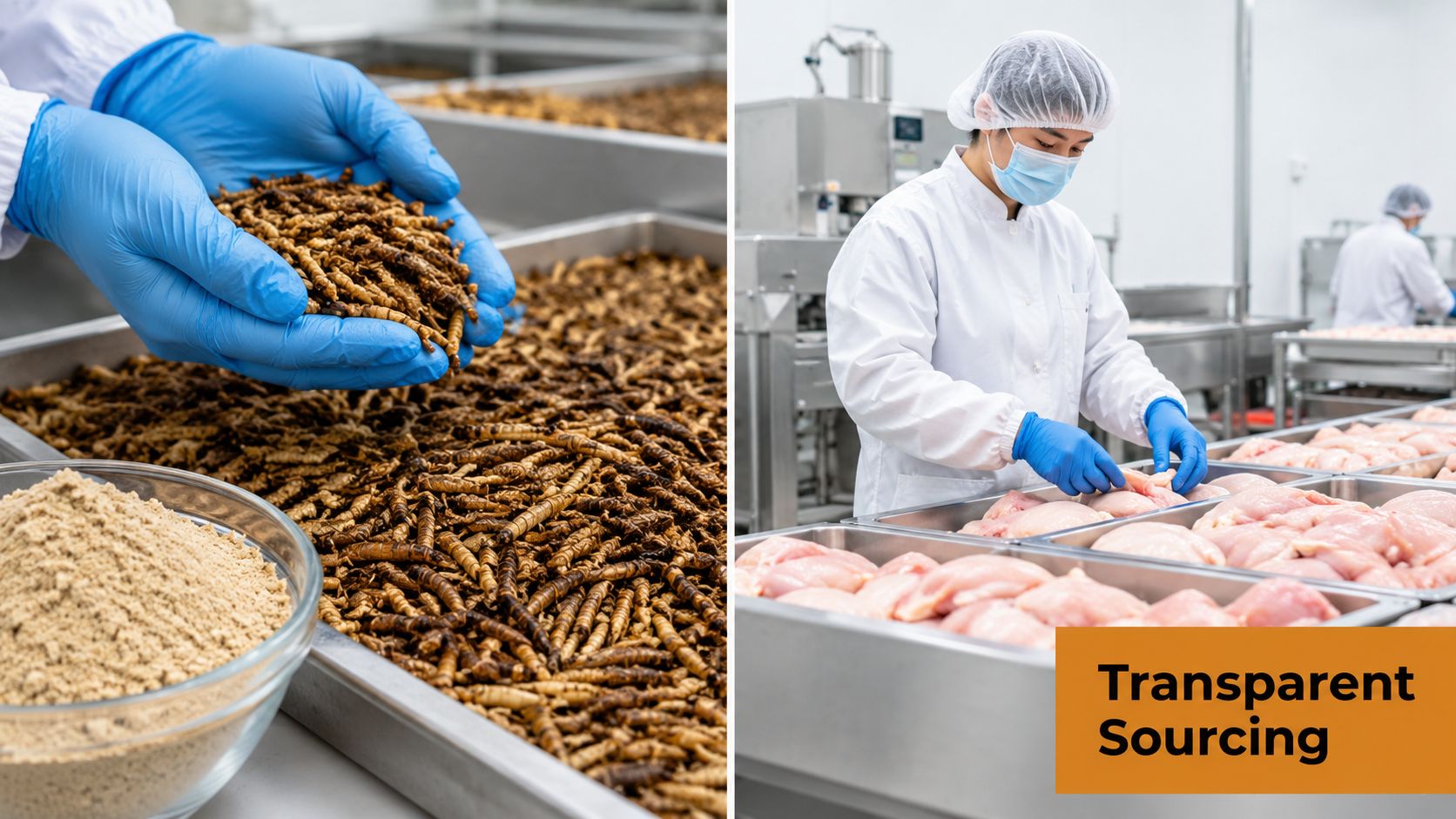
Consider two product descriptions. The first says only “premium insect protein” and gives no country of origin, production details, or testing information. The second identifies the growing location, describes the feed used for the insects, explains the drying method, and provides a way to connect the package to production records. The second description doesn't automatically prove safety, but it gives you meaningful points to verify.
Traceability reaches the nesting box
For a backyard flock, transparency has practical consequences:
- Ingredient origin helps you understand where the protein was raised and processed.
- Substrate information helps you distinguish a controlled feed source from an unclear one.
- Processing details show whether the producer considers sanitation and moisture control.
- Lot identification gives you a way to ask about a specific package rather than a brand in general.
- Testing records help separate broad compliance language from evidence about contaminants.
Imported feed isn't automatically unsafe, and domestic sourcing isn't automatically safe. The useful question is whether the seller provides enough information for you to evaluate the supply chain. A product with a clear U.S. origin statement and a controlled, plant-based insect diet may be easier to investigate than one with an incomplete source description, but you should still look for manufacturing and testing evidence.
Digital storefronts make this harder because a short product page can place “FDA compliant” beside nutritional promises without explaining what the phrase covers. The supply chain transparency guide points toward the kind of detail a buyer should expect from a producer that wants its sourcing claims examined.
For hens, ducks, and other birds, the benefit of transparency is control. You can make a better decision about what enters the diet, how treats fit alongside complete feed, and whether the seller has answers when something changes.
How to Evaluate Feed Labels and Brand Claims
Start with the label, but don't stop at the boldest phrase on the front. A practical evaluation separates intended use, ingredients, origin, manufacturing, and testing. You're not trying to become a regulatory lawyer. You're trying to find out whether the seller can answer ordinary safety questions clearly.
Read the label in layers
First, identify what the product is. Is it a complete feed, a supplement, or a treat? A dried insect product may provide protein and minerals, but that doesn't make it a replacement for a nutritionally complete poultry ration.
Next, check the species and use instructions. A homestead may feed chickens, ducks, reptiles, fish, and wild birds, but suitability for one species doesn't automatically establish suitability for another. The label should make its intended audience clear.
Then examine the source information:
- Origin: Look for a specific country or production location rather than an undefined “global” source.
- Ingredients: Prefer a clear ingredient description over a broad phrase such as “animal protein.”
- Processing: Ask how the product was dried, stored, and protected from contamination.
- Additives: Check whether preservatives, fillers, or other ingredients are included.
- Traceability: Look for a lot code or another way to identify the production run.
Ask the questions the label can't answer
AAFCO language may help you understand how a feed is represented and whether the product is intended to meet recognized feed-labeling expectations, but an AAFCO reference and an FDA compliance statement still don't answer every question about a particular batch. Ask the seller how the product is classified and whether it's meant to supplement a complete diet.
For heavy metals, ask for more than “yes, we test.” Find out whether the producer screens for lead, arsenic, mercury, and cadmium, whether testing is performed on each batch or through another sampling program, and whether documentation identifies the product tested. If the company won't explain the scope, treat the claim as incomplete.
Finally, compare the answer with the packaging. A trustworthy brand's origin, ingredient, species, and testing statements should fit together rather than contradict one another. If a page says “FDA compliant” but provides no facility context, no product identity, and no testing explanation, you still have work to do before deciding whether it belongs in your flock's feed routine.
Prioritizing Real Safety Over Marketing Buzzwords
The answer to what does FDA compliant mean is more limited than the label often suggests. For a covered food or animal-feed facility, it generally points to registration and ongoing obligations connected with food safety, preventive controls, sanitation, records, and inspection readiness. It does not automatically mean FDA approved the product, certified its nutrition, or independently tested every package.
Real confidence comes from combining several forms of evidence. Look for a facility that understands its registration duties, a written hazard-control system, sanitary production, traceable sourcing, clear labeling, and testing that addresses relevant hazards such as heavy metals. No single phrase can replace that full picture.
You don't need to accept bureaucratic language at face value. Ask who made the feed, where the ingredients came from, what risks the producer identified, how the controls are checked, and whether testing connects to the lot you're holding. Those questions protect the flock more effectively than a polished compliance badge.
Pure Grubs offers USA-grown dried Black Soldier Fly Larvae with a plant-based source, no additives or preservatives, and product information covering nutrition, origin, and multi-species use. Visit Pure Grubs to review the available feed details and choose treats with the sourcing and safety information your flock deserves.