

A Guide to the Types of Feeds for Poultry
Picking the right feed for your flock is more than just scooping something into a feeder—it’s the cornerstone of raising healthy, productive birds. Think of it less like a single menu and more like a carefully planned diet that changes as your chickens grow up. The main types of feeds for poultry are designed around a bird's specific life stage and come in different physical forms to suit their needs.
Understanding the Foundation of Poultry Nutrition
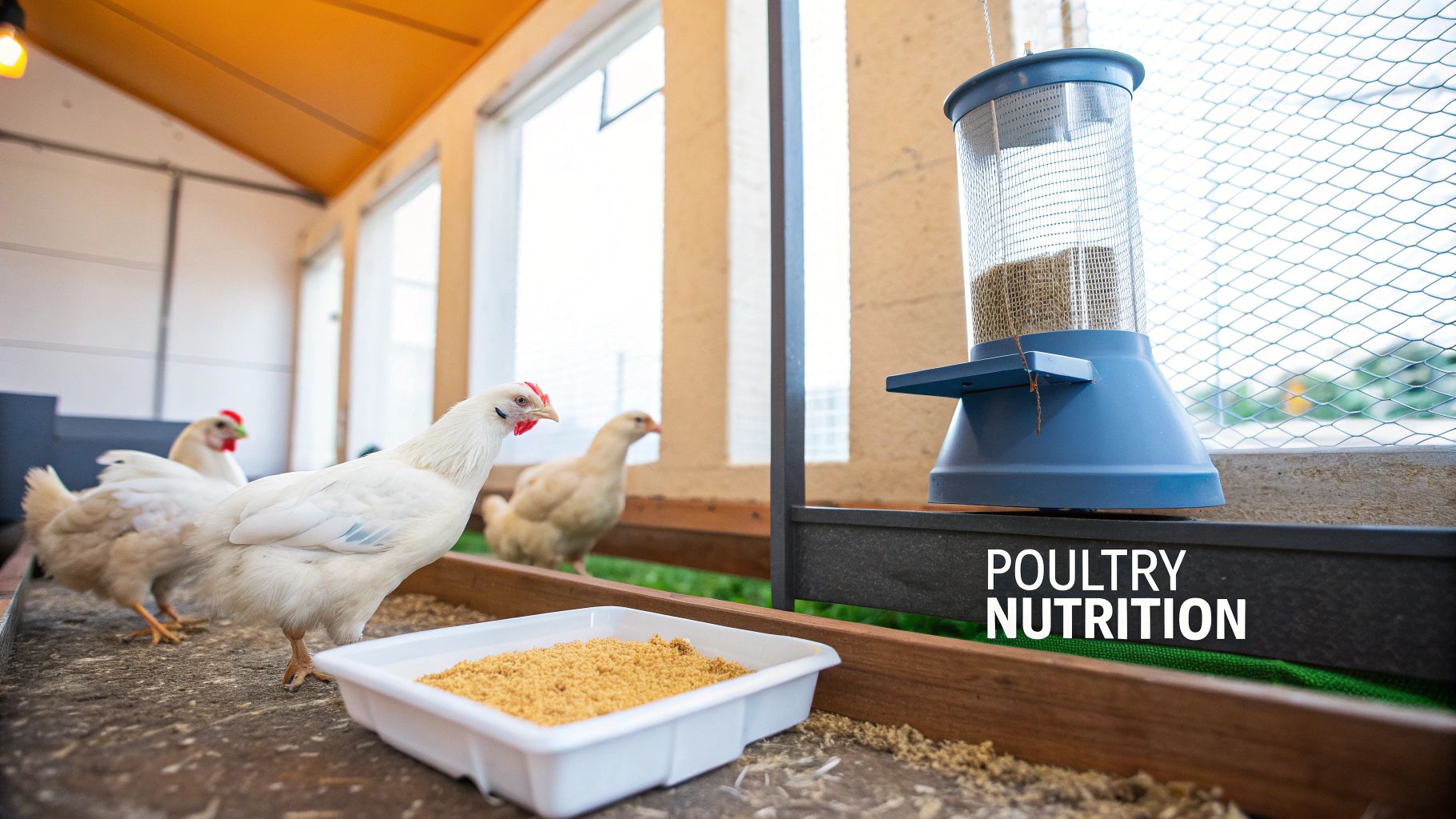
Feeding chickens is a lot like feeding a growing child. A newborn baby has completely different nutritional requirements than a teenager, and a one-size-fits-all meal plan just won't cut it. The same principle applies to your flock. Poultry nutrition is all about matching a specific formula to a bird's age and its job, whether that’s laying a steady supply of eggs or putting on weight for meat.
This is exactly why getting to know the different feed types is so important. Giving the wrong feed at the wrong time isn't just inefficient; it can cause real problems. For instance, giving a high-calcium layer feed to a young chick can harm their kidneys, while a diet too low in protein will leave them weak and underdeveloped.
Key Feed Concepts
When you walk into the feed store, it helps to have a handle on two main ideas:
- Life-Stage Feeds: These are the formulas built for specific age brackets. Starter feed gets baby chicks off to a strong start, Grower feed supports their "teenage" phase, Layer feed is for hens laying eggs, and Finisher is for meat birds in their final weeks.
- Physical Forms: This is simply about the texture of the feed. Mash is a fine, powdery meal, Pellets are compact little cylinders, and Crumbles are just pellets that have been broken into smaller, more manageable pieces.
Choosing the correct feed ensures your flock receives the precise balance of protein, calcium, vitamins, and minerals needed to thrive. This tailored approach is the bedrock of flock health, vitality, and productivity.
If you're looking to map out a complete feeding strategy, our guide on what is the best food for chickens dives even deeper into building a balanced diet.
Quick Guide to Poultry Feed Types
To help you see how it all fits together, here's a quick cheat sheet that connects the different feed types to each stage of a chicken's life.
| Feed Type | Primary Purpose | Bird Life Stage |
|---|---|---|
| Starter | Fuel rapid growth and immune development | Chicks (0-6 weeks) |
| Grower | Support steady, healthy development | Pullets/Cockerels (6-20 weeks) |
| Layer | Support egg production and shell strength | Laying Hens (20+ weeks) |
| Finisher | Maximize weight gain for meat production | Broilers (final 2-4 weeks) |
This table gives you a great starting point for making sure you're grabbing the right bag for your birds every time.
Matching Feed to Every Stage of a Bird's Life
Chickens have completely different dietary needs at different points in their lives, just like people do. What a tiny, fluffy chick needs to thrive is worlds apart from what a full-grown, egg-laying hen requires. Getting this right is probably the single most important thing you can do to raise a healthy, productive flock.
Think of it as a nutritional roadmap. Each stage of life has a specific feed formula designed to help your birds reach their full potential, whether you're raising them for eggs or for meat.
Giving a chick a layer feed, for instance, can cause serious health problems down the road. That’s why you'll see different bags at the feed store—they take the guesswork out of the equation, delivering a precise mix of protein, vitamins, and minerals for each phase of growth.
Starter Feed: The High-Protein Foundation
From the moment they hatch until they’re about six weeks old, chicks are in a period of explosive growth. They need a ton of protein to fuel all that development. That's where starter feed comes in.
This is basically their version of baby formula, packed with 20-24% protein. This powerful blend helps them build strong bones, healthy organs, and a tough immune system. It’s the foundation for their entire life. Skipping this step is like building a house on a shaky foundation—you're just asking for trouble later.
Grower Feed: The Awkward Teenage Phase
Around the six-week mark, your chicks aren't really chicks anymore. They're moving into their "teenage" phase. Their frantic growth starts to even out, and their nutritional needs change along with it. It’s time to switch them over to grower feed.
Grower feed dials back the protein a bit, usually to around 16-18%, and has less calcium than starter feed. The whole point is to support steady, healthy growth without pushing them to bulk up too quickly, which can lead to leg and bone problems. It's the perfect nutritional bridge from chickhood to adulthood.
Layer Feed: Fueling the Egg Factory
Once a young hen (a pullet) starts laying her first eggs, typically around 18-20 weeks old, her body basically becomes an egg-making machine. That’s a demanding job, and it requires a very specific diet.
Layer feed is formulated with a moderate amount of protein (around 16%) but gets a huge boost in calcium.
That extra calcium, usually making up 3.5-5% of the feed, is absolutely critical. Without it, a hen will start pulling calcium from her own skeleton to form eggshells. This leads to brittle bones for her and fragile, thin-shelled eggs for you.
This special diet is what keeps her laying strong, healthy eggs day in and day out. If you really want to get into the nitty-gritty of keeping your hens productive, we've got a whole guide on what to feed laying hens that you might find helpful.
Finisher Feed: The Final Push for Meat Birds
For chickens raised for meat (broilers), the last few weeks are all about building muscle efficiently. Finisher feed is a high-energy diet designed to help them gain weight right before processing. It has a little less protein than what they started on but is loaded with carbs to encourage tender meat.
The sheer scale of these specialized diets is incredible. Broiler feed is the biggest slice of the pie in the global poultry feed market, making up 38.60% of the total. That amounted to a staggering 385.415 million metric tons in a recent year. For comparison, layer feed, the second-largest type, clocked in at 173.038 million metric tons. It just goes to show how specialized and massive the science of poultry nutrition really is.
Choosing the Right Feed Form: Mash, Pellets, or Crumbles
Beyond just what's in the feed, the physical form it takes is a surprisingly big deal. It affects how your birds eat, how much they waste, and ultimately, how much of that carefully balanced nutrition they actually absorb. You'll typically find three main types of feeds for poultry on the shelf: mash, pellets, and crumbles.
Each texture is designed for a specific purpose. Getting it right often comes down to the age of your flock and how much feed you're willing to sweep up off the floor.
Mash: The Natural and Powdery Choice
Mash is the most basic form of chicken feed you can get. It's essentially an unprocessed, finely ground mix of all the ingredients, looking and feeling a lot like coarse, sandy flour.
Because it's so fine, mash is the default choice for baby chicks. Their tiny beaks can easily peck at and swallow the small particles. The downside? That powdery texture is also its biggest weakness. Chickens are messy eaters and love to "bill out" their food—flicking their beaks through the feeder to pick out their favorite bits. With mash, this creates a ton of waste, as the fine powder gets scattered everywhere.
Pellets: The All-In-One Nutritional Nugget
Pellets are the clean and efficient solution. They're made by taking that same mash and using a combination of heat, steam, and pressure to form it into small, dense cylinders. This process locks all the ingredients together into a single, compact bite.
The benefits of pellets are all about reducing waste and ensuring a balanced diet.
- Less Waste: The solid, heavier form makes it much harder for birds to scatter feed out of the feeder.
- No Picky Eating: Every single pellet contains the complete nutritional formula. Chickens can't just pick out the corn and leave the rest; every bite is a balanced one.
The pelleting process ensures that each bird consumes a consistent diet, preventing nutritional deficiencies that can arise from selective feeding and ultimately supporting uniform growth and production across the entire flock.
Pellets are perfect for adult birds. The size is easy for them to pick up, making it a highly efficient way to deliver their daily nutrients.
This is a great visual of how a bird's feed should change as it grows up.
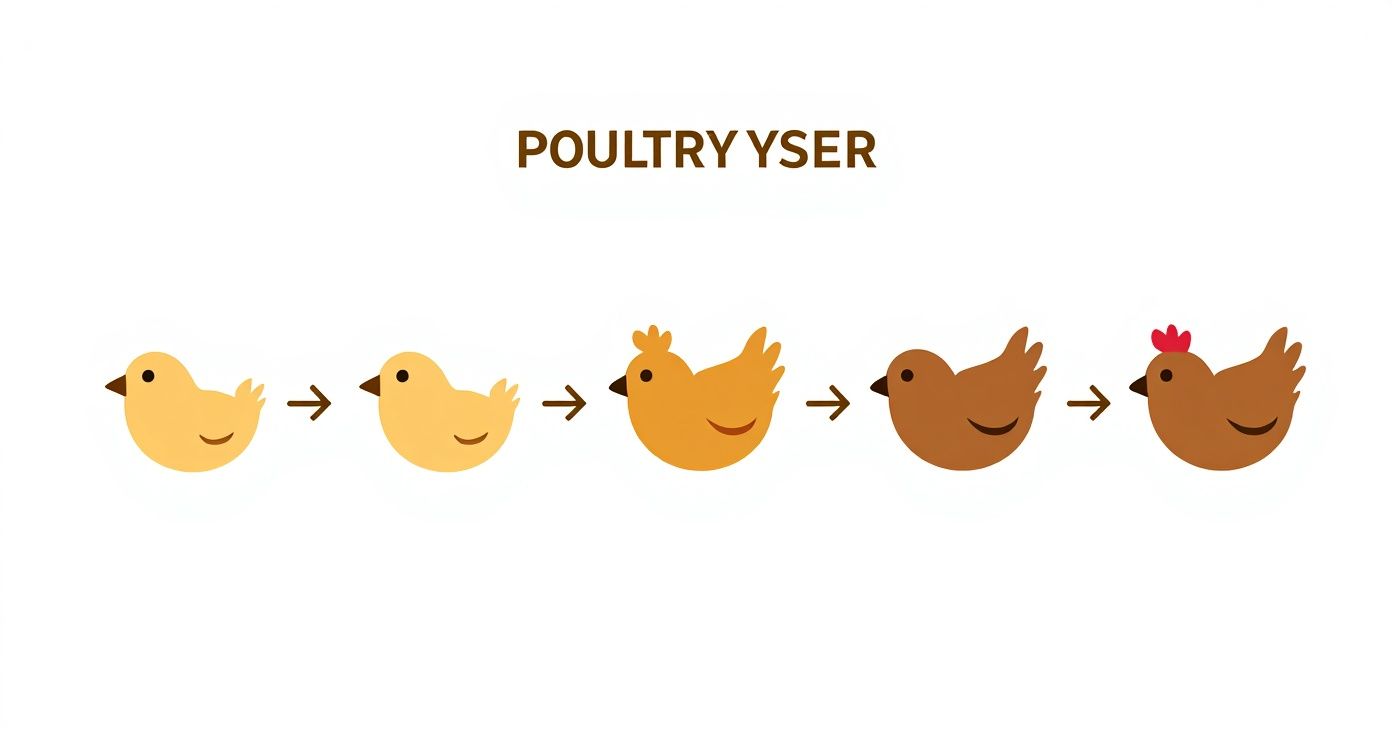
As you can see, shifting from a fine starter mash to a sturdier layer pellet is a standard part of raising healthy chickens.
Crumbles: The Perfect In-Between
So what do you do when your young birds have outgrown mash but aren't quite big enough to handle a full-sized pellet? That's exactly where crumbles fit in. Crumbles are just pellets that have been cracked and broken up into smaller, irregular-sized pieces.
This form is the perfect bridge between the two. It gives you the same great benefits as pellets—less waste, no selective feeding—but in a size that's much easier for growing pullets and cockerels to manage. It helps them get used to a solid feed without the struggle of swallowing a large pellet.
Choosing between these forms really boils down to balancing waste, cost, and the age of your flock. Here’s a quick side-by-side look to help you decide what's best for your coop.
Comparing Feed Forms: Mash vs. Pellets vs. Crumbles
| Feed Form | Best For | Pros | Cons |
|---|---|---|---|
| Mash | Baby chicks (0-8 weeks) & picky eaters | Easy for tiny beaks to eat, can be mixed with water to encourage eating. | Very messy and high waste, allows for selective feeding. |
| Pellets | Adult birds (layers and meat birds) | Minimal waste, ensures a balanced diet in every bite, easy to store. | Can be too large for young birds, some birds may reject the texture. |
| Crumbles | Growing birds (pullets, 8-16 weeks) | Less waste than mash, smaller size than pellets, good transition feed. | Can be slightly more expensive, can still have some fine, dusty waste. |
Ultimately, there's no single "best" form; the right choice is the one that fits your birds' current life stage and your management style. Many flock owners find themselves using all three at different times.
If you're new to raising chickens, the world of poultry feed can seem a little overwhelming. But there's one concept that simplifies everything: complete feeds.
Think of it like this: a complete feed is a professionally designed meal plan, created by animal nutritionists specifically for your flock. It's an all-in-one formula that packs everything your birds need—protein, energy, vitamins, and minerals—into a single, easy-to-use product.
This approach isn't just about convenience. It's about taking the guesswork out of your flock's health and ensuring every single chicken gets a perfectly balanced diet, every single time. No more worrying if they're getting enough calcium or the right kind of protein.
The Science Behind a Balanced Bag
When nutritionists formulate these feeds, they aren't just tossing a bunch of grains together. It's a precise science. They're meticulously balancing amino acid profiles to support healthy muscle growth and carefully calculating calcium-to-phosphorus ratios to build strong, solid eggshells.
Relying on just scratch grains or kitchen scraps is like letting a toddler pick their own meals. They might feel full after eating nothing but cookies, but they'd be missing out on crucial nutrients for healthy development. A complete feed is the poultry equivalent of a well-rounded dinner plate—it has the protein, the carbs, and all the essential micronutrients needed for long-term health.
A complete feed provides a reliable nutritional foundation. It supports consistent growth in meat birds and steady, high-quality egg production in laying hens. It's simply the most dependable way to ensure your flock gets exactly what it needs, every day.
The poultry industry's trust in this model speaks for itself. Complete feeds are the absolute standard, making up about 61% of the entire global poultry feed market. Considering this market was recently valued at $260.0 billion, it's clear how essential these formulas are to raising healthy birds. You can dig deeper into the growth of the poultry feed market to see just how big it is.
Why Choose a Complete Feed?
Sticking with a complete feed gives you a few major advantages that both backyard keepers and large-scale farmers count on:
- No More Picky Eaters: Every single pellet or crumble is identical. This stops chickens from sorting through their food and only eating their favorite bits, which would unbalance their diet.
- Targeted for Performance: Whether you're raising broilers for quick growth or layers for strong eggs, the feed is specifically designed to help you hit those goals.
- Fewer Health Problems: A balanced diet is your first line of defense against common problems. It helps prevent nutritional deficiencies that can cause soft-shelled eggs, weak bones, or poor feathering.
By understanding the different types of feeds for poultry and starting with a solid complete feed, you're setting your flock up for a healthy, productive life from day one.
Using Supplements and Treats Wisely
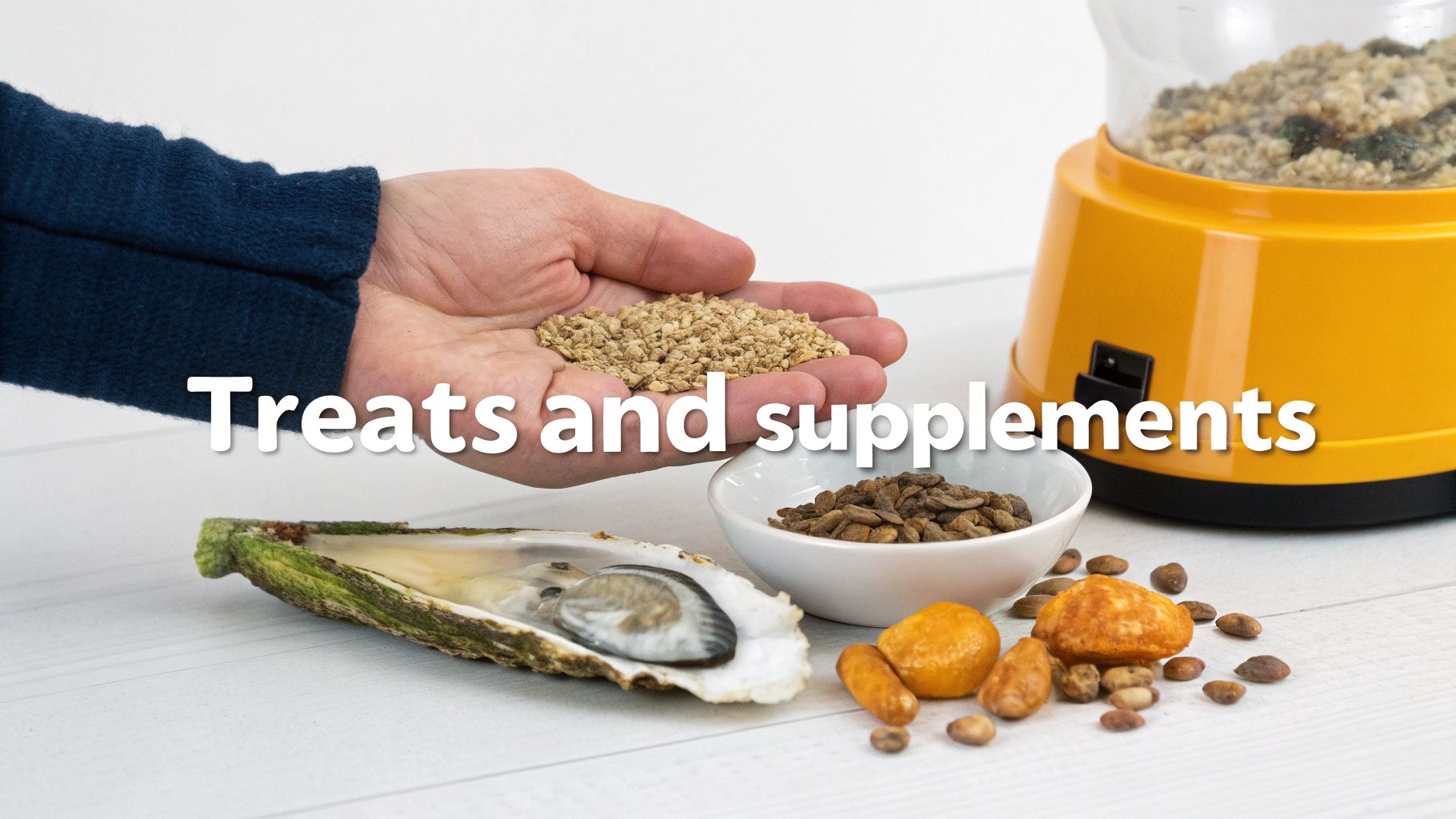
Think of your flock's complete feed as the nutritional workhorse—it's the main course that delivers everything they need. Supplements and treats, on the other hand, are the fun side dishes. They add variety, provide a boost of specific nutrients, and tap into your chickens' natural behaviors.
But there's a catch. You have to use them correctly. It’s all too easy to disrupt the carefully balanced diet their main feed provides by being a little too generous with the goodies.
A classic mistake is overdoing it with scratch grains. Chickens go crazy for them, but scratch is basically chicken candy—mostly carbs with very little nutritional punch. Its real job is to be scattered on the ground, encouraging your flock's instinct to scratch and forage, which keeps them active and busts boredom.
The best approach is the 90/10 rule. It’s a simple but effective guideline: at least 90% of what your flock eats each day should be their complete feed. The other 10% can be a mix of healthy treats and supplements.
Sticking to the 90/10 rule is your key to making sure treats are a benefit, not a problem. Overindulgence can quickly lead to nutritional imbalances, obesity, and even a drop in egg production.
Beneficial Supplements for Your Flock
Some supplements offer targeted support during specific times, like molting or laying. They aren't an everyday necessity for every bird, but they can be a huge help when the need arises.
-
Oyster Shell: Laying hens pull a massive amount of calcium from their bodies to create strong eggshells. By offering crushed oyster shell in a separate feeder, free-choice style, each hen can take exactly what she needs. This prevents you from overloading the rest of the flock with calcium they don't require.
-
Protein-Rich Grubs: When a chicken molts, she's in a race to regrow thousands of feathers, which are made of about 85% protein. This is a huge drain on her system. High-quality treats like dried black soldier fly larvae are an incredible source of both protein and calcium, helping them get through this stressful period much faster. You can learn more about how dried black soldier fly larvae support feather health and overall vitality.
-
Grit: Chickens don't have teeth. Instead, they use small, hard particles (grit) stored in their gizzard to grind down food. If your flock is out foraging, they'll likely pick up tiny stones on their own. But if they're primarily confined, you'll need to provide a small dish of commercial grit to ensure they can digest their food properly.
Treats to Avoid Giving Your Chickens
It’s tempting to share leftovers, but what's a treat for us can be harmful—or even toxic—to a chicken.
Be absolutely sure to keep your flock away from these items:
- Salty or Sugary Foods: Human snacks like chips, crackers, and candy can wreak havoc on their digestive systems.
- Avocado: The pit and skin contain a toxin called persin, which is extremely dangerous for birds.
- Dried or Uncooked Beans: Raw beans contain a natural toxin that can be fatal to chickens.
- Onions and Garlic: In large amounts, these can damage red blood cells and lead to anemia.
- Chocolate or Caffeine: Just like with many other pets, these are toxic and should never be offered.
By following the 90/10 rule and choosing safe, high-value extras, you can enrich your flock’s life and keep them thriving without accidentally compromising their health.
A Few Common Questions About Poultry Feed
Once you start raising chickens, you realize just how many practical questions pop up, especially around feeding. You're always trying to do what's best for your flock. Let's walk through some of the most common challenges I see both new and seasoned chicken keepers run into.
How Do I Switch My Chickens From One Feed to Another?
Switching feeds isn't something you want to do overnight. A sudden change can really throw your birds' digestive systems for a loop, whether you're graduating from starter to grower or just trying a new brand.
Think of their gut as being perfectly tuned to one specific recipe. If you change it abruptly, you can cause some serious upset. A gradual switch gives the good bacteria in their digestive tract time to adjust to the new ingredients.
The gold standard is a slow transition over 7 to 10 days. This gentle approach is much less stressful for them and keeps them from going off their feed entirely.
Here’s a simple schedule that works every time:
- Days 1-3: Mix 75% of the old feed with 25% of the new feed.
- Days 4-6: Move to a 50/50 mix.
- Days 7-9: Shift to 25% old feed and 75% new feed.
- Day 10: You can confidently switch over to 100% new feed.
Can I Feed My Mixed-Age Flock the Same Thing?
This is one of the trickiest situations for backyard keepers, and the short answer is no, not really. If you've got young chicks and laying hens together, their nutritional needs are worlds apart.
Your little ones need a high-protein starter feed to fuel their incredible growth. Your laying hens, on the other hand, need a layer feed packed with calcium to produce strong eggshells. Giving that high-calcium layer feed to a chick is a huge mistake—it can cause permanent kidney damage.
So, for a mixed flock, here’s the safest and most effective strategy:
- Feed everyone a grower or "all-flock" ration. These feeds have a balanced, middle-of-the-road protein level and don't have the high calcium content that's so dangerous for young birds.
- Offer calcium on the side. Put crushed oyster shells in a separate, free-choice feeder. Your laying hens know instinctively when they need more calcium and will help themselves, while the chicks and roosters will just ignore it.
What’s the Best Way to Store Poultry Feed?
How you store your feed is just as important as what you buy. You're fighting a constant battle against heat, moisture, and pests—the three biggest enemies of fresh feed.
Moisture is the most dangerous culprit because it invites mold and mycotoxins, which are flat-out toxic to your birds. To protect your investment, always store feed in a cool, dry spot. A galvanized metal can with a tight-fitting lid is perfect; it keeps both rodents and moisture out. And remember to practice "first in, first out"—use the oldest feed first and try to buy only what your flock can eat within a month or two of its milling date.
Should I Choose Medicated or Non-Medicated Starter Feed?
This question sounds complicated, but the answer is surprisingly simple. Medicated starter feed contains a coccidiostat (usually amprolium) to protect chicks from coccidiosis, a nasty intestinal parasite that is a leading cause of death in young birds.
Your decision comes down to one thing: vaccination.
- If your chicks were vaccinated for coccidiosis at the hatchery, you must use a non-medicated feed. The medication in the feed will actually work against the vaccine, leaving your chicks vulnerable.
- If your chicks were not vaccinated, using a medicated starter feed is a smart, highly recommended preventative measure to get them safely through their most fragile stage.
At Pure Grubs, we're all about helping you give your flock the absolute best. Our premium, USA-grown Black Soldier Fly Larvae are the perfect high-protein, high-calcium treat to support brilliant feather growth and strong eggshells. Give your birds a natural boost they'll love.