

Poultry Protein Supplement: Complete Feeding Guide
Your hens are laying thin-shelled eggs, one bird is losing feathers, and the bag of dried insects you bought promises plenty of protein. It's tempting to assume that a larger protein number will solve everything. In practice, poultry nutrition depends on which amino acids the birds can digest, how much energy they receive, and whether the ration supplies calcium, phosphorus, and vitamin D in balance.
A poultry protein supplement can help during growth, laying, or molt, but it isn't a substitute for complete feed. The right choice supports the ration without crowding out the nutrients that keep bones, shells, feathers, and body condition healthy.
Choosing the Right Poultry Protein Supplement
A poultry protein supplement is an added feed ingredient or treat that contributes protein, amino acids, energy, or minerals to a bird's normal diet. Dried black soldier fly larvae, mealworms, fishmeal, and soybean meal can all fit this broad description, but they don't serve the same nutritional role. A treat may be highly palatable while still being incomplete as a daily ration.
Backyard keepers usually reach for supplements for practical reasons. A hen may be molting and growing feathers, pullets may be developing, or a flock may need an appealing training reward. Those goals make sense, but the supplement should sit alongside a nutritionally complete poultry feed, not replace it.
Practical rule: Treat the supplement as a targeted addition, not as the flock's main diet.
Start by identifying the flock's production stage. Growing birds need nutrients for skeletal and muscle development. Layers need a ration that supports egg production and shell formation. Molting hens need resources for feather regrowth, but extra protein won't correct a mineral or energy gap by itself.
Then inspect more than the crude-protein number. Ask whether the product provides useful amino acids, what its calcium and fat content are, how it should be stored, and whether the supplier gives clear feeding directions. A supplement with a dramatic protein percentage can still be poorly matched to the rest of the ration.
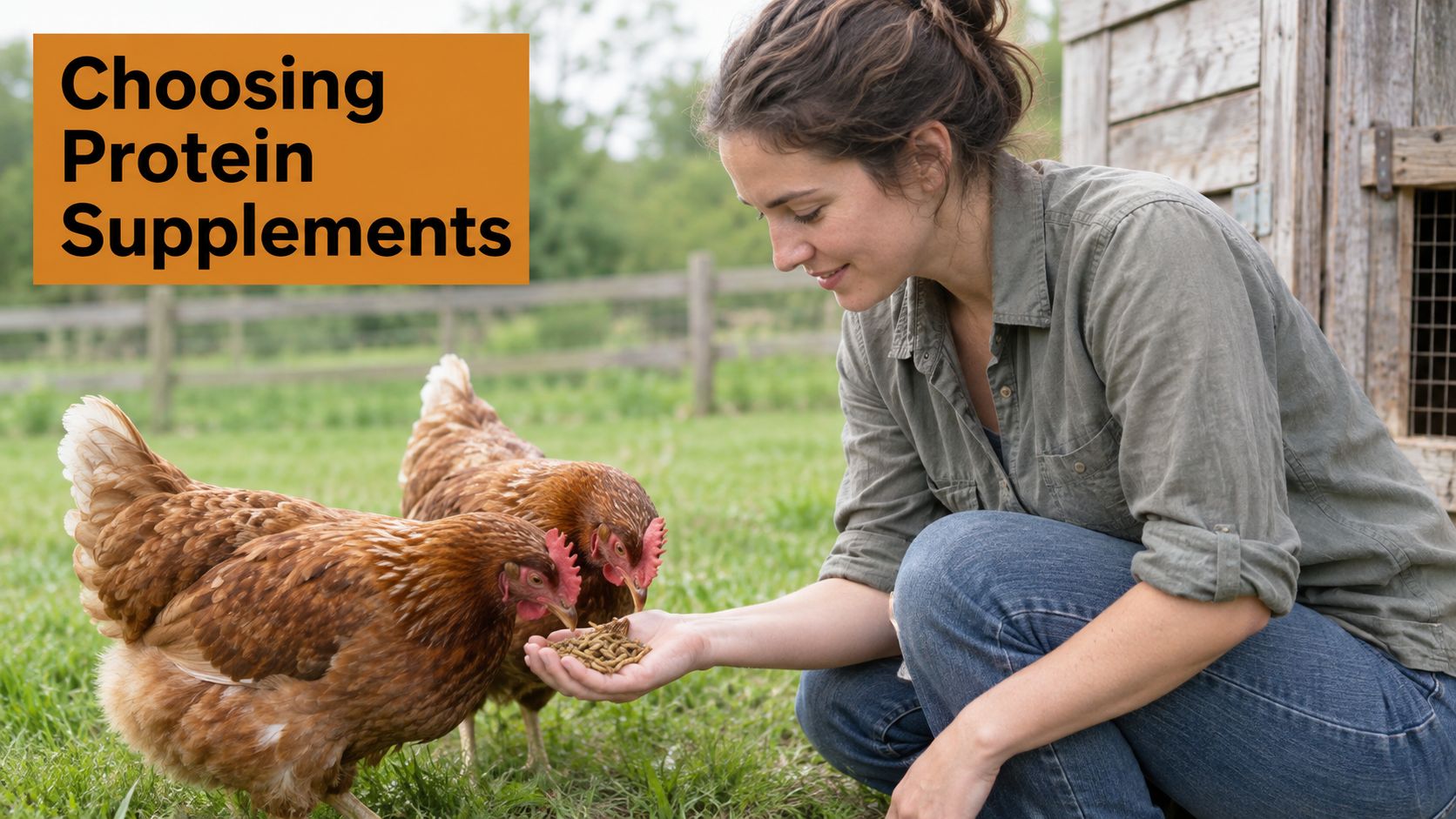
Use the same careful approach when considering USA GROWN BLACK SOLDIER FLY LARVAE FOR CHICKENS. The product snapshot lists 36–42% crude protein, 30–40% fat, and a calcium comparison with mealworms, but those label figures still need to be considered alongside the complete feed and the flock's actual needs.
The best supplement is therefore the one that fills a defined gap without creating another one. If shells are weak, investigate mineral balance. If feathers are poor, assess overall diet and health. If birds need enrichment, keep the portion modest.
How Poultry Use Protein Beyond Crude Percentage
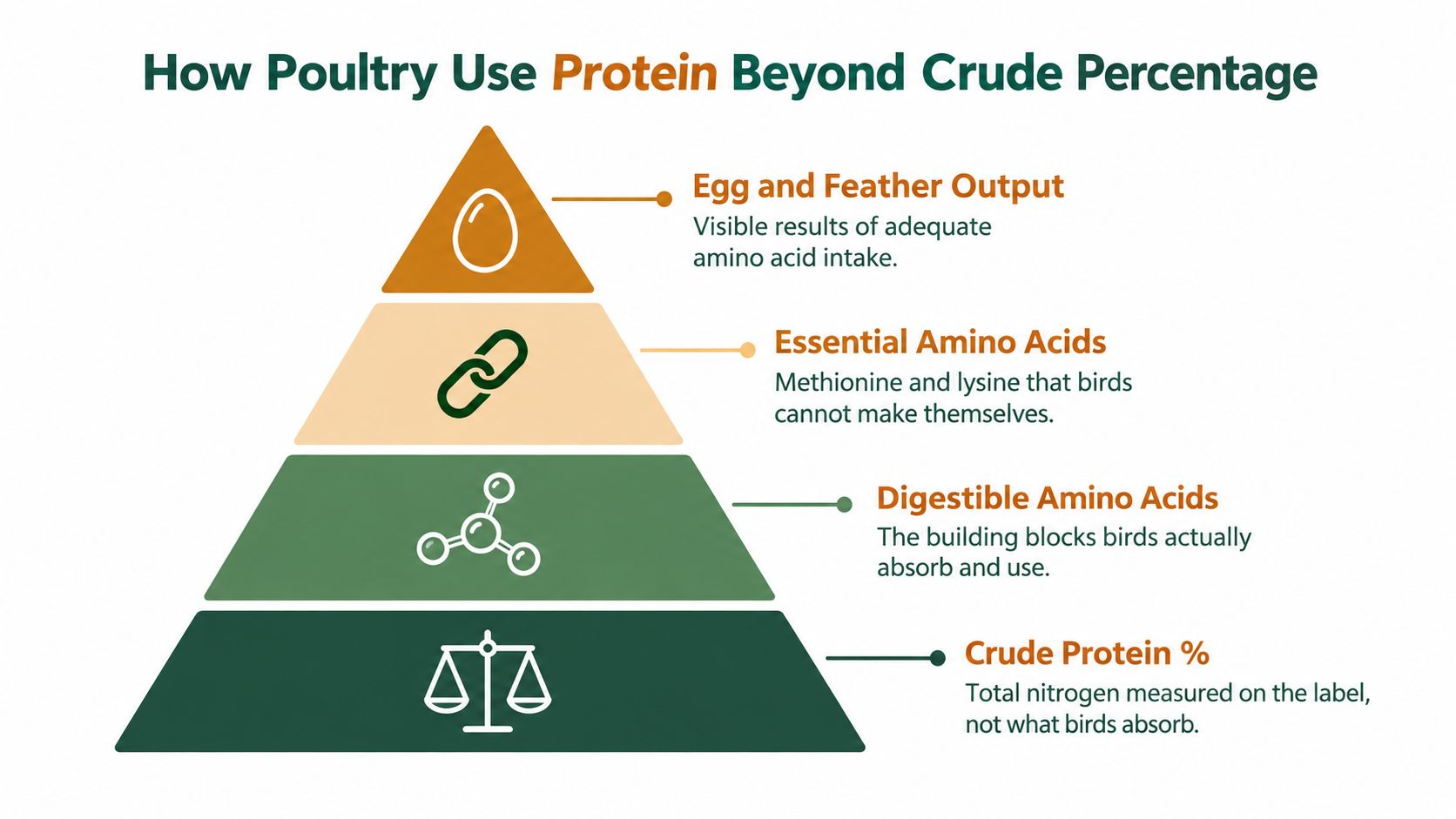
A hen may receive a treat labeled 40% protein yet still lay soft-shell eggs or grow poor feathers if that treat crowds out balanced feed. The crude-protein figure measures total nitrogen-containing material. It does not show how much of each amino acid the bird can use, or whether the ration supplies the amino acids needed for a particular task.
Poultry use 22 amino acids to build body proteins. Birds make some internally, while essential amino acids must come from feed, as described in the FAO poultry feeding guidance. Methionine and lysine are important examples because birds cannot produce enough of them to meet all production demands.
Amino acids work like keys: crude protein counts the keys in the box, but performance depends on having the specific keys for muscle, feather, and egg production. A high-protein insect treat can still leave one limiting amino acid in short supply.
Production stage changes the target
Meat chickens, laying hens, and molting birds have different nutrient priorities. Growth requires support for muscle and skeletal development. Egg production also requires suitable minerals, energy, and amino acids. Feather regrowth during molt places a different demand on the ration.
For meat chickens, standard FAO broiler feeding programs commonly provide approximately 23% crude protein from 0 to 3 weeks, 20% from 3 to 6 weeks, and 18% from 6 to 8 weeks. Some later production tables decrease toward about 15%. Laying-hen diets generally use lower protein concentrations than early broiler diets, but the appropriate target varies with age, production rate, energy intake, and amino-acid balance.
A 40% insect treat therefore does not automatically outperform a lower-percentage soybean-based ingredient. Birds need digestible amino acids in suitable proportions, along with adequate energy and minerals. If treats replace too much complete feed, the flock may consume more crude protein while receiving less calcium, energy, or another required nutrient.
Use this label-reading order:
- Complete ration first. Confirm that the main feed suits the bird's production stage.
- Amino acids next. Check for digestible lysine and sulfur-containing amino acids where listed.
- Minerals and energy. Review calcium, phosphorus, and fat before increasing a treat.
- Feeding rate last. Set the portion low enough to preserve the ration's overall balance.
Comparing Insect, Fishmeal, and Soy Protein Sources
Different ingredients solve different problems. Black soldier fly larvae can provide protein, fat, and mineral value. Mealworms are often attractive to birds but may contribute less calcium than black soldier fly larvae. Fishmeal can provide concentrated, useful protein in formulated feeds, while soybean meal is commonly used as a baseline ingredient for complete ration design.
A scientific review reports that insect meals commonly contain about 40%–60% crude protein on a dry-matter basis, although the result varies with insect species, substrate, processing, and life stage. The same review of insect meals in poultry nutrition notes that European Commission Regulation 2021/1372 permitted certain processed insect proteins in poultry and pig feed.
| Supplement type | Protein range | Calcium | Best for | Main limitation |
|---|---|---|---|---|
| Black soldier fly larvae | Often high, with composition varying by processing | Can be mineral-rich, but verify the product label | Treats that add protein, fat, and potentially useful calcium | High fat or excessive inclusion can unbalance the ration |
| Mealworms | High, but product composition varies | Generally lower than black soldier fly larvae | Palatability, enrichment, and occasional treats | Calcium contribution may be limited |
| Fishmeal | Concentrated animal protein | Variable by product | Commercial formulation where sourcing and quality are controlled | Odor, sourcing, and quality documentation require attention |
| Soybean meal | Formulated protein ingredient | Not a dedicated calcium source | Complete-ration formulation | Not a balanced standalone treat for backyard birds |
Match the ingredient to the flock goal
For a layer with fragile shells, mineral information matters as much as protein. For a molting hen, energy and amino-acid supply matter, but adding a fatty treat without considering the base ration can create a different imbalance. For commercial-style formulation, soybean meal and fishmeal are ingredients to calculate into the whole diet, not casual handfuls.
Mealworms can work well as an enrichment treat, but owners shouldn't treat them as interchangeable with a calcium-containing supplement. Black soldier fly larvae may be a more relevant option when the product's mineral profile is documented, yet the label still doesn't replace a complete layer ration.
For a broader discussion of insect nutrition, see black soldier fly larvae nutrition. The practical question isn't which ingredient sounds most impressive. It's whether the ingredient fits the bird, the main feed, and the intended feeding rate.
Safe Feeding Rates for Chickens and Ducks
A hen may rush toward a handful of dried larvae, while the feeder still holds balanced layer feed. That enthusiasm is a useful reminder: supplements should stay a small part of the daily diet unless a poultry nutritionist has formulated the entire ration around them. Treat-style feeding lowers the chance that birds displace too much layer or grower feed.
A controlled 210-day trial involving 288 Hy-Line Brown laying hens tested defatted black soldier fly larvae meal at 0%, 3%, 6%, or 9% of the diet. Egg production and egg weight did not differ significantly among treatments. Higher inclusion increased the feed-to-egg ratio during later production phases. The laying-hen BSFL trial also reported stronger eggshells with the 6% treatment and thicker shells with the 3% treatment.
The trial supports measured inclusion in a balanced ration, not unrestricted scooping. For backyard flocks, a common framework consistent with extension feeding guidance is:
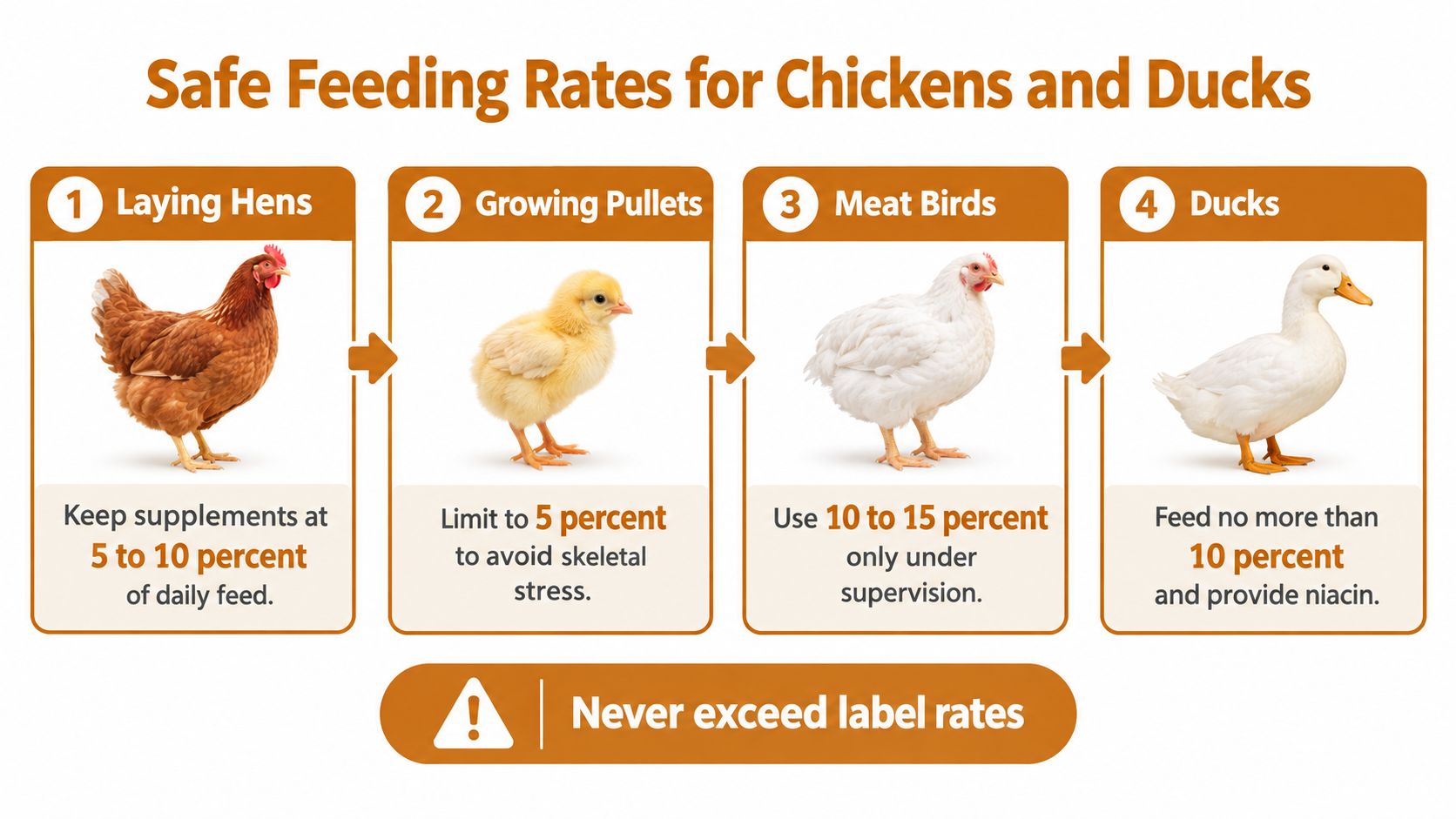
- Laying hens: Keep supplements near 5% to 10% of daily feed, then monitor shell quality, laying rate, and body condition.
- Growing pullets: Hold supplements to about 5% because young birds need a carefully balanced grower ration for skeletal development.
- Meat birds: Use approximately 10% to 15% only with supervision, since rapid growth places greater demands on energy and amino-acid balance.
- Ducks: Keep supplemental feed at no more than 10% and provide niacin through an appropriate diet or product plan.
Ducks often forage differently from chickens and may consume treats eagerly. Scatter small portions instead of allowing unrestricted access. Provide clean water, particularly with dry foods, and reduce treats if birds leave their complete feed untouched.
For a practical layer routine, see how much to feed laying hens. Introduce one supplement at a time, keep the amount consistent, and record changes in shells, droppings, appetite, and feather condition.
Persistent soft shells, poor growth, diarrhea, lethargy, or sudden production changes call for stopping treat experiments and consulting a poultry veterinarian or qualified nutritionist.
Why Protein Alone Does Not Fix Eggshells
A protein supplement is not automatically a calcium supplement. Eggshell quality depends on the coordinated supply of calcium, phosphorus, vitamin D, electrolytes, energy, and amino acids, as well as the hen's age and production stage.
That distinction matters because dried insects often attract attention for both protein and mineral content. A product may contribute calcium, but the amount depends on the species, life stage, processing method, and verified product analysis. You can't infer the whole mineral balance from a protein percentage.
A 2025 laying-hen study found that replacing soybean meal with full-fat black soldier fly larvae meal didn't significantly change feed intake, laying rate, egg mass, or feed conversion over eight weeks, but complete soybean-meal replacement significantly reduced eggshell thickness. The study on full-fat black soldier fly larvae meal reinforces a simple point: a high-protein replacement can still disturb the ration.
Read soft shells as a ration signal
If shells become thin or rubbery, first review the complete layer feed, access to calcium, phosphorus balance, vitamin D supply, and whether treats are displacing the main ration. Oyster shell or another dedicated calcium source may be appropriate for layers, but adding calcium in isolation isn't a universal fix.
Track what you can observe:
- Shell thickness: Compare eggs over time rather than judging one unusual egg.
- Breakage: Record whether cracks increase in nesting boxes or during collection.
- Laying pattern: Note changes in production alongside feed changes.
- Body condition: Check whether hens are gaining excessive weight or losing condition.
- Treat displacement: Watch whether birds eat supplements first and leave the complete feed.
Avoid responding to weak shells by only increasing insect portions. If the supplement is high in fat, large servings can also shift the flock's energy intake. The safer approach is to preserve the complete layer ration and use supplemental insects as a measured addition.
How to Verify Supplement Quality and Safety
“Natural” doesn't tell you enough about a feed ingredient. Insects can be raised on different substrates, processed under different conditions, and sold with very different levels of documentation.
The supplier should be able to identify the insect species and explain how it was produced. Substrate matters because the material insects consume can affect the resulting ingredient and the contaminants that require testing.
Supplier verification checklist
- Species identification: Confirm whether the product is black soldier fly larvae, mealworm, or another insect.
- Production substrate: Ask what the larvae were fed and whether the supplier can explain the source clearly.
- Origin: Look for a stated country of production rather than vague wording about packaging or distribution.
- Feed-grade status: Check that the product is labeled for the intended animal use and uses an appropriate common name.
- Nutritional guarantees: Review crude protein, fat, calcium, and other declared nutrients without treating them as a complete ration.
- Batch testing: Ask whether batches are tested for heavy metals, pathogens, or other relevant contaminants.
- Storage instructions: Follow directions for keeping the product dry and protected from pests.
- Intended use: Confirm whether it is a treat, a supplement, or a formulated feed ingredient.
AAFCO meeting materials state that dried insects must be feed grade, use the appropriate common name, and carry minimum crude-protein and crude-fat guarantees. The materials also describe the FDA Animal Food Ingredient Consultation process for reviewing safety concerns, as summarized in the AAFCO insect ingredient regulatory materials.
Red flags include missing species information, no origin statement, absent contaminant testing, unclear feeding directions, and claims that imply insects can replace a complete layer ration. A transparent supplier should make it easier to understand what the product is and how to use it, not ask you to infer safety from bright packaging.
For a supplier-focused look at testing documentation, review quality assurance and testing. Keep the product label and any batch documentation with your flock records.
Putting It All Together for a Healthier Flock
A sound poultry protein supplement plan rests on four decisions:
- Protect the complete ration. The main feed should match the birds' production stage and remain the primary source of nutrients.
- Evaluate amino acids, not just crude protein. Essential amino acids help determine whether birds can use the protein for feathers, muscle, and eggs.
- Treat calcium as a separate question. A protein-rich insect isn't automatically a complete shell-support strategy.
- Control the portion. Small, repeatable servings are easier to monitor than free-choice treats.
A simple weekly rhythm can keep the flock's diet predictable. Offer complete feed every day, provide clean water, and reserve supplements for measured treats or a formulated feeding plan. Keep a separate calcium source available when appropriate for layers, and don't use extra insect protein to compensate for a ration that already needs reformulation.
During molt, watch feather regrowth and body condition rather than trying to maximize treat volume. In growing birds, protect the grower ration and skeletal development. In ducks, account for their different feeding behavior and ensure the diet supplies appropriate niacin.
Egg quality deserves its own record. Note shell texture, breakage, laying pattern, and any changes after introducing a supplement. If the flock's condition worsens, remove the new treat and review the full diet before adding another product.
A 12-week study of 252 Hy-Line Brown hens illustrates why formulation matters. Reducing crude protein from 17% to 16% impaired later-period egg production and feed conversion when amino acids weren't corrected, while adding methionine, lysine, threonine, and tryptophan restored performance to levels comparable with the control diet. The amino-acid-balanced low-protein layer study found no measured differences in several egg-quality traits, and ammonia emissions from excreta decreased in the amino-acid-balanced treatment.
That result doesn't mean every backyard owner should formulate feed from individual ingredients. It means a supplement should be judged by how it fits the whole ration. If a bird needs a clinical diet change, involve a poultry nutritionist rather than guessing with treats.
Pure Grubs USA-grown black soldier fly larvae are presented in the supplied product information as dried, additive-free larvae raised on a plant-based diet, with batches tested for heavy metals and a calcium comparison with mealworms. Those are supplier-specific claims, so verify the current label and documentation before feeding, then use the product as a supplement rather than a replacement for complete feed.
The flock will tell you more than the bag's largest number. Healthy appetite, steady body condition, sound shells, and normal feather regrowth are better signals than chasing the highest protein percentage.
Pure Grubs offers USA-grown dried black soldier fly larvae as a traceable supplemental treat for chickens, ducks, and other birds, with product information covering protein, fat, calcium comparison, origin, and testing. Visit Pure Grubs to review the current product details and choose a measured poultry protein supplement for your flock.