

Poultry Feed Supplements Explained for Backyard Flocks
You're standing in the feed store, or scrolling through product pages, trying to decide whether your flock needs a vitamin powder, extra calcium, probiotics, or a bag of dried insects. Each label promises something different, and it's easy to wonder whether adding more will help or throw off the feed your birds already eat.
Start with a more useful question than “Which supplement is best?” Ask: What does this supplement add, and what might it replace? A product can serve a clear purpose, but even a nutritious treat can cause trouble if it displaces too much of a complete ration. The right choice depends on your birds, their regular feed, and the specific gap you're trying to address.
Why Poultry Feed Supplements Matter
A keeper notices thin shells in the nest box and reaches for oyster shell. Reasonable move, except the underlying cause is a heat-stressed hen eating less feed overall, so her total nutrient intake has dropped across the board. Extra calcium does nothing for that. Choosing a supplement without a diagnosis means addressing the wrong variable, and the actual problem continues while the bag sits in the feed room.
Observations like fragile shells, a hen regrowing feathers after a molt, or a flock ignoring its feed because treats are on offer can be useful clues. They just don't prove which product, if any, is needed. A weak shell can reflect the balance of several nutrients, not calcium alone, so the fix depends on working out what is missing.
A better starting point is the complete feed. Check that it suits the birds' life stage and still makes up most of what they eat. Then ask whether there's a specific reason to add something: a veterinarian or nutritionist has identified a gap, a feed ingredient serves a defined purpose, or you want to offer a treat without letting it crowd out the ration.
Before buying, write down the gap you're filling and the share of the diet the product will occupy. If you can't fill in both blanks, the purchase can wait.
This approach makes a crowded shelf easier to read. Instead of asking whether a product sounds healthy, look for a clear intended use, understandable feeding directions, and documentation that lets you judge suitability for your birds. For protein ingredients like dried insects, that means asking the supplier for safety and processing records, not just a protein percentage on the label. If a product's role stays unclear, you don't need to buy it just because it's marketed for poultry.
A careful supplement plan stays simple. Start with the regular ration, match each addition to a specific nutritional purpose, and treat dosage and product paperwork as part of the decision from the start.
The Three Roles Supplements Play in a Ration
Poultry feed supplements are products added to a diet for a particular nutritional purpose. Some provide a nutrient, such as a vitamin or mineral. Others help birds use nutrients already present in feed, or serve as an additional feed ingredient. The word "supplement" describes how a product is used, not a guarantee that it improves every flock's diet.
The scale of their role is useful to understand. The Food and Agriculture Organization reports that about 95% of poultry-feed costs typically goes toward energy and protein ingredients, while major minerals, trace minerals, and vitamins account for about 3–4%. Various feed additives, including supplements intended to support nutrient use, gut function, or production performance, make up the remaining 1–2% of feed cost, according to the FAO discussion of poultry feed costs.
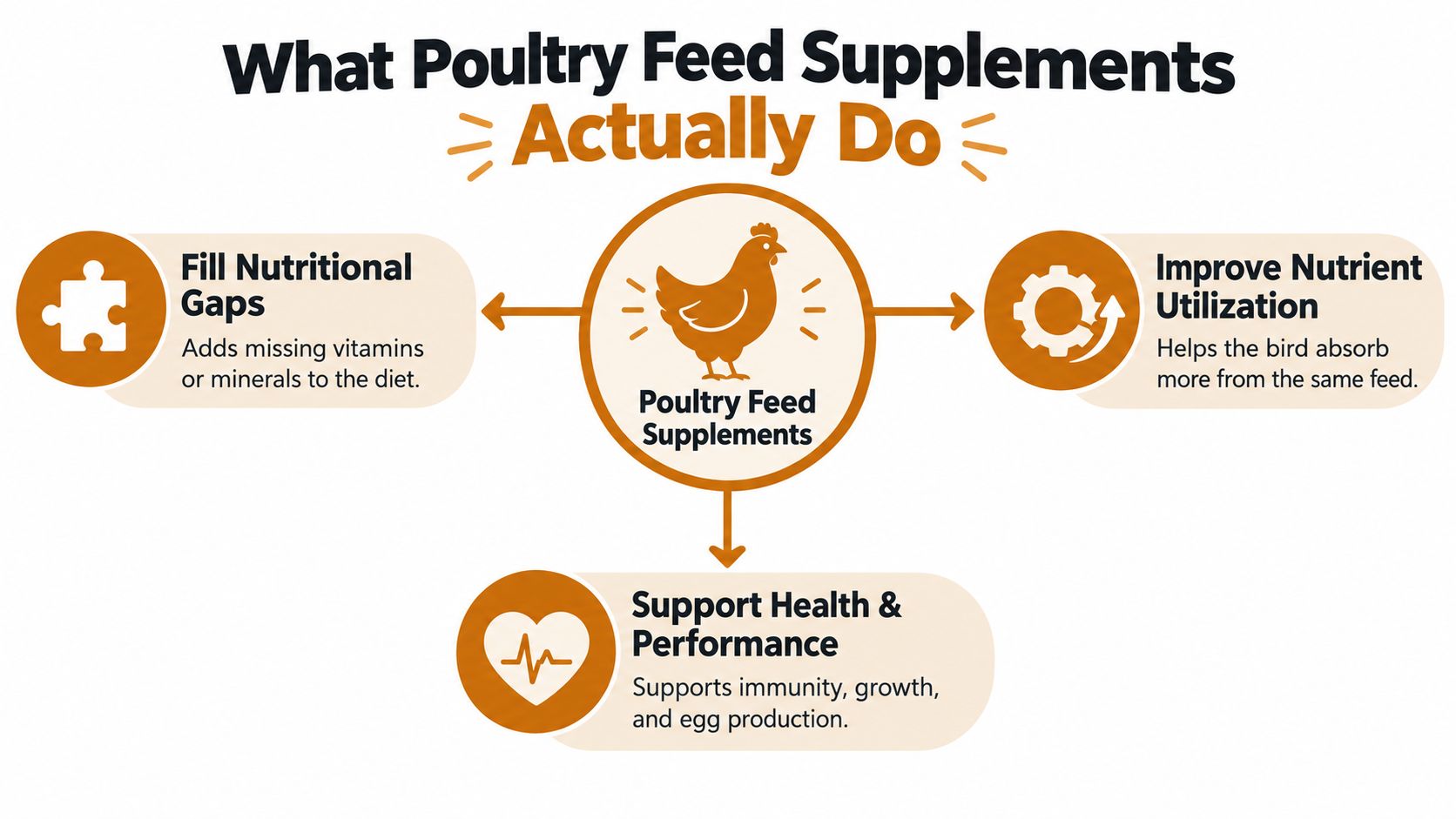
A complete ration is the meal; a supplement is a side dish. A calcium source doesn't supply the energy, amino acids, and other nutrients a hen needs, just as a multivitamin doesn't replace a balanced meal. Adding a supplement can't make an incomplete diet complete unless the product is specifically formulated and used as part of a properly balanced feed.
That distinction helps you read a label. A supplement might add a nutrient, such as calcium; support use of nutrients already in the feed, as an enzyme can; or provide an extra ingredient, such as a protein-rich treat. Those roles aren't interchangeable, and a product's nutritional value depends on how it fits into the full diet.
The practical question is always: what does this replace? Every scoop of a supplement is a scoop of formulated feed the birds didn't eat. A small treat can sit comfortably in a sensible routine. If birds start filling up on it instead of their regular ration, it stops being a harmless extra and starts changing the diet.
The Main Nutritional Categories of Supplements
Read any supplement label by asking one question first: does this product supply a nutrient, help the bird use one, or add an ingredient? The answer tells you which shelf it belongs on. A hen laying thin-shelled eggs and a broiler chick with slow growth may both "need a supplement," yet their keepers should be shopping on different shelves entirely.
Vitamins and minerals
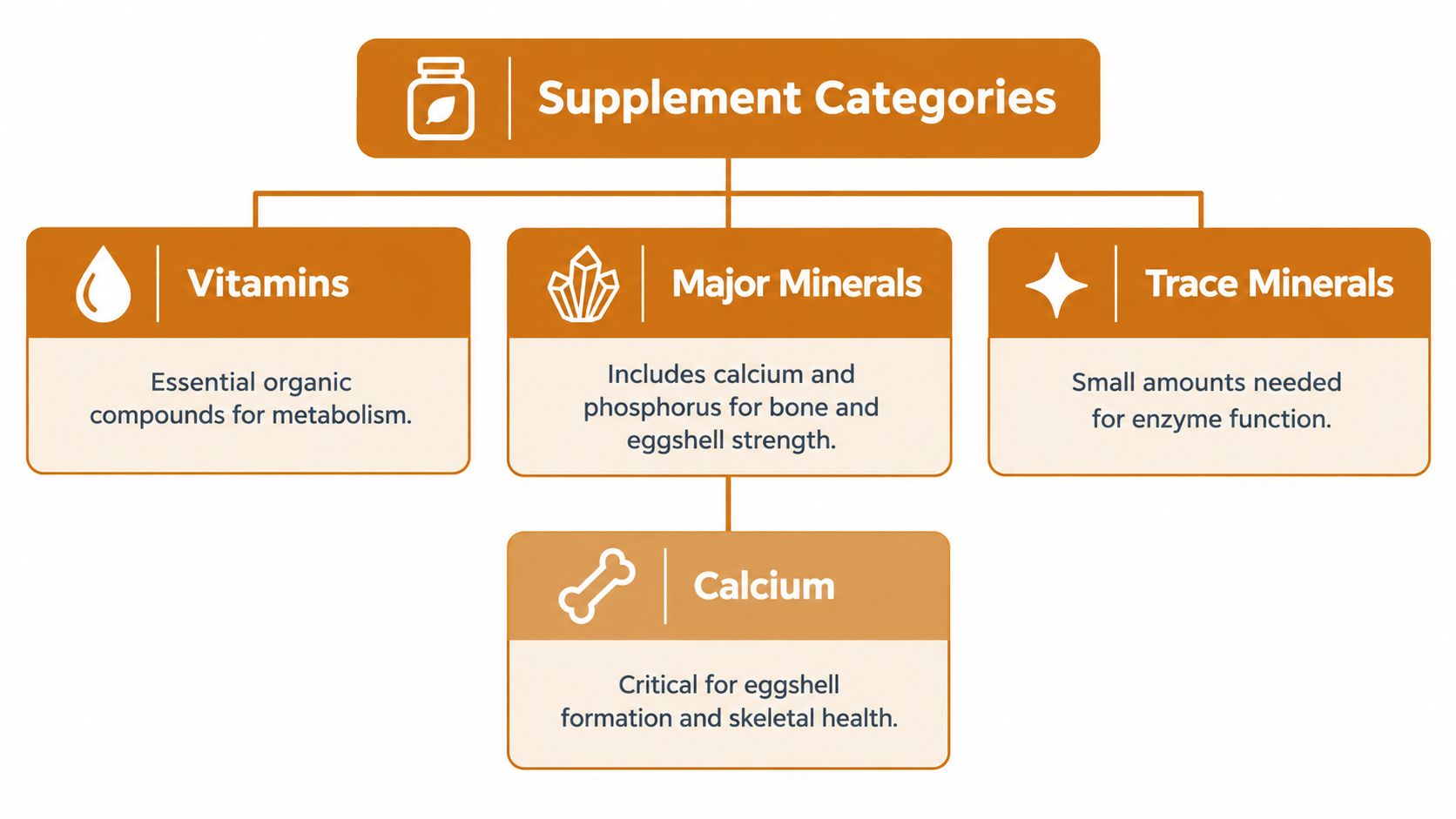
Vitamins support normal body processes, but adding extra doesn't automatically improve a diet that already provides what birds need. Major minerals, including calcium and phosphorus, contribute to functions such as skeletal development and eggshell formation. Trace minerals are needed in smaller amounts and are included in formulated feeds for specific nutritional roles.
Calcium is a common focus for layer keepers, but shell quality isn't determined by calcium alone. A hen's overall ration and the relationship among key nutrients matter, so avoid treating every shell concern as proof that more calcium is the answer.
Enzymes and probiotics
Enzymes help make certain nutrients more available. Phytase is a well-studied example: poultry have limited ability to break down phytate, a plant compound that can bind phosphorus and reduce the availability of minerals. A peer-reviewed study found that phytase allowed broiler chicks on a diet with 0.27% available phosphorus to achieve three-week weight gain comparable to chicks on 0.47% available phosphorus. A review also reported an increase of about 4–6% in apparent calcium digestibility, with results depending on diet and enzyme conditions; see the phytase research and review.
Probiotics work differently. They're live microorganisms included in some products to support the gut environment, and their usefulness depends on the product and the birds. A probiotic cannot compensate for poor feed quality or a ration that doesn't fit the flock.
Protein-based supplements
Protein sources, including insect-based ingredients, provide nutrients that may be useful as part of a broader diet. Their value depends on how much birds eat and what the complete ration already supplies. A protein-rich treat isn't automatically a balanced feed: it may add protein while failing to supply the same balance of energy, amino acids, vitamins, and minerals as the complete ration.
With insect-based products in particular, ask the supplier for a nutrient analysis before you buy, since protein and mineral content can vary between producers and batches.
If you're comparing extra calcium options for layers, this guide to calcium supplements for chickens walks through the main forms and how they differ. Whatever shelf you're shopping from, the label should state the nutrient concentration and the intended life stage. If either is missing, comparing the product against your feed tag is guesswork.
When to Supplement by Bird Type and Life Stage
The same product doesn't suit every bird or every stage of life. A laying hen, a growing broiler, and a young pullet have different nutritional priorities. Ducks and free-ranging birds can also have different diets and feeding routines, so don't assume that a product marketed for one group automatically fits another.
For laying hens, eggshell formation makes calcium important, but shell quality also depends on phosphorus and vitamin D3. Research on late-cycle hens found that increasing dietary calcium from 3.5% to 4.0% improved shell weight, thickness, and density and reduced broken or shell-less eggs; going above 4.0% provided no additional benefit in that cited work. The review of dietary factors affecting eggshell quality supports a measured approach, not unlimited calcium addition.
Broilers need a ration made for their growth purpose. If considering an added ingredient, check whether it changes the balance of that feed rather than assuming a supplement will improve performance. Chicks and young pullets also need age-appropriate feed; a product intended for adult layers may not suit birds that aren't laying.
During molting, keepers often consider protein-rich foods to support feather regrowth. Treats can contribute nutrients, but they shouldn't replace a properly formulated ration. For an overview of protein in poultry diets, see this guide to poultry feed protein content.
If you're comparing insect-based options, USA GROWN BLACK SOLDIER FLY LARVAE FOR CHICKENS is a dried BSFL product described as a treat, with protein and calcium listed in its product information. Treat that description as product-specific, not as a reason to use the larvae instead of complete feed.
For ducks and free-ranging birds, take account of the species and the whole diet. Free-ranging birds may find food outside the feeder, while ducks may receive a different ration from chickens. In either case, check the product's intended animal use and don't infer that one supplement meets every nutritional need.
Safety Checks for Poultry Feed Supplements
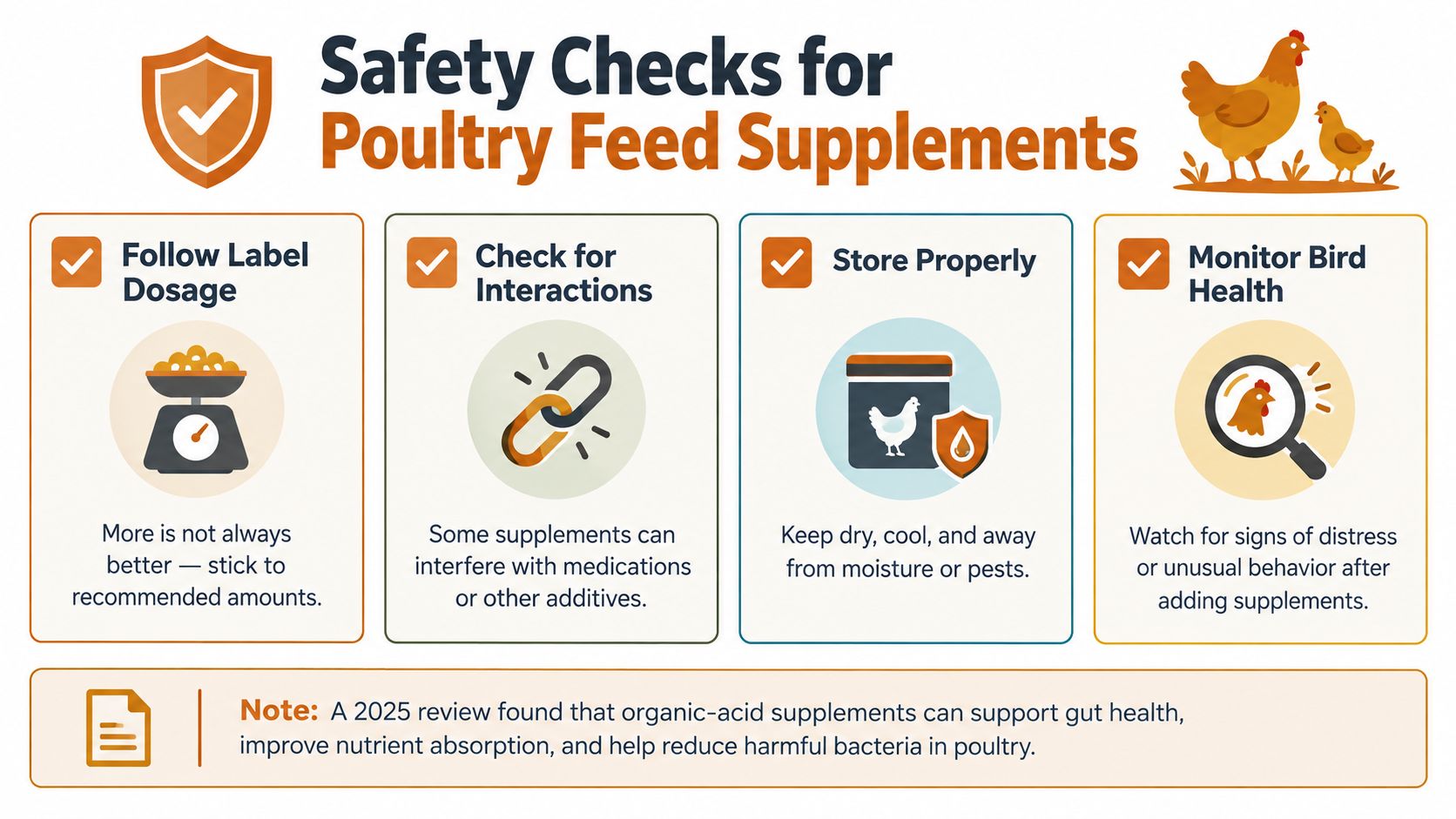
More isn't always better. A 2025 review reports that organic-acid additives are commonly used at about 0.5–3% of feed and warns that combinations can produce synergistic effects or adverse outcomes if poorly dosed. The review of organic-acid feed additives is a reminder that an ingredient's effect depends on dose and on what else is in the feed.
Use a simple checklist before adding a product:
- Read the intended use and directions. Confirm which birds the product is for and whether it's meant to be a treat, a top-dress, or an ingredient in formulated feed.
- Ask what it replaces. If birds eat less of their complete ration after you introduce a supplement, adjust your plan. A supplement that displaces a substantial share of the diet has become a ration ingredient.
- Avoid stacking products casually. Two products can overlap in ingredients or interact. Ask the manufacturer, a poultry nutritionist, or a veterinarian before combining additives when the directions don't address the combination.
- Watch the birds and the feed routine. Note whether birds continue eating their regular feed and whether you see unusual changes in behavior or condition after an addition. Follow storage instructions to help protect product quality.
For insect-based products, ask questions beyond whether the package says “dried.” What insect species is listed? Is the product intended for poultry? Where was it raised and processed? Does the seller provide information about manufacturing controls and batch-level contaminant testing? Clear answers help you evaluate the product without assuming that every dried insect feed is suitable for laying hens.
In the United States, animal-feed ingredients generally need an applicable regulatory basis, such as FDA approval, GRAS recognition, or an AAFCO-defined ingredient status. Buyers should distinguish that regulatory status from a seller's claims about facility practices or testing. If documentation isn't clear, ask the seller for it before buying.
A guide to food safety for poultry can help frame the questions to ask. The key is to make safety part of the purchase decision, not an afterthought.
Black Soldier Fly Larvae as a Protein and Calcium Supplement
Black soldier fly larvae, often shortened to BSFL, are used as an insect-based poultry feed ingredient or treat. They can supply protein and minerals, but those nutrients don't make larvae a complete ration. The practical question is how they fit beside the formulated feed, not whether they sound nutritious on their own.
A 2019 meta-analysis screened 75 insect-feed studies and retained 41 studies comprising 174 poultry trials. Across the dataset, low-level insect inclusion produced no statistically significant overall adverse effect on average daily gain, feed intake, or feed-conversion ratio when insects replaced conventional protein sources. As inclusion increased, however, average daily gain fell below the control trend at about 10% inclusion or higher, according to the meta-analysis of insect feed in poultry.
That finding isn't a universal feeding prescription. The studies covered different insect species, processing methods, nutrient profiles, and basal diets. It does show why it's sensible to treat dried larvae as a modest addition or a carefully formulated partial ingredient, not as an unrestricted substitute for complete layer feed.
Practical rule: If larvae are reducing how much complete feed your birds eat, cut back the treat rather than letting it become the main ration.
A high-protein treat can still dilute the diet if birds fill up on it. Complete feed supplies a balance of nutrients that a single ingredient may not provide, including energy, amino acids, available phosphorus, sodium, and vitamins. Keep the complete ration central, especially for laying hens.
What to ask before buying
Look for the named insect species, the intended animal use, and clear feeding and storage directions. Ask where the insects were raised and processed, what manufacturing controls the seller uses, and whether batch-level contaminant testing is available. If the product is described only as a treat, don't assume it has been formulated to replace a balanced feed ingredient.
The feeding context matters, too. A small, measured treat alongside regular feed is different from offering larvae freely throughout the day. Consider whether the birds still eat their normal ration, and keep the product's role consistent with its label and nutritional information.
Building a Practical Supplement Plan for Your Flock
A workable plan starts with the diet your birds already eat. Keep the complete ration as the foundation, then add a supplement only when you can name its purpose and explain what it contributes without displacing too much of that feed.
Use this decision sequence:
- Name the goal. Are you responding to a shell-quality concern, supporting birds during molting, or offering an occasional treat?
- Match the product to the goal. Choose a supplement with a clear nutritional role. Don't assume that one ingredient corrects a problem involving several nutrients.
- Check the fit and the seller. Read the intended-use directions, consider what the birds might eat less of, and request useful sourcing or safety documentation, especially for insect products.
For layers, think about the full balance involved in shell formation rather than adding calcium without context. During molt, a protein-containing supplement may be an option, but it shouldn't replace the complete feed. If you're uncertain, start with one clearly labeled product and observe whether your flock continues eating normally.
Supplementing doesn't have to mean buying a shelf of powders and treats. Choose a specific purpose, protect the role of the complete ration, and make the seller's documentation part of your decision. That's a practical way to support your birds without adding products they don't need.
Pure Grubs offers dried black soldier fly larvae as a supplemental treat for chickens and other birds, with product information describing its nutritional contents and intended use. If you're comparing insect-based supplements, visit Pure Grubs and review the product details and feeding guidance before deciding whether they fit your flock.