

Natural Antiparasitic Supplements for Poultry Guide
You notice a few loose droppings under the roost, a hen with a paler comb, and fewer eggs in the basket. The flock still looks active, so you wonder whether a garlic blend, oregano oil, or another natural product could help before reaching for medication.
That question deserves a careful answer. Natural antiparasitic supplements can offer useful, parasite-specific support, but they aren't universal replacements for diagnosis, approved treatment, or sound flock management. Their value depends on the organism involved, the preparation, the dose, and whether the supplement is paired with clean litter, suitable nutrition, and monitoring.
Introduction to Natural Parasite Support for Your Flock
A backyard keeper may see a bird losing condition and assume worms. That assumption can lead to the wrong product because chickens can show similar signs from coccidiosis, bacterial disease, nutritional imbalance, heat stress, or another problem entirely. Loose droppings alone don't identify a parasite, and a drop in laying doesn't prove that a cleanse is needed.
The first useful distinction is between support and treatment. A botanical may help maintain appetite, digestion, or general resilience. Another may show direct activity against a parasite in a laboratory test. A third may have animal-model evidence but little practical validation in a mixed backyard flock. Those are different levels of confidence, and product labels often blur them.
Human “parasite cleanse” marketing creates more confusion. A major medical discussion notes that herbal cleanses don't have credible evidence for reliably treating confirmed human parasitic infections, and that these products aren't well regulated for safety, as summarized by NPR's reporting on parasite cleanse safety and science. Poultry keepers shouldn't transfer broad human claims directly to chickens.
Practical rule: Treat the suspected parasite as the target, not the word “parasite” as the diagnosis.
A sensible approach starts with identification, then asks what evidence exists for that organism in poultry. It also considers whether the bird is young, laying, recovering from illness, or sharing ground with other species. This guidance helps you separate laboratory promise from flock-ready evidence, compare herbs with diatomaceous earth and nutritional support, and build a layered plan that doesn't depend on one bottle.
How Parasites Affect Poultry and Where Natural Options Fit
Internal parasites are unwelcome guests inside the digestive tract. They consume nutrients, irritate tissue, compete with the bird's normal gut processes, or damage the lining that absorbs feed. The result may be poor growth, reduced condition, abnormal droppings, weakness, or reduced production, but the signs vary by parasite burden and bird.
Learn the main targets
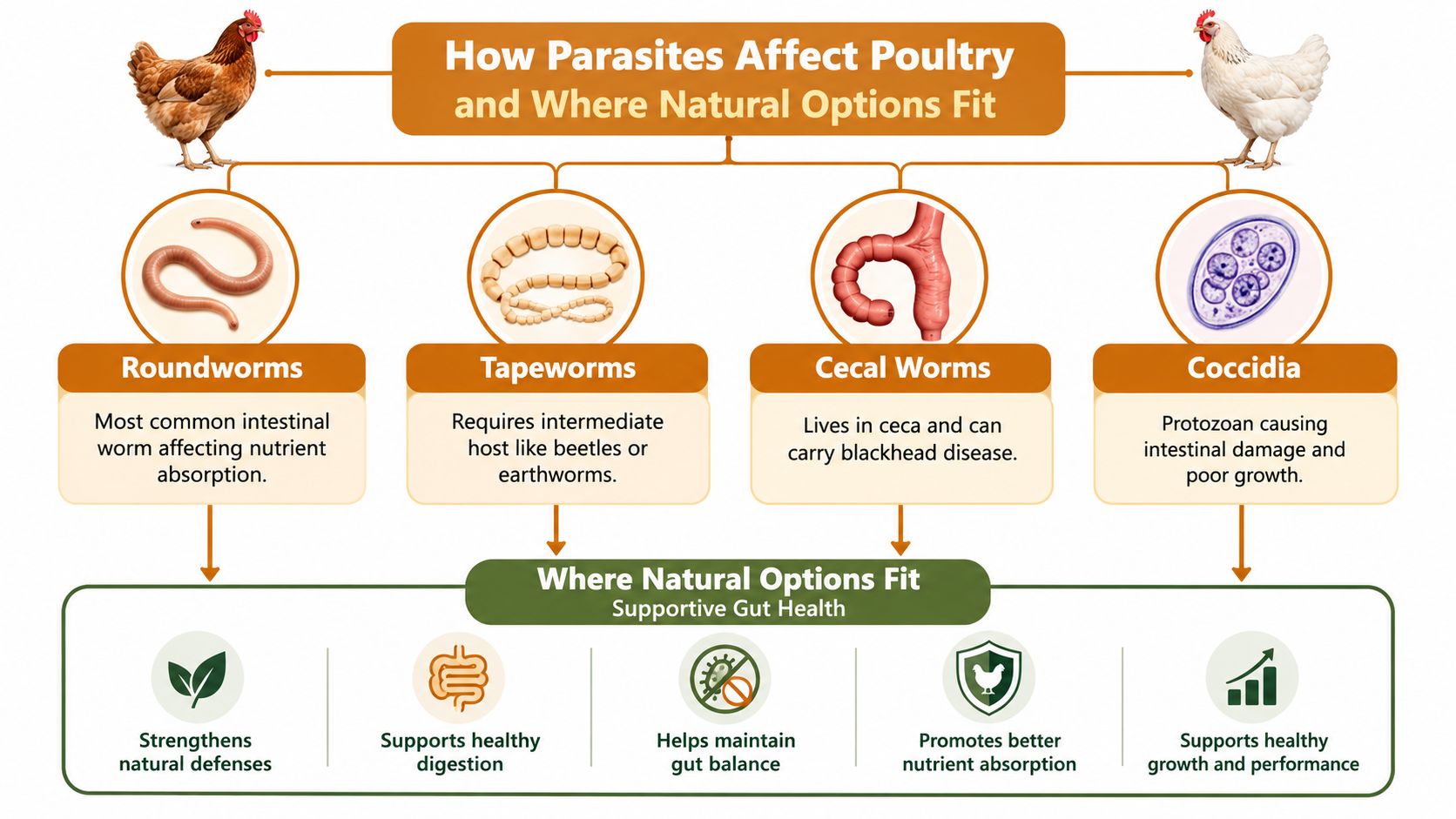
- Roundworms: These live in the intestinal tract and can interfere with nutrient use. Birds may remain outwardly normal while gradually losing condition.
- Tapeworms: These segmented worms depend on an intermediate host, such as an insect or earthworm, so outdoor access can shape exposure.
- Cecal worms: These occupy the ceca, paired digestive pouches where feed is fermented. They can also carry blackhead disease, making identification and prevention important.
- Coccidia, including Eimeria: These are microscopic protozoa, not worms. They multiply in intestinal tissue and can cause significant damage, especially in vulnerable birds.
The life cycle matters as much as the adult parasite. Droppings can contaminate litter, soil, water, and feeders. Another bird then ingests an infective stage, and the cycle continues. A supplement that affects an organism in the gut won't necessarily remove contamination from the run.
Place supplements on a control spectrum
Natural products fit into several roles:
- Resilience support helps birds maintain normal eating, digestion, and recovery. Balanced feed, clean water, and appropriate protein are central here.
- Exposure reduction comes from dry litter, sanitation, pasture rotation, and limiting contact with contaminated material.
- Direct antiparasitic activity means a compound affects the parasite itself. Evidence for this role needs to be specific to the plant, preparation, organism, and host.
This is why “natural” isn't a mechanism. Garlic powder, oregano oil, wormwood, and a mineral dust don't act in the same way, and none should be assumed to cover every internal parasite. Think of the flock plan as closing doors, removing contaminated bedding, and supporting the birds, while a targeted treatment addresses a confirmed problem.
What the Science Actually Shows About Natural Antiparasitics
The strongest lesson from the research is not that one herb solves poultry parasite problems. It's that the evidence is broad, promising in places, and uneven in quality.
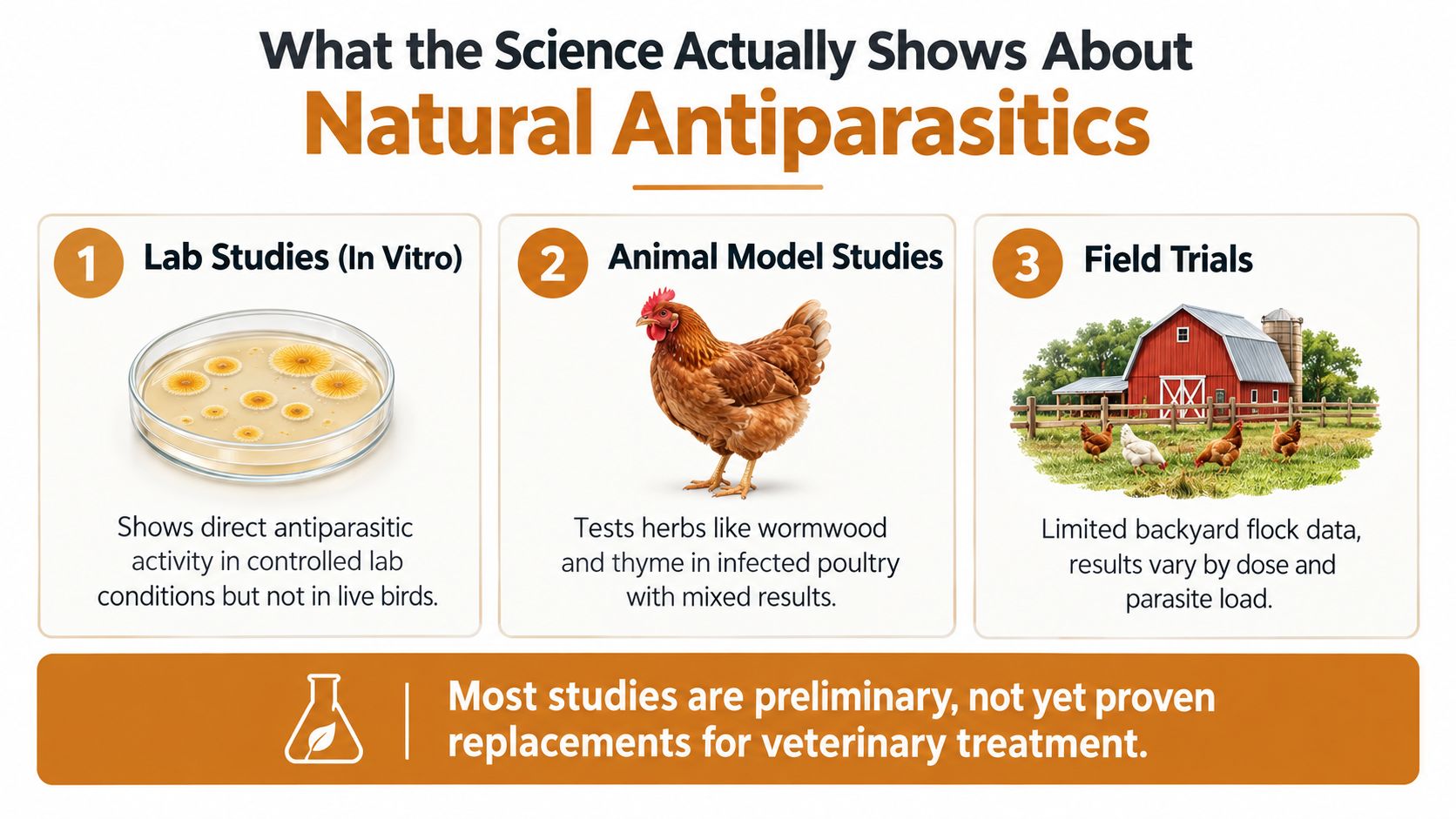
A major 2023 review of medicinal plants as antiparasitics examined 507 plant species from 126 families. Of those evaluations, 78.4% were in vitro, meaning researchers tested extracts or compounds outside a living bird or animal. The review identified 91 plant species and 34 isolated compounds with significant in vitro activity, while 23 plants and 10 compounds showed no significant effect in the tests, according to the 2023 medicinal-plant review.
Those findings show a large screening effort, not a shelf of proven poultry products. In vitro work can reveal whether a compound harms or disables a parasite under controlled conditions. It can't establish how well the ingredient survives digestion, reaches the right tissue, affects feed intake, interacts with other ingredients, or performs in birds exposed to different parasite loads.
Read herb research with the right filter
A 2022 review of herbs and spices used for antiparasitic treatment selected 49 papers, including 34 experimental studies. Among those experimental studies, 28 were in vitro only, while 6 included in vivo data, as reported in the review of herbs and spices.
Oregano appeared most often, in 15 studies, followed by thyme in 14, rosemary in 7, marjoram in 4, and cumin in 2. Frequent testing makes an ingredient interesting, but it doesn't automatically establish a reliable field protocol. Keepers still need to ask whether the study used the same plant part, extraction method, concentration, bird type, and parasite species as the product in front of them.
The distinction becomes clearer in animal research. In pigs, powdered garlic, Allium sativum, at 180 mg/kg/day, and Artemisia absinthium at 90 mg/kg/day, given for 10 consecutive days, produced reported efficacy ranging from 20% to 100%, depending on parasite taxonomy and animal age group, according to the in vivo pig study. That result demonstrates that repeated oral dosing can have measurable effects, but it also shows why a single universal claim is unsafe. Activity differed by organism, with limited effect against Cryptosporidium and variable results among nematodes and protozoa.
Evidence checkpoint: “Shown to affect parasites” is incomplete unless the label also tells you which parasite, in what host, using which preparation and dose.
For a separate product-sourcing concern, keepers can also review this discussion of heavy metals in imported black soldier fly larvae. Ingredient origin and testing matter because a natural ingredient is still a physical input into the flock's diet.
Comparing Herbal Remedies Diatomaceous Earth and Nutritional Approaches
These categories often appear together in poultry discussions, but they solve different problems. Herbs and essential oils are the category most often investigated for direct biological activity. Diatomaceous earth is usually discussed as a physical or environmental tool, while nutrition supports the bird's ability to tolerate stress and maintain normal gut function.
Herbs such as oregano, thyme, garlic, rosemary, and wormwood contain different compounds, and the preparation changes the exposure. A dried leaf, powdered bulb, water extract, and concentrated essential oil aren't interchangeable. The 2022 review cited above found that oregano and thyme were among the most frequently studied herbs and spices, but much of that literature remained preclinical. That makes these ingredients candidates for targeted support, not automatic flock-wide treatment.
Diatomaceous earth deserves especially careful wording. It may be useful in some external pest-control and dry-litter practices, but claims about reliably eliminating internal worms after adding it to feed aren't established by the evidence summarized here. Dust can also irritate the respiratory tract, so keepers should avoid creating airborne clouds around birds and people. A clean coop and dry bedding remain more dependable environmental priorities than treating mineral dust as a cure.
Nutrition works differently. A bird with adequate feed, water, and digestible nutrients has more capacity to maintain body condition during exposure. Protein supports tissue maintenance and feather growth, while minerals support skeletal and eggshell needs. That doesn't make a nutritious treat antiparasitic, but it can make nutrition an important layer in a broader resilience plan.
| Approach | Proposed mechanism | Evidence level | Best use context |
|---|---|---|---|
| Herbs and essential oils | Plant compounds may affect selected parasites or support digestion | Lab evidence is common, with some animal-model work and limited field validation | Parasite-specific, carefully sourced supplemental support |
| Diatomaceous earth | Physical drying or abrasion is proposed, mainly in environmental or external-pest discussions | Internal antiparasitic claims remain uncertain | Dry-coop practices, only with respiratory caution |
| Nutritional support | Maintains condition, gut function, and normal immune response | Strong practical rationale, but not proof of direct parasite killing | Everyday flock care, recovery support, and resilience |
The most useful comparison is therefore not “which natural product is strongest?” It is “what job is this product supposed to do?” If the answer is direct control of Eimeria, look for poultry-specific research rather than a general worm claim. If the answer is maintaining condition during molt or stress, choose a balanced feed and a suitable supplement instead of labeling it a parasite treatment.
How to Use Natural Supplements Safely and Effectively in the Coop
Start with a baseline. Record which birds look affected, note droppings and body condition, and arrange a fecal examination when signs persist or several birds are involved. A test can separate a suspected worm problem from coccidia or another cause, and it gives you a better basis for deciding whether a natural product has a reasonable role.
Build the routine around consistency and observation
Animal-model findings illustrate why dosing details matter. In the pig data discussed earlier, the botanicals were given daily for 10 consecutive days, and results varied by parasite and host group. That doesn't provide a chicken dose, but it does warn against copying a livestock number or assuming one large serving will outperform a carefully designed schedule.
Use the product's poultry label, not a human cleanse protocol. Check whether the manufacturer identifies the plant species, plant part, extraction method, batch testing, intended bird category, and any egg-use guidance. Don't combine several concentrated oils or bitter herbs because each sounds useful.
A practical coop routine includes:
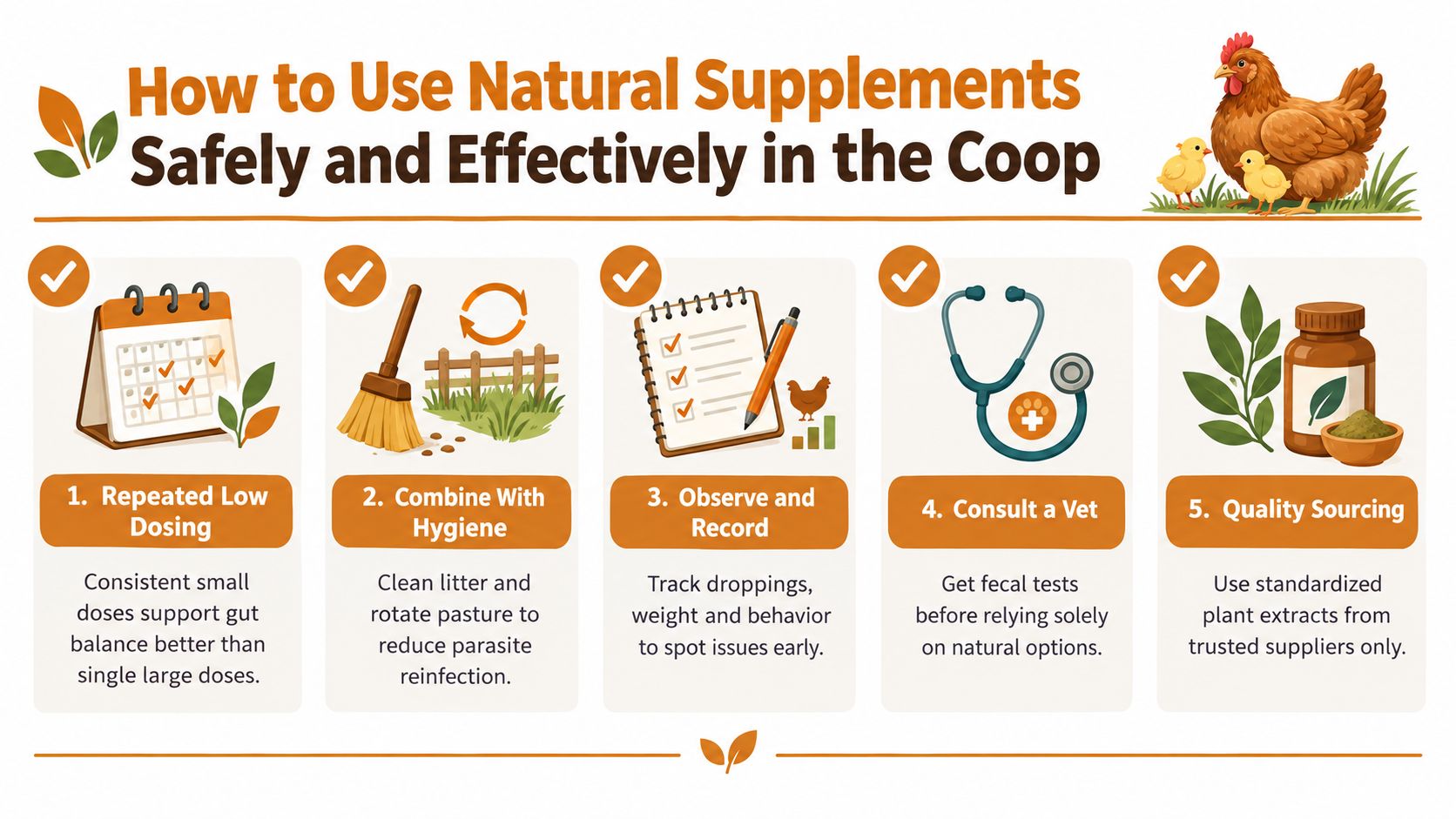
- Mix carefully: Follow the label's feed or water instructions and distribute the product evenly. Avoid adding an unmeasured concentrate to a shared drinker.
- Protect intake: Stop or reassess if birds eat less, drink less, become unusually quiet, or develop worsening droppings.
- Track outcomes: Weigh representative birds consistently when possible, and record behavior, droppings, body condition, and egg quality.
- Clean the environment: Remove wet litter, scrub drinkers, keep feeders above contaminated bedding, and reduce repeated exposure. The chicken coop hygiene guide offers a practical reference for this layer.
- Source with care: Choose suppliers that identify ingredients and provide meaningful quality-control information. General guidance about animal essential-oil safety, including why species differ, is available in this resource on essential oils safe for dogs and cats. Poultry have their own tolerances, so don't treat a dog or cat recommendation as a chicken dose.
Stop and seek help: Blood in droppings, marked weakness, rapid deterioration, severe weight loss, or multiple sick birds calls for prompt veterinary guidance, not a longer cleanse.
Natural products also aren't automatically safe for laying hens, chicks, breeding birds, or birds receiving medication. Ask a poultry veterinarian about withdrawal considerations, interactions, and whether the flock needs an approved treatment. Supportive supplements belong inside a plan that protects the birds while the diagnosis is clarified.
Real World Examples of Targeted Phytogenic Support in Poultry
Poultry research is moving toward narrower questions. Instead of asking whether a “parasite cleanse” works, researchers may ask whether a defined essential-oil blend affects a particular organism under a particular challenge. A 2025 review reported that essential oils showed in vitro and in vivo activity against major poultry parasites, while a 2026 review reported that selected plant extracts reduced lesion scores and oocyst shedding in broiler chickens challenged with Eimeria, as summarized in the supplied poultry evidence brief.
That wording matters. Lesion scores and oocyst shedding are parasite-specific measurements, not proof that every herb blend will cure every flock. Broilers raised under controlled research conditions also differ from backyard hens exposed to changing litter, pasture, weather, and mixed ages.
Use nutrition as a supporting layer
Black soldier fly larvae, or BSFL, fit the nutrition side of the plan rather than the direct antiparasitic side. They can provide protein and calcium as a supplemental feed, which may help maintain body condition, feather growth, and eggshell support. Those benefits can complement parasite management, but they shouldn't be presented as evidence that larvae kill worms or coccidia.
Pure Grubs describes its product as USA-grown, water-washed BSFL produced in FDA-compliant facilities meeting FDA and AAFCO safety standards, with batch testing for heavy metals including lead, arsenic, mercury, and cadmium. Keepers comparing insect feeds can read natural supplements for chickens for product and nutrition context.
The same principle applies to phytogenic blends. Choose the ingredient for the problem under consideration, monitor the flock, and keep sanitation in place. A targeted blend may support an anticoccidial strategy, while a nutritional treat supports recovery and condition. Neither replaces a diagnosis when birds are deteriorating.
Building a Balanced Parasite Plan for Long Term Flock Health
A durable plan has four connected parts. Identify the likely organism, reduce environmental exposure, support the bird, and reassess results. Natural antiparasitic supplements may fit in the third part or, when poultry-specific evidence exists, as targeted support alongside a professional plan.
Use risk to guide effort. A dry, uncrowded coop with clean water and managed ranging presents a different challenge from a wet run shared by birds of several ages. Young birds, visibly sick birds, and flocks with recurring signs deserve faster testing and closer veterinary involvement.
Your next steps can stay simple:
- Record the signs. Note droppings, appetite, activity, body condition, and egg changes.
- Test when concern persists. A fecal examination is more useful than guessing from one symptom.
- Choose one clearly defined support. Avoid stacking multiple unstandardized products.
- Improve the habitat. Remove wet litter, protect feed and water, and limit reinfection.
- Review the outcome. If birds worsen or fail to recover, change course with veterinary guidance.
The right question isn't whether natural products are good or bad. It's whether a specific tool has a plausible role for a specific parasite, in a specific flock, with a safety plan around it.
Pure Grubs offers USA-grown Black Soldier Fly Larvae as a protein- and calcium-rich supplemental treat for chickens and other birds, with batch testing for heavy metals and no added preservatives. Visit Pure Grubs to explore a nutrition-focused option that can complement, but not replace, parasite testing, hygiene, and targeted flock care.