

Your Guide to a Homemade Chicken Feed Recipe
If you've ever looked at the ingredient list on a bag of commercial chicken feed and wondered what half of it was, you're not alone. Making your own feed is a fantastic way to take complete control over what your flock eats, all while potentially saving a bit of money. A solid homemade chicken feed recipe really boils down to a balanced mix of energy from grains like corn and wheat, protein from sources like field peas, and crucial calcium from oyster shells. This ensures your hens have everything they need to stay healthy and keep those egg baskets full.
Why You Should Make Your Own Chicken Feed
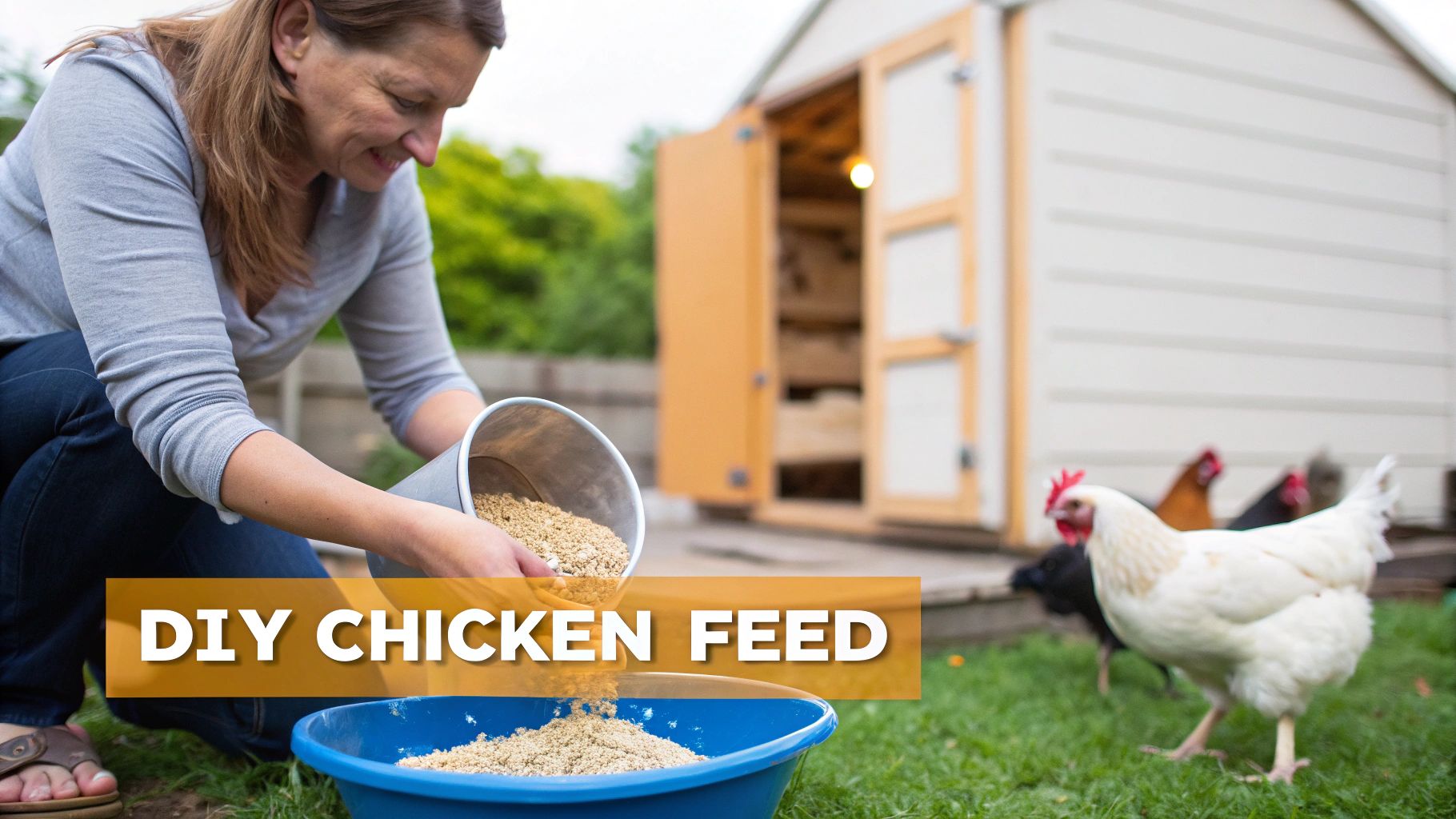
Diving into DIY chicken feed can feel like a big step, but the rewards are well worth the learning curve. For most people, the biggest driver is cost. Let's face it, feed is easily the number one expense in raising chickens, often eating up 60-70% of the entire budget. With the price of ingredients always seeming to go up, mixing your own can lead to some serious long-term savings.
This isn't just a local trend; it's a global movement among backyard poultry enthusiasts. As the raw material costs for commercial feed continue to climb, a good homemade recipe has become a go-to strategy for cutting expenses. You can read more about the backyard chicken feed market drivers to see the bigger picture.
But it's not just about saving money. It's about knowing exactly what's in every scoop.
Before we get into the nitty-gritty of recipes, let's do a quick rundown of what you're signing up for.
Commercial Feed vs Homemade Feed at a Glance
| Attribute | Commercial Feed | Homemade Feed |
|---|---|---|
| Convenience | High (Just open the bag) | Low (Requires sourcing, mixing, and storage) |
| Cost | Generally higher and variable | Can be lower, especially with local sourcing |
| Ingredient Control | Low (Fixed formula, may contain fillers) | High (You choose every single ingredient) |
| Freshness | Low (Can sit for months, losing nutrients) | High (Mix as needed for maximum potency) |
| Customization | Very Low (One-size-fits-all) | High (Easily adjustable for flock needs) |
This table really highlights the trade-off: convenience for control. For many of us, that control is exactly what we're after.
Full Control Over Ingredients
When you're the one mixing the feed, you're also the head of quality control. This is a huge advantage.
- Go Organic or Non-GMO: You get to source your own grains, so you can choose certified organic or non-GMO options. This means you know your chickens—and the eggs they lay—are free from things you'd rather avoid.
- Eliminate Allergens: It's simple to create a soy-free or corn-free recipe if you have a flock with sensitivities or if it just aligns better with your farming philosophy.
- Guarantee Freshness: Think about it—commercial feed can sit in a warehouse or on a store shelf for months, slowly losing its nutritional punch. Your homemade feed uses fresh, whole ingredients, giving your birds the maximum benefit.
The ability to hand-pick every component means you're not just feeding your chickens; you're nourishing them with a diet designed for peak health, vitality, and egg quality.
Tailored Nutrition for Your Flock
Every flock is different. Their needs can shift with the seasons, their age, or even their breed. A generic, one-size-fits-all pellet from a bag can't always meet those specific demands.
When you make your own feed, you can tweak the ratios on the fly. Need more protein to help your flock through a tough molt? Done. Want to add a bit more energy-dense corn to help them stay warm in the winter? Easy. Notice your best layers could use an extra calcium boost? You can add it.
This level of customization just isn't possible with a pre-mixed bag. It’s all about giving your flock precisely what they need, right when they need it most.
What Your Chickens Actually Need to Thrive
Before we jump into mixing ingredients, let's get into the why. Think of it like being your flock’s personal chef and nutritionist all rolled into one. Every single thing you put into their feed has a job to do, whether it's building strong eggshells or fueling their endless scratching and foraging.
A good diet isn't just about keeping the feeder full; it’s about giving them the fundamental building blocks for a healthy, vibrant life.
Chickens need a solid mix of macronutrients, just like we do. The bulk of their diet comes from carbohydrates, which they get from grains like corn and wheat. This is pure energy—the fuel they burn to run around the yard, take dust baths, and stay warm on a chilly night. If they don't get enough, the first thing you'll notice is that egg production grinds to a halt and your birds will seem sluggish.
The Power of Protein and the Calcium Connection
For a laying hen, protein is king. It’s what she uses to build a perfect egg day after day, and it's also essential for growing healthy, glossy feathers. A flock that isn't getting enough protein will show it pretty quickly—you might see a drop in laying, an increase in feather picking, or a really rough molt.
And then there's calcium. For a laying hen, this is completely non-negotiable. She needs a massive amount to create strong, smooth eggshells. Without a readily available source like crushed oyster shell, she’ll start pulling that calcium from her own bones, which can lead to serious, long-term health problems.
It's a delicate dance. Not enough protein, and egg production stops. Not enough calcium, and you get weak shells and, eventually, weak birds. Getting these two right is the absolute foundation of any good homemade feed.
Layers vs. Meat Birds: Two Very Different Diets
Not all chicken feed is created equal, because not all chickens have the same job. The nutritional goals for a hardworking laying hen are worlds away from those of a fast-growing meat bird, and your feed mix has to reflect that.
For example, a broiler (meat bird) needs a feed packed with protein—we’re talking 20-24% crude protein—to support that incredibly rapid muscle growth. A laying hen, on the other hand, does best on 16-18% protein, which is perfect for sustained, long-term egg production.
Most DIY recipes start with a base of grains like corn or wheat for energy, then add in protein from sources like soybean or sunflower meal. Finally, a calcium source, like crushed oyster shells or even baked eggshells, is mixed in to keep bones and eggshells strong. You can see these principles at play by looking at the global poultry feed market, which follows these same standards.
- Laying Hens: Their diet is a marathon, built for the long haul. The focus is on sustained egg-laying and shell quality, with a major emphasis on calcium.
- Meat Birds: Their diet is a sprint. It’s all about putting on muscle as quickly and efficiently as possible, so it's much higher in protein and overall calories.
Getting this right is crucial. Feeding a high-protein broiler feed to a laying hen for too long can overwork her kidneys. On the flip side, giving a meat bird a standard layer ration will just lead to disappointingly slow growth. You have to match the feed to the flock.
For a more detailed breakdown of what makes a perfect chicken diet, check out our guide on the best food for chickens.
The Perfect Homemade Chicken Feed Recipe

Alright, let's get our hands dirty and move from theory to the feed trough. I’m going to walk you through a field-tested recipe that has become my go-to starting point for any flock. It's balanced, uses ingredients you can actually find, and gives your laying hens everything they need to stay healthy and productive.
Our target here is a protein content of around 16-18%, the sweet spot for consistent egg layers. We'll hit that mark by combining energy-dense grains with protein-packed seeds and legumes. One critical tip: always measure your ingredients by weight, not volume. A scoop of corn weighs very different from a scoop of oats, so using a scale is the only way to guarantee your nutritional ratios are spot-on every single time.
The Core Ingredients Breakdown
Every single item in this recipe has a job to do. Once you understand the "why" behind each ingredient, you'll feel more confident making smart substitutions based on what's available or on sale at your local feed mill.
- Energy Grains: These are the foundation, making up the bulk of the feed. They provide the essential carbohydrates your chickens burn for energy—fueling all that scratching, foraging, and keeping warm in the winter.
- Protein Sources: Think of these as the building blocks for good health, feather growth, and, of course, daily egg production. If you skimp on protein, you'll see it in the nesting box first.
- Essential Supplements: A few key additions round out the mix, providing the crucial vitamins, minerals, and micronutrients that might not be present in the main ingredients alone.
Mixing your own feed is like becoming a personal chef for your flock. You control the quality of every single ingredient. This means fresh, nutrient-dense food without the fillers or mystery pellets you find in some commercial bags.
This recipe is designed to make a 100 lb batch, which is super convenient if you're buying standard 50 lb bags from a feed store. You can easily scale it down, too—just cut all the weights in half for a 50 lb batch or by a quarter for a 25 lb mix.
Basic Layer Hen Feed Recipe (100 lb Batch)
Here is a fantastic starting recipe that I've had great success with. Remember, don't be afraid to tweak it based on what you can source from your local co-op or grain elevator.
| Ingredient | Weight (lbs) | Purpose |
|---|---|---|
| Whole Corn | 30 lbs | An excellent source of energy and calories, crucial for active birds. |
| Hard Red Wheat | 30 lbs | Provides both energy and a good source of protein (~15%). |
| Field Peas | 15 lbs | A protein powerhouse (~23%) that helps reach the target protein level. |
| Oats | 15 lbs | High in fiber and adds B vitamins, calcium, and additional protein. |
| Black Oil Sunflower Seeds | 5 lbs | Adds healthy fats for feather gloss and is a treat chickens love. |
| Oyster Shell | 2.5 lbs | A free-choice calcium source essential for strong eggshells. |
| Kelp Meal | 1.5 lbs | Provides a wide array of trace minerals and vitamins. |
| Brewer's Yeast | 1 lb | A fantastic source of B vitamins for overall health and vitality. |
A quick note on sourcing: The real secret to making this affordable is buying your main grains locally. Check with nearby farms or agricultural co-ops. Buying in bulk (50 lb bags) will drastically slash your per-pound cost compared to what you’d pay for small bags at a grocery store.
Now, purists will tell you that oyster shell should only be offered "free-choice" in a separate dish, and they're not wrong. This lets hens take exactly what their bodies need. However, for sheer convenience, many of us mix a base amount right into the feed. I've found that hens are pretty good at self-regulating, so this simplified approach works just fine for most backyard flocks.
Fine-Tuning Your Feed for Every Situation
Having a single homemade chicken feed recipe is a great start, but the real magic of DIY feed is being able to adapt. Your flock’s needs aren’t set in stone; they change with the seasons, their age, and what they’re doing. Think of your base recipe as a flexible foundation, ready to be tweaked to provide the right nutrition exactly when it's needed most. This is all about making the recipe work for you, not the other way around.
One of the most common adjustments is for growing meat birds, often called broilers. While our layer recipe sits nicely around 16-18% protein to keep the eggs coming, broilers are on a different track. They need a much higher protein content—closer to 22%—to fuel that rapid muscle growth.
More Protein for Meat Birds and Molting Hens
You don't need a whole new recipe to hit that higher protein mark. The simplest way is to just increase the proportion of the high-protein ingredients you're already using. Upping the amount of field peas or adding another high-protein legume is a fantastic strategy.
It's the same story for a flock going through its annual molt. Growing an entire set of new feathers is a massive metabolic effort, and feathers are over 85% protein. You'll see egg production grind to a halt because all your hen's energy is being rerouted to feather-making. Giving them a protein-rich feed during this time can help them get through the molt faster and with less stress.
For both growing broilers and molting hens, a temporary protein boost is the answer. By bumping up the field pea component or another protein source, you can elevate the mix to support these demanding life stages without reinventing the wheel.
For a deeper dive into your options, our guide on the best protein for chickens breaks down different sources and their unique benefits.
Bulking Up for Winter Weather
When the temperature drops, your chickens start burning a ton more calories just to stay warm. You can give them a helping hand by making their feed more energy-dense. The easiest way I’ve found to do this is by slightly increasing the amount of whole corn in their ration.
Corn is packed with carbohydrates, which birds metabolize to generate body heat. Adding a little extra to their daily mix, especially as a late afternoon snack, gives them more fuel to burn through a long, cold night. It's a simple tweak, but it can make a real difference in their comfort and health all winter.
Creating Specialty Feeds for Your Flock
Beyond seasonal adjustments, you might want to create a feed that fits a specific farming philosophy or avoids certain ingredients.
- Soy-Free Mixes: Many homesteaders and flock owners prefer to avoid soy. Good news—our base recipe is already soy-free, so you're all set!
- Corn-Free Mixes: If you're looking to go corn-free, you can easily substitute it with other energy-rich grains like barley or just add more hard red wheat. The key is to watch the overall energy content to make sure your flock is still getting all the fuel they need.
Making these small but powerful changes is what truly sets a homemade feed apart. You get to be your flock’s personal nutritionist, dialing in their diet for peak health, amazing productivity, and the resilience to handle whatever comes their way.
Best Practices for Mixing, Storing, and Feeding
You’ve put in the work to create a fantastic homemade chicken feed. That’s a huge step! But what you do next—how you mix, store, and serve it—is just as important for keeping your flock healthy and safe.
First up, let's talk about mixing. If you've ever watched your chickens eat, you know they can be incredibly picky. They’ll go straight for the good stuff (hello, sunflower seeds!) and leave the boring-but-necessary bits behind. If your feed isn't perfectly blended, your flock won't get that balanced nutrition you worked so hard to create.
For smaller batches, a big, clean muck bucket and a shovel or even your hands will do the trick. Just keep turning it over until you can’t tell one ingredient from another. If you're mixing up a large amount, a small cement mixer is a game-changer. It guarantees every single scoop is as nutritionally complete as the last.
Keeping Your Feed Fresh and Safe
Proper storage is absolutely non-negotiable. Homemade feed doesn't have the commercial preservatives you find in store-bought bags, which makes it more vulnerable to moisture, mold, and pests.
The biggest threat here is aflatoxins, a nasty toxin produced by mold that can be lethal to poultry, even in small amounts. To head this off at the pass, your feed needs to be stored in something airtight and completely rodent-proof. Galvanized steel trash cans with tight-fitting lids are a classic, reliable choice for a reason. Never just leave your feed in an open bin or bag where it can suck up humidity from the air.
I make it a habit to give the feed a quick check every single time I scoop it out. I'm looking for clumps, smelling for anything musty or sour, and checking for any discoloration. If anything seems off, the whole batch gets tossed. It's just not worth the risk.
This infographic breaks down how you can tweak your base recipe for different needs, whether it's giving your molting girls an extra protein kick or bulking up your meat birds.
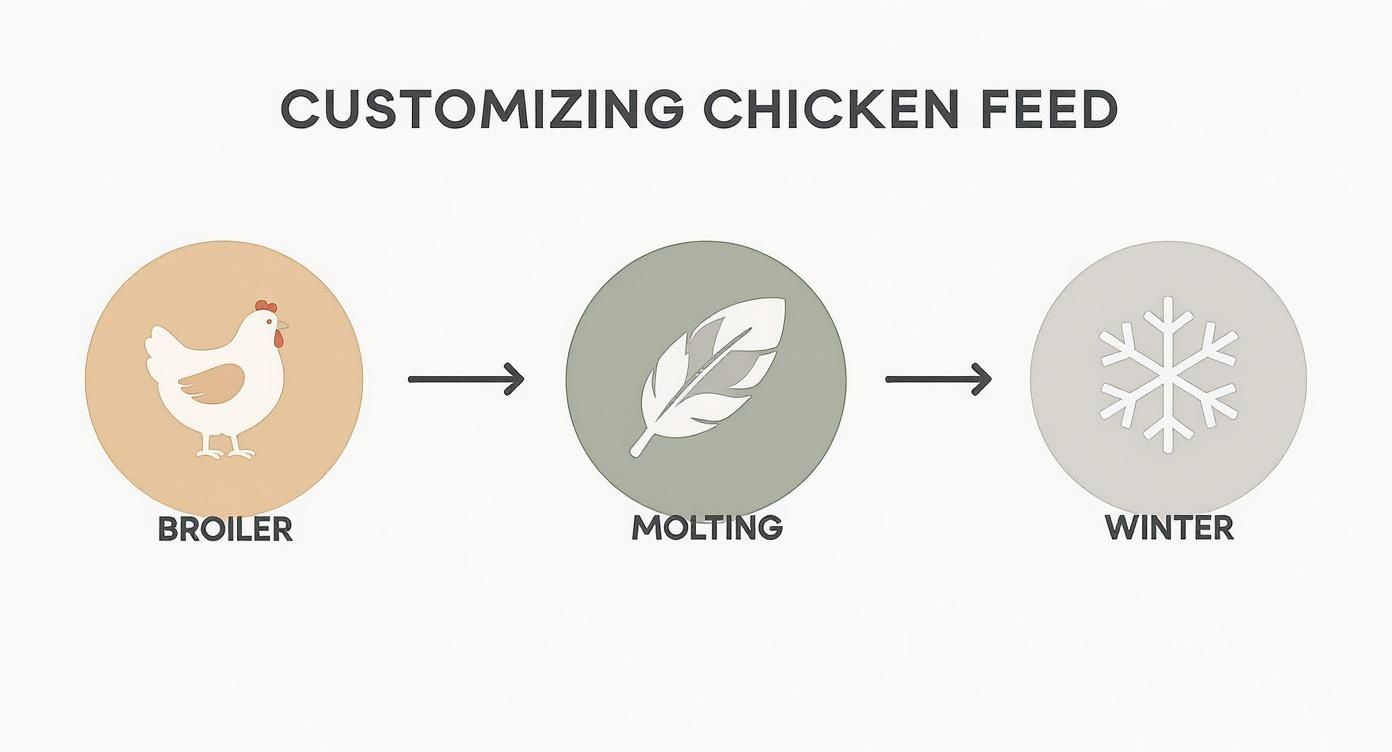
As you can see, it’s all about simple adjustments to the core ingredients to fit your flock's specific needs at any given time.
How Much to Feed and How to Switch
So, how much feed do they actually need? A good rule of thumb for a standard laying hen is about ¼ pound (or roughly ½ cup) of feed per day. Of course, this can change. A hen foraging all day in the summer will eat less than one cooped up during a cold winter snap. Keep an eye on your birds’ body condition and adjust the amount as you see fit.
When you're ready to introduce your new homemade blend, don't just swap it out all at once. That’s a recipe for digestive upset. A slow and steady transition is the way to go.
- Days 1-3: Start with a mix of 75% of their old feed and 25% of your new feed.
- Days 4-6: Move to a 50/50 blend.
- Days 7-9: Shift the ratio to 25% old feed and 75% new feed.
- Day 10: They should be ready to go 100% on the new stuff!
This gradual change gives their digestive systems time to adjust.
And last but not least, always, always provide access to fresh, clean water. It’s critical for everything from digestion to egg laying. For a deeper dive into flock care, check out our guide on how to keep chickens healthy.
Got Questions About DIY Chicken Feed? We've Got Answers
Once you start thinking about making your own chicken feed, a bunch of questions usually pop up. It's completely normal. Let's walk through some of the most common things people ask, so you can feel totally confident about what you're putting in your flock's feeder.
How Much Money Can I Really Save?
This is the big one, right? Most folks see savings somewhere in the 10-30% range compared to buying bagged feed, but it really boils down to where you get your ingredients.
Buying grains and seeds in bulk is the key. Yes, there's an initial cost, but your price per pound drops significantly, especially when you compare it to the high price of pre-mixed organic feeds. Your best bet is always to find a local farmer or a feed mill to source your core ingredients.
The global poultry feed market is a massive industry, valued at around USD 217.91 billion in 2024, and prices just seem to keep climbing. Making your own mix is one of the best ways to sidestep those rising commercial costs. You can dig deeper into the poultry feed market on imarcgroup.com if you're curious about the numbers.
Your flock's health is the ultimate report card for your homemade feed. Look for bright eyes, glossy feathers, strong eggshells, and consistent laying. If you see problems like feather picking or lethargy, it could signal a nutritional gap in your recipe.
Can I Just Toss Kitchen Scraps in the Mix?
It's tempting, but think of kitchen scraps as a fun treat, not a core part of the meal. A handful of leftover vegetable peels, some cooked rice, or leafy greens add some nice variety and enrichment for your birds.
But they can't replace the balanced nutrition your main feed recipe provides. Scraps throw off the carefully calculated protein and calcium ratios. And of course, always steer clear of anything toxic to chickens, like avocado pits and skin, raw potato peels, or anything moldy or spoiled.
How Do I Know if My Homemade Feed Is Actually Working?
Your chickens will tell you everything you need to know. A happy, healthy flock on a good diet is easy to spot. Just step back and observe them for a few minutes each day.
Here’s what you’re looking for:
- Bright, clear eyes and clean, dry nostrils.
- Smooth, glossy feathers that look vibrant, not brittle or ragged.
- Strong, uniform eggshells. No thin spots, weird shapes, or soft shells.
- Good energy levels. They should be active, scratching around, and foraging like they have a job to do.
If you start with a proven, balanced recipe from the get-go, you’re setting yourself—and your flock—up for success right away.
When you want to give your flock an extra boost, especially during a molt or the cold winter months, Pure Grubs are an incredible supplement. They are premium, USA-grown Black Soldier Fly Larvae, and they're packed with the exact kind of protein and bio-available calcium your birds need. They perfectly complement a homemade feed, helping to ensure strong eggshells and beautiful, healthy feathers.
Check them out and give your flock the best at https://puregrubs.com.