

Heavy Metal Toxicity Testing for Flocks
A bag marked “tested for heavy metals” can be useful, but it isn't a clean bill of health for your flock. Chickens don't eat only the tested ingredient. They scratch through soil, drink from waterers, peck at old timber, and turn over dust that may carry contamination. Eggs can reflect that wider exposure.
Good heavy metal toxicity testing starts with a better question: not whether one product passed a laboratory test, but whether lead, arsenic, mercury, or cadmium can reach the birds through feed, treats, soil, water, equipment, or storage. A credible plan combines representative sampling, careful report interpretation, environmental checks, and repeat testing when the source remains uncertain.
Why a Single Lab Certificate Is Not Enough
A single clean certificate can create false confidence. It tells you what a lab found in one submitted sample, under one method, from one lot. It does not tell you everything a hen eats, drinks, scratches through, or inhales over time. For a practical explanation of what one result can and cannot prove, see heavy metal testing for food.
That gap matters in a backyard flock. Birds do not live on bagged feed alone. They pick through soil, knock dust loose from old structures, peck at chipped paint, and drink from containers that are not always as clean as they look. You can have a clean result on an insect treat and still have exposure coming from the coop yard.
The FDA's chemical-contaminant guidance for animal food identifies arsenic, cadmium, mercury, and lead as toxic elements monitored in animal food. At the same time, FDA states there are no promulgated FDA guidance levels, action levels, or tolerances for heavy metals in animal food. In practice, that means a label saying “tested for heavy metals” is only one piece of evidence. It is not a blanket safety guarantee.
Practical rule: Use a certificate to answer a sample question. Use a testing plan to answer an exposure question.
That distinction changes how results should be read.
Feed safety is a whole-ration question
An ingredient can show a detectable trace and still contribute very little once it is diluted in a complete ration. The reverse is also true. A clean product test does not help much if birds spend every day picking at contaminated ground or feeding next to deteriorating materials.
I look for five things before I give any certificate much weight:
- What was tested? Feed, larvae, water, soil, eggs, or a surface wipe all answer different questions.
- Which analytes were included? "Heavy metals" means very little unless the report names the elements.
- What method and reporting limit were used? A result below the reporting limit does not prove the metal is absent.
- Which lot did the sample represent? One bag or one production run does not stand in for future batches.
- How does the result fit the whole ration? Intake depends on what the birds consume across feed, treats, and the environment.
Commercial operations often control more of those variables. Homestead flocks usually do not. Legacy soil, old fencing, weathered sheds, stored feed bins, and runoff can all complicate the picture.
The better approach is layered and repeatable. Check supplier testing. Inspect the coop and run. Sample suspicious soil, water, or surfaces when the setting justifies it. Test eggs if exposure remains plausible. A negative feed result is useful, but flock health depends on the combined exposure picture, not a single pass or fail sheet.
The Big Four Metals and How Labs Detect Them
Lead, arsenic, mercury, and cadmium deserve separate attention because a laboratory panel may report them together while their toxicological significance differs. The practical risk depends on the element, its chemical form, the route of exposure, and how consistently the flock encounters it.
Lead is especially relevant around older buildings, painted surfaces, discarded materials, and contaminated soil. Arsenic may enter through environmental sources or feed ingredients, while cadmium can be associated with contaminated soil, water, or raw materials. Mercury requires extra care because total mercury doesn't establish how much methylmercury is present. Arsenic may likewise need inorganic-versus-organic speciation when the purpose is toxicological interpretation.
Why ICP-MS matters
Modern laboratories often use inductively coupled plasma mass spectrometry, or ICP-MS, for multi-element analysis. The EPA Method 200.8 reference explains that the method uses a plasma to ionize elements, then separates the ions by their mass-to-charge ratio. That allows several trace elements to be measured in one analysis and generally provides lower detection limits than inductively coupled plasma atomic-emission spectroscopy.
The EPA first published Method 200.8 in 1990 for trace elements in water, including groundwater, surface water, drinking water, and wastewater, as documented in the same reference. The method later became important beyond water testing, including analysis of arsenic, cadmium, lead, and mercury in environmental, food, feed, and biological samples.
ICP-MS isn't a magic word that makes a result reliable. The laboratory still needs contamination controls, suitable digestion, calibration, blanks, proficiency, and procedures for spectral or matrix interference. FDA elemental-analysis guidance emphasizes these controls because trace-level contamination can create false positives or obscure low concentrations.
Ask what the panel actually measures
Before sending a sample, ask the lab:
- Does the panel include lead, arsenic, mercury, and cadmium?
- Are results reported as total elements or as specific chemical species?
- What is the limit of quantification for each analyte?
- Will the lab flag contamination in blanks or during sample preparation?
- Is the method validated for feed, insects, eggs, soil, or the particular matrix you're submitting?
For a flock owner near an older structure, laboratory testing and site inspection answer different questions. A specialist offering local lead inspection services may help identify a building or paint source, while ICP-MS testing can determine what entered a feed, soil, or egg sample. You may need both when the suspected source is structural rather than nutritional.
Sampling Protocols for Feed and Eggs
The laboratory can't correct a biased sample. If contamination is concentrated in one corner of a bag, one section of a bin, or one patch of soil, scooping from the easiest location may produce a reassuring result that doesn't represent what the flock eats.
FDA guidance recommends sampling multiple production lots and using representative composite samples because substrate, water, soil, processing equipment, and storage can create substantial variability within a lot. That principle applies to purchased feed, dried insects, home-mixed rations, and eggs.
Build a representative feed sample
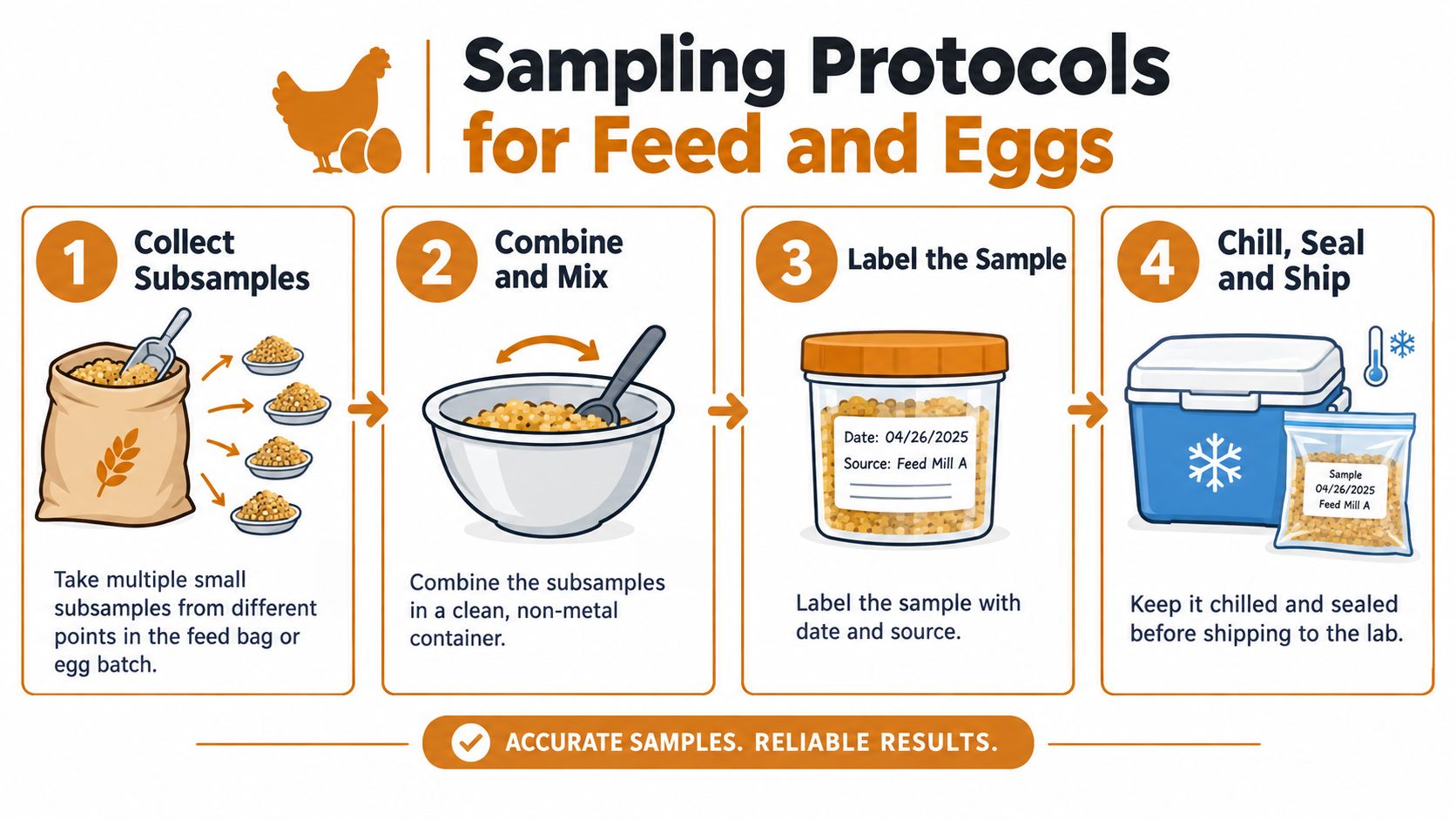
For bagged feed or treats, keep the original packaging and record the product name, lot or batch identifier, source, and date received. Use clean sampling tools and a clean container that won't introduce metal contamination. Avoid touching the sample with dirty hands or placing it on a workbench covered in dust.
Take small portions from different locations rather than one large scoop from the top. For a bin, collect from accessible points at different depths without disturbing the material unnecessarily. Combine the portions into one composite only when they belong to the same product and lot, mix gently, and transfer the laboratory's requested amount into its approved container.
For Black Soldier Fly Larvae or other dried insect treats, don't sample only the bright pieces at the surface. Include material from different parts of the bag, especially if fines or dust have settled separately. Save a sealed portion from the same lot at home if the lab recommends retaining a reference sample.
Handle eggs as a separate matrix
Eggs need their own sampling plan. Record the laying dates and flock group, then ask the lab whether it wants whole eggs, separated contents, shells, or a defined preparation. Don't assume a feed laboratory's instructions apply to eggs.
Use clean, designated containers, seal them promptly, and keep the sample chilled if the laboratory requires refrigeration. Label every container clearly with the source, collection date, lot or flock identity, and requested analytes. Ship according to the lab's instructions, because temperature, holding time, and packaging can affect whether the sample remains acceptable.
Sampling mistake to avoid: Don't combine eggs from unrelated flocks or different suspected exposure periods. A composite can reduce clarity when your real question is which group or time period is affected.
Test the source, not just the finished product
If outdoor exposure is plausible, collect separate samples of feed, eggs, and soil rather than blending them. Water may also warrant testing when birds drink from a private supply, an old pipe, a tank, or a container with unknown materials.
Keep a written chain of information. Note where each sample came from, which birds had access, what changed recently, and whether the sample represents a single lot or a composite. Those details give your veterinarian and laboratory a way to interpret an abnormal result instead of treating it as an isolated number.
Interpreting Lab Reports and Regulatory Limits
A report can look decisive because it contains precise numbers. Precision isn't the same as certainty. The first task is to identify the analyte, unit, sample type, method, and reporting limit before deciding whether a result indicates a practical risk.
A result reported as below the limit of quantification means the laboratory couldn't quantify the analyte reliably at that level using its method. It doesn't mean the element is absent. Compare results only when the sample type, preparation, units, and method are sufficiently similar.
Ingredient concentration isn't complete-feed exposure
FDA's animal-food report summarizes NRC and AAFCO maximum tolerable levels for arsenic, cadmium, mercury, and lead in complete feed, with benchmark values differing by metal and framework. An insect treat is often only part of a hen's ration, so the useful calculation is the ingredient concentration multiplied by daily consumption, followed by comparison with the complete-feed benchmark after dilution.
That doesn't create a universal pass or fail rule. The report must be interpreted with the bird species, life stage, complete ration, exposure duration, and chemical form in mind. A supplier should be able to explain how its result relates to the intended use, not merely display a “tested” claim.
| Heavy Metal | Primary Risk Factor | Evaluation Context |
|---|---|---|
| Lead | Contaminated soil, paint, dust, equipment, or materials | Consider feed, soil, eggs, and the likely route of repeated exposure |
| Arsenic | Feed or environmental contamination, with chemical form affecting interpretation | Ask whether total arsenic is sufficient or speciation is needed |
| Mercury | Contaminated feed or environment, with species of mercury affecting risk | Total mercury doesn't establish methylmercury exposure |
| Cadmium | Contaminated ingredients, soil, water, or storage sources | Interpret alongside the complete ration and ongoing exposure |
Read supplier claims critically
A certificate should name the tested lot, laboratory, method, analytes, units, and reporting limits. It should also identify whether the result applies to the product as sold or to a raw material used during production.
For a practical discussion of how contamination can move from feed into eggs, see how heavy metals in chicken feed can get into eggs. The point isn't to turn every detectable result into an emergency. It's to replace a vague label with a traceable answer about dose, dilution, and exposure.
If a result is high, pause the suspected product, preserve the remaining lot, and contact the laboratory and a poultry veterinarian. Don't make a feed change based only on a reference interval or a result detached from the flock's symptoms and exposure history.
Hidden Environmental Sources in the Coop
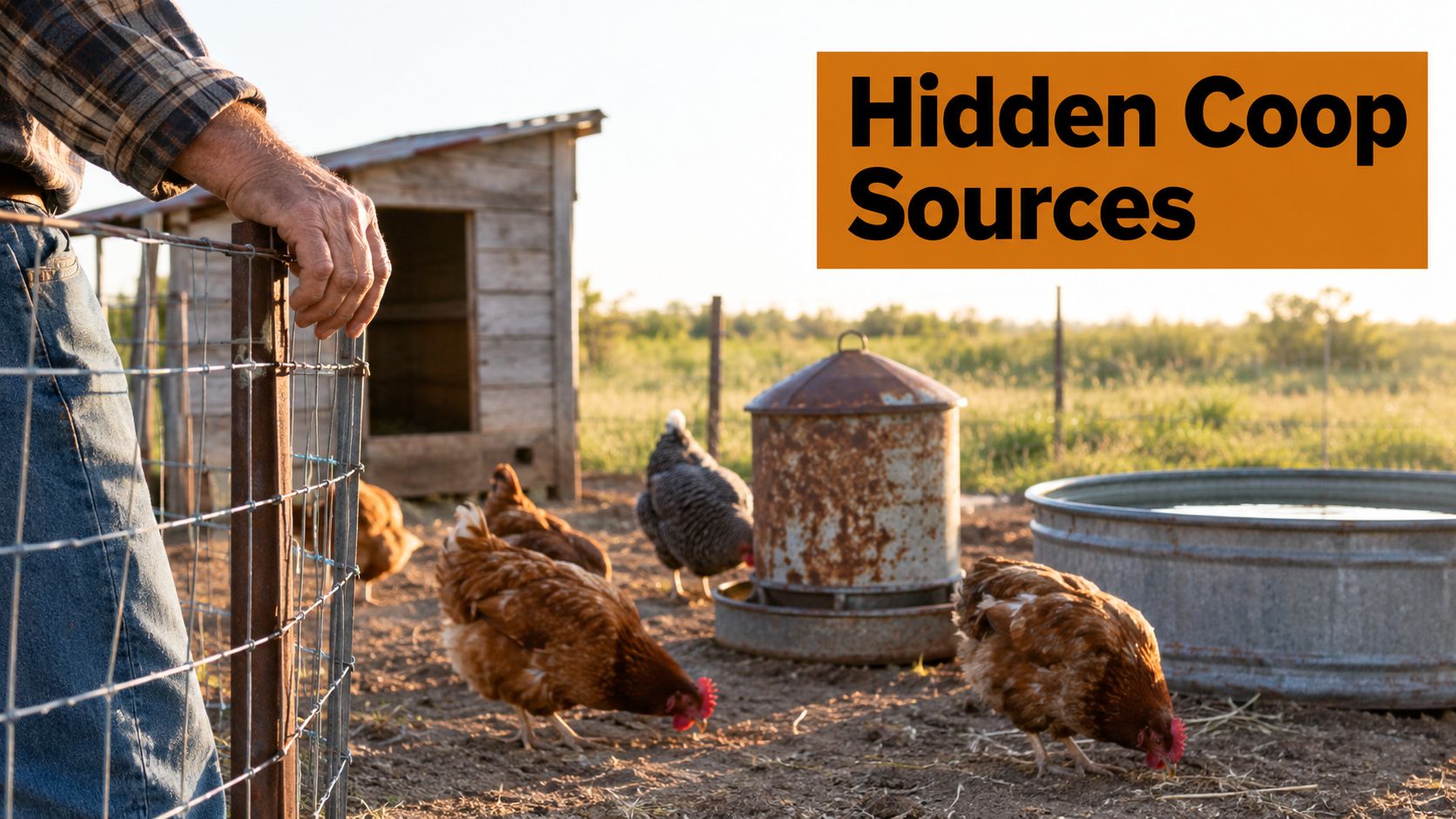
Clean feed doesn't clear a contaminated yard. A flock that forages beneath peeling paint, beside an old shed, or around treated timber may encounter metals in soil and dust even when every purchased ingredient has a satisfactory certificate.
University of California guidance says metals can enter eggs through contaminated soil as well as feed. It recommends testing eggs, feed, and soil when environmental exposure is plausible, particularly for urban and homestead flocks exposed to legacy paint, treated wood, or industrial soil.
Walk the property like a contamination investigator
Start with the places chickens spend time, not the places that look tidy. Inspect the soil beneath old painted siding, around demolished structures, along fence lines, near burn areas, beside treated posts, and under roof edges where dust or flakes may accumulate. Check whether birds can access construction debris, ash, discarded hardware, or damp areas where runoff collects.
A homesteader may see a flock dust-bathing beside a shed and think only about parasites. The more complete question is what material makes up that dust. If the shed has deteriorating paint or the soil has a history of industrial use, move the birds away from the area while arranging appropriate testing.
Use symptoms and eggs as signals, not proof
Changes in egg production, shell quality, appetite, behavior, or body condition can justify veterinary attention, but they don't identify a specific metal on their own. A clean feed result alongside an unusual egg result points toward a broader exposure investigation, not toward repeating the same feed test without changing the sample design.
The backyard chicken guidance on lead and arsenic in treats is useful as a reminder that treats belong in the exposure inventory. So do soil, water, bedding, dust, and old structures.
Environmental red flag: If birds forage where paint flakes, contaminated fill, treated wood, or industrial residue may be present, restrict access first. Test the suspected source and eggs rather than waiting for a feed certificate to answer an environmental question.
Do not serve eggs from a flock with suspected exposure to people or animals without getting professional guidance. The University of California notes that published withdrawal-time data for heavy metals in chickens and eggs are unavailable. Owners are advised to retest eggs periodically rather than rely on a fixed waiting period, so a veterinarian should help decide how to manage the flock while results are pending.
Building a Repeat Testing and Sourcing Plan
Heavy metal toxicity testing works better as a control system than as a one-time purchase decision. The plan should connect supplier records, lot sampling, environmental inspections, egg testing, and clear actions when a result is unexpected.
Start by writing the exposure map. List every feed, treat, water source, storage bin, bedding material, outdoor area, old structure, and flock group. Mark which items are controlled by a supplier and which are under your direct control. That simple inventory often reveals why a clean product test can't answer the whole question.
Use a decision path that someone can repeat
- Qualify the source. Request the product lot, analyte list, method, reporting limits, and laboratory information. Prefer suppliers that maintain lot traceability and can explain their contamination controls.
- Sample representative lots. Test incoming products when the source is new, the formulation changes, a lot appears unusual, or the flock has a plausible exposure history. Keep records so an abnormal result can be connected to the right shipment.
- Control the environment. Restrict access to questionable soil, paint, wood, dust, water, and equipment. Test the specific source rather than assuming a feed panel will detect it.
- Confirm unexpected findings. Ask the laboratory whether the sample was suitable, whether contamination was detected in blanks, and whether a second sample or a different analytical approach is appropriate. Don't blend a suspicious lot into a clean one to make the result appear lower.
- Escalate appropriately. A poultry veterinarian can assess birds and eggs, help decide whether eggs should be withheld, and coordinate further testing. If exposure is linked to a building or property, use an environmental professional for source identification and remediation advice.
Choose products with traceable controls
For insect treats, ask where the insects were raised, what substrate they received, how the product is processed, and whether testing covers lead, arsenic, mercury, and cadmium. A U.S.-grown Black Soldier Fly Larvae product such as Pure Grubs states that its batches undergo testing for these elements and are produced in FDA-compliant facilities. Treat that information as one part of supplier qualification, alongside the actual lot documentation and your flock's environment.
Set corrective-action rules before a problem occurs. A result above the limit should trigger a defined pause, retained sample, supplier notification, confirmatory test, and environmental review. Because the FDA report describes animal-food intervention as case by case rather than through universal promulgated heavy-metal tolerances, your internal action limits should be conservative and documented with veterinary and laboratory input.
Finally, keep testing proportional to risk. A flock with controlled housing and a stable, traceable feed source may need a different schedule from an urban flock foraging in legacy soil. If eggs remain suspect after feed is cleared, retest eggs periodically and investigate the environment rather than relying on a single negative certificate.
Pure Grubs offers USA-grown Black Soldier Fly Larvae treats with batch testing for lead, arsenic, mercury, and cadmium, giving flock owners a traceable option to evaluate alongside their broader feed and environmental controls. Visit Pure Grubs to review the product details and build a treat-sourcing routine that supports more informed heavy-metal risk management.