


Heavy Metal Test Method for Animal Feed Explained
The usual advice is to send a scoop of feed to a lab, wait for “pass” or “ND,” and treat the bag as clean. That advice fails the moment you ask what the number measured. A heavy metal test method is a chain of decisions: which lot you sampled, how you digested it, which instrument answered which question, which limit you compared, and which words the report used. Break any link and the same printout can look safe while hiding a rising trend, a form of arsenic the total test never separated, or a limit that applies to a complete ration and not to a treat.
A low number on one certificate does not describe the next delivery. Two labs can disagree on the same jar because their reporting limits differ. One published table can call a result acceptable while another table, still labeled as an AAFCO complete-feed figure, would not. The instrument is real. It is not the whole proof.
Why Heavy Metal Testing Matters for Animal Safety
Feed is the first link that reaches the bird. Whatever metal is in that ration comes in with every meal, not as a one-time accident. Four elements drive most feed panels, and they do not behave the same way in the body.
Lead harms the nervous system and builds up in tissue. Cadmium collects in the kidneys across months, so a modest daily dose is a different problem from a single high meal. Inorganic arsenic is the arsenic form that carries the highest toxicity concern. Methylmercury is the most toxic form of mercury. A total-metal number does not tell you which of those forms you have. It only tells you how much of the element was in the portion that was tested.
Because these elements accumulate, one reassuring result is weaker evidence than a pattern across lots. A hen whose complete feed is most of her diet takes in a much larger share of any contamination than a bird that gets the same product as an occasional snack. That is why a treat and a staple ration cannot share a casual “it's fine” label even when the lab slip shows the same concentration.
Traceability is what connects that slip to a real bag. Lot records, the kind described in SIX ERP traceability insights, let you match a result to the ingredient sources and the production run instead of to a brand name. If you keep laying hens, the downstream question is whether feed metals show up in what you eat. The practical path from ration to egg is laid out in whether heavy metals in chicken feed get into eggs.
Practical rule: A test protects animals only when you can say what the number measures, on what basis, and whether the controls behind it passed.
Where Heavy Metals Enter the Feed Chain
The lab measures what is in the sample on the day it is taken. It does not rewind the supply chain. Metals get into a feed product at four places, and a later test cannot tell you which one unless you wrote it down.
Raw ingredients carry whatever the crop, mineral, or animal material already held. Substrate or growing medium matters for insects and for crops, because larvae and plants take up what is in the material they live on. Processing equipment and water can add metals during washing, grinding, or drying if lines, fittings, or source water change. Packaging and storage can add contamination after the product looks finished, from contact surfaces, dust, or a damp warehouse.
Lots drift even when the label stays the same. Swap a supplier, a substrate pile, or a processing line and the next certificate can move without any change a buyer can see on the bag. Say mercury climbs across three consecutive lots of dried larvae while lead stays flat. A single “pass” on lot one hides that climb. The pattern points at sourcing or at a process step that handles mercury differently, not at a random lab blip.
The producer's control is simple and often skipped. Record ingredient source, substrate, water, equipment changes, and storage conditions next to each lot number, then read the lab result against that log. Without the log, a high result has nowhere to go except “retest and hope.”
That log is also what a backyard keeper can ask for when a treat brand changes color or smell between bags. Lead and arsenic in backyard chicken treats is the buyer-side version of the same question: what entered this product, and does this bag match the bag that was tested? The assay is the last check in that chain. It works when you already know which entry point you are checking.
Heavy Metals Tested and the Methods Behind Them
A heavy metal test is not one assay. It is a shared sample preparation plus an element-specific finish. The decision rule comes before the instrument name. Ask for total content when you want a screen. Ask for species when toxicity depends on chemical form. Then ask the lab which technique produced each line on the report.
The U.S. Food and Drug Administration's Elemental Analysis Manual marks the modern multi-element approach. EAM Method 4.7, an ICP-MS procedure with microwave-assisted digestion, was first issued in November 2013. It covers total acid-extractable arsenic, cadmium, chromium, cobalt, copper, lead, manganese, mercury, molybdenum, nickel, selenium, strontium, thallium, tin, uranium, vanadium, and zinc in food. FDA later folded that method into its compendium as C-008.01 for a shorter nutrient-and-contaminant list. One preparation replaced a stack of single-element runs, which is why insect meals and other biological feeds are usually screened this way.
Total screen versus chemical form
Sensitivity on that screen is tight. FDA inspection guidance describes EAM Method 4.7 measuring lead, cadmium, and other elements in foods at concentrations as low as 3 parts per billion (ppb). One ppb is about 1 microgram per kilogram, so 3 ppb is roughly 3 micrograms per kilogram. The same guidance tells analysts to use EAM 4.7 for arsenic, cadmium, lead, and mercury in applicable food investigations. When chemical form matters, it points to separate chromatographic ICP-MS methods, for arsenic species or for methylmercury versus total mercury. A total-metal result is the overall elemental concentration. Speciation is which forms are present, and those forms do not share one toxicological meaning.
For a feed or treat program, write down the method, the reporting limit, the digestion, the quality controls, and whether each result is total or a specific species. A “lead, ICP-MS” line and an “arsenic, total” line are not the same kind of answer.
Lead and cadmium normally share the screen: microwave-assisted nitric acid digestion, then ICP-MS. Arsenic splits. Total arsenic does not show whether the inorganic forms, the ones with the highest toxicity concern, are the ones in the sample. Chromatographic ICP-MS answers that. Mercury is the awkward element. It is volatile during digestion, so labs often pull it off the multi-element run and measure it by cold-vapor atomic absorption after microwave-pressure digestion. Methylmercury still needs its own speciation method. Treating mercury as “just another ICP-MS line” is how a report looks complete and is not.
Which instrument fits the question
ICP-MS is the usual choice for multi-element screening at trace levels, provided the lab controls matrix interference. ICP-AES or ICP-OES is the route in ISO 27085 for arsenic, lead, and cadmium in animal feeding stuffs. That framework is built for higher concentrations, not for the very low end of a food-safety screen. If your question is “is this near a few micrograms per kilogram,” an optical-emission method aimed at milligrams per kilogram will not answer it, even if the certificate looks official.
| Element | Why it matters | Standard test method | Analytical note |
|---|---|---|---|
| Lead | Neurotoxic and accumulates in tissue | ICP-MS after microwave acid digestion | Report with a stated limit of quantification |
| Arsenic | Inorganic forms carry the highest toxicity concern | ICP-MS for total arsenic; chromatographic ICP-MS for species | A total result does not show chemical form |
| Cadmium | Accumulates in kidneys over time | ICP-MS after microwave acid digestion | Low-level results need a stated limit of quantification |
| Mercury | Methylmercury is the most toxic form | Cold-vapor atomic absorption after microwave-pressure digestion | Volatile during digestion, so handled separately |
A method name without the element's finish is a label, not a result. Total arsenic is not inorganic arsenic, and total mercury is not methylmercury.
How to Run the Test and Prove the Result
For dried insect feed and other animal-feed matrices, a defensible multi-element method is representative homogenization, microwave-assisted nitric-acid digestion, then ICP-MS or ICP-AES/ICP-OES. A government analytical procedure for animal-derived products specifies homogenizing approximately 0.5 g of sample, adding ultrapure nitric acid and an internal-standard solution, finishing microwave digestion, and quantifying lead and cadmium against calibration curves normalized to that internal standard. The same procedure notes that ISO 27085:2009 covers arsenic, lead, and cadmium in animal feeding stuffs by ICP-AES, with a stated quantification limit of 3 mg/kg or lower, and that it is not intended for very low concentrations. Mercury stays on a dedicated cold-vapor atomic-absorption procedure after microwave-pressure digestion. Report a limit of quantification, not the word “pass,” or a buyer cannot tell a true low result from a blunt reporting threshold.
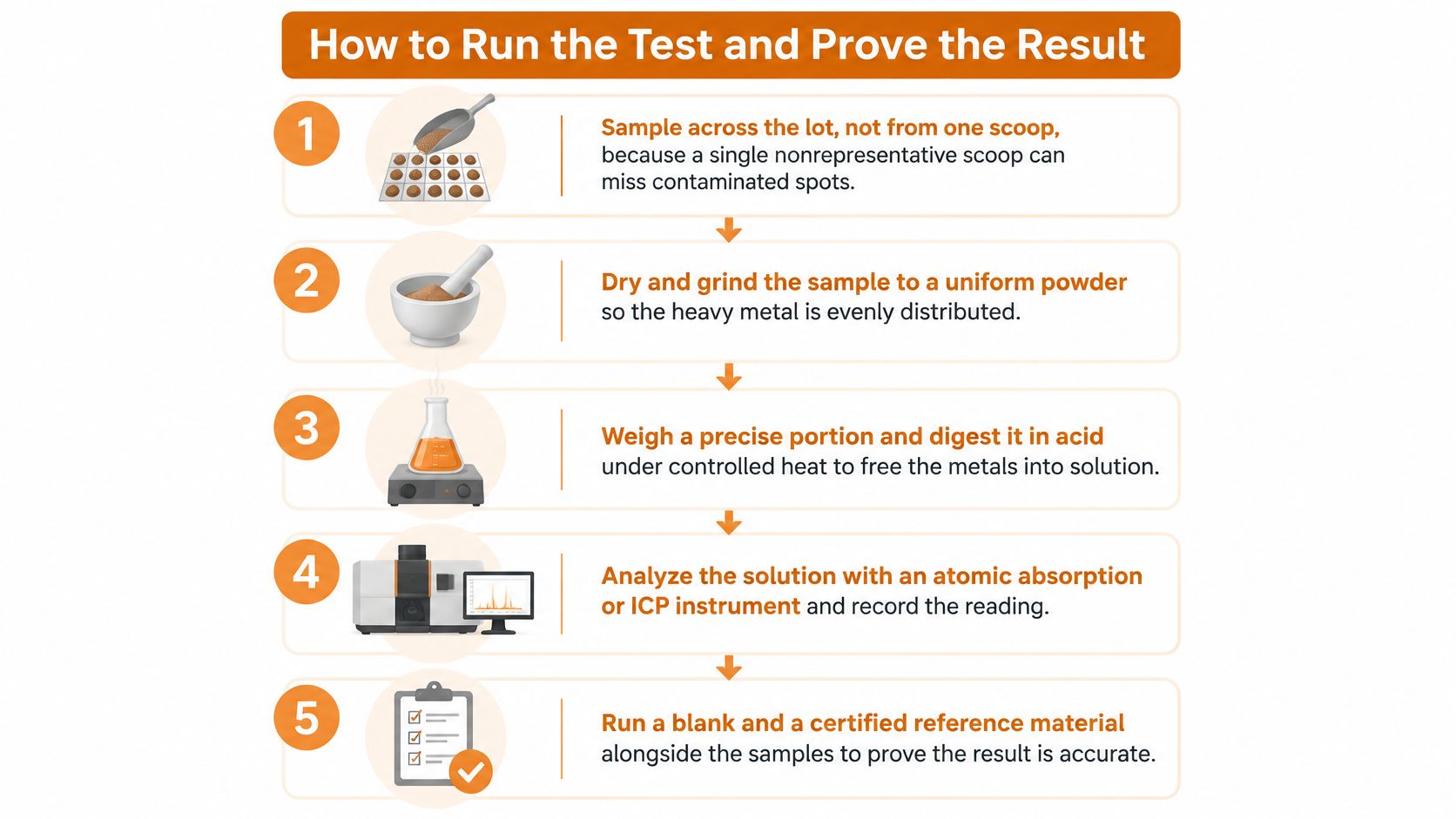
Eight steps and why each one exists
- Sample across the lot, not from one scoop. A single grab can miss a contaminated pocket, so the subsample has to represent the run.
- Homogenize and reduce particle size. Metals sit unevenly in whole larvae, pellets, and meals. A fine mix is what makes 0.5 g stand in for the bag.
- Weigh approximately 0.5 g of the dried homogenate. That mass is the procedure's starting point, not a rounded handful.
- Add ultrapure nitric acid and an internal-standard solution. The acid frees the metals. The internal standard corrects drift and some matrix effects on the calibration.
- Finish microwave digestion until the matrix is broken down. Incomplete digestion leaves metal trapped in solids the instrument never sees.
- Dilute the digest to a known volume inside the calibration range. A reading outside the curve is not a concentration yet.
- Measure by ICP-MS or ICP-AES/ICP-OES against curves normalized to the internal standard. Mercury does not ride this step.
- Calculate on an as-fed basis with units and a limit of quantification. Buyers feed the product as sold, not a theoretical dry solid.
Controls that prove the run
Instrument output is not performance. An interlaboratory ICP-MS study of arsenic, barium, cadmium, mercury, lead, and selenium in animal food and veterinary specimens cites FDA acceptance criteria of 90–105% recovery for accuracy and less than 6% coefficient of variation for precision. Those benchmarks are what a certificate should be able to show.
Reagent blanks catch metals from acids and vessels. They should sit near zero and below the limit of quantification. Matrix spikes check recovery inside the feed itself, where the matrix can suppress or enhance the signal, and should land in that 90–105% window. Duplicate preparations measure precision and should stay under a 6% coefficient of variation. Calibration verification catches drift during the run. A certified reference material checks overall bias against a known material.
The run is valid when those controls pass and the digest is clear, with no visible residue. Miss the controls and the number is not verified, however many decimal places it carries. A practical certificate names the laboratory and method, sample and test dates, matrix, dilution or digestion, analyte-specific limit of quantification, result with units, and recovery or duplicate status. The panel should at least include lead, arsenic, cadmium, and mercury, because they differ in toxicity and in analytical behavior. Brands that publish lot testing for that four-element panel, Pure Grubs among them, still owe you those fields, not a slogan. How a feed mill ties lab work to released product is the point of a quality assurance testing program. Before you trust a sequence of injections, a Verbex system suitability guide is a useful companion on what “the instrument was fit” requires.
Complete-feed tolerable levels are reference points for a whole ration, not an automatic legal limit for a treat or an ingredient. Set a conservative internal action level, trend lots, investigate excursions, and confirm a suspect result with an independent preparation or a second laboratory.
Reading a Lab Report Line by Line
A certificate can look calm and still hide its limits. Each term is a claim with a boundary, and each boundary is something you can request in writing.
ND, not detected, is the line people misread first. AAFCO's multi-element method digests with nitric acid and hydrogen peroxide, then measures by ICP-MS, using kinetic-energy discrimination to cut interference. FDA's food compendium uses microwave-assisted digestion with ICP-MS for arsenic, cadmium, chromium, lead, mercury, and other elements. Neither document turns “ND” into zero. Not detected means below that laboratory's reporting or quantification limit, not absolute absence. Two laboratories can print different numbers for the same sample because their limits differ. A single scoop also may not describe the lot, and drying an insect treat removes water and concentrates both nutrients and contaminants.
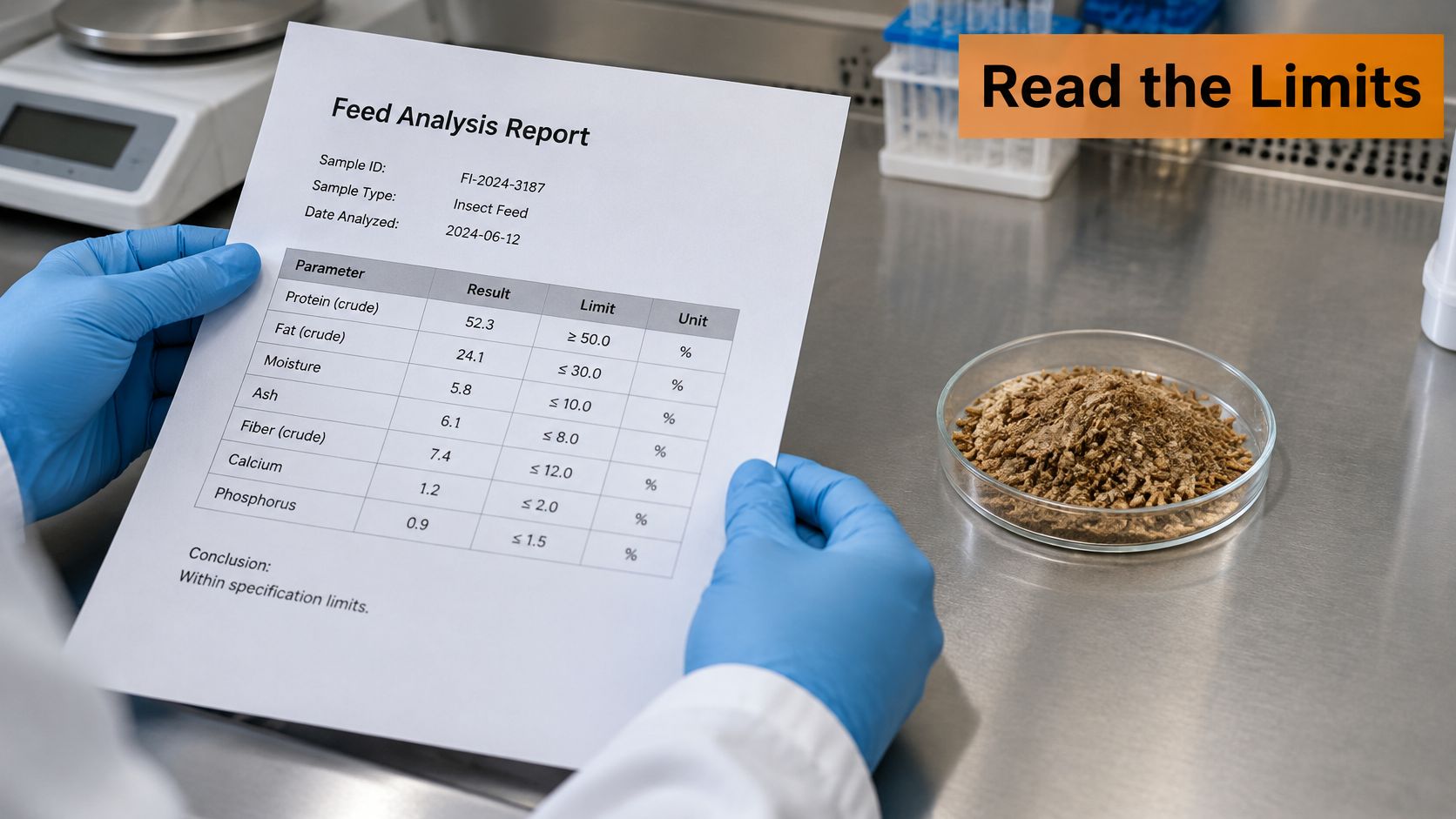
What to ask for on each line
| Report term | What it means | What to request |
|---|---|---|
| ND (not detected) | Below the laboratory's reporting limit, not proof of zero | The numeric limit of quantification for each element |
| Limit of quantification | Lowest level the lab reports with confidence | The value for each element in the same units |
| As-fed basis | Result for the product as sold | Confirmation that the basis is stated |
| Dry-matter basis | Result after moisture removal, so values read higher | A conversion to the as-fed basis |
| Batch or lot identifier | Links the result to one production run | A lot number that matches the package |
| Method name | Shows the digestion and detection technique used | The method reference, such as an FDA EAM or AAFCO method |
The limit of quantification is the lowest level that lab will stand behind. Ask for it on every element, in the same units as the result. As-fed is the product as you pour it. Dry-matter strips the water out, so the number reads higher. A dry-matter arsenic figure compared with an as-fed benchmark is a unit error, not a safety finding. The lot identifier has to match the package in your hand. A method name such as an FDA EAM or an AAFCO-referenced method tells you the digestion and the detector. File the PDF with that lot number.
A complete report carries the lot, the matrix, the method, the units, the limits, the basis, and the quality-control status. Missing any one of those, you do not yet know whether “no heavy metals” means anything.
Which Feed Limit Applies to Your Product
There is no single heavy-metal limit that travels with every bag. Jurisdiction, animal category, ingredient versus complete feed, and the safety endpoint all change the number. Treating one table as a universal pass/fail is how a product “passes” in one sentence and fails the next.
California's feed-safety guidance lists AAFCO maximum tolerable levels for complete feed of 0.2 ppm mercury, 0.5 ppm cadmium, 10 ppm lead, and 30 ppm arsenic. An FDA heavy-metal report reproduces a different AAFCO table: 2 ppm mercury, 0.5 ppm cadmium, 30 ppm lead, and 50 ppm arsenic. NRC values in that same FDA report differ again. Cadmium is the only figure that matches across the two AAFCO-labeled rows. Mercury, lead, and arsenic do not. A result of 1 ppm mercury sits under one of those mercury figures and over the other.
| Source | Arsenic | Cadmium | Lead | Mercury |
|---|---|---|---|---|
| California feed-safety guidance, AAFCO maximum tolerable levels, complete feed | 30 | 0.5 | 10 | 0.2 |
| FDA heavy-metal report, AAFCO table, complete feed | 50 | 0.5 | 30 | 2 |
| NRC values in the same FDA report | Consult the report | Consult the report | Consult the report | Consult the report |
Three questions before you compare
You will meet three kinds of numbers, and they are not interchangeable.
- Maximum tolerable level: A dietary concentration tied to an animal-safety endpoint for the class of feed the table names.
- Action level: A trigger your regulator or your own program uses to investigate, not automatically a legal ceiling for every product.
- Labeling threshold: A disclosure rule. It can force a statement without being the same as a feeding limit.
All of the ppm figures above are complete-feed references. A supplemental treat or an ingredient has to be read through inclusion rate and total dietary exposure. A small handful of dried larvae is not most of a hen's day. A contaminated mash that is the ration is. Below a limit is not automatically zero risk. Above a complete-feed benchmark is not automatically illegal for a treat until you know how much of the diet that product is.
Put the limit's source and its scope beside every result. “Passes heavy metals” deletes the only facts that make the comparison real.
Quick Reference From Result to Action
Each row is a pattern you will see, what it indicates, and the next move. The number is actionable only when method, limit, basis, lot, and controls are all on the page.
| Result pattern | What it indicates | Next step |
|---|---|---|
| ND for all four elements with listed limits | Below each laboratory's reporting limit | Keep the report with the lot and retest if the lot changes |
| Value below the limit on a non-blank matrix | Limited sensitivity at that level | Request a lower-limit run or an independent laboratory |
| Result above a complete-feed benchmark | Exceeds a complete-feed reference, scope unclear | Check the inclusion rate and whether the reference applies to a treat |
| Missing recovery or duplicate data | Quality control not demonstrated | Request the QC summary before relying on the number |
| Mercury reported without its method | Mercury handled by a separate procedure | Ask which digestion and cold-vapor procedure was used |
| Results rising across lots | Possible sourcing or process change | Trend the lots and set an internal action level |
ND with the limits printed is usable. File it against the lot and do not stretch it to the next production run. A value sitting on a non-blank matrix means the lab could see something, but not with enough sensitivity to call the level. Ask for a lower-limit run or a second lab rather than averaging the ambiguity away. A result over a complete-feed benchmark is a scope problem first. Check inclusion rate before you quarantine a treat or clear a staple.
Missing recovery or duplicates means the accuracy and precision checks were not shown. Do not average that gap into a pass. Mercury without a method line is incomplete, because that element does not share the multi-element digestion. Ask which digestion and which cold-vapor procedure produced the number. A rise across lots is the pattern a single pass conceals. Plot it, set an internal action level under the benchmark you use, and investigate the source log before the next delivery ships.
If two rows fire at once, fix the missing proof before you debate the limit. A rising mercury line with no method and no duplicates is not a close call. It is an unfinished test.
Confirm Your Lot Before You Feed
Do not feed a lot because the brand “tests for heavy metals.” Feed it when that lot's certificate survives five checks.
- Laboratory and method. Named lab, named digestion, named detector, mercury called out if it used a separate procedure.
- Lot identifier. The code on the PDF matches the code on the package in the bin.
- Limit of quantification. Each of lead, arsenic, cadmium, and mercury has a numeric limit in the same units as the result.
- Basis and units. As-fed or dry-matter is stated, and you are not comparing a dry-matter number with a complete-feed ppm table by accident.
- Quality-control status. Recovery and duplicates are on the report and met the lab's stated criteria.
If a producer says every batch is tested for those four elements, ask for the lot-level report. A general safety claim does not identify your bag. Producers catch drift with a conservative internal action level and a lot-to-lot trend. Any excursion gets confirmed on an independent preparation or at a second laboratory before the lot is released or rejected. One retest of the same digest only repeats the same preparation error.
Bin-side checklist
- Match the lot on the report to the package before you open the bag.
- Confirm a numeric limit for each element, not a bare ND.
- Confirm the limit's source and scope, complete feed or treat, and which table you used.
- Confirm the controls passed, recovery and duplicates included.
- Feed only after all five checks pass. A missing line is a stop, not a maybe.
That is the whole chain in one decision. Sampling, digestion, instrument, species versus total, report wording, and the limit's scope either hold together or they do not. When they hold, the certificate is evidence you can feed on. When they do not, “pass” is a word on a page.
Pure Grubs tests each batch of its dried black soldier fly larvae for lead, arsenic, mercury, and cadmium and sells those larvae as a supplemental treat, not as a complete feed. If you want the product behind that lot-level heavy metal test method, see what is in the current bags at Pure Grubs. Match the certificate to the lot before you put it in the feeder.