

Green Soldier Fly: What It Really Is
Have you ever asked what the larvae in a bag of “green soldier fly” feed ate before it reached your chickens? Most flock owners compare protein or calcium first, but the more important question may be where the insect was raised and whether the finished larvae were tested for contaminants.
The name sounds like it describes a special green-colored insect. In most commercial listings, it doesn't. It usually points to the black soldier fly, Hermetia illucens, a useful feed insect whose nutritional value and safety depend heavily on its rearing conditions. Understanding that difference can help you choose treats that support your flock without treating every dried grub as interchangeable.
Decoding the Green Soldier Fly Confusion
Search for “green soldier fly” and you'll find product pages, poultry treats, composting guides, and insect-farming discussions using the phrase in different ways. That makes it easy to assume the green soldier fly is a separate species from the black soldier fly. In commercial feed, however, both names commonly refer to Hermetia illucens, the black soldier fly.
The biological name matters because it gives you something specific to look for on a label. A product that merely says “fly larvae,” “grubs,” or “soldier fly feed” leaves important questions unanswered. A clearer label identifies Hermetia illucens, states the country of origin, and explains enough about the rearing substrate for you to judge the product responsibly.
A long history behind a modern feed ingredient
The species was formally described by Carl von Linnaeus in 1758, giving it a documented scientific history of more than 250 years. Fossilized early-instar larvae have also been identified in coprolites from caves in Tamaulipas, Mexico, with specimens dated from 4,300 to 260 years ago. Those findings connect the insect with decomposing organic material and human environments long before modern insect farms existed. (Entomology review of Hermetia illucens)
Researchers later became interested in the species for waste conversion and forensic science. By 1994, its larvae were already being used to help estimate the time of colonization on human remains. Today, that history has expanded into animal feed, waste management, and sustainability research. (Documented history and applied uses of black soldier flies)
Practical rule: Treat “green soldier fly” as a commercial naming variation until the label proves otherwise. The species name and production details tell you more than the color word.
What flock owners should focus on
You don't need to search for a rare green variant. You need to determine whether the larvae are correctly identified, responsibly raised, properly processed, and traceable.
That shift in attention is important. A product can use attractive language about sustainability while still giving you little information about its feedstock or contaminant controls. Conversely, a plainly labeled product may give you the details that matter most: species, origin, substrate policy, processing method, and testing.
For chickens, ducks, reptiles, or fish, the useful question isn't “Does this say green soldier fly?” Ask instead: “Can the seller explain what these larvae were fed and how the final batch was checked?”
Lifecycle and Physical Identification Traits
What exactly is the dried, ridged piece in a bag of “green soldier fly” feed? A flock owner usually sees the insect only as a preserved larva. Its pale to brownish, slightly curved body belongs to Hermetia illucens, the species commonly called the black soldier fly. The commercial color label describes marketing more reliably than biology, so the species and production records deserve closer attention.
Under suitable conditions, larvae can reach about 27 millimeters in length and 6 millimeters in width. They pass through six instars, or growth stages, and may complete larval development in roughly 14 days. The same University of Florida guidance on black soldier fly biology describes the adult female's reproductive output, with about 500 to 900 eggs laid during a short adult lifespan of 5 to 8 days. Those figures explain how a managed colony can grow quickly, while also showing why production conditions need careful control.
From egg to feed ingredient
The cycle starts when an adult female places eggs near a suitable food source. After hatching, the young larvae feed, shed their skins, and grow through successive instars. Their bodies become thicker and more pronounced as they mature, with coloring that can range from brownish to gray.
Producers generally harvest larvae before or around the change toward the prepupal stage. Drying removes moisture and makes the biomass practical to store, transport, and offer as feed. The life stages are easier to follow in this black soldier fly life cycle guide, which presents the sequence more plainly than a technical diagram.
What healthy dried larvae look like
Inspect a new bag before feeding. Properly dried larvae should be intact, dry, and fairly consistent in color and texture. A few broken pieces are expected during handling. Dampness, heavy clumping, mold, excessive powder, or an unusual chemical smell are reasons to stop and contact the seller.
Appearance can reveal storage or processing problems, but it cannot reveal everything the insect accumulated while growing. A crisp, clean-looking larva could still reflect contaminated substrate. Ask where the feedstock came from, whether heavy-metal testing was performed, and whether the seller can provide batch documentation. Substrate transparency is more useful than a reassuring color name.
For comparison, USA GROWN BLACK SOLDIER FLY LARVAE FOR CHICKENS is a listing that identifies the product as black soldier fly larvae and describes a USA-grown, plant-based production approach. Treat those statements as details to verify, not as a replacement for records about sourcing and testing.
This short video shows the insect's development:
For home-raised or farm-produced dried larvae, packaging also affects storage and waste. Packaging Panda eco packaging offers compostable options for lower-waste presentation and storage projects.
Nutritional Mechanics and Eggshell Support
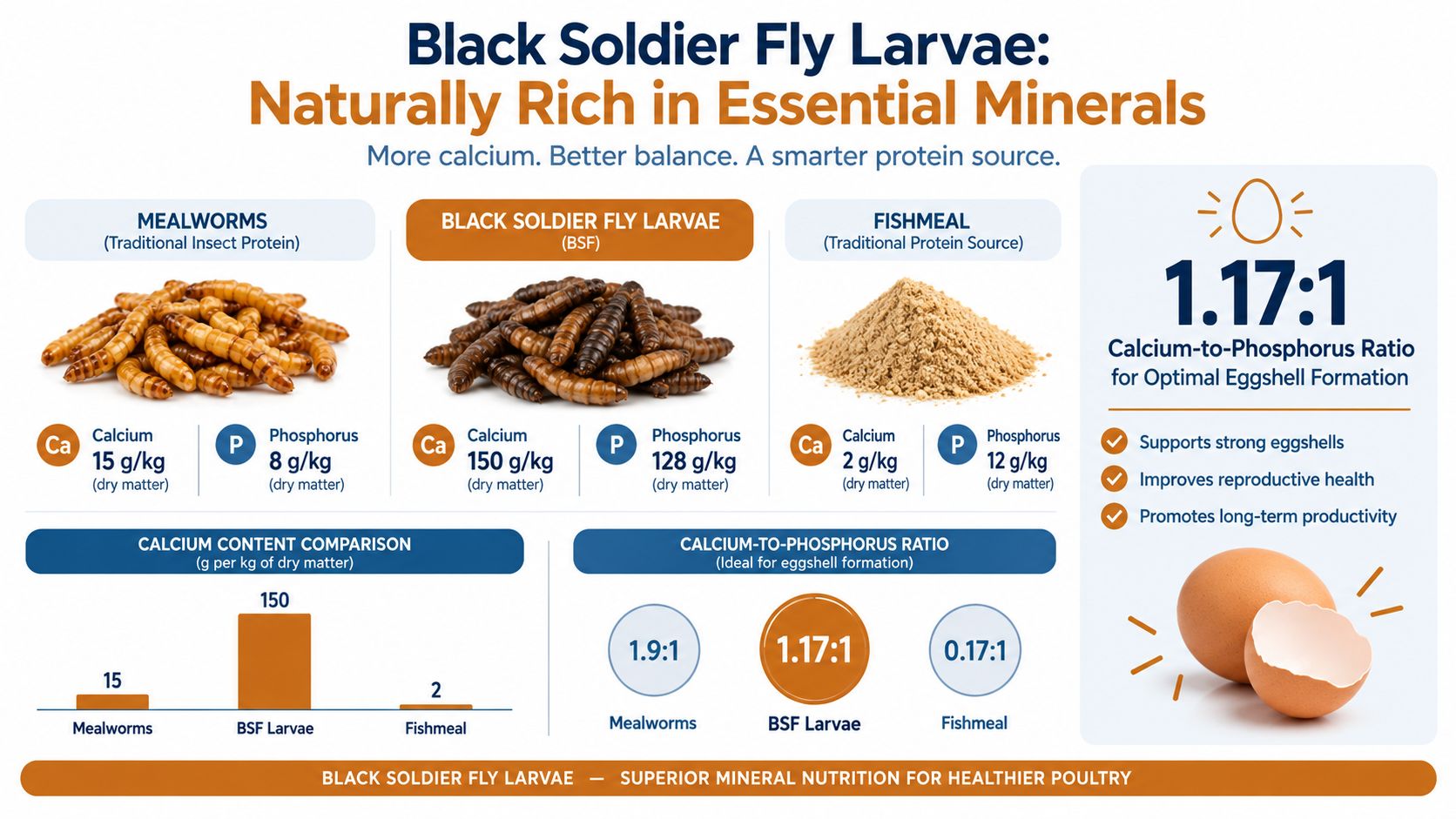
Black soldier fly larvae deliver about 5% to 8% calcium on a dry-matter basis, with phosphorus reported at about 0.6% to 1.5%. This mineral content can make them a richer calcium source than many other insect meals. Research also shows that the rearing substrate can change calcium, potassium, and the Ca:P balance, so the feedstock behind the larvae matters as much as the species name. (Research on mineral composition and substrate effects)
That mineral content does not turn a handful of larvae into a complete layer ration. Larvae work better as a supplement within a diet that already provides the hen with balanced energy, protein, vitamins, and minerals.
Calcium isn't fixed inside the insect
A larva's mineral profile reflects what it ate while growing. Two products made from the same insect species can therefore deliver different mineral results if their substrates differ. A commercial name, color description, or attractive package cannot confirm the mineral content or reveal whether the product was raised on a controlled feedstock.
Species identity tells you what insect you have. It doesn't tell you exactly what that insect accumulated during rearing.
That distinction matters when you are comparing domestic and imported products. Ask for a clear nutrient analysis, information about the substrate, and batch-level testing where available. Heavy-metal testing belongs in that conversation because a product can meet a protein claim while still leaving important questions about what entered the rearing system.
A producer seeking consistent eggshell support should standardize the substrate and test each batch's mineral profile. A flock owner should treat broad claims about “green” or black soldier fly nutrition as a starting point, not a guarantee.
What eggshell support really means
Eggshell formation depends on the hen's complete nutritional program. Calcium must be present in the diet, and the bird must be able to absorb and use it. A review of black soldier fly mineral nutrition identified calcium as the larvae's most abundant mineral while noting that diet and processing can alter the final profile. (Review of black soldier fly mineral nutrition)
Research with laying hens has reported stronger eggshells after feeding black soldier fly meal. The researchers also called for more work on calcium absorption and metabolism. An observed improvement does not prove that every dried-larva product will produce the same result, particularly when substrate and processing differ.
Use larvae as a measured addition during periods when birds need extra energy or variety, while keeping balanced layer feed as the nutritional foundation. If shells remain thin, examine the whole ration, flock age, illness, stress, and water access before adding more treats.
A stronger shell claim is only as useful as the mineral information behind it. Ask how the larvae were raised, what testing supports the label, and which insect species the product actually contains.
Biosecurity and Sourcing Safety Risks
A dried larva can look clean and still carry a hidden sourcing problem. Black soldier fly larvae can concentrate nutrients from their substrate, but they can also concentrate contaminants. Cadmium and lead have been shown to bioaccumulate in larvae even when their levels in the feed substrate are relatively low. (Safety review of substrate-related heavy-metal risks)
That makes the phrase “waste-fed” too broad to evaluate on its own. Some controlled systems use carefully managed organic streams, while an unverified product may give you no meaningful information about what entered the rearing bins. The risk lies in the lack of control and documentation, not in the insect's name.
Why imported feed deserves closer questions
Independent research has highlighted safety variability by substrate and origin. A 2025 research note reported that imported dried black soldier fly larvae from China averaged 25 times more lead and 8 times more arsenic than North American product. That finding doesn't mean every imported product is unsafe, and it doesn't prove every domestic product is safe. It does mean country of origin and production controls deserve a place in your buying decision. (Research note on origin-related contaminant differences)
The same research area has found that toxic elements can accumulate in larvae and frass even when the substrate contains only small amounts. Mercury was noted as an exception in one 2024 study, which is another reason not to assume that one contaminant pattern predicts all the others. (Research on toxic-element accumulation in black soldier fly systems)
| Feature | USA-Grown, Plant-Fed | Imported, Waste-Fed |
|---|---|---|
| Species identification | Should state Hermetia illucens | May use broad terms such as grubs or fly larvae |
| Feedstock information | Plant-based claims can be checked with the seller | Waste-stream details may be unclear |
| Origin | Traceable domestic origin is easier to verify | Country and facility information may require extra questions |
| Contaminant concern | Still requires testing because origin alone doesn't prove safety | Substrate and origin variability require close scrutiny |
| Batch documentation | Ask for current laboratory results | Don't assume testing from a generic product description |
| Flock-use decision | Consider only with clear labeling and evidence | Avoid products that can't explain their production controls |
Protecting the flock and the egg basket
Heavy metals matter beyond the bird eating the treat. Laying hens can transfer some unwanted substances through biological pathways, so flock owners who eat or sell eggs should take sourcing especially seriously. A seller should be able to explain whether finished larvae are tested for lead, arsenic, cadmium, and mercury, and whether the results apply to the batch you are buying.
The guide to heavy metals in imported black soldier fly larvae provides additional context for the origin and testing questions that often get overlooked in consumer discussions.
Treat traceability as part of feed safety, not as a luxury feature. If the seller can't identify the insect's origin and substrate controls, you can't make a sound judgment about the bag's risk profile.
How to Evaluate Insect Feed Labels
What does the bag tell you about the insects your flock will eat? Read an insect-feed label like a sack of grain. The front panel attracts attention, while the species statement, analysis, origin, substrate, and supporting records provide the useful evidence.
Start with identity. The label should name Hermetia illucens, the black soldier fly, rather than relying on “black grubs,” “fly larvae,” or “green soldier fly.” Those names may help shoppers find a product, but they do not establish which insect is present. A scientific name gives you a firmer starting point for comparing products.
A practical label check
Use this order when assessing a bag:
- Find the species. Confirm that it contains black soldier fly larvae, not an unspecified insect blend.
- Locate the origin. Check where the insects were raised and where they were processed. “Packed in” describes the packaging location, not necessarily the production site. Imported feed may involve several facilities, so ask for enough detail to follow that chain.
- Ask about substrate. The seller should explain whether larvae received a controlled plant-based diet, approved feed inputs, or another defined substrate. “Organic waste” is too vague to assess feed safety. Substrate transparency matters because the insects develop from what they consume.
- Check the analysis. Look for crude protein, fat, calcium, phosphorus, moisture, and feeding directions. A species-wide nutrition claim is not a batch analysis. Diet and processing can change the finished product.
- Look for contaminant testing. Ask whether finished larvae were tested for lead, arsenic, cadmium, and mercury. Results should identify the relevant batch or production lot. This question deserves extra attention when imported feed has limited information about its substrate or handling.
- Review additives and processing. The label should disclose preservatives, flavorings, oils, or other additions. Whole dried larvae and processed meal do not automatically have the same nutritional profile.
A checklist can help you remember these questions, but a completed marketing graphic is not laboratory evidence. Suggested thresholds may vary by species, life stage, processing method, or feeding purpose. Use the actual label and supplier documentation before deciding what belongs in the flock's feed.
Marketing phrases that need verification
“High calcium” should include a calcium value and a stated basis, such as dry matter. “USA-grown” should explain where rearing and drying occurred. “Clean” and “sustainable” remain broad descriptions until the seller identifies the feedstock, handling practices, and testing behind them.
A supplier's standardization information can show how it manages variation between products or batches. This overview of black soldier fly product standardization offers a reference for consistency questions buyers can ask.
Choose another product if the seller cannot answer basic questions. A lower price is no saving if you cannot establish what your birds are consuming.
Practical Feeding Strategies for Your Flock
Dried black soldier fly larvae work best as a supplemental tool, not as the foundation of a flock's diet. Keep a complete layer ration available, then use larvae to add variety, encourage movement, or provide a useful reward during demanding periods such as molting or cold weather.
Begin with a small amount and watch how the birds respond. Chickens may rush toward any novel treat, but excitement doesn't tell you whether the product suits every bird or whether the flock is eating too much of it. Adjust gradually, and keep fresh water available.
Match the treat to the job
For training, toss a few larvae into a specific area and call the birds toward it. This can encourage foraging and make it easier to move a flock without chasing individual hens. Scatter them over clean litter or a safe outdoor surface so the birds work for the treat rather than swallowing a large pile at once.
During molt, larvae can add protein and fat to the overall feeding program, but the complete ration still supplies the broader range of nutrients birds need. In winter, a small supplemental treat may provide useful energy, yet it shouldn't displace the balanced feed that supports daily maintenance and egg production.
Young pullets, roosters, ducks, and mixed-species groups may have different dietary needs. If one species receives the larvae regularly, check that the product is appropriate for that animal rather than assuming a poultry treat suits every pet or livestock species.
Keep mineral claims in perspective
If your hens produce thin or rough shells, don't respond by endlessly increasing treats. Check whether they have reliable access to the complete layer ration, whether another flock member is dominating the feeder, and whether illness or stress could be affecting laying performance. Black soldier fly larvae can contribute calcium, but they don't correct every cause of poor shell quality.
Use the product's feeding directions when available, and keep records if you're testing a new treat. Note the product name, origin, batch information, the amount offered, and visible changes in appetite or droppings. Good notes help you distinguish a genuine feeding issue from a one-time change in weather, flock behavior, or storage quality.
The safest routine is simple: buy traceable larvae, offer them as a supplement, and let the complete ration do the heavy nutritional work.
Store dried larvae in a cool, dry, sealed container. Discard feed that becomes damp, moldy, rancid-smelling, or contaminated by rodents. If the bag lacks an origin statement or the seller can't answer questions about substrate and heavy-metal testing, don't use your flock as the product tester.
Pure Grubs offers USA-grown, dried black soldier fly larvae with product information focused on origin, plant-based rearing, and use as a supplemental treat for poultry and other animals. Visit Pure Grubs to review the available larvae and compare the sourcing details with the safety checklist above.