

FDA Approved Food Manufacturing Facilities Explained
The familiar advice to buy feed from an FDA-approved facility sounds reassuring, but it asks you to trust the wrong phrase. When you're comparing dried-larvae bags for your flock, the useful question isn't which bag makes the biggest approval claim. It's which seller can explain the claim and show the paperwork behind it.
Why FDA Approved Food Facilities Confuse Buyers
You're holding two bags of dried larvae. One announces FDA approval in large lettering; the other says less about regulators but offers traceable production information. It's tempting to assume the louder bag has passed a government quality check.
That's the misunderstanding. FDA explains that a food-facility registration number means the facility is registered, not that FDA has approved it, cleared an inspection, or endorsed its products. Registration covers applicable domestic and foreign facilities handling food for U.S. consumption, including animal food, according to FDA's explanation of food-facility registration claims.
A registration list isn't an approval list
The historical scale helps explain why those distinctions matter. Before October 22, 2012, FDA reported 172,969 active registered domestic facilities and 285,977 foreign facilities, totaling 458,946 food and feed facilities, with domestic establishments representing about 37.7% and foreign establishments about 62.3% of that snapshot, according to its 2013 annual report on food facilities and inspections.
In fiscal year 2012, FDA and states working under FDA contracts inspected or attempted to inspect 24,462 domestic food facilities, while FDA inspected 1,342 foreign facilities; the same report cautions that the registration snapshot and inspection year aren't perfectly matched measures. Those historical figures aren't a current inspection rate, and they don't tell you whether a particular larvae supplier operates safely.
Practical rule: Treat an approval phrase as a request for explanation, not a reason to stop asking questions.
A keeper searching for FDA approved food manufacturing facilities usually wants something sensible: confidence that the feed was made responsibly. But that search phrase bundles together different questions about the building, its operating controls, the ingredient, and the batch in your bag.
The same reading habit helps with adjacent animal products. Pure Paw Labs' resource on checking pet supplement safety claims offers a related context for questioning manufacturing language, rather than treating a reassuring phrase as proof.
For your flock, don't rank bags by how often they mention FDA. Ask what each claim describes and what evidence supports it.
What Food Facility Registration Actually Covers
Think of registration as putting a facility's street address and activities on the regulator's map. It identifies an operation that belongs within the regulatory system. It isn't a gold star for the recipe inside your feed bag.
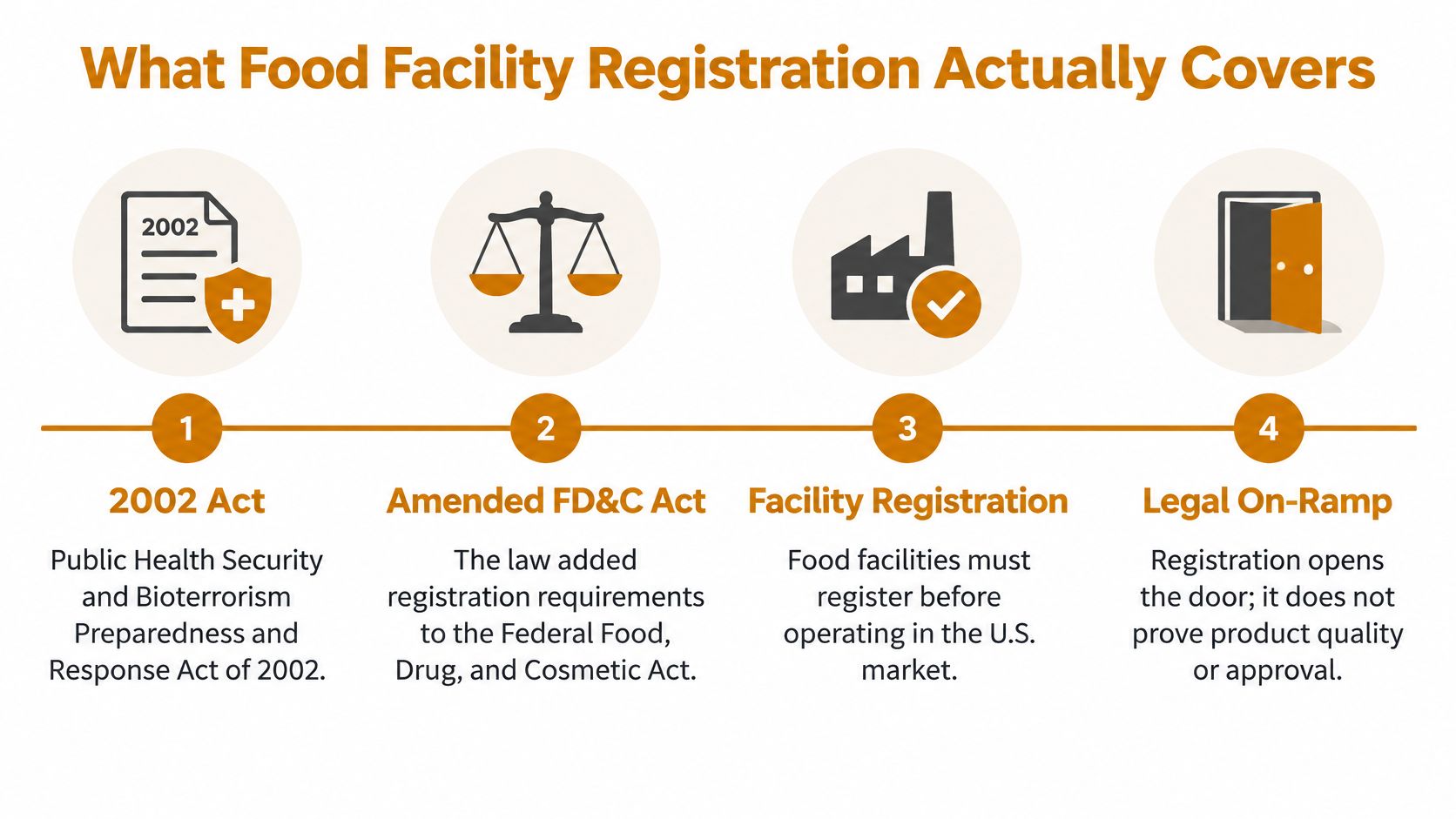
The requirement originated in the Public Health Security and Bioterrorism Preparedness and Response Act of 2002, which amended the Federal Food, Drug, and Cosmetic Act. Registration regulations took effect on December 12, 2003, as described in FDA's food-facility registration overview.
How registration became an ongoing responsibility
The system developed beyond an initial filing. The Food Safety Modernization Act, or FSMA, signed in 2011, required renewal every two years and additional facility information, according to that FDA overview.
FDA's 2016 final rule required registration records to identify the activity conducted for each food-product category and include an assurance that FDA would be permitted to inspect. Electronic submission became mandatory on January 4, 2020, and a unique facility identifier became part of registration beginning October 1, 2020, under the same registration framework.
This visual separates that legal entry point from a product-quality claim.
Follow the activity, not just the brand name
The covered activities are manufacturing, processing, packing, and holding food for U.S. consumption. Animal food belongs within that framework, so an insect-feed operation isn't outside the discussion just because its customers keep chickens rather than cook dinner.
For a buyer, the practical distinction is between the name on the retail bag and the facility carrying out the relevant work. If the seller discusses a registered warehouse, ask whether its explanation also identifies where the larvae were processed and packed.
- Identify the operation: Ask which facility performs the activity being described.
- Match the details: Compare the business name, location, and activity with the seller's explanation.
- Check currency: Request confirmation that reflects the facility's current registration status.
For a business navigating the administrative side, African Import Export Solution offers food facility registration support. Such assistance concerns the filing process; buyers should still evaluate the actual facility and product documentation separately.
You don't need to memorize the registration timeline before buying treats. You do need to recognize that a filing identifies an operation, while the next set of questions concerns how that operation runs.
Preventive Controls Inside an Animal Food Plant
A registered address tells you little about what employees do when equipment drifts out of specification or an ingredient raises a contamination concern. Those are operating questions, and they call for operating records.
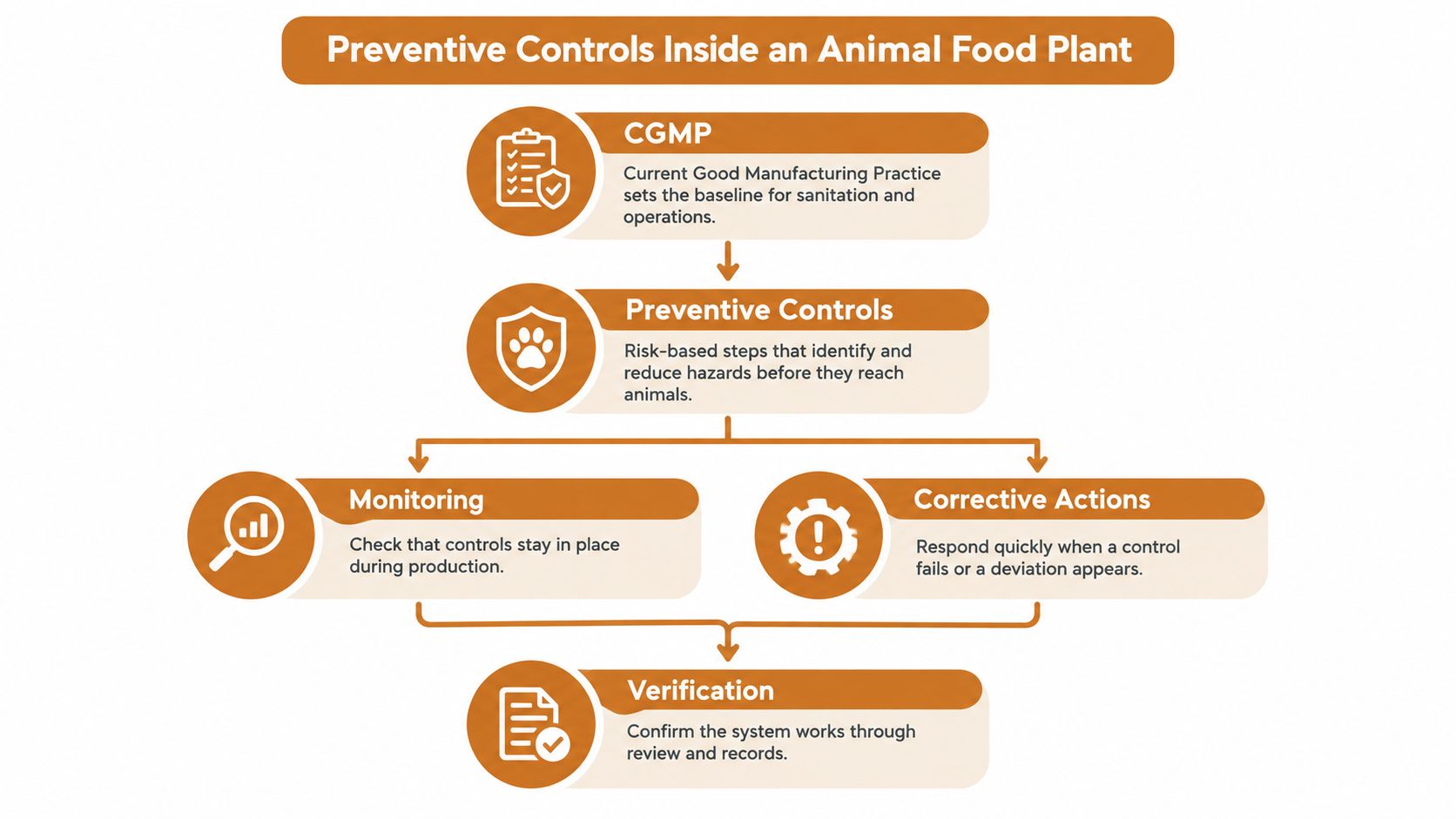
For animal-food facilities, the relevant framework is generally Current Good Manufacturing Practice and Preventive Controls for Animal Food, found in 21 CFR Part 507. Covered operations must evaluate reasonably foreseeable biological, chemical, and physical hazards and implement risk-based controls when required, as explained in FDA's guidance on starting a food business.
Follow a hazard through production
For dried black soldier fly larvae, often shortened to BSFL, useful questions concern microbial contamination, contamination from the production environment, foreign material, chemical residues, and heavy metals. Naming a hazard doesn't establish that it is present. It identifies something the facility should evaluate in relation to its process and intended use.
A meaningful answer connects the concern to an actual procedure:
- Hazard analysis: What could reasonably go wrong, and where could it happen?
- Preventive control: What action prevents or reduces a hazard that requires control?
- Monitoring: What does an employee measure or observe during production?
- Corrective action: What happens to the process and affected food when something goes wrong?
- Verification: Who checks that the procedure and its records demonstrate control?
Preventive controls may involve processing, sanitation, or supply-chain measures, with environmental monitoring where relevant and a recall plan. The point isn't to collect impressive procedure names. It's to see a documented connection between a hazard and the work used to manage it.
Someone qualified must oversee the plan
FDA requires the food-safety plan to be developed or overseen by a Preventive Controls Qualified Individual, or PCQI. FDA materials identify reanalysis at least every three years, and sooner when significant changes in ingredients, equipment, processes, or emerging hazards require it, under the framework described above.
Validation asks whether a control can do its intended job. Verification checks whether the system is being implemented and working as intended, including through records review.
Sanitation deserves concrete questions, too. FullScope Pest Control's guidance on protecting kitchens from pest violations provides a food-service comparison, not proof that an animal-feed plant meets its own obligations.
A clean-looking finished product can't tell you whether employees followed the control plan throughout production.
For a keeper connecting manufacturing concerns with everyday feeding decisions, this guide to food safety for poultry provides a useful companion. Keep the manufacturer's responsibilities distinct from what you do with the bag after purchase.
How FDA Compliance Differs From Feed Labels
A poultry-feed label can discuss the factory, the ingredient, and a voluntary quality program in the same small patch of packaging. Those statements may all sound reassuring, but they answer different questions.
Facility oversight concerns the operation. Ingredient status concerns what may be marketed and how it may be used. A certificate or seal needs its own explanation of scope before you can decide what weight to give it.
What Common Feed Claims Do and Do Not Prove
| Claim on the bag | What it can show | What it does not prove |
|---|---|---|
| FDA registered | A claim about facility registration | Product approval or inspection clearance |
| FDA compliant | An assertion that applicable requirements are being followed | Which requirements apply or what records support the assertion |
| AAFCO-defined ingredient | A reference to an ingredient definition | Unrestricted use for every species or purpose |
| Third-party certified | Assessment against the named program's criteria | FDA approval or complete regulatory compliance |
| Batch tested | Testing associated with an identified batch, if records match | Control of every hazard throughout production |
Use the table to sort claims, not to award points. A bag carrying several labels still needs an explanation of what each one covers.
Ingredient permission is a separate question
Animal-food substances can be subject to the food-additive petition process. Generally, an additive must be approved, covered by an FDA regulation, and used as specified; FDA's guidance on enforcement policy for AAFCO-defined animal-feed ingredients explains the relevant policy distinction.
Under FDA's October 2024 policy, the agency generally does not intend to initiate enforcement action for ingredients listed in AAFCO's 2024 Official Common or Usual Names and Definitions of Feed Ingredients when the policy's conditions are met. AAFCO is the Association of American Feed Control Officials.
That is enforcement discretion, not formal FDA approval of an ingredient. Don't translate a reference to an AAFCO definition into permission for every species, label statement, or feeding direction.
- Read the ingredient name: Ask which recognized name or definition the seller relies on.
- Check the intended use: Match the species and feeding purpose to that explanation.
- Consider the destination: Ask how the product meets the feed rules of the state where it will be sold.
If a larvae bag lists chickens, fish, and reptiles, don't assume the manufacturing claim settles every listed use. Ask the seller to explain the ingredient's status for the animal you feed.
A voluntary certificate can contribute useful evidence within its stated scope. It shouldn't replace answers about the ingredient, applicable operating requirements, or lawful distribution.
How to Verify a Food Manufacturing Facility Claim
Send the seller a focused request instead of asking whether the product is safe. A broad question invites a broad reassurance; a document request gives you something to evaluate.
Start with the facility that processes or packs the product you intend to buy. Ask the seller to identify that operation clearly, especially when the retail brand and manufacturer have different names.
Ask for evidence that matches the product
A practical request can cover the following:
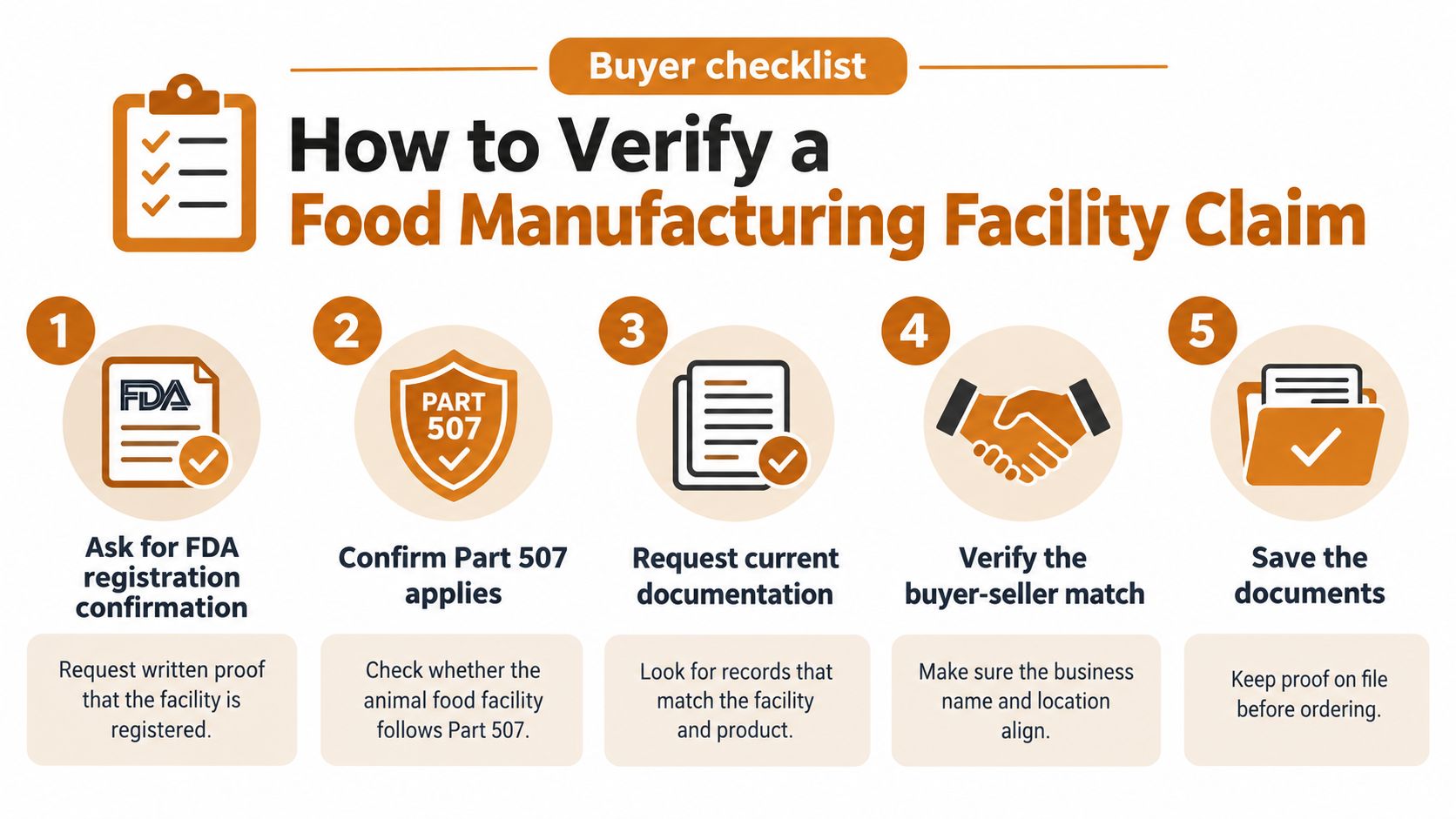
- Facility identity and registration confirmation: Match the name, address, and activity to the product's manufacturing path.
- Applicable food-safety requirements: Ask whether Part 507 applies and request the food-safety-plan scope and confirmation of PCQI oversight.
- Control records: Request relevant monitoring summaries, calibration and verification evidence, and how corrective actions are documented.
- Traceability and recall procedures: Ask how a lot can be followed through production and distribution.
- Testing and inspection information: Request recent contaminant results tied to a lot and the facility's most recent inspection classification.
These requests follow the documentation-based approach supported by FDA's FSMA questions and answers. A seller may offer summaries or redacted material rather than proprietary operating details; assess whether the response still answers your specific question.
Keep the request organized enough that you can compare suppliers fairly.
Read inspection classifications carefully
FDA publishes inspection information and uses these classifications:
- NAI, No Action Indicated: The classification indicates no action is called for.
- VAI, Voluntary Action Indicated: The classification calls for voluntary action.
- OAI, Official Action Indicated: The classification indicates official action.
Ask for the inspection date, scope, and any follow-up explanation rather than treating an abbreviation as a complete history. The classification concerns an inspection, not an endorsement of everything currently sold.
A certificate of analysis, often abbreviated COA, addresses the sample or lot identified on that report and the tests listed there. Monitoring and corrective-action records address a different question: whether employees maintained controls during production.
Buyer's checkpoint: Match the lot on the test report to the lot you're buying before using the result to judge that bag.
For help interpreting that distinction, consult this explanation of quality assurance testing. Ask which contaminants were tested, what results were reported, and how the seller decided whether the lot met its acceptance criteria.
What BSFL Buyers Should Check Before Ordering
For insect feed, start with the intended animal and the product's role in its diet. A larvae treat offered for backyard hens needs an explanation that fits that use, not just a statement about the building where it was dried.
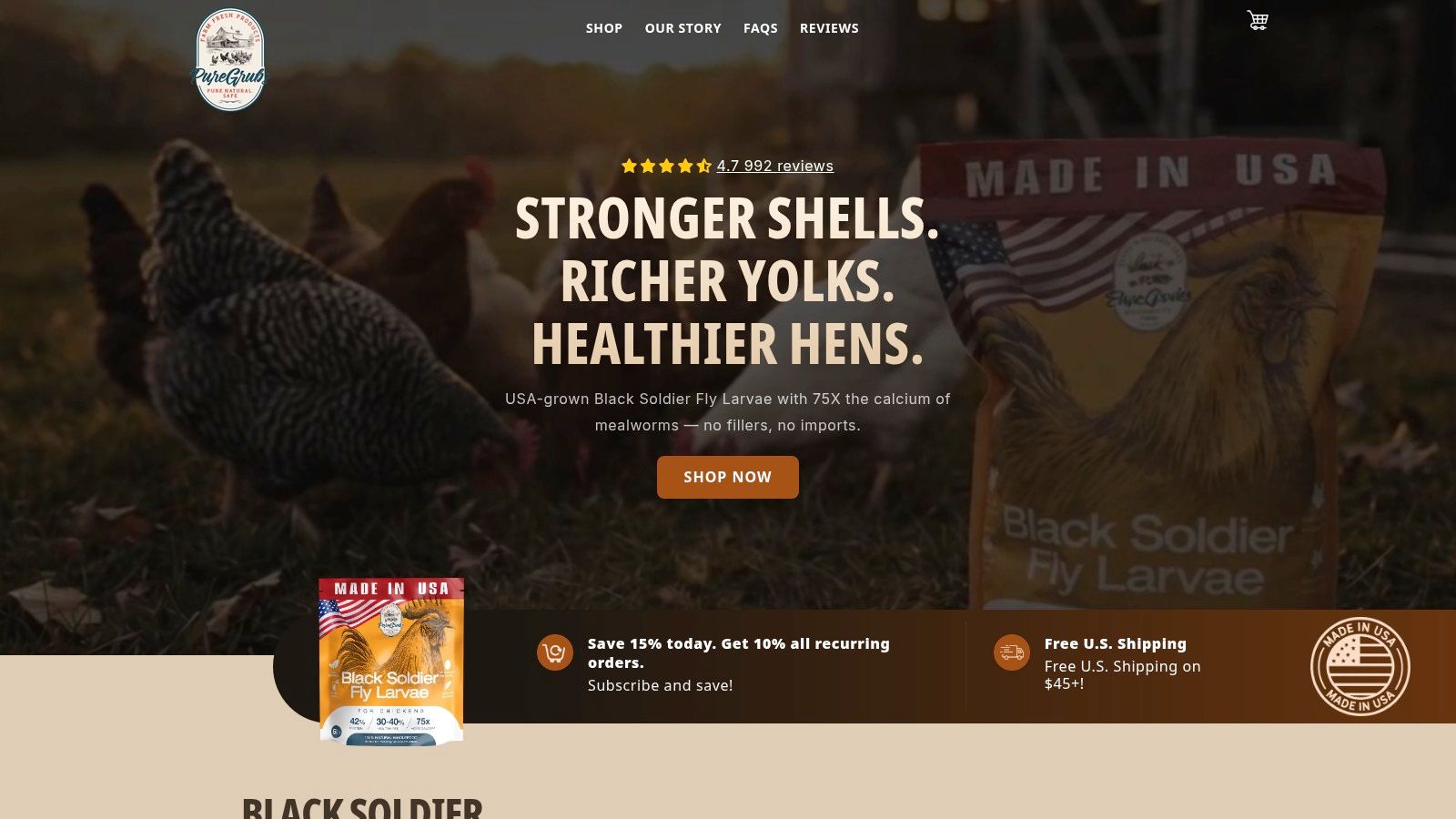
Use the storefront as a starting point for questions, rather than as the final evidence.
Compare specific answers, not countries alone
A U.S.-grown option may give you a straightforward origin claim to investigate. An imported option deserves the same document-based review, not automatic dismissal. Ask either seller where growing, processing, and packing occurred, and whether the paperwork covers those operations.
Pure Grubs' USA GROWN BLACK SOLDIER FLY LARVAE FOR CHICKENS is one option to examine. The brand describes its larvae as grown and dried in the United States without additives or preservatives, and states that production facilities are FDA compliant and that batches are tested for lead, arsenic, mercury, and cadmium.
Treat those as brand statements to verify, not independent findings or FDA endorsement. Ask for the relevant facility explanation and a test report linked to the lot offered for sale.
The practical comparison looks like this:
- Specific origin versus a broad location claim: Can the seller identify the production steps and locations?
- Named contaminants versus “tested for safety”: Does the report identify what the laboratory measured?
- A matching batch versus an example report: Does the documentation apply to the bag you'll receive?
- A defined feeding use versus a long animal list: Can the seller support the intended species and use?
The same questions belong in a supply-chain transparency review. A seller who explains the production path gives you something concrete to check against the label.
Use this accompanying video as additional context, while keeping written records central to your purchasing decision.
Don't let nutrition claims replace safety evidence
Calcium comparisons and protein descriptions concern nutrition. They don't answer whether a particular batch met contaminant criteria or whether the label's intended use is supported.
If a nutrition comparison seems unclear, request the underlying analysis and comparison basis. You can evaluate nutritional suitability and manufacturing evidence separately without assuming that either settles the other.
Your Next Step When a Feed Bag Makes a Claim
Pick up the next larvae, scratch, or treat bag you're considering and make a short note before ordering. Don't begin by deciding whether you trust the brand. Begin by recording exactly what it asks you to believe.
Separate the claims in your notes
Use these lines:
- Facility claim: Copy the wording about registration, compliance, manufacturing, or approval.
- Ingredient and use: Record the ingredient name, intended animal, and feeding purpose.
- Evidence offered: Note any lot test, certificate, traceability statement, or document the seller makes available.
If the facility line says FDA approved, mark it needs clarification. Don't silently replace it with registered or compliant, because the seller still needs to explain which claim it can support.
Send a focused message: ask for registration confirmation, an explanation of applicable animal-food preventive controls, and the latest relevant contaminant results tied to the lot available for purchase. You're asking the seller to connect its words to your prospective bag.
Buy on the strength of matching answers, not on the number of reassuring phrases printed on the package.
Decide what remains unanswered
A useful response identifies the operation, explains the product's intended use, and connects supporting records to what you'll receive. If a document describes a different facility or an unrelated lot, ask about the mismatch before treating it as evidence.
You don't need to become a plant auditor to make a more informed choice. You need a repeatable habit that distinguishes an identifiable fact from an unsupported assurance.
Save the label, the seller's response, and any relevant report together. Then apply the same questions to the next supplier, whether the product is domestic or imported, and choose the one whose evidence fits the birds you feed.
Pure Grubs offers USA-grown dried black soldier fly larvae as treats and supplemental feed for chickens and other birds. Visit Pure Grubs to review the product information, then ask how its facility and batch-testing statements connect to the bag you're considering.