

Eggshell Calcium Supplement for Hens: A Practical Guide
You reach into the nesting box, lift an egg, and feel the shell give under your fingers. Yesterday's eggs seemed fine. Today you're wondering whether to crush some kitchen eggshells, buy oyster shell, or add a calcium-rich treat before another egg breaks.
An eggshell calcium supplement can be useful, but choosing an ingredient is only part of the job. The better question is whether your hens' feeding program delivers the right calcium, in the right form, without upsetting the rest of their diet.
Why Hen Eggshells Break Down in the First Place
That fragile egg is a reason to investigate, not an instruction to start pouring powder into the feeder. Think of shell quality as the outcome of connected processes: what the hen eats, what she draws from her bones, and what's available while she forms the shell.
Follow the calcium through the hen
Dietary calcium supplies material for shell formation. The hen also mobilizes calcium from bone, so the egg you collect reflects more than the contents of the supplement dish.
Physical form affects delivery. In controlled laying-hen research, dried eggshell supported production, but fine eggshell and fine limestone produced poorer egg specific gravity in older hens than large-particle calcium. Larger particles remain longer in the digestive tract and can release calcium during the dark period, when shell formation continues, as described in the study of eggshell calcium availability and particle size.
That finding explains why an apparently adequate mineral supply can still leave you with disappointing shells. A hen needs usable calcium during shell formation, not a generous amount somewhere in the coop.
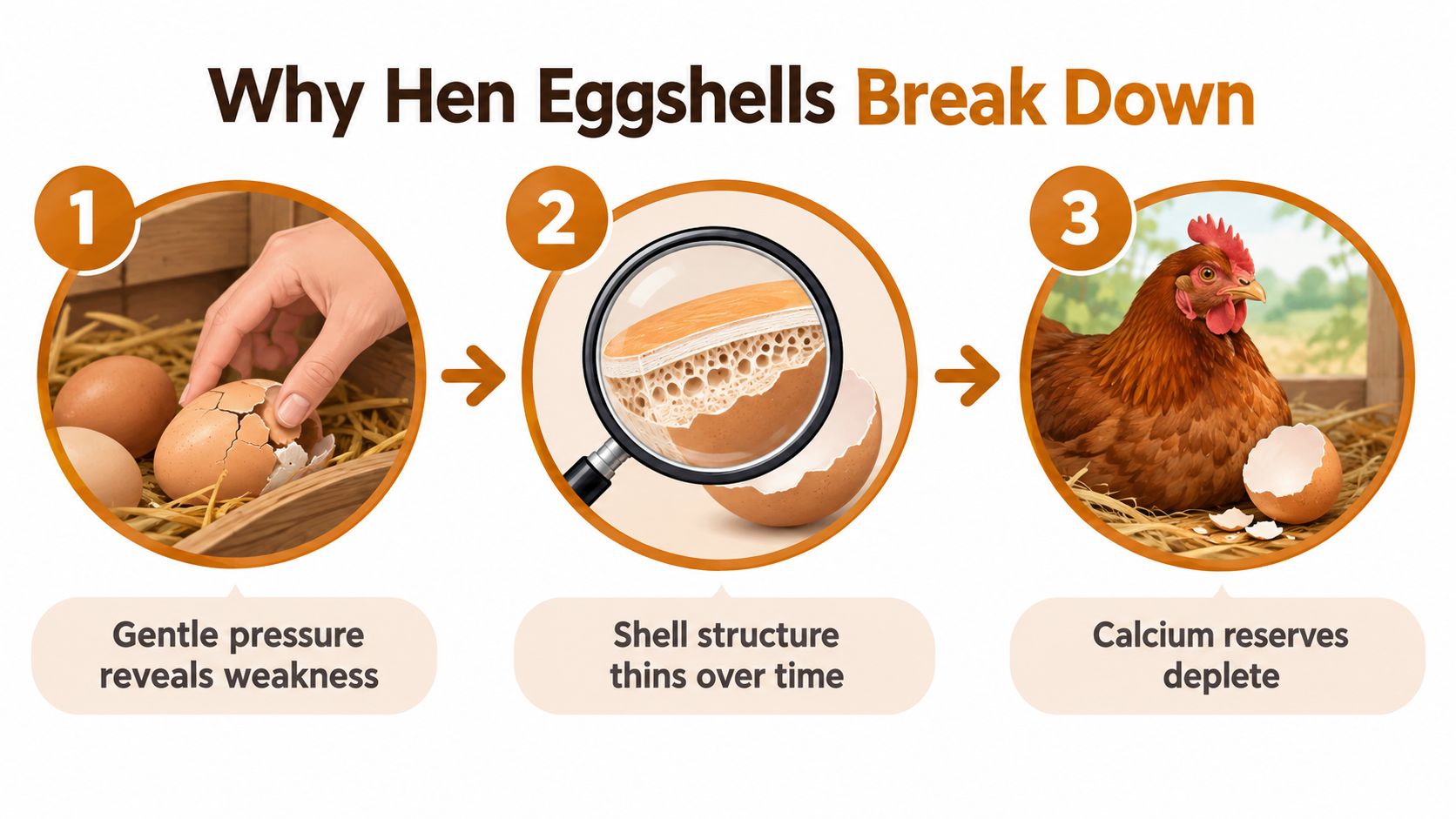
This visual summarizes one possible route to shell weakness, rather than diagnosing every broken egg.
Separate a supply problem from an access problem
Before changing ingredients, watch the flock eat. Check whether every hen can reach the complete feed and whether the bird producing weak shells uses the calcium container.
- Feed intake: Look at what hens consume, not just what you offer.
- Individual condition: Identify whether the problem belongs to a particular hen or appears throughout the flock.
- Delivery: Check the calcium product's physical form and feeding directions.
Record housing, lighting, and routine changes as context for a veterinary discussion, rather than assuming they explain the egg. A soft shell alone doesn't tell you which part of the system needs attention.
The Calcium Carbonate Story Most Keepers Miss
Eggshell calcium isn't a mysterious mineral found only in eggs. It's primarily calcium carbonate, the same compound used in many conventional calcium supplements.
Research reviews describe avian eggshells as approximately 96% calcium carbonate, with the remainder consisting of minerals and organic components. They also report variation between shell sources, which is why a household batch shouldn't be treated as a laboratory-standard ingredient, according to the review of eggshell composition and calcium recovery.
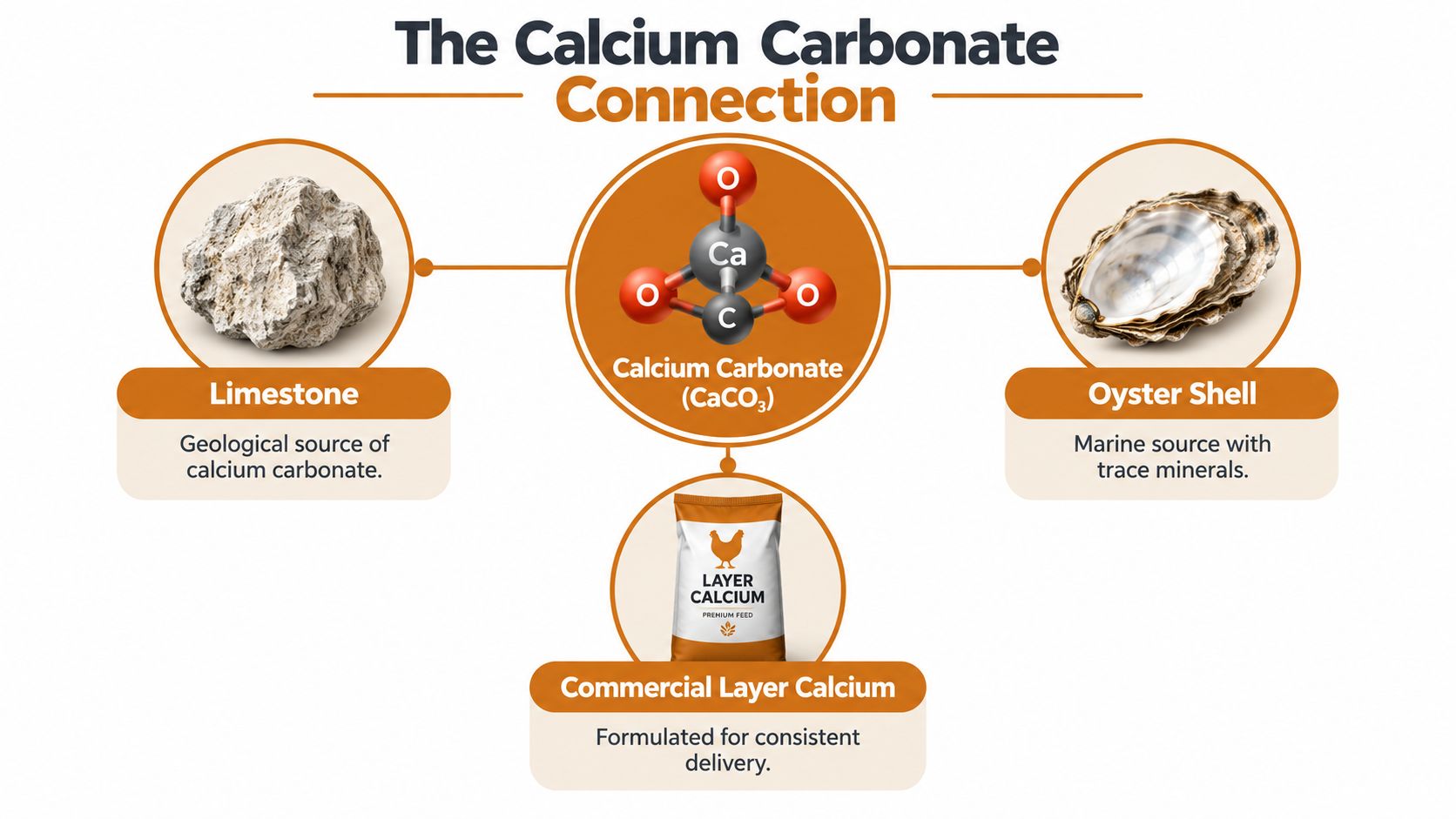
The illustration connects familiar calcium ingredients, but a shared mineral name doesn't make their feeding characteristics identical.
Read the amount that matters
Calcium carbonate content and elemental calcium aren't interchangeable. The first describes the compound; the second describes the calcium supplied by that compound.
A label stating the weight of eggshell powder hasn't necessarily told you the calcium contribution. For feeding calculations, ask for elemental calcium, serving weight, and product-specific instructions.
Label-reading rule: Compare products by the calcium they supply and how they're intended to be fed, not by the largest percentage on the package.
Mineral balance also belongs in that comparison. The guide to phosphorus and calcium balance offers a useful starting point for considering the complete ration instead of evaluating calcium alone.
Match the product to the animal
If you're browsing Bandana Rx's online vet pharmacy calcium category, use it as a place to examine formulations and intended uses. Don't assume a veterinary calcium product is suitable for routine hen feeding merely because its name includes calcium.
The same caution applies to instructional videos: compare any preparation or feeding advice with poultry-specific product directions. Keep the distinction between ingredient preparation and diet formulation in mind while watching.
You're choosing a delivery system, not just a mineral source. The earlier particle-size finding is particularly important when deciding whether finely powdered shell is the form your flock needs.
Reading the Flock for Calcium Trouble
Start with observations you can describe accurately. “The flock needs calcium” is a conclusion; “the same hen has laid fragile eggs while leaving her layer feed untouched” is useful information.
Don't squeeze eggs to test them. Inspect them during normal collection and record breakage, unusual surfaces, and whether a shell is present.
Keep shell observations separate from health signs
Use a notebook or phone log to connect eggs, feeding behavior, and individual hens.
- Thin or shell-less eggs: Record whether they recur and whether you can identify the hen. Don't diagnose a mineral deficiency from appearance alone.
- Broken eggs in the nest: Note whether you saw an intact but fragile egg or found fragments afterward. Those observations aren't equivalent.
- Wrinkled or unusual shells: Photograph the pattern for comparison and for a veterinarian if it persists.
- Picky eating: Watch what the hen chooses and leaves behind, especially around the complete ration.
- Weakness or difficulty standing: Seek veterinary advice rather than treating the bird with an uncalculated calcium dose.
Yolk color, molt, and shell appearance shouldn't be bundled into a single deficiency diagnosis. A visible change can help you notice that something needs attention without identifying its cause.
A supplement label can tell you what's in the bag. It can't tell you why a particular hen is struggling.
Compare hens rather than averaging the flock
Keep age and laying stage in your notes. An older layer, a bird entering lay, and a hen returning to production shouldn't automatically receive the same response to an unusual egg.
The calcium deficiency in chickens guide can help organize your observations before discussing persistent trouble with a poultry professional. Bring the feed label, supplement label, photographs, and your intake notes.
The most useful daily check is simple: watch the birds as well as the eggs. Repeated problems deserve investigation even when the feeder appears full.
Comparing the Main Supplement Options
The shelf offers different kinds of products, not interchangeable solutions. A mineral powder, a coarse shell ingredient, and an insect treat should each have a defined job beside the complete ration.
Calcium Supplement Options at a Glance
| Source | Typical Elemental Calcium | Particle Behavior | Best Fit |
|---|---|---|---|
| Commercial calcium carbonate powder | Use the product's declared specification | Fine form; don't assume overnight delivery | A calculated addition under feeding guidance |
| Oyster shell | Check the poultry product label | Check the supplied size distribution | A poultry-specific supplemental calcium option |
| Limestone | Use the supplier's analysis | Available forms must be evaluated separately | Formulated diets or suitable coarse-calcium programs |
| Ground eggshell | Approximately 380 mg per gram, as reported in the review of eggshell powder as a calcium source | Depends on preparation and grinding | A controlled calcium ingredient, not a complete ration |
| Black soldier fly larvae | Request product-specific calcium information | Whole insect form; don't equate it with coarse mineral particles | A complementary treat supplying nutrients beyond calcium |
The eggshell review also emphasizes hygienic processing, dietary balance, and commercial specifications. Its practical message is more useful than the calcium concentration alone: a viable ingredient still needs quality control and an appropriate inclusion level.
For the table's unspecified entries, don't substitute a generic internet value for the actual bag you're feeding. Ask the supplier for a usable specification.
Decide by the gap you're trying to fill
If your concern is the delivery issue described earlier, choose by particle form and poultry feeding directions. If you're considering an insect treat, evaluate it as part of the whole feeding program rather than as a direct substitute for the mineral container.
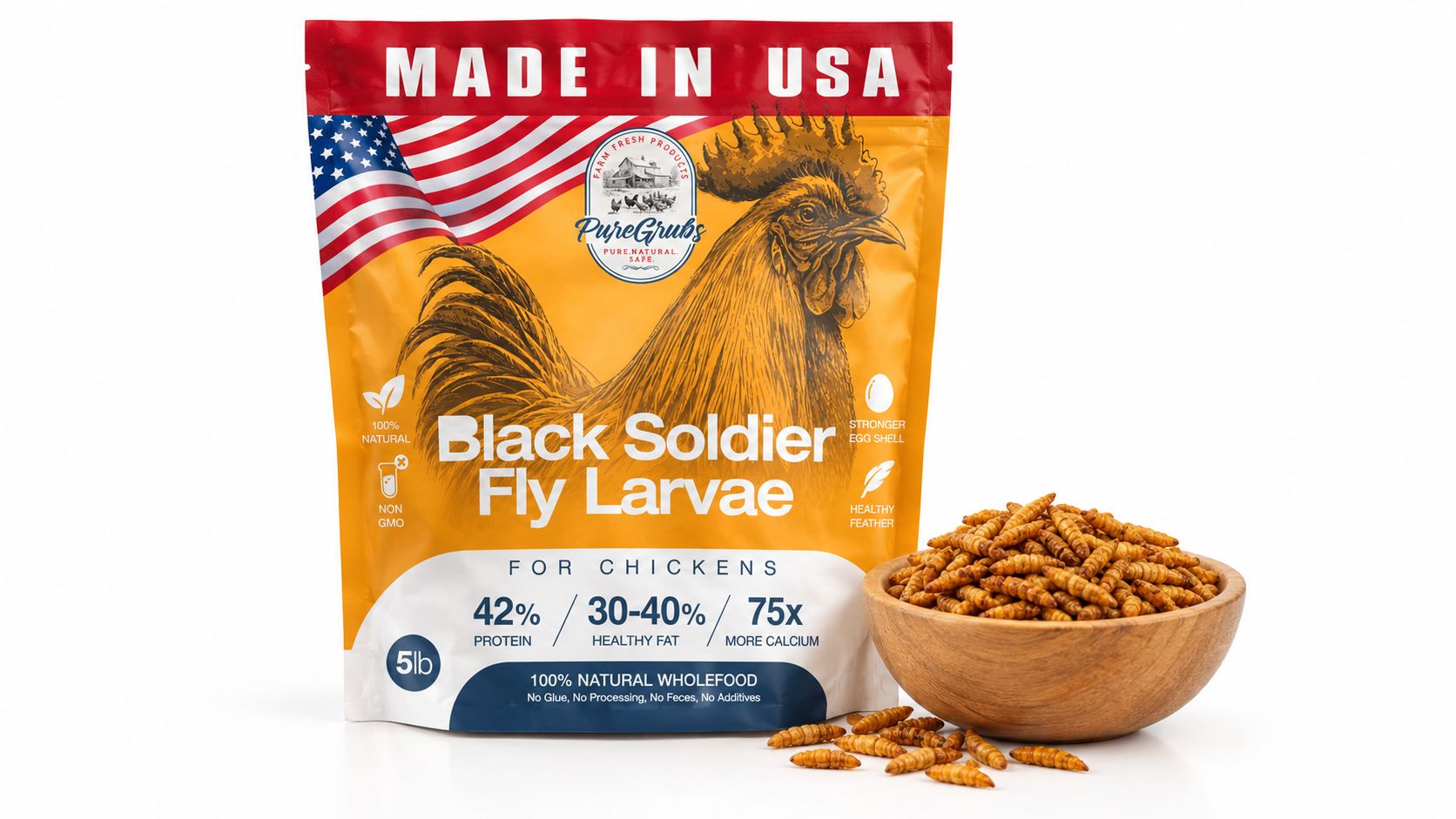
A dried-insect option is USA GROWN BLACK SOLDIER FLY LARVAE FOR CHICKENS. It belongs in the complementary-feed category, alongside rather than in place of complete feed and any indicated mineral supplement.
Before purchasing any supplement, separate sourcing information from performance promises. The safety guide from maxijournal.com is a general resource to consider, not a poultry formulation standard or evidence that a particular product will strengthen eggs.
Your buying decision should answer practical questions: Is it intended for poultry? Is calcium declared clearly? Are preparation, storage, and feeding directions available? If those answers are missing, a prominent natural-calcium claim doesn't resolve the uncertainty.
Where Black Soldier Fly Larvae Fit In
Black soldier fly larvae are better understood as a calcium-and-protein package than as eggshell powder in another shape. Their place in the diet is different because an insect feed brings more than a concentrated mineral ingredient.
That distinction matters when you're reviewing treats. Instead of asking whether a snack contains calcium, ask what it contributes to the ration and what the hens eat less of after receiving it.
Evaluate the package without assuming superiority
A calcium-containing treat may be a useful choice within a balanced program. It doesn't follow that its calcium is more available to your hens than another source, or that feeding it will outperform a correctly formulated mineral program.
Calcium concentration, calcium availability, and improved shell strength are separate claims. A product needs appropriate evidence for each; the ingredient name alone doesn't establish them.
The overview of black soldier fly larvae benefits is a starting point for considering their broader feeding role. For portion decisions, use the product directions and the requirements of the base diet.
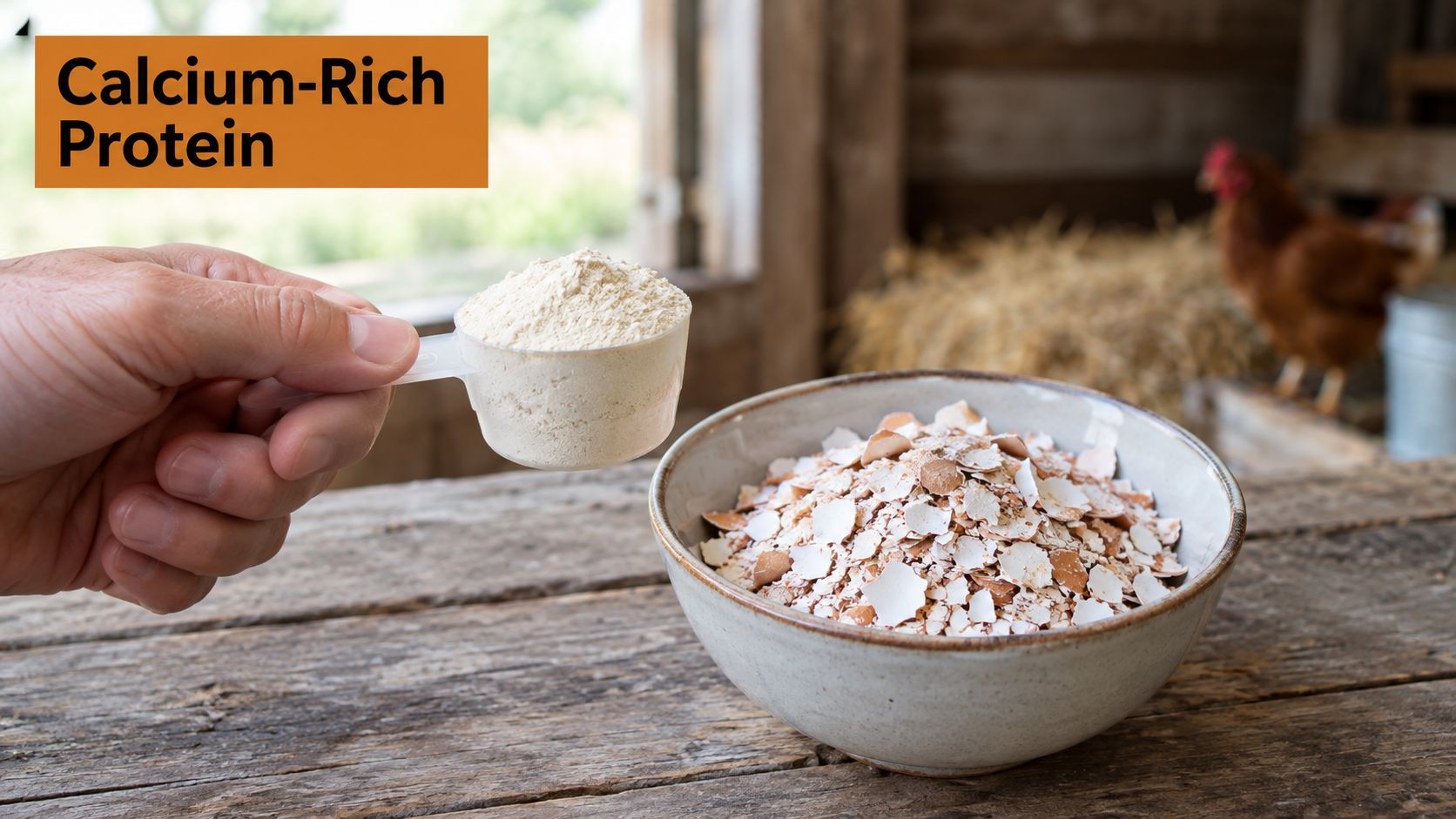
The contrast with powdered eggshell helps clarify the different jobs.
Review the feeding stage before the treat
When hens enter lay, move through production, or return after molt, review the complete feeding program rather than automatically increasing both treats and calcium. A bird's current stage is a reason to check the ration, not permission to improvise its mineral content.
- Entering lay: Confirm that the base feed is appropriate for the bird's stage.
- During production: Keep records of complete-feed consumption when adding treats.
- After molt: Reassess the ration before interpreting a treat as a recovery formula.
My practical preference is to select complementary foods that have a clear nutritional purpose. That can make a calcium-containing insect treat a considered addition, but it still shouldn't carry responsibility for balancing the flock's diet.
Building a Daily Feeding Framework That Actually Works
Put the feed label on the kitchen table before opening another supplement bag. Write down what the complete ration supplies, how much the flock consumes, and every extra you offer.
This inventory often reveals a more useful question than which supplement to buy: do you know the total diet well enough to change it safely?
Calculate before adding
The basic calculation is amount eaten multiplied by declared calcium concentration. Keep the units consistent, and repeat the calculation for each calcium-containing addition.
Don't use feeder disappearance as an exact measure of consumption if you haven't accounted for spillage. If the product lacks a calcium specification, ask the supplier rather than guessing.
A veterinarian or poultry nutritionist can help interpret those calculations, especially for a mixed-stage flock. Keep the earlier mineral-balance discussion in mind when reviewing the result.
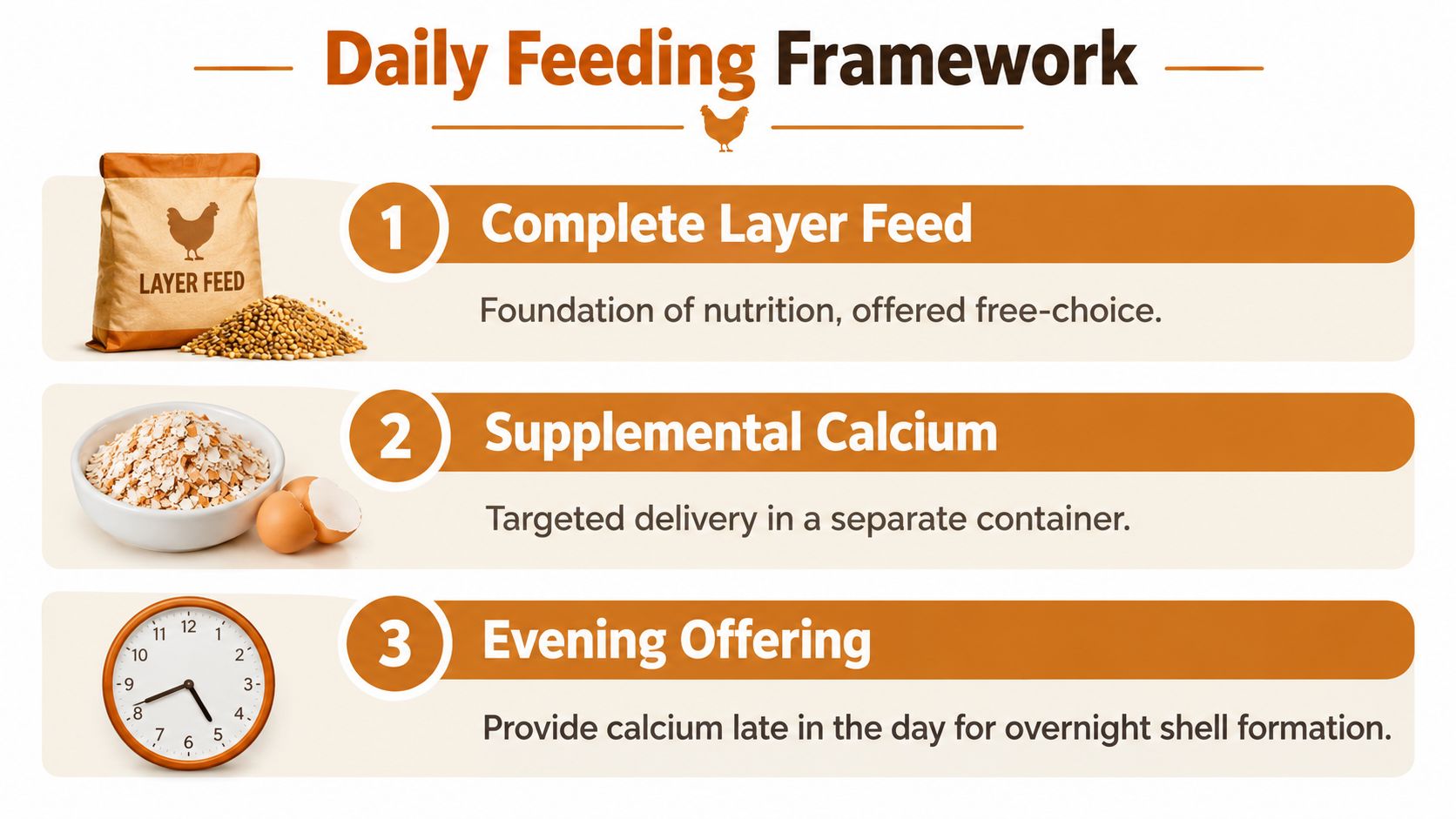
The visual below separates the foundation, the targeted supplement, and the timing check.
Make the routine observable
- Morning: Check the complete feed, drinking water, and access for quieter hens.
- Afternoon: Inspect any separately offered poultry calcium and follow its directions. Don't interpret late-day availability as a reason to give an extra dose.
- Treat time: Measure the offering consistently and observe whether hens still eat their main ration.
- Egg collection: Log unusual shells, breakage, and the likely hen.
- Before roosting: Note birds that have eaten poorly or appear unwell.
Introduce changes deliberately rather than changing feed, calcium, and treats together. Otherwise, you won't know which adjustment affected intake or shell appearance.
Feeding habit: Keep enough detail that another keeper or your veterinarian could understand what the birds actually received.
For general background on skeletal nutrition, you can browse calcium benefits for bones at Vitamin Planet. Human calcium guidance isn't a dosing guide for hens; poultry decisions belong with the ration's instructions and appropriate professional advice.
Three Myths That Quietly Damage Shell Quality
Enthusiasm for a natural supplement can outrun the information needed to use it. These assumptions deserve particular caution.
More calcium always produces stronger shells
More isn't automatically better. A review of extended laying-period nutrition reports improved shell measures when dietary calcium rose from 3.5% to 4%, but increased breakage and some cessation of laying at 4.5%, as discussed in the recent review and laying-hen research on eggshell calcium.
Those findings aren't a universal backyard dosing threshold. They show why an uncalculated addition can be counterproductive, and why the complete diet matters more than the supplement's headline concentration.
Action: Review the existing ration before adding more mineral.
Homemade eggshell powder is automatically safe
Washing and heat treatment address preparation concerns, but they aren't heavy-metal tests. A contamination analysis describes lead accumulation in eggshells and lead substitution for calcium during shell formation in its assessment of eggshell environmental contamination.
That doesn't mean every household shell is hazardous. It means boiling or baking can't establish that an unknown shell source is contaminant-free.
Action: Avoid unknown or potentially contaminated sources, prevent fecal contamination, and use a poultry-appropriate preparation method rather than relying on a casual grinding tutorial.
Natural and clean mean the same thing
Natural describes an origin, not a safety result. A familiar-looking ingredient can still come with unanswered questions about handling, composition, and environmental exposure.
- Ask about sourcing: Can the supplier explain where the material originated?
- Ask about controls: What microbial and contaminant checks apply?
- Ask about the batch: Does testing relate to the material you're buying?
Action: Favor documented specifications and relevant testing over reassuring package language. You're feeding hens whose eggs may reach your family's table, so traceability deserves the same attention as calcium content.
Putting It All Together for Your Flock
A sensible eggshell calcium supplement decision starts with the flock, not the shopping cart. If your hens already receive an appropriate ration, the next step is to identify a specific feeding or delivery gap rather than layering on ingredients.
Use a calm review to decide whether you need a different product, a clearer routine, or veterinary help.
Run the checks before changing the program
- Base feed: Can you identify the ration, read its mineral declaration, and describe actual consumption?
- Egg pattern: Is the problem recurring, flock-wide, or associated with a particular bird?
- Calcium form: Does the supplemental ingredient match the delivery concern and carry poultry-specific directions?
- Treat purpose: Does the treat have a defined role, and are you keeping it distinct from the balanced ration?
- Source confidence: Can you obtain composition, handling, and testing information?
If you can't answer the first question, begin there. Buying another supplement won't make an unknown diet easier to calculate.
Make tomorrow's adjustment modest
Photograph your feed and supplement labels. Watch the flock during feeding, clean and check the relevant containers, and start a shell-quality log.
Choose an adjustment you can explain: restoring access to the main feed, measuring treats consistently, or asking a professional whether the calcium form is appropriate. Avoid changing several inputs at once, and don't postpone veterinary care for a bird that appears unwell.
Keep expectations realistic. A suitable calcium ingredient can be part of a sound program without being the answer to every cracked egg.
The goal is dependable nutrition and useful observations, not the largest calcium offering. When you know what the hens receive, what they consume, and which birds are struggling, you can make a much more precise decision about eggshell powder, coarse mineral calcium, or a complementary insect feed.
Pure Grubs offers USA-grown dried black soldier fly larvae as a complementary treat for chickens. Visit Pure Grubs to review its insect-feed options and consider how they fit alongside your flock's complete ration and targeted calcium program.