

Ducks and Waterfowl Care: A Complete Feeding Guide
You're standing in the feed aisle with a bag of crumble in one hand, a scoop of scratch grain in the other, and a flock at home that seems happy enough. Then you notice the choices: starter feed, grower pellets, layer ration, dried insects, peas, oats, and treats labeled for chickens. Which one belongs in the feeder, and which one belongs only as an occasional reward?
Good care for ducks and waterfowl starts with a better question than “What do ducks eat?” You need to ask what your birds are doing right now. Are they growing, laying, molting, breeding, foraging, or maintaining body condition through cold weather? Their feed, water, calcium access, and habitat should change with those demands.
This guide translates nutrition and waterfowl management into practical decisions for the feed store, brooder, pond edge, and backyard enclosure. You'll learn how balanced feed works, where Black Soldier Fly Larvae (BSFL) fit, why calcium belongs with layers rather than ducklings or drakes, how pond conditions influence health, and why species and regional habitat can change what “healthy” looks like.
What Every Duck and Waterfowl Keeper Needs to Know
At the feed store, the right bag often depends less on the brand and more on the flock standing in your yard. A brooder full of fast-growing ducklings needs a different ration from a group of laying females. A drake sharing the same enclosure as layers creates another complication, because a feed designed for eggs may provide more calcium than his body needs.
Ducks aren't small chickens with waterproof feathers. They grow differently, use water constantly, and have distinct nutritional needs, including careful attention to protein, niacin, calcium, and phosphorus. They also turn almost any wet area into a muddy feeding station, which means nutrition and habitat management are connected from the start.
The questions behind the feed bag
A first-time keeper usually needs answers to practical questions:
- What belongs in the main feeder? A complete waterfowl, gamebird, or otherwise appropriate poultry ration should supply the nutrient balance that scratch grains and kitchen scraps can't provide alone.
- Can treats improve the diet? Insects, peas, leafy greens, and other foods can add variety, but they should remain supplements rather than replace complete feed.
- When does calcium become important? Laying females have a much greater need for eggshell production than growing birds, and excess calcium can harm birds that aren't laying.
- How much does water matter? Ducks need clean water beside dry feed so they can swallow and process it safely.
- Does a pond make the flock healthier? Water supports natural behavior, but stagnant, dirty, or poorly drained areas can create new risks.
The broader picture matters, too. North American survey totals can look stable while individual species and regions move in different directions. The 2026 estimate for total breeding ducks in the major survey area was 33.4 million, similar to the 2025 estimate of 33.9 million and about 6% below the long-term average dating back to 1955 (Ducks Unlimited's waterfowl survey overview). A backyard flock doesn't follow continental averages, but the same lesson applies: don't judge every bird, pond, or season by one headline.
Core Nutritional Needs for Healthy Waterfowl
A healthy ration gives ducks more than calories. It supplies building materials for feathers, muscles, bones, eggs, immunity, and daily movement. The easiest way to avoid nutritional gaps is to make a complete waterfowl or gamebird pellet the foundation, then use treats sparingly.
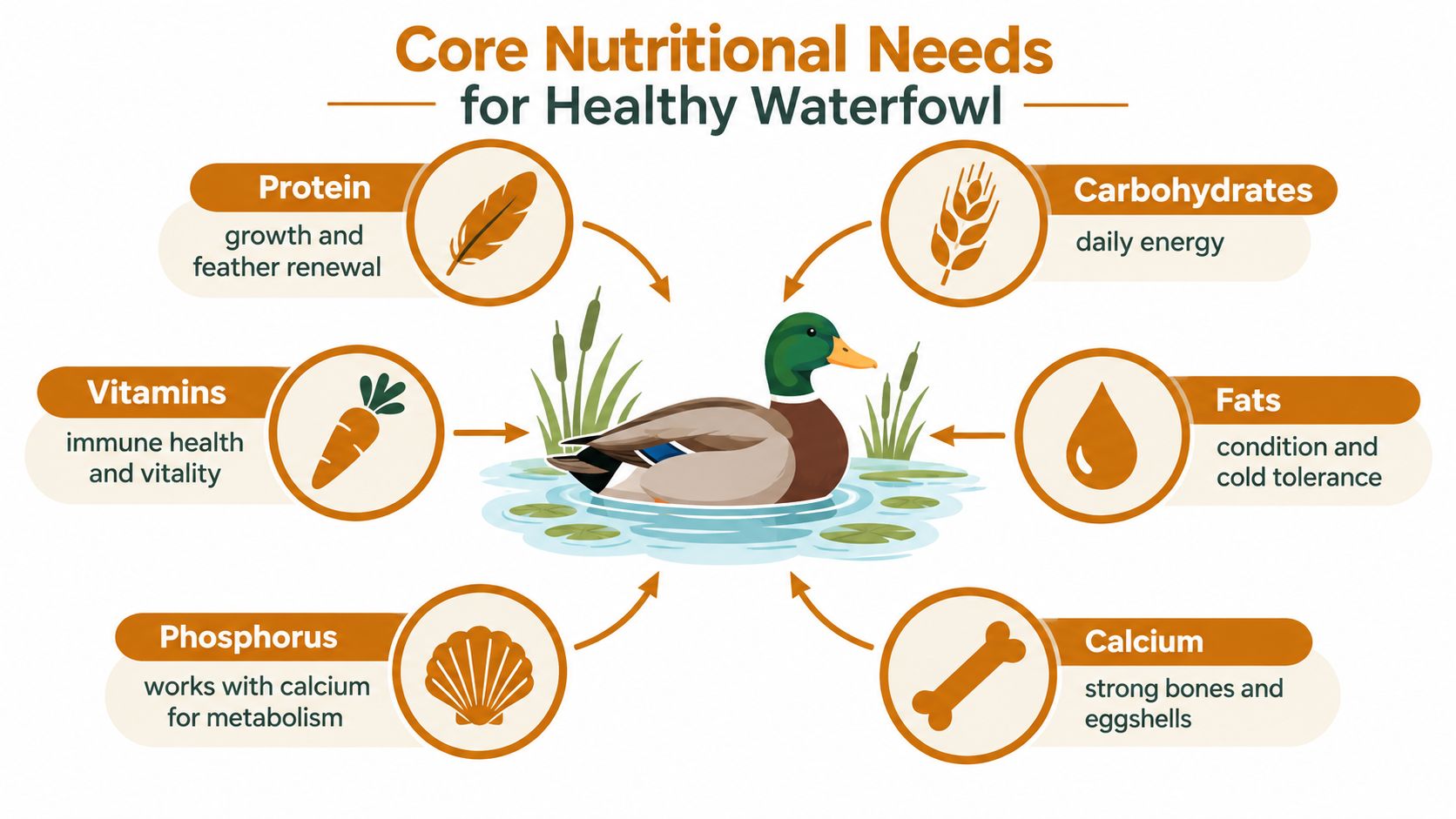
Six jobs your feed must perform
- Protein builds muscle and supports feather growth and renewal. Birds need it during early growth and again during molt, when damaged or old feathers are replaced.
- Carbohydrates provide everyday fuel. Grains are useful energy sources, but grain alone lacks the complete nutrient profile a growing or laying duck needs.
- Fats help maintain body condition and provide concentrated energy, particularly during cold weather or physical stress.
- Calcium and phosphorus work together for bones, metabolism, and eggshells. Think of calcium as the concrete in an eggshell. Laying ducks require markedly more dietary calcium than growing ducks, with breeder and layer diets commonly placed around 2.7% to 3.1% calcium in the referenced nutrition guidance (Waterfowl Nutrition).
- Niacin supports normal leg and skeletal development. It's a nutrient ducklings need careful attention to because ducks are more vulnerable to deficiency than chickens. A complete ration helps prevent the hidden gaps that appear when keepers rely heavily on scratch or bread.
- Vitamins A, D, E, and B-complex support immune function, bone development, reproduction, and general vitality.
Practical rule: Dry feed and clean water belong beside each other. Ducks use water to swallow feed, and a dry feeder without nearby water creates an avoidable management problem.
Bread, seed-only mixes, and scratch grains may be attractive to ducks, but they dilute the nutrients in a complete ration. A handful of grain can be a useful reward. It shouldn't become the meal.
Where insect treats fit
Insect treats can contribute protein, fats, and minerals, but they're still treats. For example, USA GROWN BLACK SOLDIER FLY LARVAE FOR CHICKENS are listed with 36% to 42% crude protein, 30% to 40% fats, and a calcium content described as 75 times higher than mealworms in the catalog snapshot. Those figures make BSFL an interesting supplemental option for ducks, especially during molt or for laying females, but they don't turn a treat into a complete feed.
For a closer look at how insect nutrition fits poultry feeding, see this explanation of BSFL nutritional value. Offer small portions, watch body condition, and keep the complete ration in charge of the diet.
Best Treats for Ducks and Waterfowl Compared
Treats work best when each one has a job. A protein-rich insect can support a molting bird, while peas add moisture and plant protein. Corn supplies energy, but it shouldn't crowd out the minerals, amino acids, and vitamins in complete feed.
The table below uses the catalog information supplied for BSFL and qualitative descriptions for the other common treats. Exact nutrient values vary by product, preparation, and moisture content, so treat the categories as decision guidance rather than laboratory guarantees.
Comparing common treats for ducks and waterfowl
| Treat | Protein | Fat | Calcium Contribution | Best Use |
|---|---|---|---|---|
| Black Soldier Fly Larvae | High, catalog-listed at 36% to 42% crude protein | Rich, catalog-listed at 30% to 40% | High relative to mealworms, according to the product snapshot | Supplemental protein for molt, laying support, or training |
| Mealworms | Protein-rich, but composition varies | Moderate, product-dependent | Lower than the referenced BSFL comparison | Occasional training reward |
| Earthworms | Natural animal protein | Variable | Useful but inconsistent | Foraging enrichment and small treats |
| Peas | Moderate plant protein | Low | Limited | Moist treat for active birds and warm or cold-weather enrichment |
| Leafy greens | Low | Low | Depends on the green | Variety, pecking enrichment, and hydration |
| Cracked corn | Low compared with complete feed | Energy-dense | Poor as a primary mineral source | Small cold-weather or recall reward |
| Oats | Moderate, depending on form | Moderate, product-dependent | Limited | Mixed into treats in modest amounts |
| Watermelon and similar kitchen scraps | Low | Low | Minimal | Occasional hydration-rich reward |
BSFL offer a particularly useful combination for keepers who want a treat with both protein and calcium. They're still not a substitute for a layer ration, and they shouldn't be used as the sole calcium strategy.
Match the treat to the bird
Ducklings benefit most from a complete starter diet, not a large bowl of treats. Growing birds can receive tiny amounts of greens or insects after they're eating their main ration reliably. Laying females can make better use of calcium-rich supplemental treats, but their primary support should come from a properly formulated layer or breeder feed and appropriate calcium access.
Cracked corn, oats, and fruit are better reserved for enrichment or training. If a treat makes the flock ignore its regular ration, the portion is too large or too frequent.
For more ideas that keep treats in their proper role, use this guide to the best treats for ducks. A sensible rule is to keep treats to no more than 10% of daily intake, as specified in the feeding brief. The exact scoop depends on bird size and the amount of complete feed consumed, so judge portions by the flock's appetite, body condition, and regular feed intake.
Life Stage Feeding from Duckling to Layer
A duckling, drake, and laying hen may share a pen, but their feed needs differ. Young birds are building bones and feathers, laying females are producing eggshells, and drakes need maintenance rather than a high-calcium reproductive ration.
Calcium makes the difference easy to see. Layer and breeder diets are generally around 2.7% to 3.1% calcium, while starter and grower diets use much less, as noted in Waterfowl Nutrition. That contrast is deliberate. A growing duckling or nonlaying male should not receive layer feed as its everyday ration.
Waterfowl feed by life stage
| Life Stage | Protein % | Calcium % | Feed Type | Key Caution |
|---|---|---|---|---|
| Duckling starter | 18% to 20% | Lower than layer feed | Waterfowl or gamebird starter | Do not use layer feed |
| Grower | Brand-dependent, follow the grower label | Lower than layer feed | Grower ration | Watch niacin and leg development |
| Layer or breeder | Brand-dependent, follow the layer label | About 2.7% to 3.1% | Layer or breeder ration | Best suited to actively laying females |
| Drake maintenance | Brand-dependent, follow the maintenance label | Avoid unnecessary high-calcium feed | Maintenance or mixed-flock ration | Limit long-term access to layer feed |
Ducklings under eight weeks should be kept away from layer feed. Its calcium load can contribute to kidney and bone problems. Drakes that eat layer rations for extended periods also receive unnecessary minerals, including the risk of organ calcification described in the feeding guidance.
Make the transition based on the bird
Begin with an appropriate starter ration, then follow the label's grower transition instead of changing feed because a calendar date arrives. Fast-growing meat breeds need close attention to niacin. Weak legs or poor mobility can become serious welfare problems quickly.
Move females to layer or breeder feed when they begin laying, rather than relying on an assumed age. In a mixed flock, separate feeding areas may prevent the wrong birds from eating the wrong ration. Provide calcium for actively laying females, while keeping ducklings and drakes from making oyster shell or high-calcium layer feed their main food.
A practical starting point for young birds is this guide on what to feed baby ducklings. Muscovies, Pekins, and Call ducks differ in growth rate, body size, and activity. Check the ration label, watch body condition, and ask an avian veterinarian or experienced breeder when your flock does not fit the usual pattern.
Habitat and Health Essentials for Waterfowl
A good feed program can't compensate for a wet, dirty, overcrowded enclosure. Ducks splash, soil water, and carry mud into bedding, so their habitat needs deliberate separation between drinking, bathing, resting, and feeding areas.
Start with water access that matches the bird's age. Ducklings need a shallow splash area where they can clean their bills and explore without entering water deep enough to exhaust or chill them. Adult birds can use deeper bathing water, but the pond or tub should have an easy exit so tired birds don't become trapped.
Design the enclosure around health outcomes
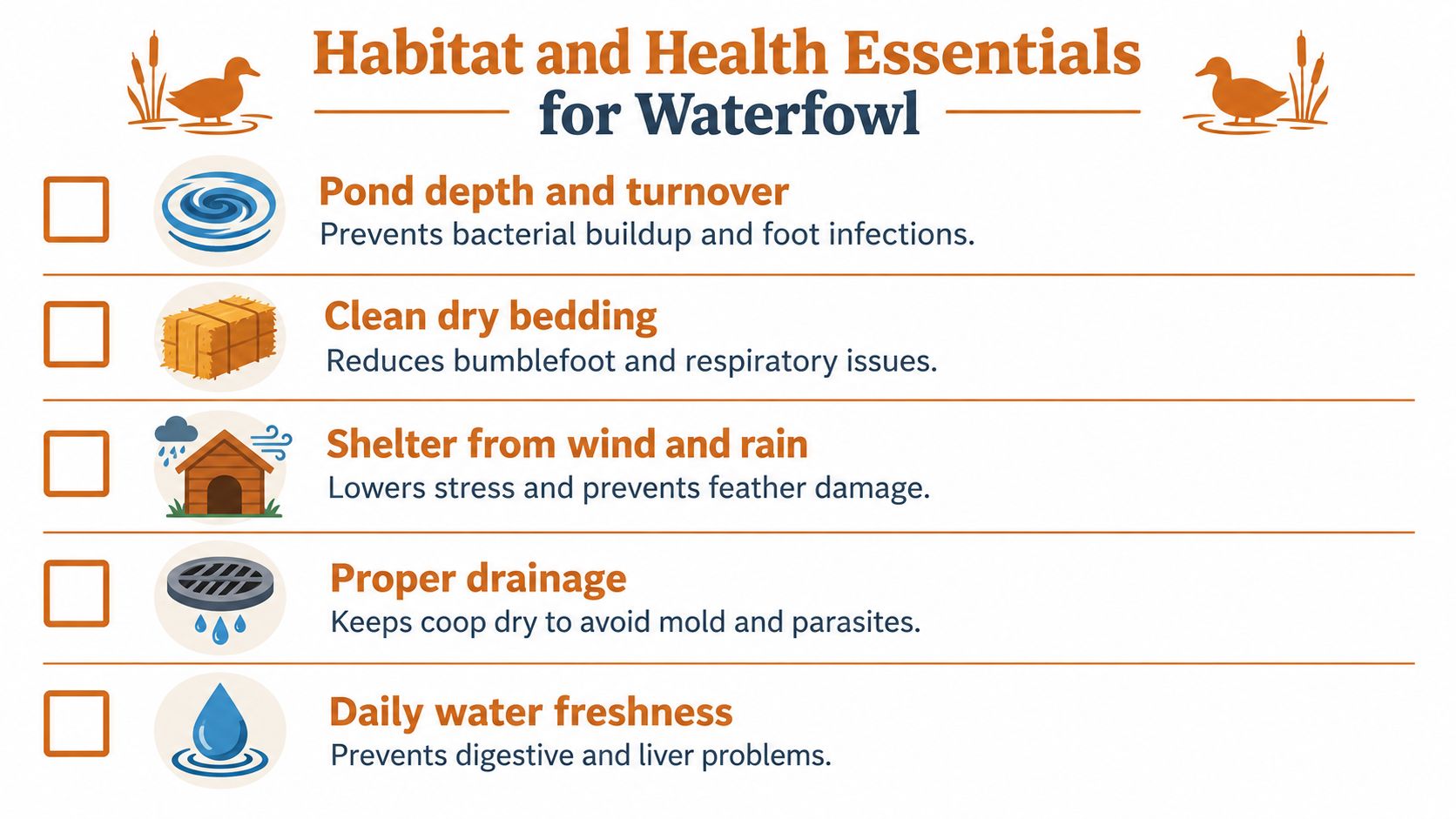
- Use water that stays fresh. Replace drinking water when it becomes fouled, and clean containers before algae, slime, or feed buildup develops.
- Provide dry resting ground. Raised or well-drained bedding reduces prolonged foot exposure to manure and moisture, which helps limit foot lesions and bumblefoot.
- Ventilate without creating drafts. Air exchange removes moisture and ammonia, while shelter protects birds from direct cold wind and rain.
- Manage pond turnover and drainage. Stagnant water and accumulated organic matter deserve immediate attention. A pond should have a cleanable edge and a way for birds to leave the water comfortably.
- Separate new arrivals. Quarantine newcomers before mixing them with the established flock, and clean tools, footwear, and feeders between groups.
Add minerals with purpose
Grit supports mechanical digestion when birds consume whole grains, greens, or forage. Oyster shell supplies calcium, but it should be offered in a way that lets actively laying females choose it rather than forcing high calcium on ducklings or drakes. Keep both stations clean and dry, and don't assume a mineral dish fixes an otherwise incomplete ration.
A weekly inspection catches small problems before they become flock emergencies. Look at eyes for discharge, feet for swelling or sores, the vent for stuck droppings, feathers for parasites or damage, and droppings for unusual changes. Check appetite and movement at the same time. A duck that isolates itself, stops eating, or struggles to walk needs prompt veterinary attention.
Clean water, dry bedding, and early observation prevent more trouble than a cupboard full of emergency supplements.
Why Drought and Habitat Loss Matter to Your Flock
A flock can look normal while its environment becomes less forgiving. Regional surveys show why population headlines need context. The 2025 May pond estimate fell to 4.2 million, a 19% decline from 2024 and the lowest estimate since 2004, even though total breeding ducks remained roughly flat at about 34 million (Ducks Unlimited's 2025 duck numbers report). Stable totals can hide a weaker wetland pipeline.
For backyard keepers, less water can mean fewer insects and plants for natural foraging, more crowding around the remaining wet areas, and heavier reliance on purchased feed. As ponds shrink, organic material and droppings become concentrated. That makes water hygiene, drainage, and access to clean drinking water more important, not less.
Wild waterfowl also respond to changing habitat. Drier breeding areas can alter where birds stop, forage, and raise young. Loss of nesting cover can reduce shelter, while crowded water sources may increase competition and aggression. Those outside pressures don't automatically make a domestic flock sick, but they can expose weak points in a poorly managed enclosure.
Build a buffer at home
Monitor your pond level, water clarity, odor, mud depth, and bird behavior. If ducks spend all their time in one stagnant corner, move drinking water away from the bathing area and rotate access where possible. Planting drought-tolerant vegetation and improving drainage can protect the ground around the coop while reducing irrigation demands. A practical resource on ways to save water and money on landscaping can help you choose lower-water planting strategies around the enclosure.
Don't wait for a drought warning to make changes. Provide shaded resting space, maintain a clean backup waterer, protect forage areas from being stripped bare, and reduce stocking pressure when the available ground can't recover.
Species-Specific Tips for Common Ducks and Waterfowl
Breed name changes the feeding conversation. A heavy Pekin and an active Indian Runner may share a pond, but they don't use energy in the same way. Ornamental goals also call for different portion control than a flock selected for eggs, meat, or sustained outdoor foraging.
Common ducks and waterfowl compared
| Species | Primary Use | Feed Focus | Key Care Note |
|---|---|---|---|
| Pekin | Meat and eggs | Controlled portions with complete feed | Heavy bodies need careful weight management to reduce mobility problems |
| Rouen | Meat and eggs | Balanced ration with portion awareness | Watch body condition and leg comfort |
| Indian Runner | Eggs and active foraging | Lower-energy maintenance when forage is abundant | Provide room to move and search for food |
| Khaki Campbell | Egg production and foraging | Complete layer support once actively laying | Monitor condition during sustained production |
| Call duck | Ornamental | Appropriately sized feed and access to grit | Small bodies can be overwhelmed by large feed pieces |
| Muscovy | Meat, eggs, and quiet homestead flocks | Adequate protein during molt and growth | Their leaner profile doesn't remove the need for complete nutrition |
| Toulouse goose | Grazing and ornamental or utility use | Pasture and controlled supplemental feed | Needs grazing space and protection from muddy buildup |
| Chinese goose | Grazing, alerting, and ornamental use | Forage-centered management | Provide pasture without letting it become depleted |
| Sebastopol goose | Ornamental | Complete feed plus carefully managed grazing | Long feathers need clean, dry resting areas |
| Swans | Pond-based ornamental or wildlife setting | Species-appropriate professional guidance | Their size, behavior, and habitat needs differ substantially from ducks and geese |
Pekins and Rouens can gain excess weight when treats are freely available. Portion the complete ration, limit corn-heavy rewards, and watch how easily each bird walks, rises, and reaches water. Indian Runners and Khaki Campbells often spend more time moving and foraging, but active behavior doesn't justify a seed-only diet.
Call ducks need feed that fits their smaller bills and bodies. Muscovies may appear quiet and lean, yet they still need adequate protein during growth and molt. Geese generally make greater use of pasture than ducks, while swans require specialized planning rather than a simple extension of duck care.
Before buying birds, speak with a local breeder, waterfowl club, or avian veterinarian familiar with the breed. Ask about mature size, temperament, common leg issues, seasonal feed changes, and whether your available pond and pasture can support the flock.
Your Waterfowl Care Checklist
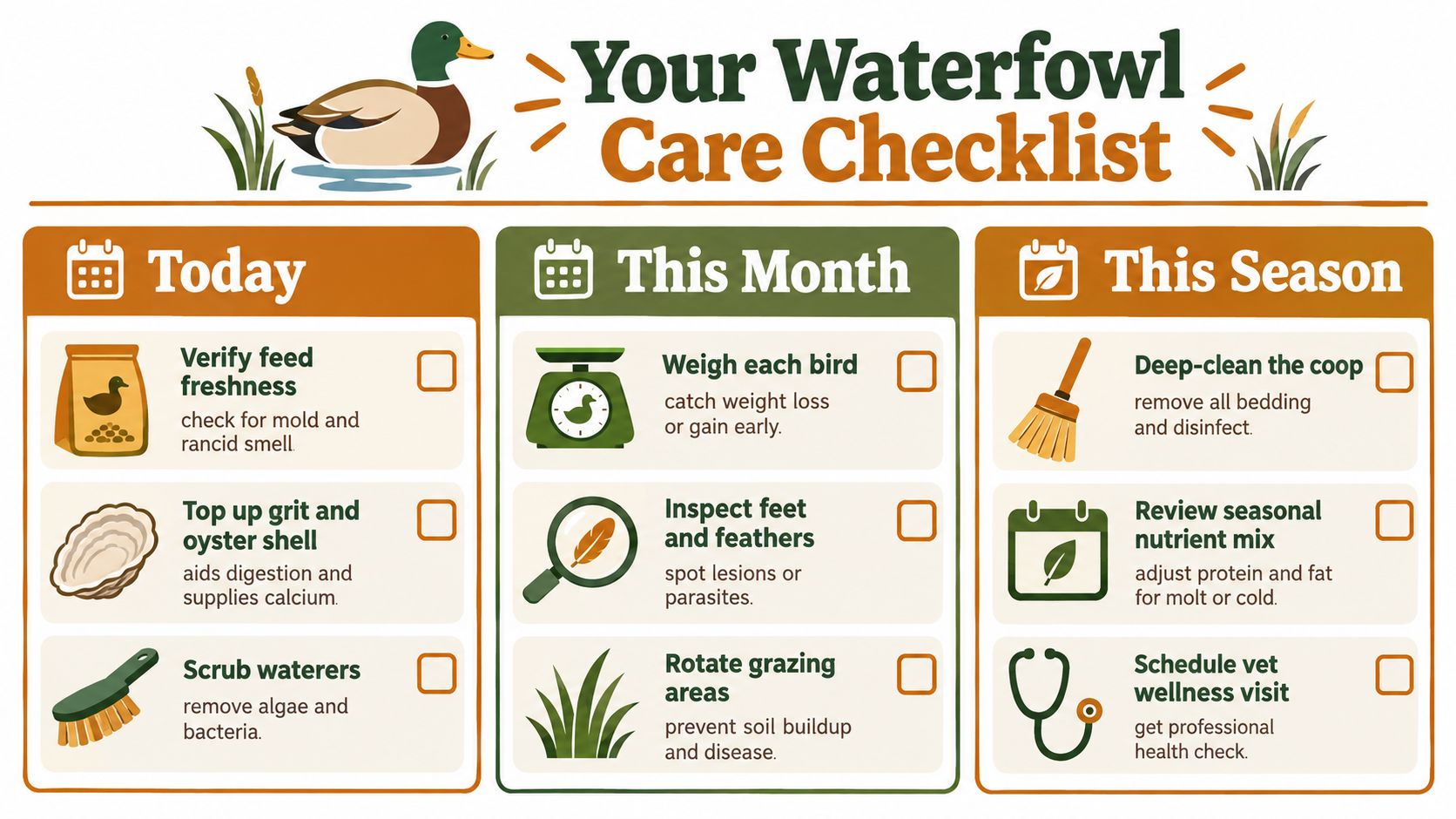
Healthy waterfowl care comes from repeatable routines, not dramatic fixes. Use this schedule to turn nutrition, habitat, and observation into tasks you can verify.
Today
- Check feed freshness: Look for mold, dampness, insects, or a rancid smell before filling the feeder.
- Refresh minerals: Top up grit and offer oyster shell where actively laying females can access it.
- Scrub waterers: Remove algae, slime, bedding, and feed residue, then refill with clean water.
- Inspect access: Make sure ducklings can leave splash water easily and adult birds can reach dry shelter.
This month
- Weigh each bird: Record body weight or body condition so gradual loss or gain doesn't go unnoticed.
- Inspect feet and feathers: Check for sores, swelling, broken feathers, parasites, or reluctance to walk.
- Review droppings and appetite: Note unusual changes and isolate birds that appear ill while contacting a veterinarian.
- Rotate grazing areas: Give heavily used ground time to recover before mud and manure accumulate.
This season
- Deep-clean the coop: Remove old bedding, clean surfaces, and improve drainage before the next weather shift.
- Review the nutrient mix: Adjust the feeding plan for growth, laying, molt, or cold weather, without turning treats into the main ration.
- Check pond resilience: Maintain shaded areas, clean backup water, safe exits, and a plan for dry conditions.
- Reassess flock capacity: Match bird numbers to the forage, shelter, water, and cleaning time you can provide.
A small personal touch can make the routine easier to remember. If you're labeling the enclosure or giving the flock area some character, a custom sign for duck lovers can mark the coop while reinforcing that daily care belongs on the household schedule.
Pure Grubs offers USA-grown, dried Black Soldier Fly Larvae as a supplemental insect treat for ducks, chickens, and other birds, with catalog-listed protein, fat, and calcium details suited to careful treat planning. Visit Pure Grubs to review the larvae options, then choose a portion that supports your flock without replacing complete waterfowl feed.