

Comida De Gallina Ponedora: A Guide to Better Eggs
If your hens are laying soft shells, thin shells, or eggs that crack in the basket, the problem usually isn't the nest box. It's what's going into the feeder, and more specifically, whether that feed can keep up with the hen's daily mineral drain. Good comida de Gallina Ponedora is less about stuffing birds with calories and more about matching the biology of shell building.
That difference matters because an egg isn't a casual byproduct. It's a mineral transfer, a protein transfer, and a timed construction project that happens inside a living bird while she's still eating, drinking, and moving around the yard.
Understanding the Connection Between Nutrition and Egg Quality
A keeper often notices the problem before the labels on the feed bag tell the truth. The flock looks active, the bowls are empty at the right time, and then the egg basket starts filling with shells that feel flimsy in the hand. That's usually the point where nutrition stops being an abstract idea and becomes a daily reality.
A laying hen doesn't just “make eggs.” She pulls minerals out of her diet, moves them through her body, and packages them into shell, white, and yolk. When that supply line is short, the shell is usually the first place the problem shows up.
What the egg is really taking from the hen
The practical mistake is treating feed like a fuel source only. Layer feed has to do more than keep a bird alive, it has to support repeated shell construction, feather upkeep, and the constant turnover that comes with active laying. That's why comida de Gallina Ponedora is a maintenance tool, not just a meal.
A shell that comes out weak is rarely a mystery. If the hen doesn't have enough usable mineral at the right time, the egg still gets laid, just with a less reliable outer layer. In the coop, that means more cracks, more soft spots, and more waste.
Practical rule: Don't judge a layer diet by how full the feeder looks. Judge it by the shells you collect and the consistency of the eggs over time.
The best keepers read the egg before they read the feed bag. If shells are improving, the ration is doing its job. If they're not, the diet is asking the hen to do more than her feed can support.
The Core Nutritional Demands of Laying Hens
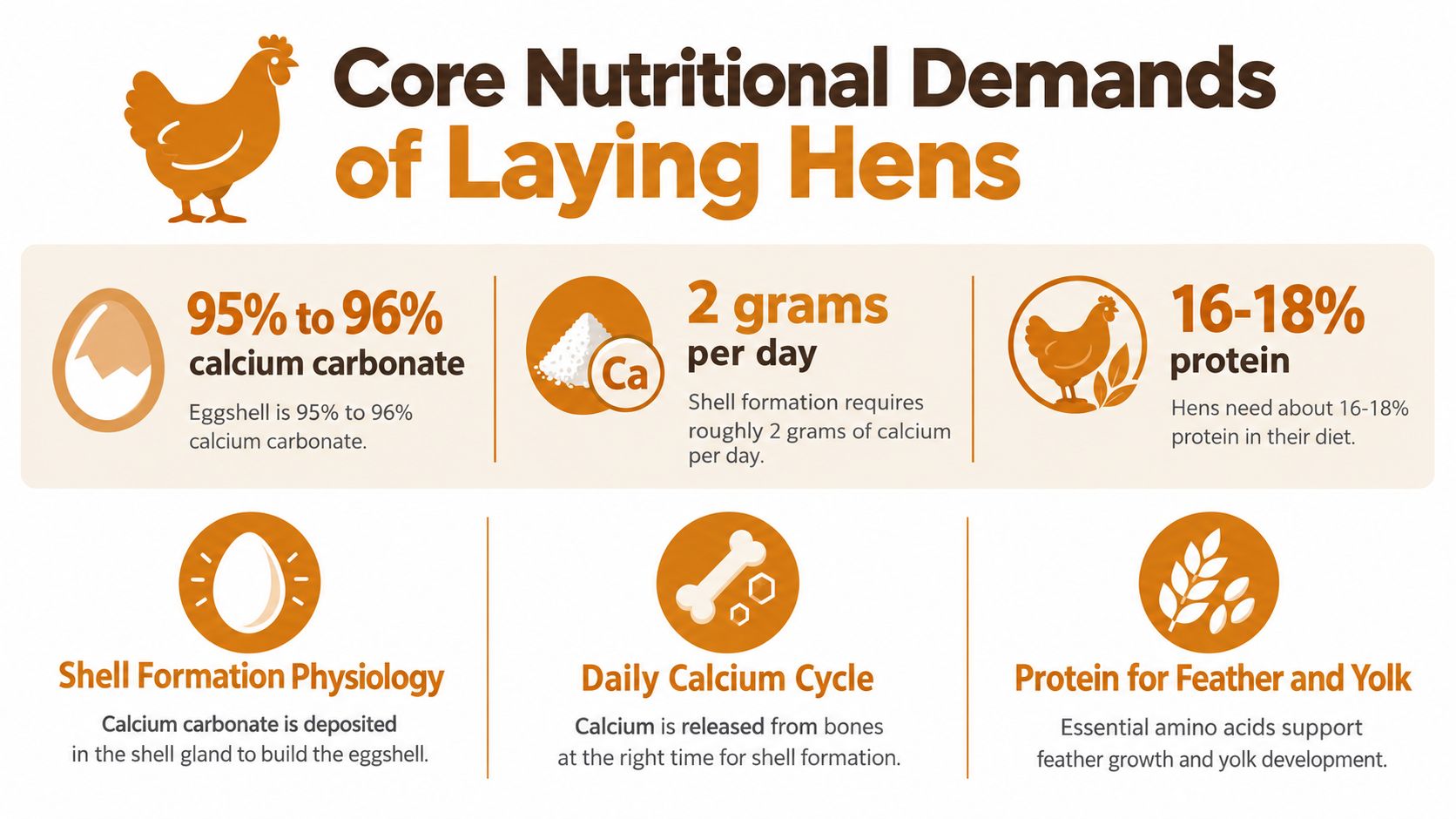
A hen can empty the feeder on schedule and still struggle to produce a sound shell. Shell formation uses a large mineral supply: the shell is about 95% to 96% calcium carbonate, and a layer needs roughly 4 grams of calcium intake per day because only about 50% to 60% of dietary calcium is used in shell formation (The Poultry Site). The ration must deliver usable calcium consistently, not merely contain a high number on the label.
Why timing matters as much as total intake
The shell takes roughly 20 hours to form. During that period, the hen must deposit about 25 mg of calcium every 15 minutes (UF IFAS). That is a continuous demand. A bowl filled once in the morning cannot compensate for calcium that is poorly absorbed, unavailable at the right time, or consumed in an unbalanced ration.
Layer diets commonly provide about 3.0% to 4.0% calcium and 0.35% to 0.50% phosphorus. Those figures reflect the daily work of shell formation, and the two minerals must remain balanced. Calcium source and feeding pattern therefore matter alongside total intake.
For keepers testing insect-based ingredients, black soldier fly larvae can support the broader protein strategy while offering a scientifically backed, safer alternative to imported insect meals. They do not replace the need to manage calcium, phosphorus, energy, and amino acids, but they can fit into a ration designed around those requirements.
Why older hens often need tighter management
The Merck Veterinary Manual lists typical layer feed intake at about 80, 90, 100, 110, and 120 grams per bird per day across successive life stages. Research on second-cycle hens also found that 4.5% calcium improved eggshell quality and feed conversion per dozen eggs compared with 3.0% calcium.
A hen may be eating enough by volume and still miss the mineral supply required during shell formation. Older birds deserve closer attention to intake, shell condition, and the actual formulation in the feeder.
Evaluating Commercial Feed Bases and Protein Sources
Commercial layer feed used to mean a narrow set of choices, and many keepers still think in those old categories. Soy and fish meal have been common standards for a long time, but the better question isn't just what protein source is traditional. It's what that protein source does for the bird once it's in the trough.
Layer feed has to support feather replacement, body maintenance, and egg output without making the flock sluggish or inconsistent. That's where source matters. Two feeds can list similar crude protein on the tag and still behave very differently in the coop.
Why crude protein on its own is a weak guide
Protein percentage tells you almost nothing about how the bird will use it. Digestibility, amino acid balance, and how the ingredient interacts with the rest of the ration all shape the result. A keeper who has watched hens do well on one feed and stall on another has seen that difference firsthand, even if the label looked similar.
For a practical overview of how protein content gets discussed in poultry rations, see this internal guide on poultry feed protein content. The useful lesson is simple. Feed is a system, not a single nutrient number.
Where newer protein options fit
Recent insect-based ingredients have changed the discussion because they can contribute protein in a form that birds work with well. The case for them isn't just novelty. It's that they bring a different nutritional matrix, one that may complement a layer ration instead of just padding it.
That said, insect meals aren't interchangeable with every commercial protein source. Some are better suited for treat-level use, some for partial inclusion, and some are more about calcium contribution than raw protein. The right choice depends on what the flock needs most, and what the rest of the ration already covers.
Useful rule of thumb: If a feed choice sounds great on one nutrient and vague on everything else, it probably needs a closer look.
The Research Behind Black Soldier Fly Larvae
A hen can have a sound ration on paper and still produce fragile shells if calcium arrives at the wrong time. Shell formation is a supply problem as much as a total-intake problem. During active formation, the bird may need about 25 mg of calcium every 15 minutes, so the usefulness of an ingredient depends on how it fits the ration and how consistently the hen eats it.
Black soldier fly larvae, or BSFL, bring more to the discussion than novelty. They supply protein and can contribute calcium in a form that fits a layer ration without requiring the entire diet to be rebuilt. BSFL meal can provide about 5% calcium, giving it a different role from many other insect ingredients. The research also supports BSFL as a scientifically backed, safer alternative to imported insect meals, provided the ingredient is used as part of a balanced ration. (Frontiers in Veterinary Science)
What the feeding trials show
In a 210-day trial, 3% defatted BSFL meal improved eggshell thickness compared with the control, while 6% BSFL meal improved eggshell strength. Higher inclusion later increased the feed-to-egg ratio, showing why more insect meal is not automatically better. Shell traits can improve while feed efficiency worsens if inclusion climbs too far.
That trade-off matters in a backyard flock. BSFL works better as a targeted part of the ration than as a blanket replacement for every other protein or mineral source.
Why the form of the ingredient matters
Physical form and intake pattern can change the result. In one line of research, hens given BSF larvae under range-feeding conditions produced eggs with lower shell weight and thickness than controls. Access pattern and the wider diet matrix therefore matter. The hen still has to consume the nutrient consistently and at the right point in the shell-building cycle.
The internal guide to black soldier fly larvae nutrition examines BSFL as a feed ingredient rather than a novelty. That is the practical frame: use the larvae to support ration management, not to replace it.
Practical Feeding Strategies for Optimal Results
A hen can have the right ration on paper and still lay weak shells if feeding is sloppy. The fix is practical: keep the base feed steady, give calcium in a form she can use, and use treats without pushing out the layer ration. That is the daily reality behind comida de gallina ponedora, and it is where a flock often improves or slips.
Build the routine around the shell cycle
Shell formation runs for hours, and the hen needs calcium in small, repeated amounts during that window. The practical issue is timing. A bird can only use what is available when her body is laying down shell material, so steady access matters more than a single heavy serving.
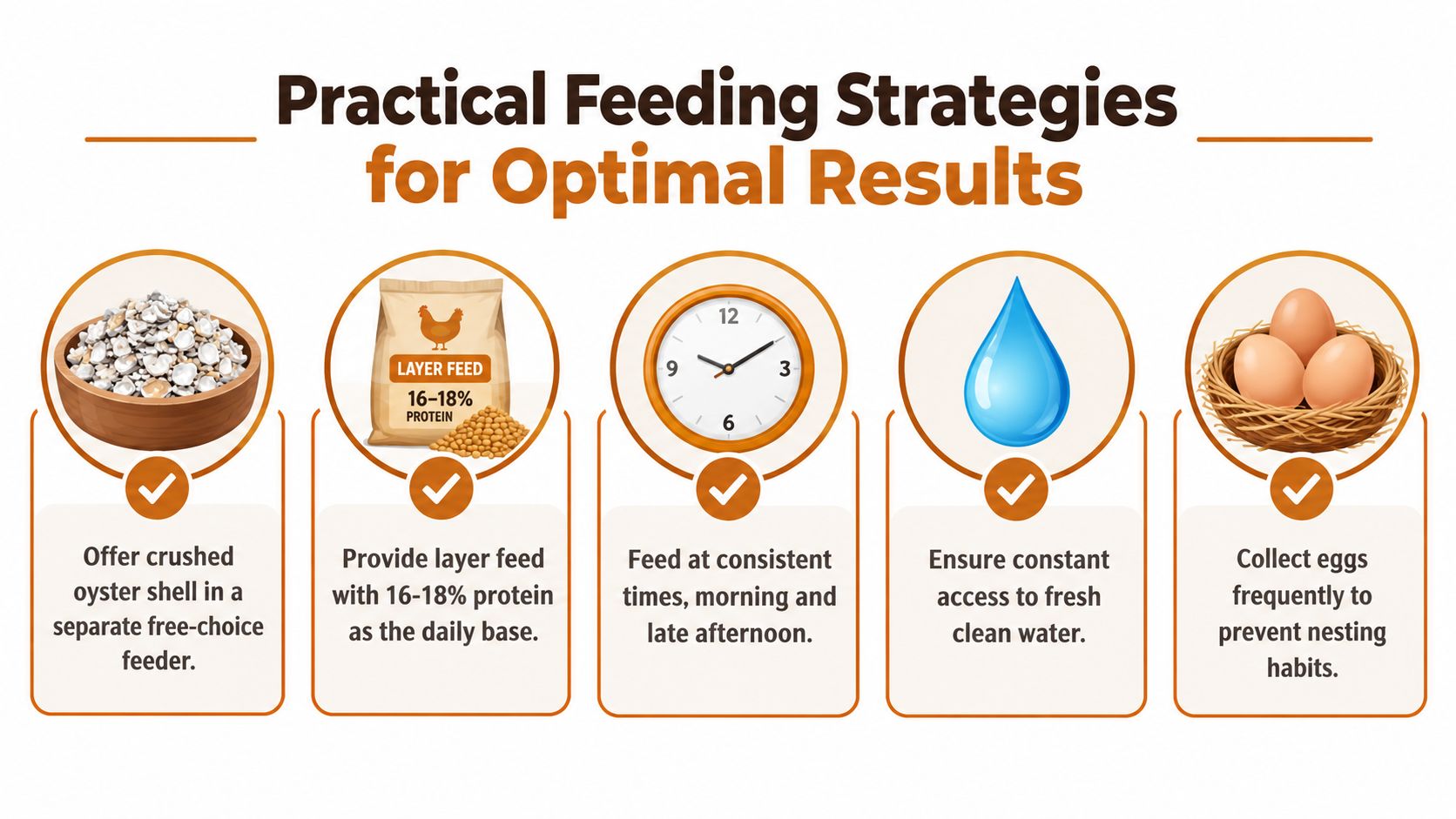
Morning and late-afternoon feeding help keep intake predictable, and fresh water has to be there all day. If hydration drops, feed use drops with it, and that shows up in the egg before it shows up anywhere else.
Grit matters too, especially when birds eat anything beyond a uniform pellet. It helps them break down tougher feed pieces and get more from the ration. Free-choice oyster shell is better than mixing everything together, because hens can take what they need instead of forcing the same intake on every bird.
Use treats without sabotaging the base diet
Insect treats can support the ration, but they still need boundaries. If extras crowd out the layer feed, shell quality often suffers even while the flock seems well fed. Treats should sit beside the base ration, not replace it.
BSFL fits that rule well. Use it as a supplement, not a substitute for a balanced layer feed. That keeps the diet predictable while still giving the flock a useful protein boost. Research on black soldier fly larvae points to a safer path than imported insect meals, as long as the rest of the ration stays in balance.
What the feeding trials show
Trials keep making the same point. A 210-day trial found that 3% defatted BSFL meal improved eggshell thickness compared with the control, while 6% BSFL meal improved eggshell strength. The higher inclusion later raised the feed-to-egg ratio, so more insect meal was not automatically better.
That trade-off matters in a backyard flock. BSFL works best as a targeted part of the ration, not as a blanket replacement for every protein or mineral source.
Keep the simple checks in place
- Offer free-choice oyster shell: Let hens regulate their own calcium intake.
- Keep the base feed consistent: Sudden feed changes often show up first in shell quality and egg size.
- Watch the basket, not the bag: The shell tells you more than a label does.
Why Calcium Source Matters More Than Just Amounts
A lot of feeding advice gets calcium wrong by making it sound uniform. It isn't. A hen doesn't care that calcium exists in the ration if it arrives at the wrong speed, in the wrong particle size, or from a source that doesn't stay available long enough for shell building.
The article on calcium sources for chickens makes the point clearly, and the practical version is easy to see in a coop. Large particles of limestone or oyster shell behave differently from fine powders, because they don't disappear all at once. That slower release is useful when shell formation stretches through the night and early morning.
Why some hens still struggle after supplementation
Many keepers find this part frustrating. They add calcium, yet thin shells persist. The issue often lies not in the idea of calcium, but in the form and timing of the calcium source. Older hens, in particular, can benefit from a better source profile, and trials have shown that 4.5% calcium improved shell quality and feed conversion compared with 3.0% calcium in second-cycle hens (Merck Veterinary Manual).
The practical lesson is to stop asking only “how much calcium?” and start asking “what kind, and when does the hen get it?” That question solves more shell issues than blind supplementation ever will.
How to think about supplements versus structure
A supplement can fix a gap, but it can't repair a sloppy feeding system. If birds are short on water, if the base ration is weak, or if calcium is all packed into one short feeding window, the shell still suffers. The right source works because it fits the hen's biology, not because it's flashy.
For a deeper practical overview, the internal guide on sources of calcium for chickens is worth keeping handy. It lines up with what experienced keepers already know, source and timing matter just as much as the amount on paper.
Bringing It All Together for a Thriving Flock
A good egg program looks simple from a distance, but it only works when the details are steady. Keep the layer feed consistent, give calcium in a form the hen can use, and treat supplemental protein or insect feed as support, not as a way to patch a poor ration. That balance protects shell quality and avoids the common mistake of fixing one gap while creating another.
The mechanic here is continuous supply. Shell formation is not a one-time event, it is a steady process that depends on calcium arriving in small amounts throughout the laying cycle, roughly 25 mg every 15 minutes during shell formation. Layer diets are built to match that ongoing demand, with calcium and phosphorus kept at levels calibrated to the hen's daily output rather than a single feeding moment (The Poultry Site).
What a reliable routine looks like
A reliable routine does not need tricks. It needs feed offered on time, clean water, a separate calcium source, and a protein source that supports the bird without unbalancing the ration. BSFL fit that role well as a supplement, because they add insect nutrition without pretending to replace the base feed.
Ingredient quality still matters. A clean, traceable BSFL source gives you a more controlled option than imported insect meals with uncertain handling or storage. Pure Grubs is one example of a U.S.-grown BSFL option that fits this kind of practical use, because it supplies black soldier fly larvae as a supplemental feed instead of a full ration.
Watch the birds, not the label. Strong shells, fewer cracks, and steadier production tell you the system is working. When the feeding plan matches the hen's real daily demand, the basket usually follows.