

Clean American-Made Black Soldier Fly Larvae for Laying Hens
Imported dried black soldier fly larvae have been found with 25 times more lead and 8 times more arsenic than North American material. That result changes the buying question for laying hens. The issue isn't whether chickens enjoy grubs. They do. The issue is whether the larvae were raised on controlled feedstock, processed safely, and tested before they reached your coop. Food-safety research on black soldier fly larvae shows that origin and production method can materially affect both contamination risk and nutritional consistency.
For backyard flocks, I recommend clean American-made black soldier fly larvae for laying hens whenever the seller can document country of origin, substrate controls, sanitation, and batch testing. BSFL can be a useful calcium-rich supplement, but they're not a replacement for a complete layer ration or a substitute for careful feed sourcing.
Why Origin Matters for Black Soldier Fly Larvae
Black soldier fly larvae are bioaccumulators. In plain English, they can take up substances from the material they eat, including metals such as lead, arsenic, cadmium, zinc, manganese, chromium, iron, and tin. A food-safety review found that both substrate and processing method influenced the larvae's heavy-metal profile, and that blanching reduced microbial contamination while slightly lowering heavy-metal concentrations. The peer-reviewed review also reported a sharp contamination difference between imported Chinese larvae and North American material.
That doesn't mean every imported bag is dangerous or every American bag is automatically clean. It means you shouldn't treat all dried larvae as interchangeable. The producer needs control over the feedstock, a documented kill step, traceability, and laboratory verification. A package that only says “insect meal” or “distributed by” leaves too many important questions unanswered.
What clean sourcing should prove
Look for a supplier that can answer these questions directly:
- Where were the larvae raised? The label should identify the United States or name the domestic farm and production facility.
- What did they eat? “Plant-based diet” is more useful than vague references to organic waste.
- How were they processed? Ask whether the product was washed, heat-treated, or otherwise processed to reduce microbial risk.
- Was the finished batch tested? Request a Certificate of Analysis covering lead, arsenic, mercury, cadmium, and pathogen screening.
AAFCO's Ingredient Definition Committee report from January 2026 lists “Dried Black Soldier Fly Larvae” as an official ingredient definition entry. That standardization matters because laying-hen feed depends on consistent, identifiable ingredients, not novelty products with unclear specifications. A 2025 PubMed-indexed study also concluded that live BSFL could be included at up to 30% of daily feed intake without impairing egg quality, although that finding shouldn't be treated as permission to replace a balanced layer ration with dried treats. See the research comparing USA-sourced and imported larvae before buying.
| Heavy Metal | U.S.-Grown BSFL | Imported BSFL | AAFCO Limit |
|---|---|---|---|
| Lead | Verify by batch | Verify by batch | Verify current standard |
| Arsenic | Verify by batch | Verify by batch | Verify current standard |
| Cadmium | Verify by batch | Verify by batch | Verify current standard |
| Mercury | Verify by batch | Verify by batch | Verify current standard |
The verified research establishes a meaningful origin gap, but it doesn't provide universal “typical ranges” for every U.S. and imported product. A responsible seller should give you the actual batch result rather than asking you to trust a broad country label.
What Black Soldier Fly Larvae Actually Are
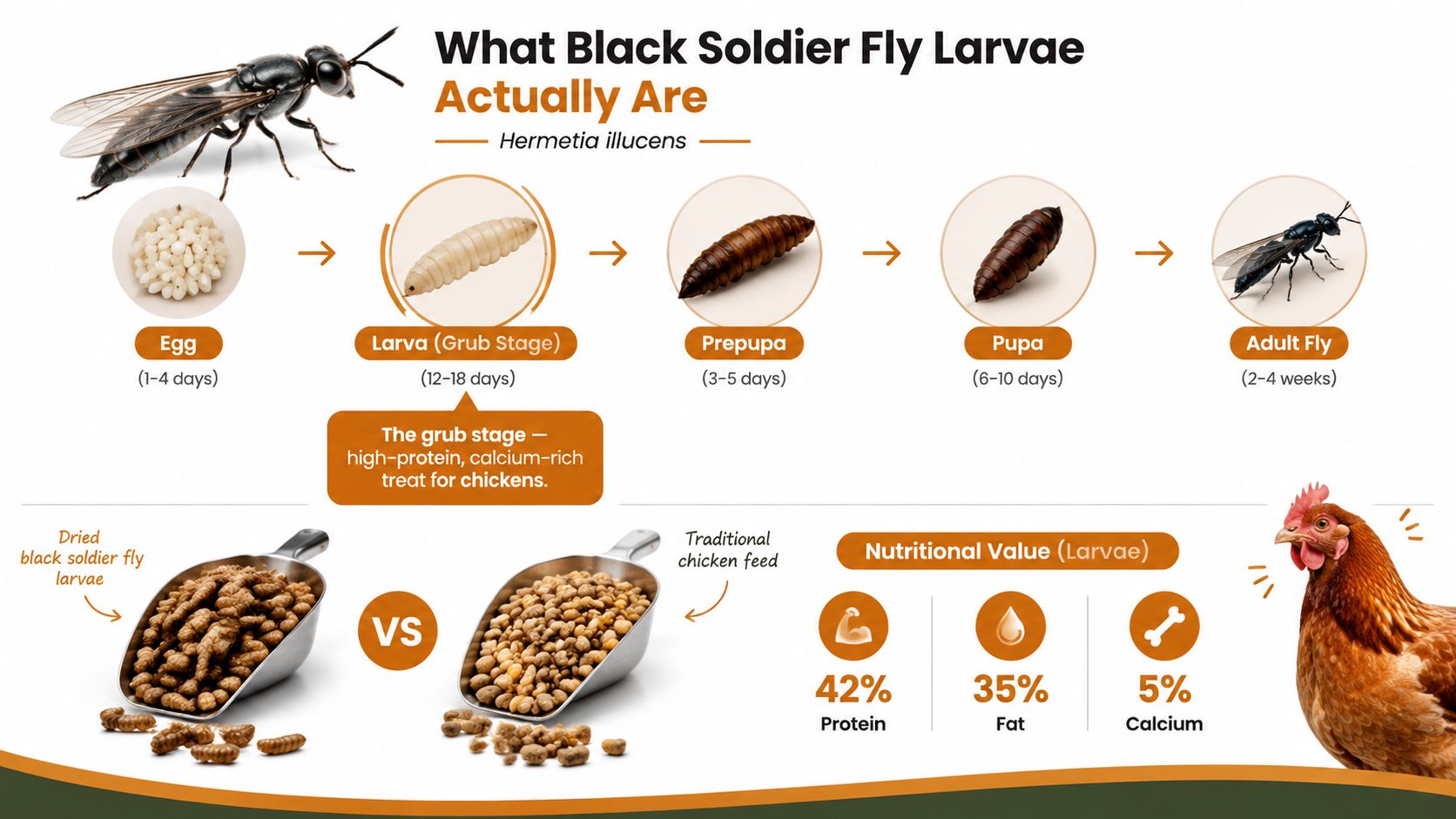
Black soldier fly larvae are the grub stage of Hermetia illucens, a species distinct from pest flies and household maggots. The adult insect doesn't behave like a garbage fly, and commercial larvae aren't collected from refuse. Responsible producers raise them on controlled feed inputs, then harvest the larvae or prepupae before they mature into adult flies.
The life cycle is straightforward: egg, larva, prepupa, pupa, and adult fly. The larval stage is the familiar soft grub, while the prepupa is the stage that moves away from the feeding material to pupate. Drying removes moisture and leaves a tan to light-brown, crunchy treat that resembles a larger, more substantial mealworm.
Why chickens recognize them as food
Hens are natural foragers. They scratch, investigate, and quickly learn which movements or feeding locations produce edible insects. Dried BSFL work like mealworms in that respect, but their practical value for layers comes from their mineral profile as well as their protein and fat.
The USA Grown Black Soldier Fly Larvae for Chickens catalog description identifies whole larvae, a plant-based diet, U.S. production and drying, and the absence of additives, preservatives, and fillers. It lists 36% to 42% crude protein and 30% to 40% fat for that product, while the broader nutritional profile of BSFL can vary with feedstock and processing.
Don't confuse a clean commercial product with larvae raised on random waste. The insect species may be the same, but the production system determines what the finished treat contains. That distinction is the foundation of safe feeding.
Nutritional Benefits for Laying Hens
A laying hen needs more than protein from a treat. BSFL combine protein, fat, and calcium, making them a practical supplement when you choose a controlled product and keep the main ration complete. The listed product provides 36% to 42% crude protein and 30% to 40% fat. Its calcium advantage over mealworms is supported by comparative laying-hen research, although the exact value depends on the larvae product and processing. For a full breakdown of the nutrient profile, see black soldier fly larvae nutrition.
Those nutrients can support feather regrowth during molt, provide energy, and complement calcium already supplied by layer feed and oyster shell. They do not make dried larvae a replacement for a formulated layer ration.
Research on eggs provides a more useful guide than broad claims about “healthy treats.” A 2024 laying-hen study found that adding 2% black soldier fly larvae oil calcium salt significantly increased eggshell weight and thickness. The treatment also improved albumen weight, albumen height, and albumen ratio, while reducing egg fat and cholesterol. Read the study on calcium salt from BSFL oil.
A separate 2024 meta-analysis reported overall improvements in feed efficiency, Haugh units, albumen quality, and eggshell quality among hens receiving BSFL meal. Another poultry study found that eggshell strength increased linearly with BSFL meal, while albumen height and yolk weight remained unchanged. That result supports a specific recommendation: use BSFL primarily for their mineral and shell-support role, not as a promise that every egg trait will improve. Review the laying-hen findings on BSFL meal and shell traits.
| Nutrient | Dried BSFL | Dried Mealworms | Typical Layer Feed |
|---|---|---|---|
| Protein | 36% to 42% in the listed product | Varies by product | Formulated to be complete |
| Fat | 30% to 40% in the listed product | Varies by product | Formulated for the ration |
| Calcium | Substantially more in comparative analysis | Lower in comparative analysis | Balanced for laying hens |
| Vitamins and minerals | Not complete | Not complete | Complete when properly formulated |
The practical limit
BSFL are a supplement, not a complete feed. They cannot replace the balanced vitamins, minerals, amino acids, and energy supplied by a formulated layer ration. Offer measured amounts for variety, during molt, or to encourage active foraging.
The dose still matters. A 2025 study on defatted BSFL meal found no overall decline in egg production or egg weight, with 3% inclusion providing the best balance of eggshell quality and antioxidant status in that trial. Higher inclusion later affected feed-to-egg ratio, so unlimited access is a poor feeding plan. See the PubMed-indexed dose study.
BSFL vs Mealworms for Backyard Flocks
Mealworms remain useful. Most chickens already recognize them, picky pullets often accept them immediately, and their flavor can make them an easy training reward. But for a laying flock, calcium is the deciding advantage, not novelty.
The available product information describes BSFL as offering dramatically more calcium than mealworms, while the research supports BSFL as a useful supplement for shell traits. The exact value depends on the product, substrate, drying process, and whether the comparison uses whole larvae, meal, or a processed calcium salt. Treat “more calcium” as a reason to investigate the label, not as a license to stop offering a complete layer diet.
| Nutrient or Metric | Dried BSFL | Dried Mealworms |
|---|---|---|
| Crude protein | 36% to 42% in the listed product | Varies by product |
| Crude fat | 30% to 40% in the listed product | Varies by product |
| Calcium | Substantially higher than mealworms | Lower than BSFL |
| Calcium-to-phosphorus balance | Product-specific, verify analysis | Product-specific, verify analysis |
| Lysine | Present, amount varies | Present, amount varies |
| Methionine | Present, amount varies | May be slightly higher in some comparisons |
| Price per pound | Varies by seller and package | Varies by seller and package |
My recommendation for a mixed flock
Choose BSFL for laying hens when shell support is the priority. Choose mealworms when immediate acceptance matters more, or keep a small amount of both for enrichment. Neither treat should displace the ration that supplies the flock's daily nutritional foundation.
The research also shows why simple winner-takes-all comparisons are misleading. In one laying-hen trial, low inclusion rates maintained feed intake and survival, while the highest BSFL group improved shell weight, shell weight per unit surface area, and external shell traits by 8.9%, 9.1%, and 1.9%, respectively, versus control. Those results support BSFL as a targeted layer supplement, particularly for older hens with thinning shells, but they don't prove that every dried product delivers the same result.
Feeding Rates and How to Introduce Larvae
Start with 1/4 cup of dried larvae per bird per day as a treat amount, then observe appetite, droppings, body condition, and whether the hens continue eating their layer feed. The provided feeding guide allows an increase of 1/4 cup every two to three days, with a ceiling of 1/2 cup per bird per day, but keep total treats at no more than 10% of daily intake so the flock doesn't fill up on an incomplete food.
A simple first-week routine
- Days 1 and 2: Scatter a small measured portion across clean litter or the run floor. This turns the first serving into a foraging activity rather than a sudden bowl of unfamiliar food.
- Days 3 and 4: Offer the same kind of serving in a shallow dish. If the hens rush it, don't assume they need more. Keep the portion controlled.
- Days 5 through 7: Mix larvae into wet mash or crumble, or add them to a small treat station after the flock has eaten its regular feed.
A hanging bundle can provide enrichment for bored birds, but make sure it doesn't become an unlimited snack source. Pullets under 8 weeks should receive less than mature layers, and young birds should remain on an age-appropriate complete starter or grower feed.
If the flock refuses them
Crush a few larvae over familiar feed, use a wet mash to soften the texture, or scatter them where the hens already scratch. Give the flock time to investigate. If yolks become unusually dark or the birds leave regular feed behind, reduce the treat amount immediately.
Safety, Heavy Metals, and FDA Compliance
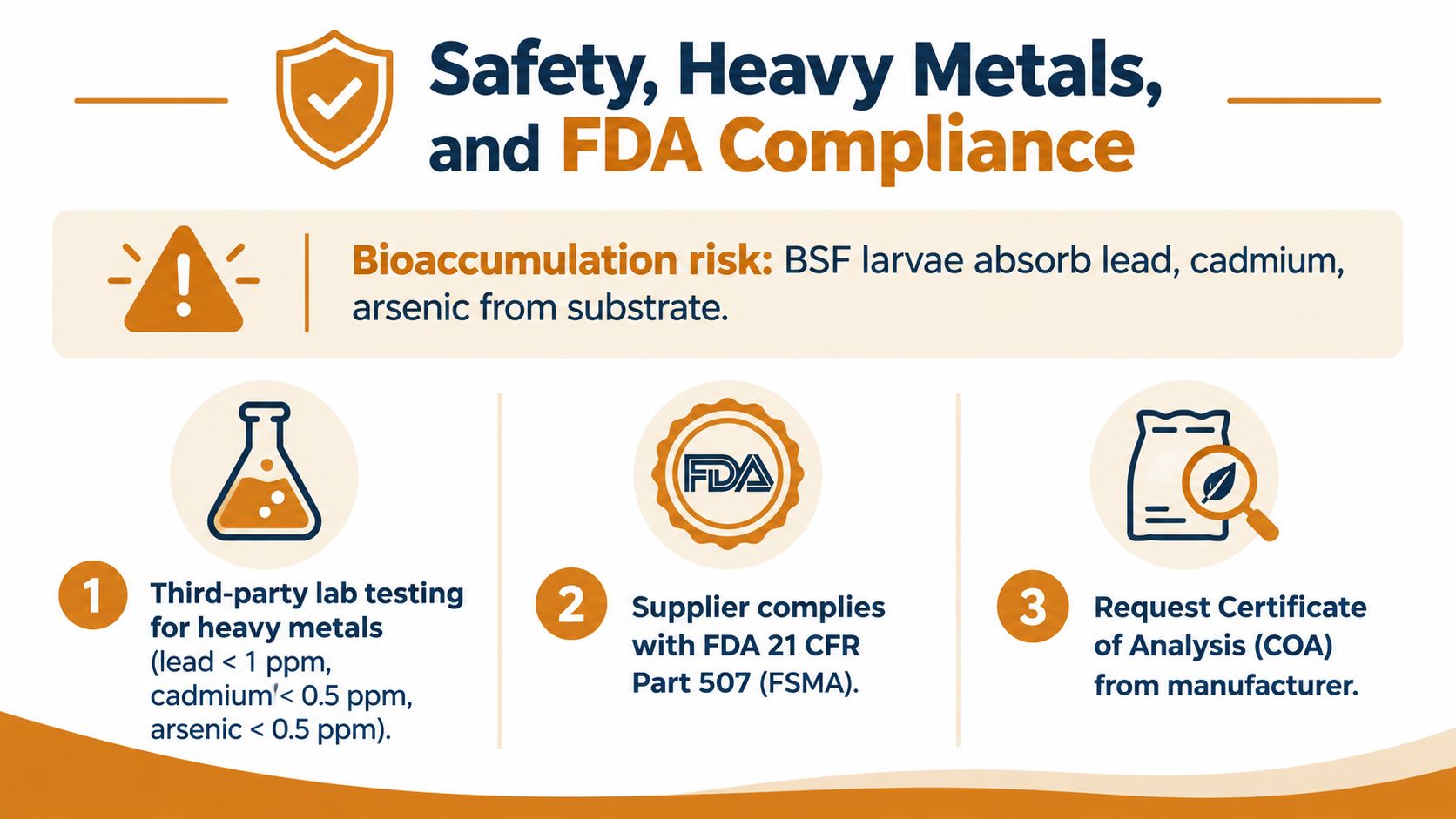
Every bag of dried larvae isn't equally safe. The substrate becomes the first safety filter because BSFL can accumulate metals from contaminated feed inputs. The processing stage adds another filter, since blanching and other kill-step practices can reduce microbial contamination.
The strongest purchase record includes country of origin, feedstock controls, processing details, and batch-level laboratory results. Ask for testing for lead, arsenic, mercury, and cadmium, plus Salmonella screening. A Certificate of Analysis should identify the lot tested and the laboratory that performed the work.
What FDA and AAFCO status means
AAFCO ingredient definitions help regulators and feed manufacturers identify standardized ingredients. The January 2026 AAFCO Ingredient Definition Committee report lists Dried Black Soldier Fly Larvae as an official ingredient definition entry, a meaningful step toward consistent treatment in feed systems used by state regulators.
That doesn't mean a consumer can assume every product complies with every applicable requirement. FDA animal-food rules, facility controls, labeling, and state feed regulations still matter. Ask the manufacturer whether its facility follows applicable FDA requirements, including preventive controls for animal food, rather than relying on an American flag printed on the front of a bag.
The safety filter is documentation. Country of origin is important, but a clean product should also have a controlled substrate and a current batch analysis.
The egg pathway deserves a measured answer. A 2025 laying-hen study reported low transfer of arsenic, lead, and cadmium from BSF meal into egg yolk and egg white, but it still warned that metals in the diet and excreta require attention. The study on metal transfer into eggs supports caution, not complacency. If you feed insects regularly, choose a supplier that treats residue testing as routine quality control.
For a practical look at supplier testing documentation, review Pure Grubs quality assurance testing.
Buying Tips and Storage Best Practices
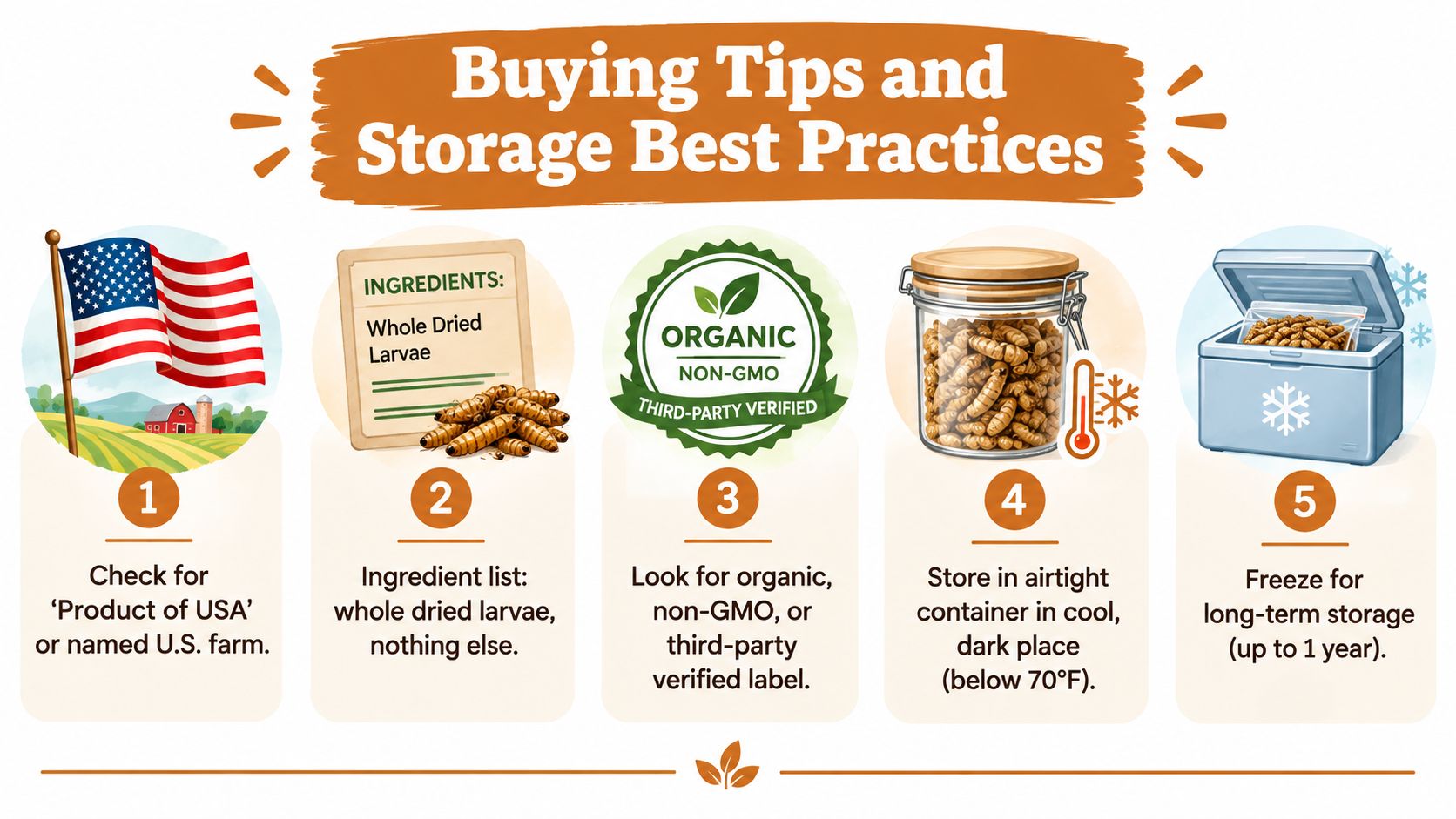
Read the back of the bag before you read the marketing copy. I want to see “Product of USA” or a named U.S. farm, a single-ingredient declaration such as whole dried black soldier fly larvae, and a clear route to laboratory documentation.
A label that says “distributed by” may identify the seller without identifying the farm or country where the larvae were raised. “Insect meal” is also too vague for a buyer who cares about egg safety. If the company won't tell you the origin or explain its testing, choose another supplier.
The label-reading checklist
- Origin first: Confirm domestic production, not merely domestic packaging.
- Ingredients next: Prefer whole dried larvae with no fillers, preservatives, or unnamed blends.
- Testing matters: Look for a heavy-metal panel and pathogen screening, or request the current COA.
- Traceability counts: A lot number, production contact, and named facility make follow-up possible.
- Claims need context: “High calcium” means more when the label provides an analysis or the seller explains the testing basis.
Store an opened bag in an airtight container in a cool, dry, dark place. Squeeze out excess air before sealing, and keep moisture away from the larvae. For longer storage, freezing is practical, but follow the supplier's guidance and let the container reach room temperature before opening so condensation doesn't dampen the product.
Discard larvae that smell off, feel soft from moisture, show clumping, or have visible mold. Direct-from-farm websites often make batch information easier to find, while marketplace listings can blur the difference between manufacturer, distributor, and importer.
Frequently Asked Questions About BSFL
Do BSFL replace oyster shell or grit?
No. BSFL can complement a calcium program, but they shouldn't replace free-choice oyster shell or a complete layer ration. Oyster shell supplies a deliberate calcium source, while grit supports mechanical digestion. They serve different purposes, so keep both systems separate and available as appropriate for your flock.
Can dried larvae carry disease or parasites?
Processing lowers the risk, but it doesn't make an untraceable product trustworthy. Heat treatment or drying can reduce microbial contamination, and reputable suppliers should support their process with pathogen testing. The safest choice is a sealed product from a traceable producer that can provide batch documentation, rather than larvae of unknown origin or insects collected from uncontrolled material.
When should I expect stronger shells?
Don't promise yourself an overnight change. Shell quality depends on the hen's age, genetics, complete ration, calcium access, hydration, stress, and overall health. Controlled poultry research found improved shell measurements at defined BSFL inclusion levels, including the 2% calcium-salt treatment described earlier, while another trial found stronger shell traits at its highest tested BSFL group. Track shell weight, cracks, and thin shells over time instead of judging the result from one day's basket.
How do I judge the cost per hen?
Use a simple record rather than a vague value claim. Write down the package cost, package weight, and the measured amount served to the flock. Divide the total package weight by the daily flock serving to estimate how long it lasts, then compare that result with your mealworm and layer-feed costs. Because prices vary by seller and package, there isn't a defensible universal cost-per-hen figure here.
The value calculation should also include what you're buying beyond calories. A documented U.S. origin, controlled feedstock, heavy-metal panel, pathogen screening, and a current COA can justify choosing one product over a cheaper bag with no traceability. For laying hens, that safety record matters because the flock produces food for your household.
Pure Grubs offers whole, dried, USA-grown black soldier fly larvae with a plant-based diet, no additives or preservatives, and product information centered on traceable sourcing and supplemental nutrition. If clean origin and documented quality are your priorities, visit Pure Grubs to review the available larvae for your flock.