

Black Soldier Fly Pupae: Life Cycle, Uses, and Key Facts
You're standing beside a rearing bin, expecting a mass of hungry cream-colored larvae, when a few begin crawling away from the feed. They darken, stop eating, and disappear into a drier corner. If you've only been watching the larval stage, it's easy to mistake this movement for a problem. It's the beginning of the black soldier fly pupae stage, when the insect changes from a feeding machine into a sealed biological workshop.
That transition matters to flock owners, insect farmers, and feed processors. Pupae are often overlooked because larvae are easier to recognize and market, yet late-stage biomass can contain concentrated protein, fat, and chitin. The catch is that its value depends on harvest timing, rearing substrate, processing, and safety controls, not on the insect's species name alone.
What Happens When a Black Soldier Fly Reaches the Pupal Stage
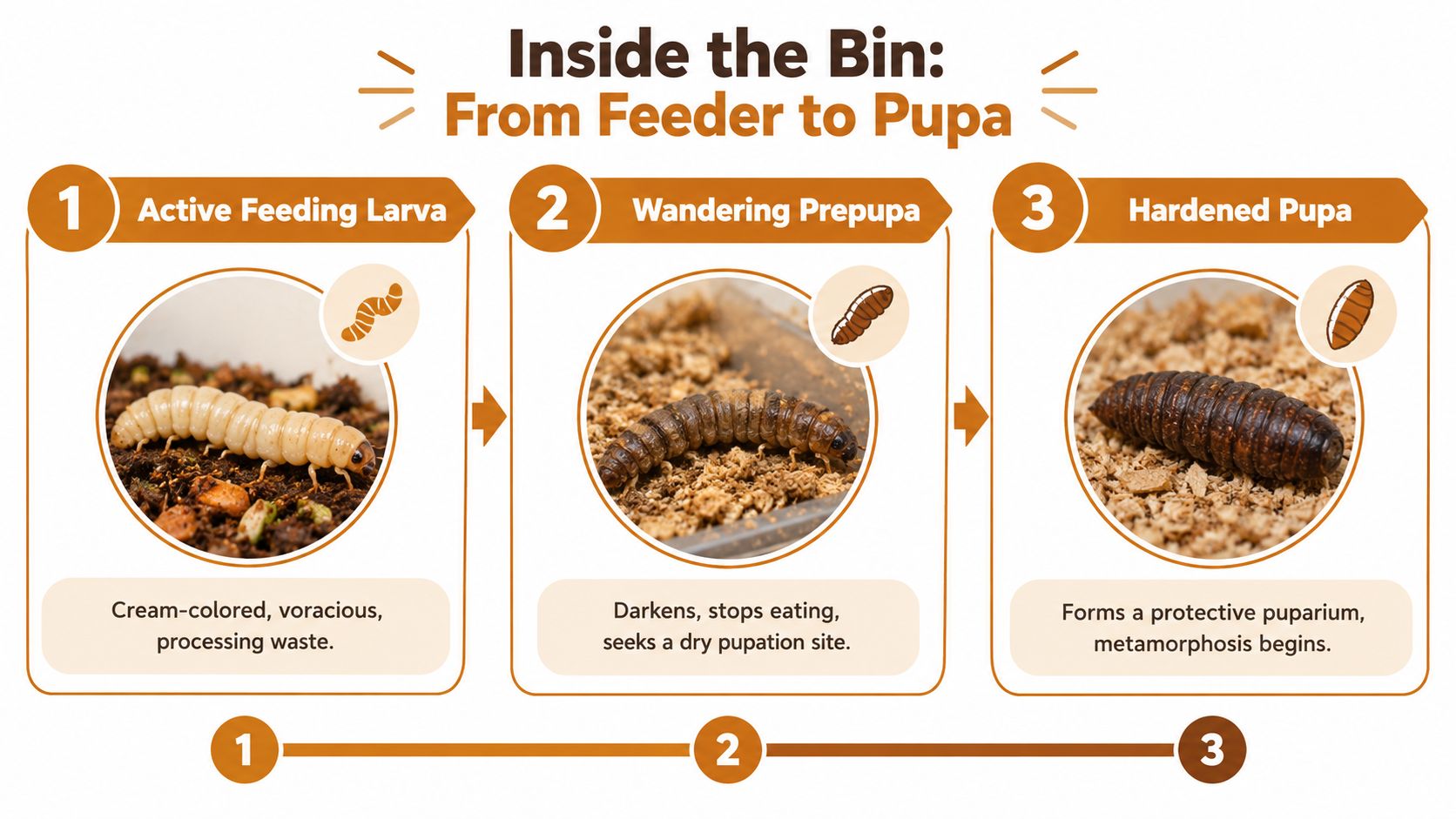
A healthy bin has a rhythm. Young larvae stay in the moist feed, moving constantly as they consume organic material. Later, one larva begins to look different. Its cream color turns gray, then brown, and its body becomes firmer. It stops feeding and starts searching for a sheltered, relatively dry place.
This wandering insect is the prepupa. It has emptied much of its gut and is leaving the food zone, a useful natural separation that farmers can work with. In a production setup, self-harvesting ramps or dry collection areas allow prepupae to move away from the substrate before they harden into pupae.
Reading the bin correctly
Once the insect settles, movement becomes minimal. The outer body darkens and hardens into a protective casing called a puparium. Inside, the larval body is being reorganized for adult emergence. From above, the pupa may look inactive or lifeless, but stillness is the visible sign of intense internal change.
For a small producer, this is the point where observation prevents avoidable losses. A bin that stays wet and crowded can make it harder for prepupae to find a suitable pupation site. A dry collection zone, gentle handling, and separation from spent substrate help preserve the biomass and keep frass from mixing with the material selected for processing.
Practical rule: A dark, non-feeding insect isn't automatically dead. Check for the firm casing and stage the harvest around the prepupal or pupal transition.
The complete sequence is easier to follow with this black soldier fly life cycle guide, especially if you're learning to distinguish active feeding from normal wandering behavior. Flock owners who want a ready-to-use insect treat rather than a home rearing project may also encounter USA GROWN BLACK SOLDIER FLY LARVAE FOR CHICKENS, which is a larval-stage product rather than a harvested pupal ingredient.
The pupal stage is operationally important because the insect has stopped using incoming feed for growth. Its body now contains reserves built during larval development, along with structural material associated with the casing. That makes late-stage biomass a potential feed ingredient, but it also means the processor must decide whether the target is whole insects, meal, extracted fat, or a secondary product such as chitin.
The Biology of Pupation and Metamorphosis
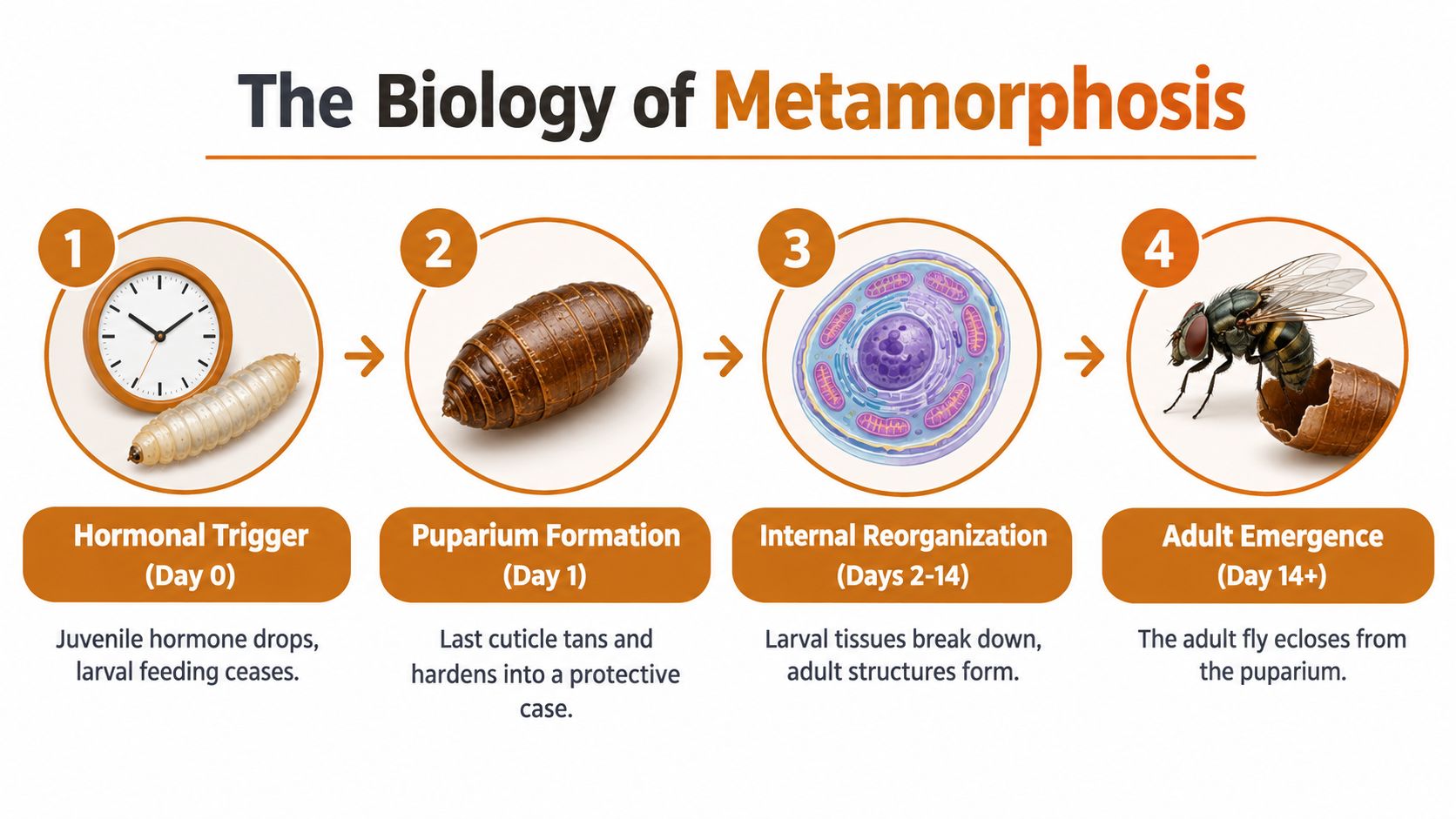
A larva that has spent its life eating eventually leaves that job behind. Its internal signals shift from growth to transformation. Feeding stops, movement becomes purposeful, and the insect seeks a stable place where its developing pupa can remain undisturbed.
The protective casing forms from the final larval cuticle. That outer layer tans and hardens around the pupa, much like temporary walls enclosing a renovation site. The casing shields the work area while the insect's body is reorganized inside.
What changes inside the casing
Metamorphosis involves extensive biological remodeling. Many larval tissues are broken down and reused, while adult features, including legs, wings, antennae, and reproductive organs, develop. The process resembles dismantling one machine and assembling another from selected components within the same protected space.
Timing matters because late-stage insects are not all at the same point in development. A reviewed account of BSF life-cycle and rearing research describes the full black soldier fly lifespan as about 20 to 22 days, with the pupal stage lasting about 6 to 8 days before adult emergence (reviewed BSF life-cycle and rearing research). Another agricultural extension description places pupation at about two weeks. Temperature, diet, colony line, and management can therefore change the working schedule on a farm.
Why timing affects harvest value
Harvesting before adult emergence keeps the insect's stored biomass in the feed stream. Once the insect becomes a flying adult, it no longer provides the same practical feed material. The preferred harvest point depends on the product: live-feed suppliers may select active prepupae, while meal processors may prefer more uniform late-stage material for drying and milling.
Pupation also helps explain changes in nutritional composition. The insect has accumulated reserves to fuel metamorphosis, and the casing adds chitin and other structural material. For a flock owner, that means pupae represent a late developmental stage with concentrated stored biomass, but their harder structure can affect acceptance, digestibility, and processing choices. Whole pupae, ground meal, and separated fractions may therefore serve different feed purposes.
How Pupae Differ From Larvae and Prepupae
A flock owner opening a rearing bin may see larvae, prepupae, and pupae together. They belong to the same life cycle, yet each stage behaves differently. Larvae eat, prepupae relocate, and pupae stay enclosed while adult structures develop. Those visible behaviours help farmers sort a batch before composition or safety testing.
| Stage | Behaviour | Appearance | Key Composition | Typical Use |
|---|---|---|---|---|
| Larvae | Active feeding and movement through the substrate | Soft, pale, usually cream-colored | Moist biomass with developing protein and lipid reserves | Live treats, fresh feed, or continued colony growth |
| Prepupae | Stops feeding and seeks a drier pupation area | Darkening body with a firmer surface | Gut-cleared late-stage biomass with changing nutrient proportions | Live feeding, self-harvesting, or processing |
| Pupae | Mostly motionless inside a hardened casing | Dark brown to black, firm outer covering | Concentrated reserves plus more structural chitin | Drying, grinding, meal production, or stage-specific research |
The practical difference for a flock owner
For backyard chickens, texture can matter more than the label. Larvae are soft and familiar to birds. Prepupae are darker and often more active. Fully formed pupae have a firmer casing, so some animals may accept them less readily unless the pupae are softened, ground, or mixed into a formulated feed.
Pupae are the stage many discussions skip, even though farmers may harvest them as a distinct late-stage biomass. Their stored reserves support metamorphosis, while the casing contributes more structural chitin. In practical terms, whole pupae, ground meal, and separated fractions can suit different feeding and processing plans.
Processors face a related choice. Prepupae can be easier to handle before the casing hardens fully. Pupae offer a more clearly separated stage for batch sorting, but their firmer covering can change drying behaviour, grinding requirements, fat recovery, and the amount of chitin retained in the final feed.
Why “late stage” isn't one uniform category
Late-stage insects should not be treated as one consistent product. Colony performance can shift across generations under different breeding and rearing conditions, as shown in commercial-colony and substrate findings. Controlled feeding work also found that diet affects how many insects reach prepupation, with dairy manure producing lower survivorship than the best tested diet.
A bin full of larvae therefore does not reveal the final harvest quantity. Count the stage you plan to sell or feed, and record the substrate and harvest timing for every batch. That record connects the appearance of the insects with the material's handling and feed-use decisions.
Nutritional Profile of Black Soldier Fly Pupae
A fresh pupa and a dried pupa can look nutritionally different even when they come from the same colony. Water changes the apparent concentration, so comparisons are most useful on a dry-matter basis. This is similar to comparing soup with its concentrated stock: the ingredients may be the same, but moisture changes the weight and the measured proportion of each nutrient.
Historical work reported prepupal black soldier flies at 44% dry matter, 42% protein, and 35% fat (classic entomology research on prepupal composition). Later studies also found substantial protein. One reported total protein of about 34.29 to 34.98 grams per 100 grams in pre-pupae fed experimental diets. Another documented pupae at about 39.20% protein and 39.32% fat. These results support closer attention to pupae, the late-stage biomass often skipped in larva-focused discussions.
| Nutrient | BSF Pupae (% DM) | Fishmeal (% DM) | Notes |
|---|---|---|---|
| Protein | About 39.20% in one pupal composition study | Not specified in the verified data | Supports protein contribution, but values vary by stage and substrate |
| Fat | About 39.32% in one pupal composition study | Not specified in the verified data | Supplies concentrated energy and affects storage stability |
| Dry matter | About 26.6% in pupal-stage material in one study | Not specified in the verified data | Fresh-stage moisture changes weight and handling requirements |
| Chitin | Stage-dependent, with pupae richer than larvae in one study | Not specified in the verified data | Adds structural fiber and can affect digestibility |
| Ash | Strongly substrate-dependent | Not specified in the verified data | Mineral load requires feedstock and batch monitoring |
What those nutrients mean in practice
Protein can support tissue maintenance, growth, feather production, and recovery. A poultry or aquaculture manager still needs a complete ration, however. The available data do not establish one universal amino acid profile or show that pupae can replace fishmeal in every formula. They show why pupal biomass should be assessed as its own ingredient, with a specification for each batch.
Fat deserves separate attention. Late-stage insects store energy for metamorphosis, so pupal meal can contribute concentrated energy. That same fat can increase oxidation risk during storage. Drying, oxygen control, temperature management, and suitable packaging help protect the ingredient before use.
Pupae also change structurally as development proceeds. One compositional study found about 26.6% dry matter in pupal-stage material compared with 32% in larvae, while its review described developmental changes in protein, fat, chitin, ash, minerals, and amino acids (developmental nutrient shifts in BSF). These shifts explain why larval and pupal figures should not be exchanged automatically.
For background on larval feed value, see this guide to black soldier fly larvae nutrition. Farmers evaluating the stage most articles skip should record whether a product contains larvae, prepupae, or pupae, then compare its moisture, protein, fat, and handling properties on the same dry-matter basis.
Why Substrate and Safety Matter as Much as Species
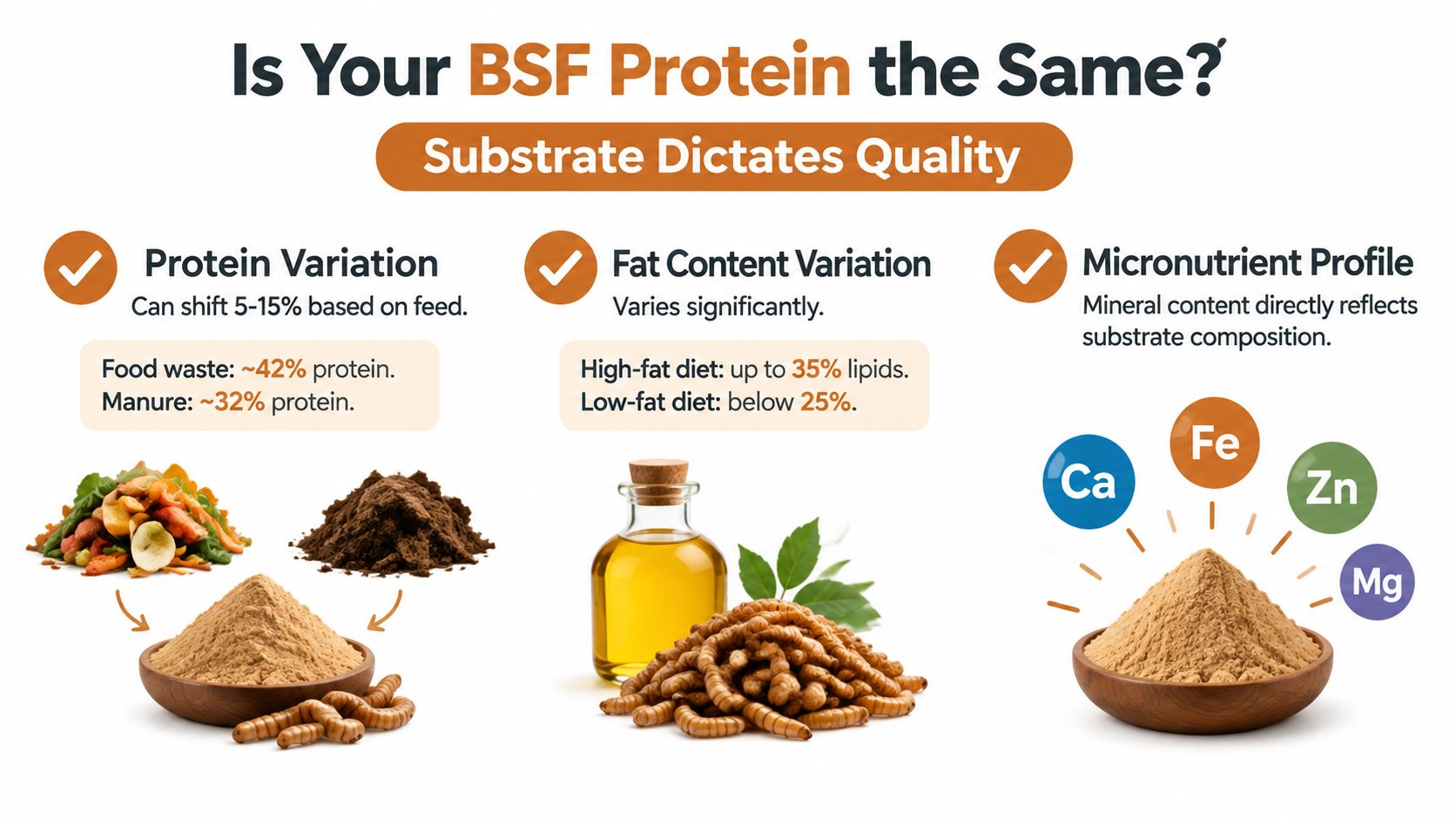
A flock owner can buy pupae from the same insect species and still receive very different feed ingredients. Species sets the biological platform, while the substrate helps shape protein, fat, ash, mineral content, and possible contaminants. The pupal stage deserves this same scrutiny, because the material harvested after larval growth carries the history of what the insects consumed.
Independent compositional work found protein at roughly 399 to 431 grams per kilogram of dry matter. Ether extract ranged from 218 grams per kilogram of dry matter on digestate to 386 grams per kilogram on restaurant waste, while ash shifted from 27 grams per kilogram to 197 grams per kilogram across those diets (substrate-driven BSF composition research). These differences affect ration formulation, mineral balancing, storage decisions, and buyer acceptance. A pupal product should therefore be assessed by batch, not judged by species name alone.
Clean inputs still need verification
A controlled waste-conversion system can reduce some biological hazards, but it does not make every output suitable for animal feed. Research summarized in a recent ACS report indicates that larvae can remove most human-pathogenic viruses from certain spoiled food, sewage sludge, or livestock manure streams. Viral reduction still says nothing about every chemical contaminant or about the finished product's complete safety profile (ACS report on BSF and organic-waste virus removal).
Ask the supplier what entered the rearing bin, how feedstock is accepted, and how each lot is traced. The discussion of heavy metals in imported black soldier fly larvae explains why origin and testing deserve more attention than a simple “natural protein” label.
Buyer's question: What entered the bin, what came out of it, and which test connects the two?
Mineral accumulation can create problems for feed mills and livestock operations even when the insects appear healthy. Quality controls should match the intended use, separate feed from fertilizer outputs, and confirm that a substrate acceptable for waste treatment is also suitable for poultry, fish, or pet food.
Industry and Farm Uses for Pupal-Stage Biomass
A flock owner may see the pupal bin as the final stop after larval feeding ends. A processor sees a separated material with different handling and processing options. Once the insect has stopped eating and moved away from the wet substrate, its darker casing can make collection easier. That stage deserves attention because it can support several product streams, not just become an unwanted remainder.
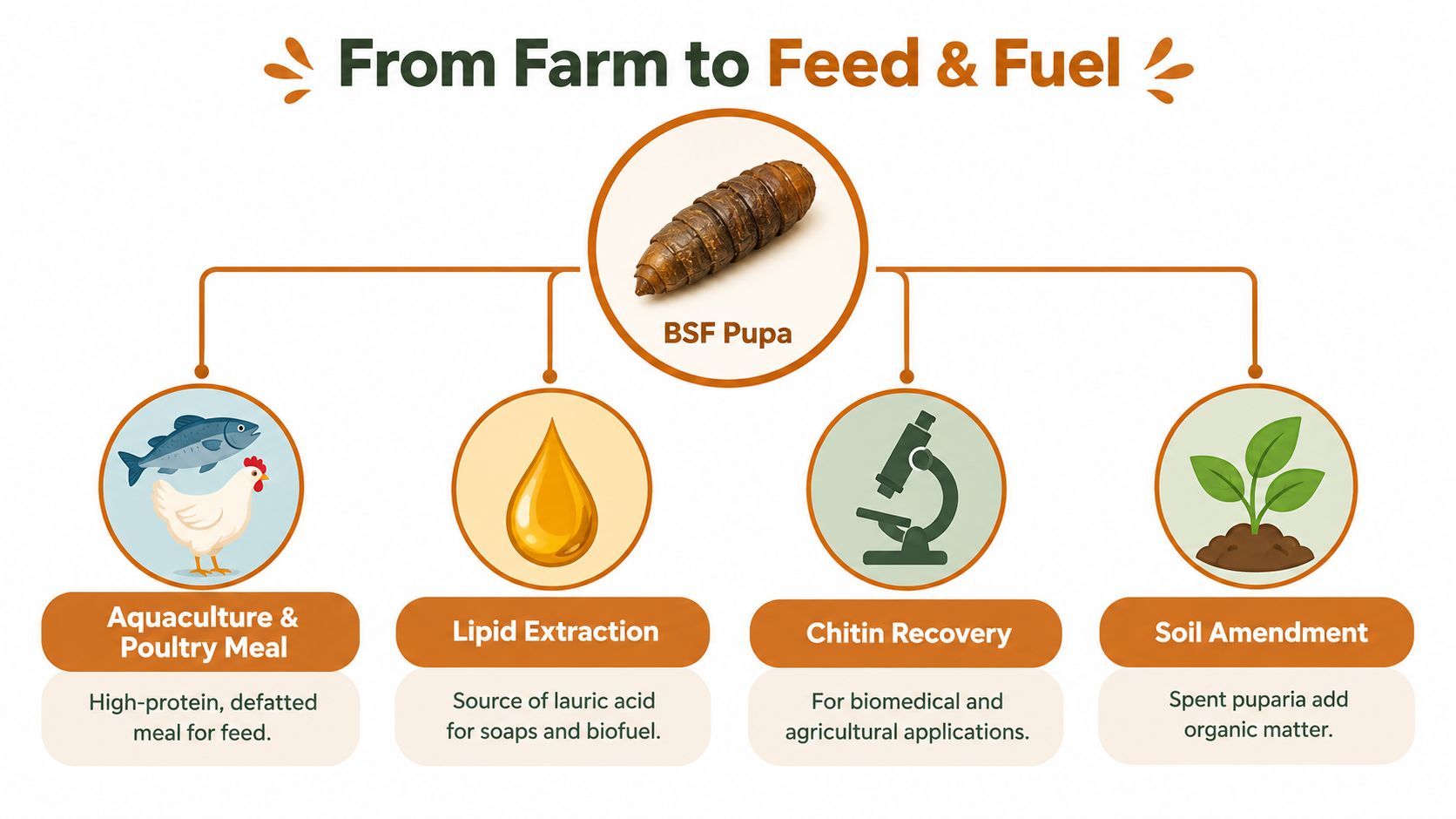
Feed ingredients
Dried whole pupae can be milled for evaluation in poultry, aquaculture, and pet-food formulations. Defatting removes part of the lipid fraction and produces a more protein-focused meal. Whole-pupal processing retains more energy, though the remaining fat can increase oxidation concerns and requires suitable storage.
For a small flock, live or dried larvae may be simpler. Birds often recognize and eat them readily. A processor may prefer a consistent late-stage fraction, however, because a mixed bin of larvae, prepupae, pupae, frass, and substrate is harder to standardize.
Lipids and structural fractions
The pupal body can be separated into materials with different uses. Its fat fraction may serve as feed energy or as an input for soaps and other lipid applications, provided the producer first measures yield and fatty acid composition. The chitin-rich casing may also have agricultural, technical, or research value. Developmental-stage research has reported differences between pupae and larvae in chitin content and in the balance of saturated and unsaturated lipids. Those changes can affect extraction and digestibility, as noted earlier in the developmental composition comparison.
Pupal skins and exuviae can remain useful after the insect leaves them behind. Research on fermented material found stronger antibacterial activity and higher antioxidant markers than in unfermented exuviae, suggesting a possible route toward functional additives rather than simple disposal (research on fermented pupal exuviae).
Frass and closed-loop production
Frass can return to the farm's circular system as a soil amendment, subject to appropriate handling and end-use rules. Pupal biomass may also be incorporated into frass in closed-loop production, creating a choice between one combined output and several separated materials.
That decision depends on testing, equipment, customer requirements, and local regulations. A feed-grade stream needs different specifications from a soil amendment or technical chitin fraction. The strongest operation assigns each output a defined quality standard and customer, so pupal-stage biomass is managed as a usable material rather than generic waste.
Choosing a Quality BSF Pupae or Larvae Source
A trustworthy supplier should make the production chain visible. Start with the insect's full species name, Hermetia illucens, then check the country of origin and the exact substrate used during rearing. “Insect protein” without those details doesn't tell you enough about nutrient consistency or potential contaminants.
Use this checklist before buying for a flock, fish system, pet-food formulation, or feed mill:
- Species and origin: Confirm that the supplier identifies the species and states where the insects were raised and processed.
- Substrate disclosure: Ask what the insects consumed. A vague reference to “organic material” leaves important safety and composition questions unanswered.
- Lot documentation: Request a certificate of analysis tied to the specific batch, not a generic document from an unrelated production run.
- Heavy-metal testing: Look for testing that addresses lead, cadmium, arsenic, and mercury when the product is intended for animal feed.
- Microbial controls: Ask how the supplier monitors Salmonella and Enterobacteriaceae and how the product is treated after harvest.
- Residue screening: If the substrate could contain agricultural or industrial inputs, ask whether pesticide or related residue testing applies.
- Traceability: A supplier should be able to connect the finished bag or bulk lot to its rearing and processing records.
- Processing information: Find out whether the product is fresh, frozen, dried, defatted, or ground, because the form changes storage and feeding decisions.
- Clear use category: Feed, fertilizer, pet treats, and bioactive ingredients may have different requirements. Don't assume approval for one use transfers to another.
Certifications can support confidence, but a logo shouldn't replace batch-level evidence. Missing certificates of analysis, unexplained origin, and suppliers who can't name their substrate are practical warning signs.
For backyard flock owners, a transparent dried larvae product may be simpler than trying to source or process pupae directly. Pure Grubs offers USA-grown, dried black soldier fly larvae for chickens and other birds, with a plant-based diet, no additives or preservatives, and heavy-metal testing described for its batches. Visit Pure Grubs to review the available insect-feed option and choose a product that fits your flock's feeding routine.