

Black Soldier Fly Larvae in House: Safe Indoor Setup
You lift the lid on the kitchen compost bucket and find a mass of flat, gray larvae moving through the scraps. Or you spot a few crawling out from beneath a garage trash can, a basement drain, or a damp corner. Finding black soldier fly larvae in a house is unsettling, especially if you didn't put them there, but the insects usually tell you more about a hidden moisture or waste problem than about the cleanliness of your home.
The response depends on which situation you're facing. An accidental indoor occurrence calls for source hunting and exclusion. A deliberate colony can work in a garage or utility area, but only when the bin, feedstock, airflow, and escape controls are planned together. I've kept BSFL bins in both a garage and a basement, and the practical lesson is simple: the larvae are easy to manage when the system is controlled, and surprisingly unpleasant when the food turns anaerobic.
Why Black Soldier Fly Larvae Show Up Indoors
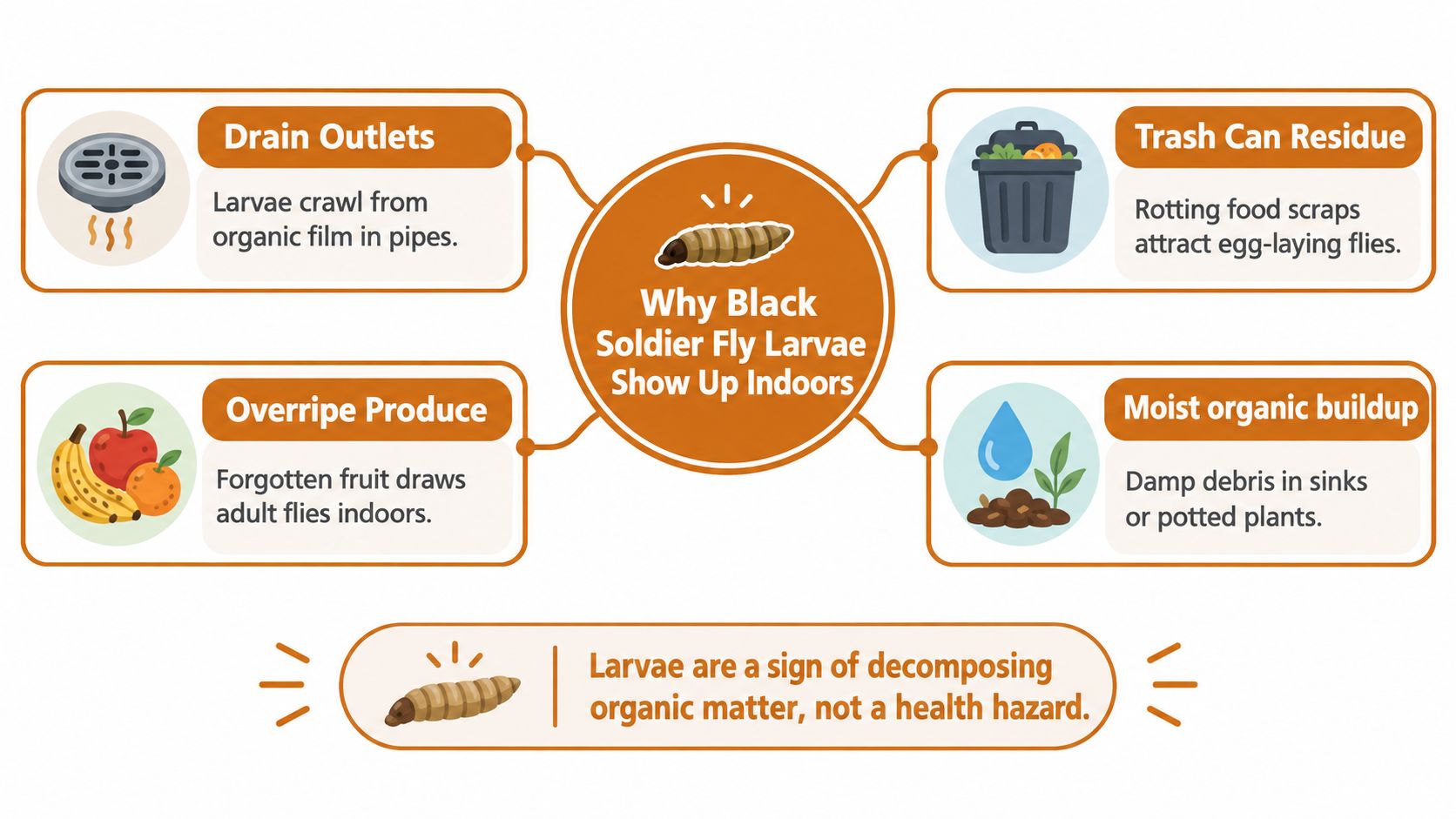
The first time you see larvae crawling from a bathroom drain or under a trash container, your instinct may be to spray everything. Pause before doing that. Black soldier fly larvae indoors usually indicate a specific source of moist, decomposing organic matter, not a general household infestation.
Mississippi State University Extension documents indoor or immediately adjacent sources including septic-system breaches, broken toilet wax seals, damaged plumbing or slabs, outdoor sewage problems, pet feces, animal carcasses in attics or wall voids, and forgotten food such as open canned pet food. The larvae aren't typically associated with clean, dry living areas. Their presence is a clue that wastewater, organic residue, or decaying material is accumulating somewhere nearby. Mississippi State University Extension explains the documented indoor sources and source-removal approach.
Read the larvae as a trail
Start at the place where you found them, then work backward. Mature larvae often leave their feeding material, so the visible cluster may be several feet away from the actual source. Check these locations in a deliberate order:
- Trash and compost: Look beneath liners, around the rim, and under the container. A small amount of food residue can sustain larvae.
- Pet areas: Inspect damp food, spilled wet feed, litter, feces, and hidden scraps under appliances.
- Plumbing: Examine slow drains, crawl spaces, floor penetrations, toilet bases, and areas with staining or persistent dampness.
- Concealed voids: If the larvae keep appearing near a wall, ceiling, attic, or slab, investigate the possibility of a trapped animal or plumbing failure.
Historically, soldier fly larvae have also been found in dense mats beneath laying hens or swine in older open-sided livestock housing. That behavior fits their biology. They naturally exploit animal-waste environments, rather than conventional indoor living spaces.
Practical rule: If larvae appear without a managed bin, find the wet organic source before applying any pesticide.
A deliberate colony looks different. It has a defined container, controlled feed, and a predictable place for larvae to gather. An accidental occurrence appears in or around a waste source, spreads only while that source remains available, and often produces wandering larvae near drains, trash, or concealed damp material. Remove the breeding material, clean the residue, repair the leak, and seal the route that allowed adult flies access.
Choosing the Right Bin and Indoor Location
An indoor BSFL setup should begin with the location, not the larvae. A good bin in a bad room still becomes a smell problem, while a modest bin in a stable garage or utility area can run smoothly.
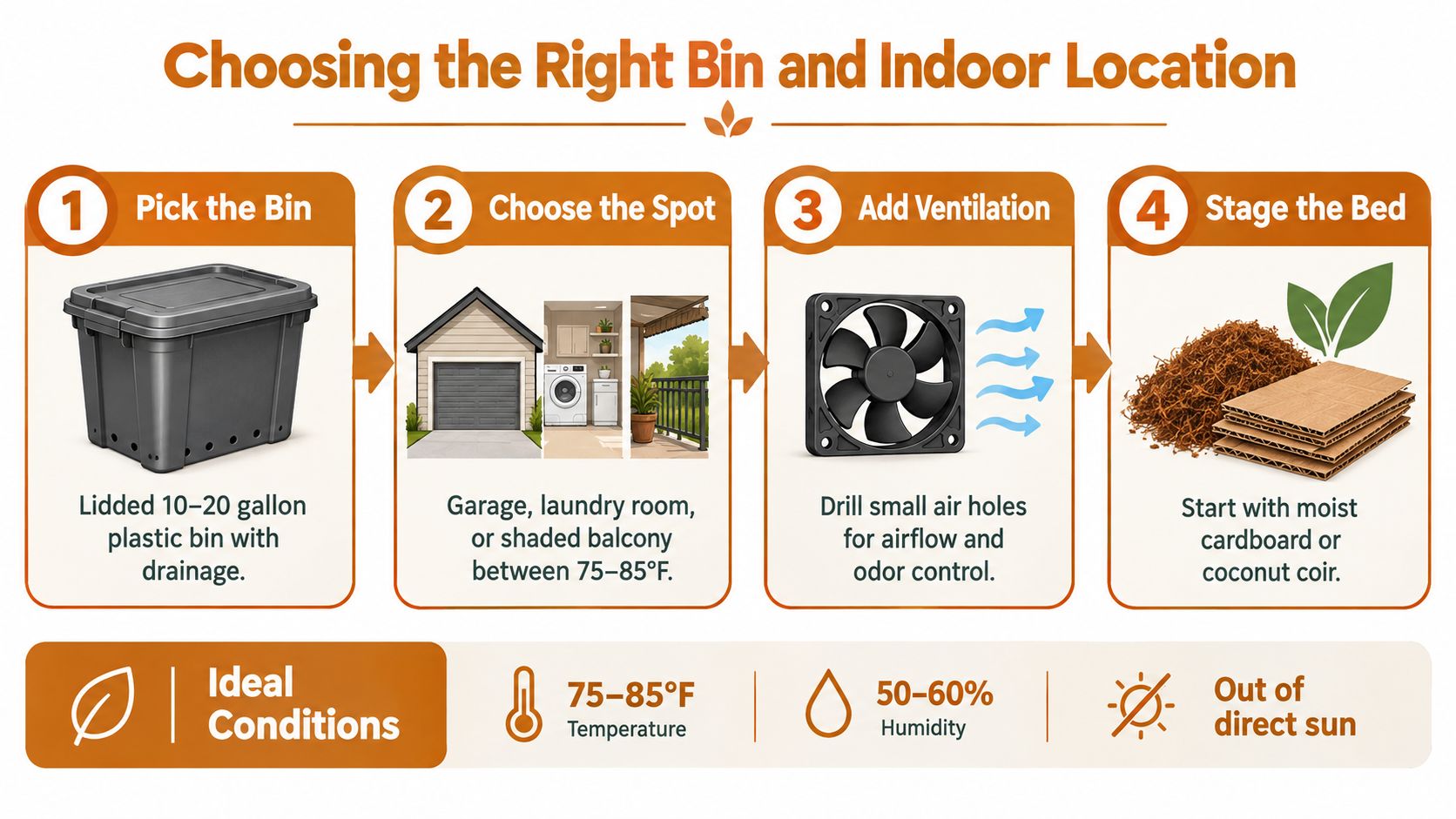
Use a shallow, drainable plastic container with a lid or cover that allows ventilation. A sealed tote is a poor choice because it traps humidity, heat, and odor. Drill or fit ventilation openings, but cover them with a material that prevents larvae and nuisance insects from using the holes as exits. Put the entire unit inside a washable secondary tray. That tray protects the floor when a lid shifts, a drain leaks, or a mature prepupa takes the wrong route.
Build around stable conditions
Aim for a warm zone of 28–32°C, with relative humidity around 65–75%, and use a 12:12 light-dark cycle when maintaining a colony. These conditions support feeding and maturation without turning the bin into a wet, sealed box. A shallow container gives you more control over moisture and makes it easier to identify hot or compacted patches.
A garage, basement, laundry room, or utility room is usually more suitable than a kitchen, bedroom, or living room. Keep the bin away from direct sun, stored food, children, and curious pets. If the room can't hold a reasonably stable temperature, supplemental heating may be necessary, but heat cables and pads should never sit directly under wet substrate without a thermostat and fire-safe separation.
From the second day onward, provide airflow across the container. You don't need a powerful fan. Gentle air movement helps remove excess humidity and reduces the chance of an oxygen-poor substrate developing a sharp odor.
Use a ramp and a dry upper surface
A ramp lets mature prepupae leave the feed bed and collect in a cup rather than wandering over the floor. Use a textured, moderately steep surface that reaches a dry upper edge. Place the collection cup directly beneath the exit, and secure the ramp so it can't shift as the larvae climb.
For a detailed equipment and maintenance overview, Pure Grubs' guide to raising soldier fly larvae offers another practical reference. If you want a ready-to-use supplemental poultry option rather than raising every larva yourself, USA GROWN BLACK SOLDIER FLY LARVAE FOR CHICKENS is one cataloged dried-feed choice. Treat any dried larvae as an addition to a complete ration, not as a replacement for balanced poultry feed.
Feedstock Choices That Work Indoors
Indoor BSFL bins succeed or fail on feed more than on almost anything else. I have had a garage bin stay clean on plain mixed scraps, then turn sour fast from one heavy load of wet fruit and leftovers. The larvae can process a wide range of waste, but moisture, chemistry, texture, and nutrient quality still decide whether the colony stays manageable inside a house.
Feedstock also changes how reliably larvae make it through the cycle. In controlled comparisons summarized in Frontiers in Sustainable Food Systems research on substrate composition and BSFL survival, mixed organic waste performed far better than some single-stream wastes. That lines up with what works in a basement or utility room. A varied feed bed is usually steadier, less messy, and easier to correct when conditions drift.
A practical feedstock ranking
| Feedstock Type | Survival Outcome | Moisture Risk | Household Note |
|---|---|---|---|
| Mixed organic waste | Approximately 98.2% survival in one controlled study | Moderate, depending on the blend | A balanced mixture is generally more reliable than a single watery ingredient |
| Food-industry substrate near 70% moisture | More than 80% survival | Manageable when drained and aerated | Useful when the material is consistent and free from contaminants |
| Chicken-feed control | About 90% survival in the cited comparison | Lower than fresh produce | A dry, predictable reference feed, not a complete household waste strategy |
| Vegetable and fruit waste | Approximately 61.5% survival in one study | High, especially when pulpy | Mix with dry carbon material and avoid deep wet layers |
| Fish-processing waste | Approximately 62.4% survival in one study | High, with strong odor potential | Risky indoors because of smell and rapid decomposition |
For an indoor setup, the ranking matters less as a scorecard and more as a warning. Wet produce scraps look harmless, but they collapse into sludge if you add too much at once. Fish waste can work biologically, yet it is a poor trade indoors because smell becomes the main limit long before the larvae quit.
Keep the chemistry boring
The safest feed bed is the boring one. Aim for substrate that stays close to neutral, without sharp sourness, greasy patches, or salty runoff.
The same Frontiers summary reported survival to prepupa at about 98–99% at initial pH 6–8, compared with 88.68% at pH 4 and 91.62% at pH 2. You do not need to test every batch with a meter, but your nose and eyes are usually enough for routine management. If the bin smells strongly fermented, looks glossy, or starts pooling liquid at the bottom, stop adding wet scraps and correct the mix.
Feed in small batches after the previous layer is mostly consumed. Avoid meat-heavy, salty, oily, moldy, or chemically contaminated waste. Add shredded cardboard or another dry carbon material when the feed is pulpy or runny. The bed should feel moist and loose, not flooded, and it should never release standing liquid when pressed.
That is the difference between an indoor colony and an accidental household mess. Deliberate BSFL culture uses measured feed, controlled moisture, and plain, low-drama inputs.
Managing Temperature, Humidity, and Odor
Indoor BSFL bins usually fail at the household level before they fail at the insect level. The larvae can tolerate a fair bit. Your garage, basement, or utility room usually cannot tolerate sour sludge, protein rot, or wandering larvae for long.
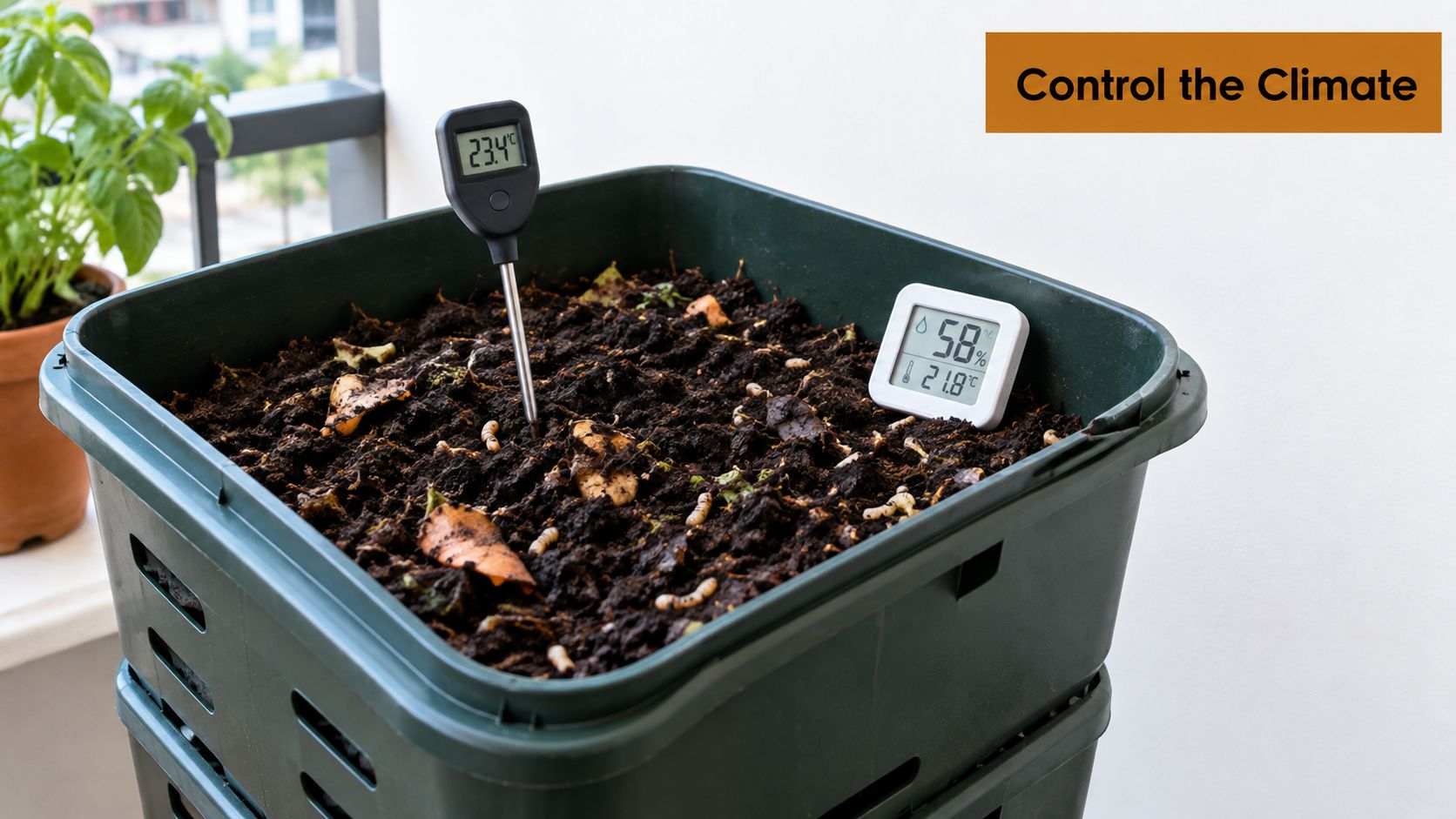
Temperature is part of that. BSFL develop best in warm conditions, with commonly reported immature development around 27–33°C, but the reading only matters if you interpret it with the bin in front of you. In a cold basement week, a sluggish colony with wet feed is not just “running cool.” It is often sliding toward compaction, odor, and stalled feeding. In a hot garage, the opposite problem shows up. The top looks fine, but the feeding zone can turn heavy and rank fast if airflow is poor.
The daily check
Keep a basic thermometer and humidity sensor near the bin, not buried in the substrate. Then check the colony like a person who has to share the building with it.
- Inspect the surface: Look for pooling liquid, matted feed, spreading mold, or larvae climbing the walls instead of feeding.
- Check the smell: A mild earthy or fermented smell can happen. Sharp ammonia, sewage, or rotten-protein odor means the bin needs correction now.
- Test the texture: If the bed packs like mud, mix in dry shredded cardboard and improve drainage. If it has gone dry and the larvae are inactive, add moisture in small amounts instead of dumping in water.
- Confirm the exits: Check the lid, mesh, ramp, and collection cup for gaps, because an indoor colony becomes an accidental infestation the moment mature larvae start turning up on the floor.
Airflow helps from the start. Do not seal the container to trap the smell. That usually traps heat and moisture, and the odor gets worse.
What to do when the bin smells
Stop feeding first. Let the larvae work down the material already in the bin. Pull out soaked pockets, add dry carbon bedding, and spread the feed layer thinner so air can reach more of the bed. If the smell still hangs on after that, move the bin outside or shut it down. Cover scents and room sprays do not solve a wet BSFL bin.
For broader household odor control after you clean the source, the Purified Air Duct Cleaning odor guide gives useful general steps for tracking down and reducing lingering smells in nearby rooms.
Cold storage has a narrow use indoors. It can buy you short-term holding time if you need to pause handling, separate larvae, or clean the bin. Earlier research noted that larvae can survive brief refrigeration, but cold exposure still raises stress and mortality. Use the fridge as a temporary stopgap, not as a substitute for correct temperature, moisture, and airflow in the colony itself.
Harvesting Prepupae Without an Indoor Escape
Mature prepupae are useful because they often harvest themselves, but that behavior can also put them on your basement floor. As larvae finish feeding, they darken, become more mobile, and seek a drier route away from the wet substrate.
A self-harvesting ramp turns that instinct into a controlled collection system. The ramp should begin in the feeding bed, rise toward the rim, and end above a cup. Give the surface enough texture for climbing, then keep the landing area dry. A smooth plastic ramp can leave prepupae stranded, while a rough surface with large gaps can create escape points.
Set up the collection path
Place the collection cup inside the secondary tray, not directly on an exposed floor. Secure the cup so an active larva can't push it aside. If the bin has multiple possible exits, block every route except the ramp. A dry upper surface matters because it encourages mature prepupae to climb toward the intended exit instead of wandering through damp bedding.
Harvest the cup regularly. For poultry, offer live prepupae as a supplemental treat, keeping the birds' complete ration as the nutritional foundation. Remove dead material and wash the cup before returning it to service.
The black soldier fly life cycle guide can help you distinguish actively feeding larvae from mature prepupae that are ready to leave the bed. That distinction matters because premature harvesting reduces the colony's ability to complete its cycle.
When larvae climb the walls
Wall climbing usually means the bin is telling you something. Check for overfeeding, excess moisture, heat buildup, or a ramp that doesn't provide a usable route. Reduce the next feed, add dry carbon material, and inspect the bottom for standing liquid.
Don't respond by adding more food. That increases heat and decomposition while leaving the original problem in place. If prepupae keep appearing outside the bin, replace the cover, repair the mesh, deepen the secondary tray, and inspect the room for scattered larvae before assuming the colony is healthy.
Safety, Sourcing, and What High Calcium Actually Means
“High calcium” is useful only when you know which larvae, raised on what substrate, and fed at what role in the ration. BSFL isn't automatically interchangeable across suppliers or suitable as a complete poultry feed.
Substrate composition matters because larvae can accumulate contaminants, including heavy metals. Traceable production and batch testing give you more meaningful safety information than a generic calcium statement. Ask suppliers where the larvae were raised, what they consumed, whether batches are tested, and whether the product is intended as a treat, supplemental feed, or ration ingredient.
Treat the calcium claim as one part of the picture
A 2025 broiler study found no significant overall growth-performance difference when BSFL meal replaced part of soybean meal at 5% in the starter phase and 10% in the grower phase, although birds were heavier at week two. A laying-hen study found that replacing soybean meal with up to 10% BSFL maintained production, body weight, egg quality, and sensory characteristics, but the 10% group consumed about 3.8 g calcium per bird daily versus 4.9 g in the control group. The Frontiers in Animal Science research discusses BSFL inclusion, laying-hen outcomes, and calcium intake.
That result doesn't mean BSFL harms layers. It means a supplement can displace another ingredient, and the whole ration still determines calcium supply. Keep treats supplemental, especially for laying hens whose calcium needs are tied to egg production.
Ask what the label leaves out
A responsible supplier should be able to explain:
- Substrate controls: Whether larvae are raised on a traceable feedstock rather than unpredictable waste.
- Testing: Whether batches are screened for relevant contaminants, including heavy metals.
- Use instructions: Whether the product is intended for chickens, ducks, reptiles, fish, or another species.
- Nutritional role: Whether the larvae are a treat or part of a formulated diet.
For more detail on why origin and contamination controls matter, this resource on heavy metals in imported black soldier fly larvae is relevant. The same caution applies to a home-raised colony. Never feed larvae from a bin containing chemically treated material, unknown waste, paint residue, pesticides, or spoiled substances you can't identify.
Troubleshooting and When to Stop the Colony
A household BSFL colony is working when the substrate stays contained, the odor remains manageable, larvae have a clear harvest route, and the family accepts the setup. If one of those conditions fails repeatedly, the right answer may be to move the project outdoors or end it.
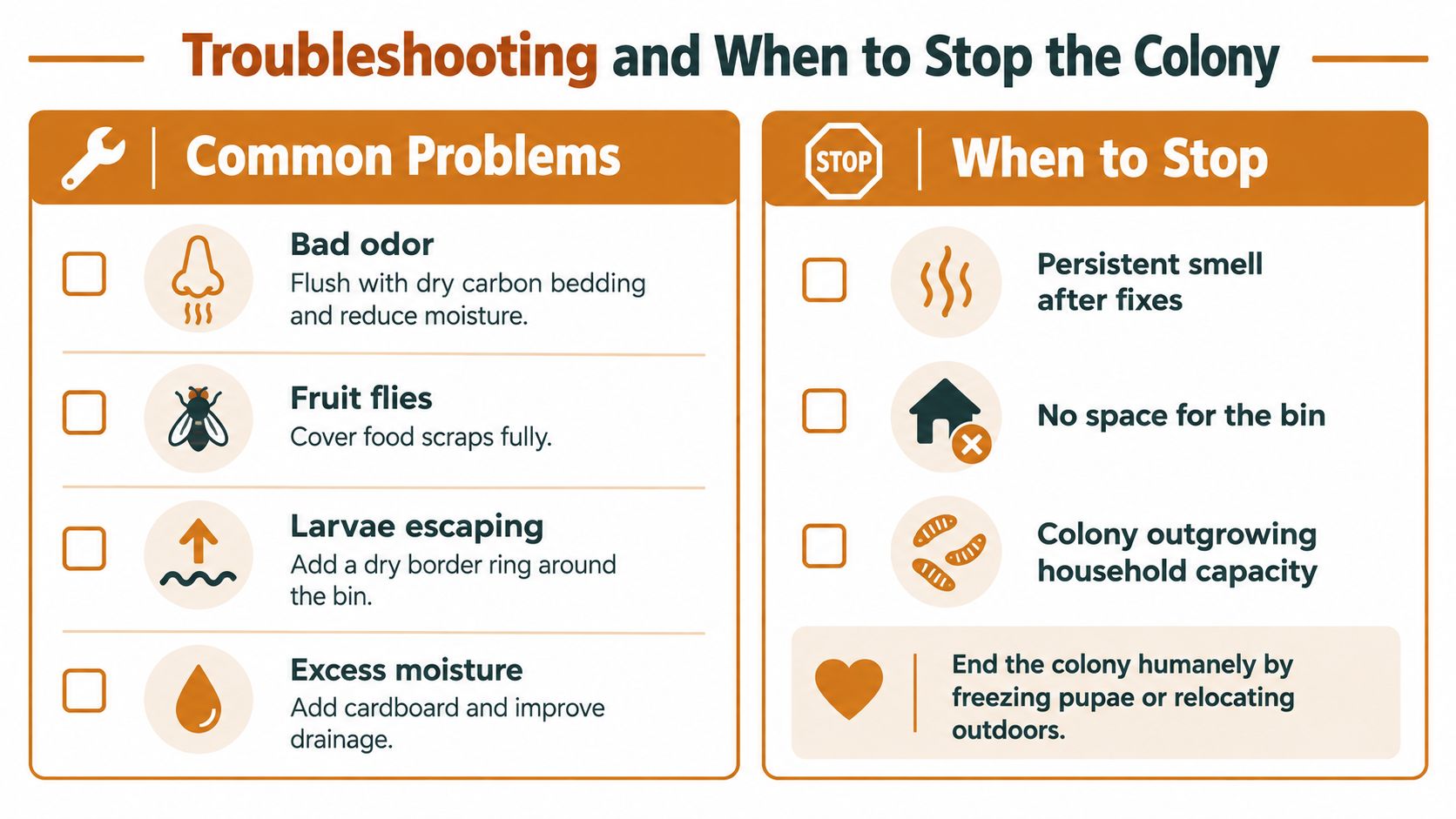
Match the symptom to the response
- Persistent bad odor: Stop feeding, remove saturated material, add dry carbon bedding, and increase airflow. If the smell remains after the correction, relocate or shut down the bin.
- Fruit flies or other nuisance insects: Cover fresh scraps fully, clean residue from the rim, and improve lid and ventilation screening.
- Larvae escaping: Check for overfeeding and excess moisture, then repair the ramp, lid, and mesh. A dry perimeter around the container can help reveal escape routes.
- Mold bloom: Remove heavily affected material, reduce the feed load, and avoid sealing the bin. A small surface patch isn't the same as a failed colony, but spreading mold deserves action.
- Larvae in walls or drains: Treat this as a separate source investigation. The managed bin may not be responsible, especially if larvae appear far from it.
Mississippi State Extension's guidance remains the practical standard for an accidental occurrence: remove the breeding source and exclude access. Insecticide won't repair a broken toilet seal, leaking plumbing, carcass, or food residue.
Know when the project no longer fits
Stop the indoor colony if the smell persists after moisture and feed adjustments, you can't keep the bin in a suitable location, or the colony produces more larvae than your household can safely contain. In a home with free-roaming chickens, dogs, or young children, use the secondary tray and a secure lid as basic containment, not optional accessories.
Relocate suitable material outdoors where local conditions allow, or end the colony humanely by freezing larvae or pupae before disposal. Clean the bin, tray, ramp, and surrounding floor with soap and water, then inspect nearby drains, pet areas, and waste containers. The aim isn't to preserve every colony. It's to keep a useful composting system from becoming an indoor pest problem.
If you want to avoid the uncertainty of a home-raised feed source, Pure Grubs offers USA-grown dried black soldier fly larvae as a supplemental option for chickens and other birds. Visit Pure Grubs to compare a traceable poultry treat with the practical requirements of maintaining a contained indoor colony.