

Are Black Soldier Flies Dangerous? a Safety Guide
You toss a handful of dried grubs into the run, and the flock comes running like you rang a dinner bell. Then, usually a few minutes later, the question sneaks in: are black soldier flies dangerous?
That's a fair question. It's also a better question than gets answered.
A lot of articles stop at “they don't bite or sting,” which is true, but that isn't the whole safety picture for a chicken keeper. The more useful answer is this: black soldier fly larvae are usually low-risk when they're raised on clean inputs, processed correctly, and tested for contaminants. If those controls are sloppy, the risk changes.
That's the part that matters at the coop. Your hens don't care what a fly is called. What matters is what those larvae ate before they were dried, how they were handled after harvest, and whether anyone checked the finished batch.
What Most Keepers Actually Worry About
Most flock owners aren't just worried about bugs in the abstract. They're worried about very practical things.
They want to know if the adult flies will bite, sting, or bother people. They want to know if larvae can spread disease to chickens, ducks, dogs, or kids. They've heard odd stories about maggots and wounds, and they wonder if that applies here. They also worry about something less visible, which is often the more important issue: heavy metals, drug residues, or other contaminants in dried larvae sold as feed.
Then there's the everyday coop question. What happens if live larvae aren't eaten right away? Do they become a problem in bedding, nest boxes, or feed bins?
The question behind the question
When people ask whether black soldier flies are dangerous, they're often mixing together five separate concerns:
- Adult fly behavior: Do they bite, sting, or act like house flies?
- Disease transfer: Can the larvae carry something harmful into the flock?
- Parasite fears: Are people really talking about myiasis when they say “dangerous”?
- Contaminated feed: Could imported or poorly sourced larvae bring in metals or residues?
- Leftover live larvae: If some escape notice, will they create a nuisance?
The simplest way to sort this out is to stop treating BSFL as “just a bug” and start treating them as a feed ingredient with a production history.
Practical rule: The main safety question isn't “Is this insect scary?” It's “What substrate was it raised on, how was it processed, and was the batch tested?”
That framing clears up a lot of confusion. Biology removes some fears right away. Production controls answer the rest.
Meet the Black Soldier Fly and Its Larvae
A keeper usually meets this insect in one of two forms. You notice the adult fly hovering near compost and wonder if it belongs in the same mental category as house flies, or you open a bag of dried grubs and wonder what, exactly, your birds are eating.
The species is Hermetia illucens. The adult often looks a little wasp-like because of its narrow body and dark color, but its job in the life cycle is very different from the nuisance flies people already know.
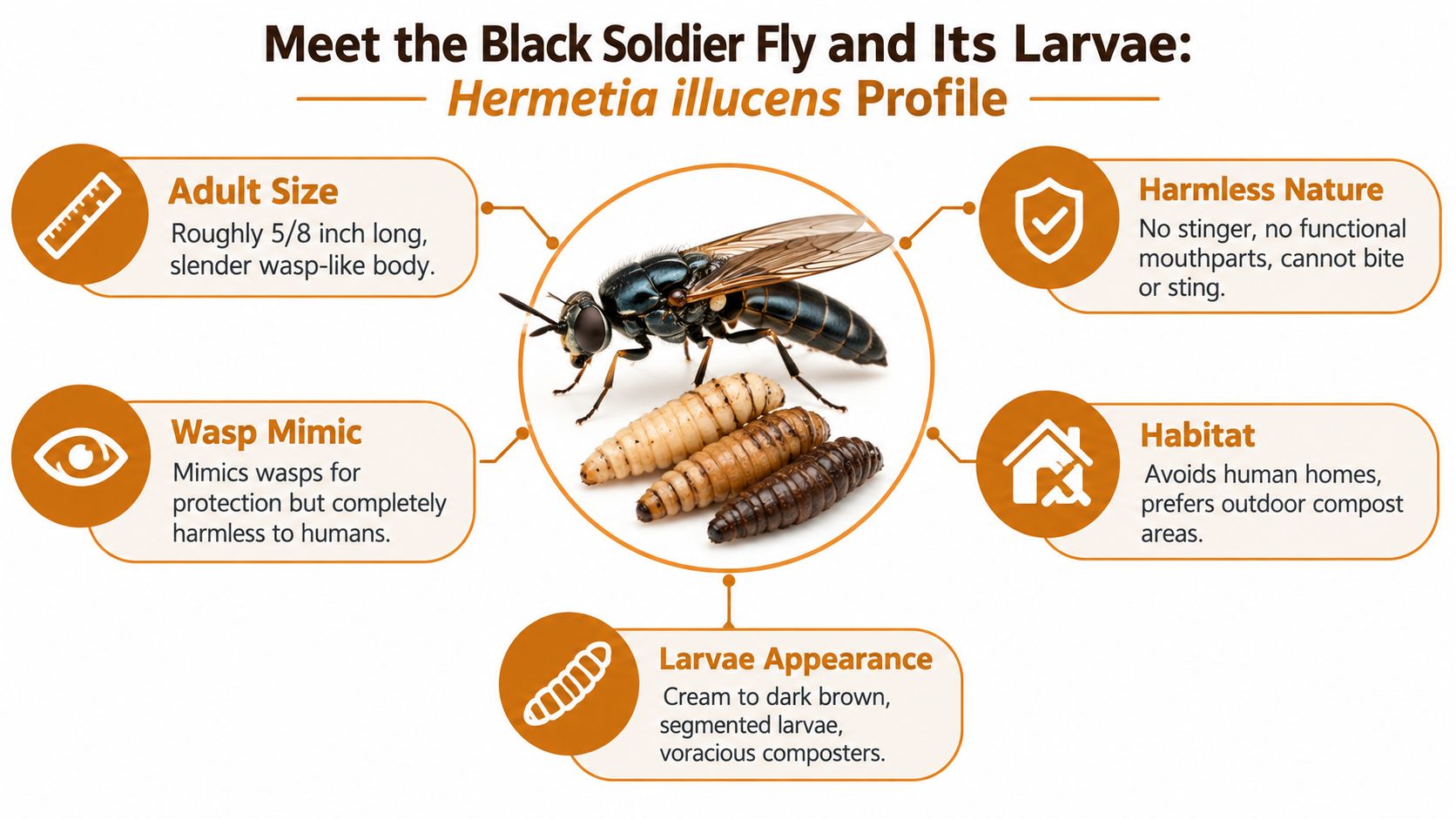
What the adult fly is actually like
Black soldier flies have been studied for decades as more than a pest species. A historical review of black soldier fly research traces that shift from basic identification and forensic work toward waste recycling and animal-feed use. That long paper trail matters because it means flock owners are not dealing with a brand-new ingredient that appeared out of nowhere.
Adult black soldier flies are generally regarded as low concern around people and livestock because they do not bite, do not sting, do not feed in the same way nuisance flies do, and are not known for spreading specific diseases in ordinary contact (review on black soldier flies and human safety).
If you want help telling the life stages apart, this guide to the black soldier fly life cycle gives a clear visual of the adult, larval, and pupal stages.
Why the larval stage matters more to keepers
For safety, the larva is the part to pay attention to. It is the feeding stage, the little conversion engine that turns organic material into insect protein and fat. A kitchen sponge is only as clean as what it has soaked up. BSFL work the same way from a feed-safety standpoint.
That is why a chicken keeper should look past the species name and ask about the production chain. Larvae raised on clean, approved substrates and processed under controlled conditions are a different feed ingredient from larvae grown on unknown waste streams. The insect itself is only part of the story. The substrate, the drying or heat treatment, and any contaminant testing are what tell you how safe that bag is for a flock.
A product such as USA GROWN BLACK SOLDIER FLY LARVAE FOR CHICKENS is sold as a feed ingredient with a sourcing and processing history, not as random grubs scooped from a compost pile. That distinction clears up a lot of the anxiety around BSFL.
The Four Real Risk Pathways to Understand
A worried keeper usually isn't asking one question here. They're asking four at once. Could the adult flies bother birds or people? Could the larvae cause infestation? Could the larvae carry residues or contaminants from what they were raised on? And does processing reduce the microbial risk enough to make the final feed ingredient a low-risk choice?
That framing helps because BSFL safety is conditional. The insect species matters less than the chain of custody around it.
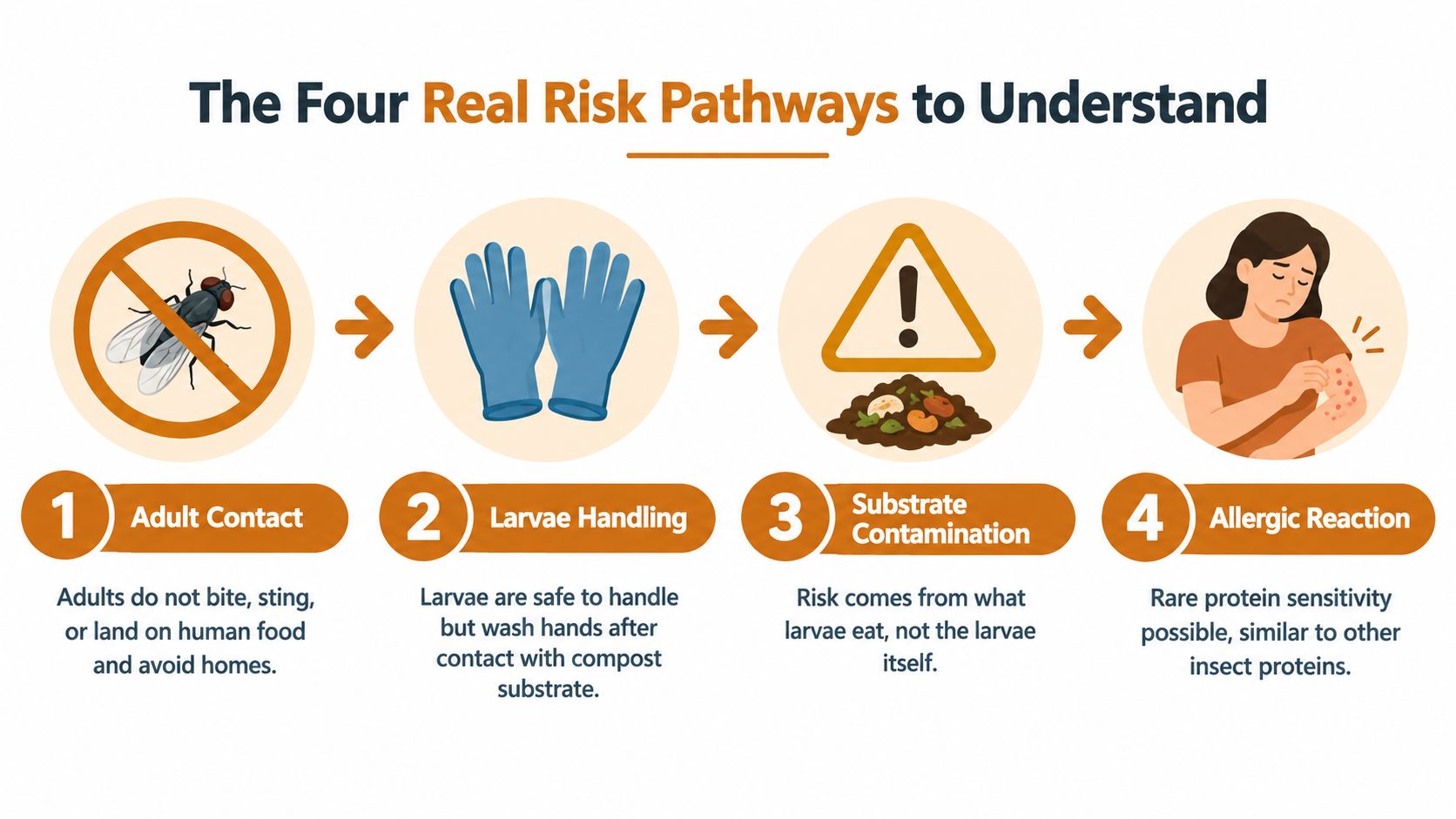
Adult contact is the least important pathway for flock safety
Adult black soldier flies catch the eye first, but they are not usually the part that creates feed-safety problems. For a backyard flock, the sharper questions start earlier in the production chain, before the larvae ever reach your feed scoop.
If your concern is simple contact, the answer is usually reassuring. Adult black soldier flies are not the kind of fly known for biting, stinging, or harassing animals around the coop in ordinary conditions, as noted earlier.
Myiasis is real, but it is not the routine risk for flocks fed clean, processed larvae
People hear the word "larvae" and picture an infestation. That mixes together two very different situations.
A food-safety review describes rare cases of enteric or intestinal myiasis, and at least one cutaneous case, tied to unusual exposure pathways such as contaminated fruit or access through wounds (food-safety review with myiasis discussion). That is a separate issue from feeding a cleaned, processed BSFL product to healthy birds.
Healthy chickens do not become a host because they peck at larvae.
The practical dividing line is husbandry. Open wounds, filthy wet areas, and accidental contamination belong in one category. A dried or heat-treated feed ingredient raised under controlled conditions belongs in another.
A few points make that easier to sort out:
- Wounds change the risk: Broken skin is a different situation from intact skin and normal feeding.
- Contaminated material changes the risk: Accidental exposure to dirty organic matter is not the same as feeding processed larvae.
- Weak birds need closer watching: Sick, injured, or compromised animals always deserve tighter management around waste, litter, and pests.
Later on, if you're also trying to reduce nuisance flies around compost, manure, or feed areas, these MODERN LYFE fly control strategies are a practical companion resource.
Before the next point, it helps to see the husbandry side in action.
Substrate transfer is the central safety hinge
This is the question many short articles skip. Larvae are little conversion units. What goes into the rearing bin can show up, in some form, in the larvae.
Published research has shown transfer of veterinary drug residues from rearing material into BSFL, including compounds such as oxytetracycline, enrofloxacin, narasin, eprinomectin, and salinomycin (research on veterinary drugs and BSFL safety). For flock owners, that matters more than the familiar "do they bite or sting?" question.
A kitchen sponge works as a simple comparison. If it soaks up clean water, no one worries. If it soaks up dirty dishwater, you treat it differently. BSFL safety follows that same logic. Clean, approved substrates lower risk. Questionable waste streams raise it quickly.
Heavy metals and processing are the two controls that finish the job
Substrate is only the first gate. Processing is the second.
In the same food-safety review cited above, blanching markedly reduced microbial counts, and Salmonella spp. and Listeria spp. were not detected in the BSFL samples. The study also reported heavy metals below legal limits in the tested material, and the authors considered the blanched larvae safe under the microbial benchmarks they used.
That is the plain-English takeaway for a coop owner. Safety does not rest on the insect name alone. It rests on three practical controls working together: what the larvae were fed, how they were processed after harvest, and whether the producer checks for contaminants that can travel from substrate to flock.
If you keep those three controls in view, the worry becomes much easier to sort.
BSFL Compared to Mealworms and Crickets on Safety
Black soldier fly larvae, mealworms, and crickets can all be reasonable feeder insects. The smart comparison isn't “Which bug wins?” It's “What risks travel with each product?”
A more useful way to compare them
Mealworms and crickets are also low-risk when they're farmed cleanly and processed well. BSFL stand out because the discussion around them often includes waste conversion, which makes sourcing more important to ask about.
Here's the practical comparison.
| Safety Factor | Black Soldier Fly Larvae | Mealworms | Crickets |
|---|---|---|---|
| Pathogen concern | Usually tied to substrate and processing quality rather than the insect itself | Usually tied to farming hygiene and storage conditions | Usually tied to farming hygiene and storage conditions |
| Heavy metal concern | Worth special attention because larvae can bioaccumulate contaminants from rearing material | Also depends on feed inputs | Also depends on feed inputs |
| Calcium profile | Often chosen by keepers who want a naturally calcium-rich insect option | Often supplemented depending on use | Often supplemented depending on use |
| Sourcing transparency | Very important because substrate history drives safety | Important | Important |
| Best buying question | What were they raised on, and was the batch tested? | How were they raised and stored? | How were they raised and stored? |
The comparison that actually helps you buy
If you're choosing among these insects for chickens, ducks, reptiles, or wild birds, don't turn the choice into a tribal argument.
Use these questions instead:
- Ask about the feed stream: With BSFL especially, the substrate matters because contaminants can move from substrate to larvae.
- Ask about processing: Dried products should come from a system with clear kill-step and handling controls.
- Ask about testing: If a seller can't speak clearly about contaminant testing, you're buying on trust alone.
- Ask about origin: Traceable domestic production is easier to verify than a vague supply chain.
That's the common thread. Any of these insects can be fed responsibly. None of them should be treated as interchangeable if the production chain is a mystery.
FDA GRAS, AAFCO, and Heavy Metal Testing Explained
A bag of dried BSFL can look simple. The safety work behind that bag is not. For flock owners, these labels and test terms matter because they answer a more useful question than "does this insect bite?" They tell you what controls were in place before the larvae ever reached your feeder.
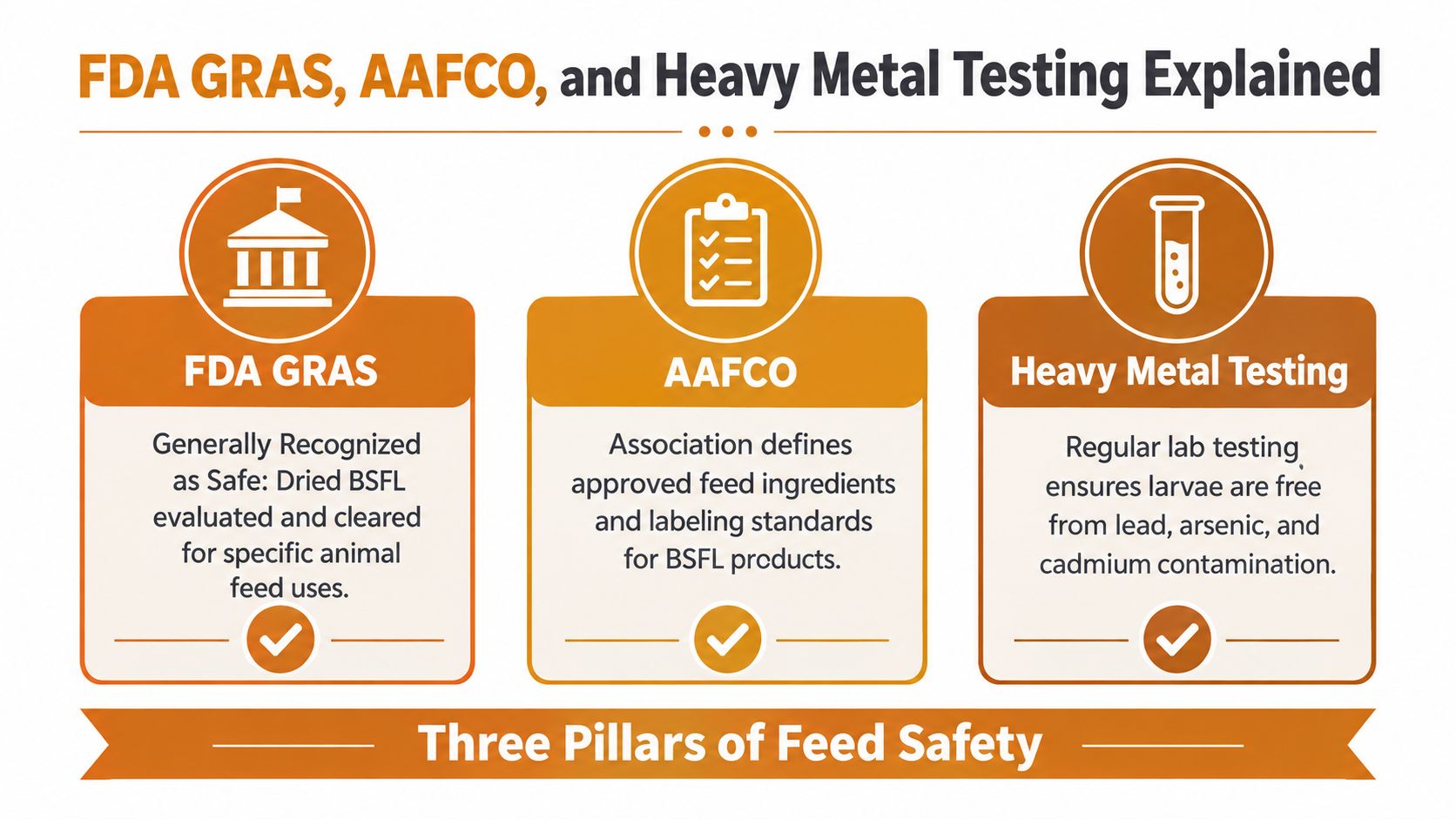
What FDA GRAS is doing here
FDA GRAS means “Generally Recognized as Safe” for a specific ingredient and a specific use. It is not a blanket promise that every BSFL product on the market is equally safe. The fine print matters.
For a keeper, GRAS works a bit like a fence line on a pasture. It sets the boundaries for what is acceptable, including contaminant and microbial specifications, so producers know the limits they are supposed to stay within. As noted earlier, recent reporting on dried BSFL has highlighted limits for metals such as lead, arsenic, cadmium, and mercury, along with microbial thresholds. That tells you what regulators are watching. The focus is on what may be carried into the insect through the production chain.
What AAFCO helps with
AAFCO handles the naming and feed-definition side. That sounds dull until you compare it with buying from a seller who uses vague terms and offers no clear ingredient identity.
A defined feed ingredient gives mills, retailers, and keepers a shared language. It helps separate a traceable product from a mystery treat.
If you want a plain-English look at why contaminant screening deserves so much attention here, this guide on heavy metals in imported black soldier fly larvae gives a useful consumer-level overview.
What heavy metal testing actually tells you
Heavy metal testing checks whether the rearing material left unwanted residues in the larvae. That is the safety hinge with BSFL. Larvae process whatever they were raised on, so a clean output starts with a controlled input.
Research summaries have repeatedly treated cadmium as one of the metals worth close attention, and substrate studies keep circling back to the same practical lesson. Many feed streams can work, but only if producers monitor the inputs and verify the finished batch. A substrate comparison also found larvae remained below EU feed limits for toxic elements under the tested conditions (review discussing cadmium monitoring and feed-limit comparisons).
What “tested” should mean to you: a batch-level contaminant check tied to a defined lot, not a broad promise on a label.
That is why GRAS, AAFCO definitions, and lab testing belong in the same conversation. One sets the use boundaries, one defines the ingredient, and one checks whether this batch stayed inside the lines.
Why USA-Grown and Traceable Production Matters
A dried grub looks simple in the scoop. The production chain behind it usually isn't.
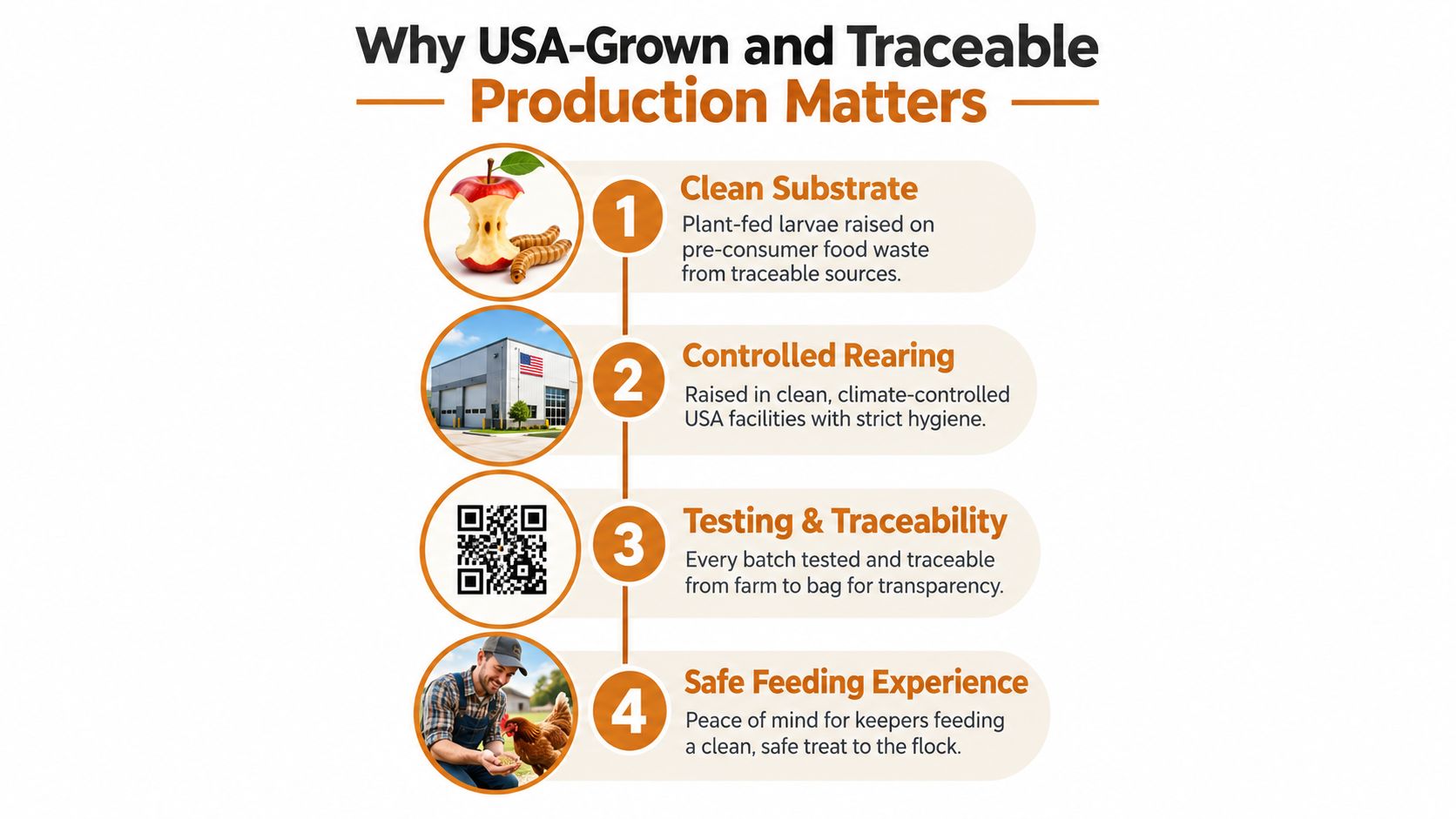
Traceability starts with the substrate
If larvae are raised on defined, auditable inputs, a keeper can ask sensible questions and expect real answers. If they're raised on loosely described waste streams with little transparency, you're left hoping that someone upstream made good decisions.
That's why domestic sourcing matters to many flock owners. It tends to make the paper trail easier to follow. If you want a direct comparison of supply-chain issues, this explanation of USA-sourced vs imported black soldier fly larvae for chickens helps sort through the practical differences.
What production controls do for your flock
People sometimes hear phrases like “traceable” or “tested” and think they're just marketing gloss. Used correctly, they're not.
They mean someone can identify:
- The input stream: what the larvae were fed.
- The facility controls: how the insects were raised, handled, and dried.
- The batch identity: which lot produced the bag in your hand.
- The verification record: whether contaminant or microbiological testing was done.
That chain protects the birds and the keeper. If a question comes up about odor, storage, appearance, or contaminant concern, traceability gives you somewhere to go besides internet guessing.
The coop-level benefit is simple
For the person feeding a handful at dusk, all this boils down to a short list.
You want a product with a known origin, a defined feed stream, and testing that isn't hidden behind vague language. You want a producer that treats larvae as a regulated feed ingredient, not as a novelty treat.
No mystery origin. No blind trust. Fewer surprises.
Common Misconceptions Worth Putting to Rest
Two bad shortcuts dominate this whole topic.
The first is the blanket claim that black soldier flies are harmless under every condition, so no further questions are needed. The second is the shrug that says all dried larvae are basically the same, so buying decisions don't matter much.
Both shortcuts hide the issue.
Misconception one says the species alone determines safety
It doesn't.
The species does answer some things. Adult black soldier flies aren't known for biting, stinging, or acting as specific disease vectors. That helps. But species identity doesn't tell you whether a batch was raised on clean substrate, dried under controlled conditions, or checked for contaminants.
A bug can be harmless by nature and still become a poor feed ingredient if its production chain is careless.
Misconception two says all dried grubs are interchangeable
They aren't.
The most overlooked difference is not shape, color, or bag size. It's whether the producer can tell you where the larvae came from, what they were fed, and what testing was done before sale.
That's why I'd treat any product lacking that transparency as unverified, not automatically unsafe but not automatically safe either.
Buy with the same mindset you'd use for any feed ingredient. “Natural” is not a substitute for sourcing discipline.
The balanced position is plain enough. BSFL don't deserve the fear they often get from people who mistake them for pest flies. They also don't deserve the free pass they get from sellers who talk only about how harmless the insect looks.
Practical Safety Questions From the Coop
Once the big safety picture is clear, the everyday questions get easier.
How should you store dried BSFL
Store them in a sealed container in a cool, dry place. Room-temperature storage is commonly workable for dried insect treats when the product stays dry and protected from humidity.
Watch the batch itself. If you notice a musty smell, clumping, or visible mold, don't talk yourself into using it up. Discard it.
Do they make eggs unsafe to eat
If the feed ingredient is clean, feeding BSFL doesn't put grubs into eggs or somehow transfer insect parts into the egg in a strange way. Hens digest the fats and proteins as feed.
The more relevant egg-safety concern is still the one covered earlier: whether the larvae were produced from clean inputs and handled properly before you bought them.
What about Salmonella and cross-contamination
The practical concern here is less about the concept of BSFL and more about feed handling. Keep dried larvae separate from raw poultry processing areas, wet litter, and anything that could reintroduce contamination after purchase.
For your own routine, keep it simple:
- Use a sealed container: Moisture is the enemy.
- Keep the scoop clean: Don't use the same scoop for messy raw-feed tasks.
- Store away from damp feed areas: Dry products stay safer when they stay dry.
- Buy from transparent suppliers: Certificates of analysis and clear sourcing matter.
Are they suitable for more than chickens
Yes, many keepers use BSFL for ducks, wild birds, fish, and reptiles. The main practical adjustment is portion size and species appropriateness, especially for smaller animals.
That doesn't mean one product fits every animal in every amount. It means the ingredient itself can have broad use when the production quality is solid.
Pure Grubs offers USA-grown black soldier fly larvae with a focus on traceable production and batch-level contaminant testing, which is exactly the part of the safety conversation that matters most for flock owners. If you want to see a source that treats BSFL as a feed ingredient rather than just a bug, visit Pure Grubs.